From the Archives: Oz Pearlman

Given Oz Pearlman’s recent notoriety, I figured it might be fun to dig into the archives and see what I’d written about him on my old site. This was back in the early 2000s, when he was mainly known as Penguin’s product demonstrator. And apparently I’d just seen him in a live NYC show—an event I have absolutely zero memory of.

I wrote:

I don't know how anyone could imagine that having Oz Pearlman demonstrate a trick is a good marketing strategy. What am I missing? Am I the only one in the world who thinks that guy is a total tool? I used to think he was in on the joke; that he knew how lame some of those tricks are and he knew how lame his performance was. But then I saw his "magic" "show" at a "theater" here in New York City, and I realized he's just really a shitty performer. He has some technical skills, but those are offset by a miserable sense of showmanship and stage presence. Oz, get a director, and get a fucking writer too. If you have $35 dollars to blow in the city, I urge you to check out his show. It's such a grim deal. It's like watching Faces of Death and you're seeing a monkey get his head bashed in with a hammer and you're thinking to yourself, "How can I find something so repellent and fascinating at the same time?" In an art-form that many people already consider to be meaningless, an Oz Pearlman show has to be the most meaningless facet of magic on the planet. Remind me not to go to shows that cost $35 and starts at 5 in the afternoon.

So if you’re thinking, “People only trash Oz now because he’s wildly successful,” please note: I was two decades ahead of the curve. I thought he was garbage when he was a nobody. And yes, the critique I made recently is the same one I made back then too. He needs a writer.

Other than that, I mostly just mentioned him in passing on the site.

I suggested his name was confusing. “Oz” already has a magical connotation: Wizard of. And that’s pronounced Ahz. Him making people pronounce his name Ohs was going to be nothing but headaches for him. I suggested he use a different pronunciation entirely: Ooze. As in, “There’s some ooze coming out of my anal pustule.” Looking at him, that felt like the one people would naturally gravitate toward.

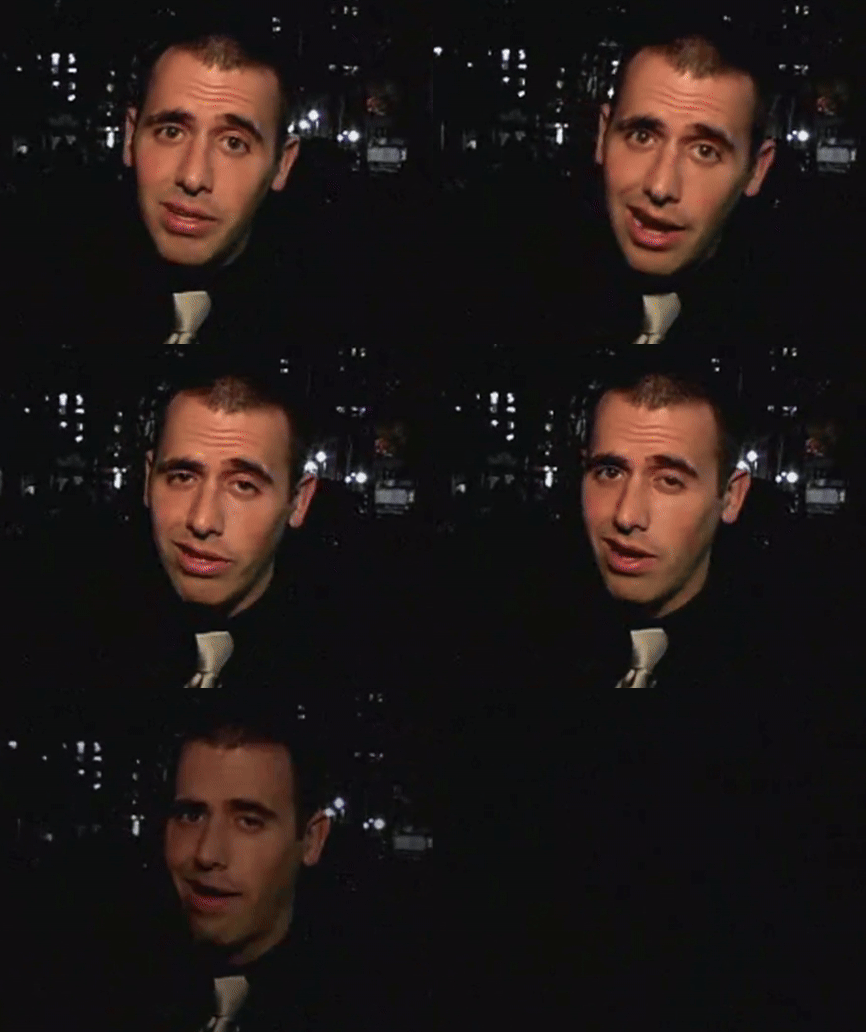
Another time, I wondered what was going on with his mouth in this demo and said, “He's talking funny, right? Not funny like what he's saying is amusing, lord no. But funny like, oh I don't know, like he had a zit on his lip and somebody popped it with a baseball bat.”

Or when there was controversy about Oz stealing this Dave Harkey effect where someone runs their finger along a straw and Oz makes it melt where they stop. I came to Oz’s defense and said, “I truly believe that Oz really did invent this trick independently. I've heard that in order to generate realistic expectations, he often creates tricks where women must stroke something that's .5 cm in diameter.”
Now, you might say, “Who’s the joke really on here, Andy? Oz is on 60 Minutes, and you’re still talking shit about him on a blog.”

Look, I’m doing exactly what I want to be doing. Oh, “Oz was on 60 Minutes”? Big deal. So was I. For decades. You don’t recognize my style? A guy named Andy? With a lot of opinions?


Spex Mix: The Wash

You might ask why I have a whole series of posts about ways to have a spectator mix a deck and still retain a partial stock.

The reason is this: I like techniques that move the needle.

And a spectator mix technique is one that does.

You may spend 100s of hours mastering a false shuffle. But the most perfect false shuffle is not enough to undermine people’s knowledge of false shuffles. I’ve had spectators claim a 100% real shuffle must have been a false shuffle. Given that, I don’t really see any reason to work on a false shuffle other than to impress other magicians. And what rational human wants to do that? Oh, gee… Mark Calabrese is impressed by me? Now my life is complete.

Here’s a technique I use when I need to protect a larger group of cards, up to a full suit. It happens seated at a table.

The stack starts on the bottom of the deck. I remove the deck from the case. Spread it and get a right thumb break over my stack.

Now two things happen at once:

  1. My left arm swipes across the table like I’m brushing aside any dust or debris.

  2. My right hand goes to my lap and drops off the stack and immediately comes up and starts dribbling the cards all over the table.

Lay people cannot tell that a quarter of the cards are missing.

Have them wash the cards around the table. When they’re satisfied they’re well mixed, gather up the cards toward yourself into a loose pile. Reach into your lap with your left hand to pick up the stack and slide the loose pile off the table on top of the stack. Square everything and you’re good to go.

If you want the stack to end up on top of the deck, then just do this whole process face up.

You can follow it up with the Jerx-Ose False(ish) Cut, retaining the stack on the top or bottom depending.

There’s nothing revolutionary here. It’s a slight variation on a process I’ve posted in the past, and I’m not even suggesting that was original. But I wanted to include it in the Spex Mix series as it’s something I use quite frequently. It might seem unsophisticated compared to some of the fantastic false shuffles that exist in magic. But it has the important distinction that it can’t be dismissed as a false shuffle.

Charms

This is another one for the Jerx Glossary, which I will have to update soon.

Subscribers to The Juxe know that one of my favorite albums this year is Moisturizer by Wet Leg. And my favorite song from that album (and one of the finest love songs ever written) is “Davina McCall.”

I was watching a live performance of that song on YouTube a couple of months ago and noticed something hanging from the guitars of Hester Chambers and Josh Mobaraki, the lead and rhythm guitarists for the band.

When I finally watched the video on a bigger screen, I realized they were just fat tassels or something along those lines.

But on the small screen of my phone, I thought they were small cloth bags. They reminded me of the things you see in movies and TV shows about the occult or witchcraft—“charm bags” or “hex bags.” Little pouches stuffed with herbs, crystals, hair, symbolic tchotchkes—whatever—that are supposedly for cursing someone, protecting someone, or casting a spell. I don’t really know. It’s witchcraft, not science.

And that made me think: wouldn’t it be funny to learn an instrument in secret and then surprise people in my life with my ability to play that instrument, but only ever do so when I’ve placed this strange bag on it. The unspoken implication being that this little object is somehow what’s letting me play the thing. Andy could never play guitar. But now he can? But only when that little bag is dangling from one of the tuning pegs?

I would always laugh it off, of course. “That’s ridiculous. I just like the way it looks.” But any time I pick up a guitar without the bag on it, all I can manage is dissonant twanging.

It’s a long way to go for something that’s only on the verge of being a trick. But I’ve always thought that if there was some skill you were planning on learning anyway, learning it in secret—without telling anyone—is a good way to go. Then you can create an interaction later on where you seemingly acquire this skill instantaneously. People appreciate these little fantastical touches in their lives, so long as they don’t get the sense you’re actually trying to sell them on it.

And that whole idea—linking some odd little element to whatever’s about to happen—is really the heart of what I’m calling “Charms.”

Charms are a subset of Imps. What makes them their own thing is that you don’t explain them. They’re simply things that are present or happen during an effect and draw a bit of attention because they’re just slightly peculiar. But you never call them out yourself.

Types of Charms

Unusual Objects — Examples:
A small cloth bag of unknown contents you hang on a doorknob before a trick.
A jade rabbit figurine you tap against objects before using them.

Jewelry — Examples:
A thin ring you slip on for certain effects.
A pendant you pull out from under your shirt only during specific routines.

Consumables — Examples:
A mint or pill you pop before reading someone’s mind.
A small sip of tea before a coincidence effect.

Gestures — Examples:
A syncopated tapping on your temples before naming a thought.
Drawing a small circle in the air over an object before vanishing it.

Incantations — Examples:
A short phrase or word of unknown origin murmured under your breath.

Environmental — Examples:
Cracking a window open one inch before a mentalism routine.
Changing the room’s lighting before an ESP test.

Clothing Adjustments — Examples:
Rolling up just one sleeve—always the same one.
Buttoning your shirt up to the top before starting.

Scents — Examples:
Striking a single match and letting it extinguish naturally.
Dabbing a bit of essential oil onto your wrist beforehand.

Timing — Examples:
Delaying a trick until a specific, odd time: “Yeah, I can show you something. Let’s do it around 10:17.”
Counting off a certain number of seconds before revealing a change.

Audio — Examples:
Spinning an old coin and taking a breath as it rings to a stop.
Clicking a pen twice—pause—then once more as they focus on their thought.

For these things to register as “Charms,” they need to be repeated. If you do the pen-clicking thing once, then it’s just something that happened once. But if they notice it multiple times in a routine, or over the course of multiple performances, then it becomes something potentially intriguing.

Critics of this technique will say that it turns simple tricks into something bordering on the occult: whispered incantations, ritualistic gestures, etc. And yet these same magicians will perform 1000 tricks where the magic happens “when I snap my finger.” That too is a Charm. It’s just the most unoriginal, boring, easily dismissed version of one.

If anyone asks about your Charm, just brush it off. “I say that before each trick? Huh. Honestly, I’m not sure. I guess it’s just something I picked up somewhere.” “I always button my shirt up to the top before reading your mind? No, I don’t. Do I? Well, it’s nothing, it’s just a habit, I guess. I don’t need to do it.” Then you try to read their mind with your collar open and fail miserably.

The idea isn’t to get people to accept the “power” of your Charms. Like the tassels on the guitars, Charms are ornaments hung on an effect that embellish the experience with a little extra texture, aesthetic appeal, and mystique.

Mailbag #156

You are writing a lot about creating experiences.

It is easy to create amazing experiences by spending a lot of money. (visit a 3 star Michelin restaurant, tickets for the OASIS world tour ...)

Do you think it is possible to create the same level of experience while being on a budget?

What is your point of view?—SD

“Do you think it is possible to create the same level of experience while being on a budget?”

Yes. In fact, you’re more likely to create a memorable experience with little money.

Money buys spectacle, which can lead to great experiences, but frequently doesn’t. The bigger the investment, the bigger the expectations, and expectations kill experiences. You stop being present and start running a cost–benefit analysis on the moment.

What night of the year do people plan and invest in the hardest? New Year’s Eve. What night reliably disappoints the most people? New Year’s Eve. It’s not a subtle correlation.

A $600 dinner may be a great experience, if you’re lucky. But more often than that it’s like, “$600 for this? I mean. It was good… but….”

And even when you’re the one picking up the tab, the money can still distort things for the other person or people. They may start feeling like they’re supposed to react a certain way, or enjoy it at a certain level. They might begin overthinking the whole situation. Why did he spend this much? What does this mean? Am I showing enough appreciation? It stops being a shared moment and starts being a transaction they’re now emotionally managing. The whole thing becomes less pure.

I’ve spent years thinking about how to turn time with someone into something they remember. I think I have a book’s worth of stuff to say on it, actually. I can’t get into too much detail, because it hasn’t crystallized into a form suitable for sharing yet. But I believe there are elements you can put into place that are likely to lead to peak experiences. And none of them really require much money.


I know so many people who read your site daily, which makes me wonder if anyone has ever tried to snatch you up to write the marketing emails for one of the big magic companies. If I started my own online shop, what’s the possibility I could bring you on in that capacity?—DS

I feel like someone asked this before.

I think writing magic marketing emails would be fun. I’d happily do that for a living wage. But no one would pay a living wage for that, so the “possibility” of that happening is next to zero.

If I did it, I’d want to allow people the ability to opt-in to an uncensored version, so I could say whatever I wanted. “Pull your pants down before you watch this demo unless you want your mom to find a bunch of crusty cum stains in your undies when she does your laundry this week.”

See? I could do it just fine.


I don't wanna keep bringing up Oz but I found this interview with someone who had her PIN revealed by Oz. Apparently he kept insisting that he wouldn't use her real PIN and then revealed it on air.

Just wanted to hear your thoughts on this. I feel like a lot of magicians have a terrible sense of people's personal boundaries and will deliberately break them for the sake of surprise.—AO

Yeah, I don’t know. Craig Petty suggested in a recent video that maybe it was some kind of miscommunication, but after skimming through this one, it doesn’t really sound that way.

It sounds like Oz pre-showed the woman to “make up a new PIN code” that was mathematically based on her real PIN code. And, obviously, that process allowed him to get her real PIN code, and he understood revealing that would be much more impactful than revealing some random four-digit number.

Is it a shitty thing to do? Yeah, kind of. But I also think Oz understands he has a relatively short shelf life as far as being in the spotlight of the general public, and he needs to capitalize on it now. The short-term reaction was likely more important than any long-term repercussions. Because in the long term he’ll be back doing corporate shows for Nabisco anyway.

Also, this woman seems like a bit of a dope too. She’s acting like a PIN code is difficult to change. How does she think it works? Like… she understands we need her ATM card or other banking info for the PIN to have any meaning, yes? She knows you can’t just walk up to an ATM, shout her name at the screen, punch in her PIN code, and have it start shooting her money out, right? Relax, dingbat.

Until December...

This is the final post until December. Regular posting starts again on Monday, Dec. 1st. The next issue of the newsletter will be sent out Sunday, November 30th.


Has Ellusionist given up?

Here’s their Black Friday “deal” this year.

“Happy Black Friday. 86% of you will be paying full price.”

Gee, thanks.


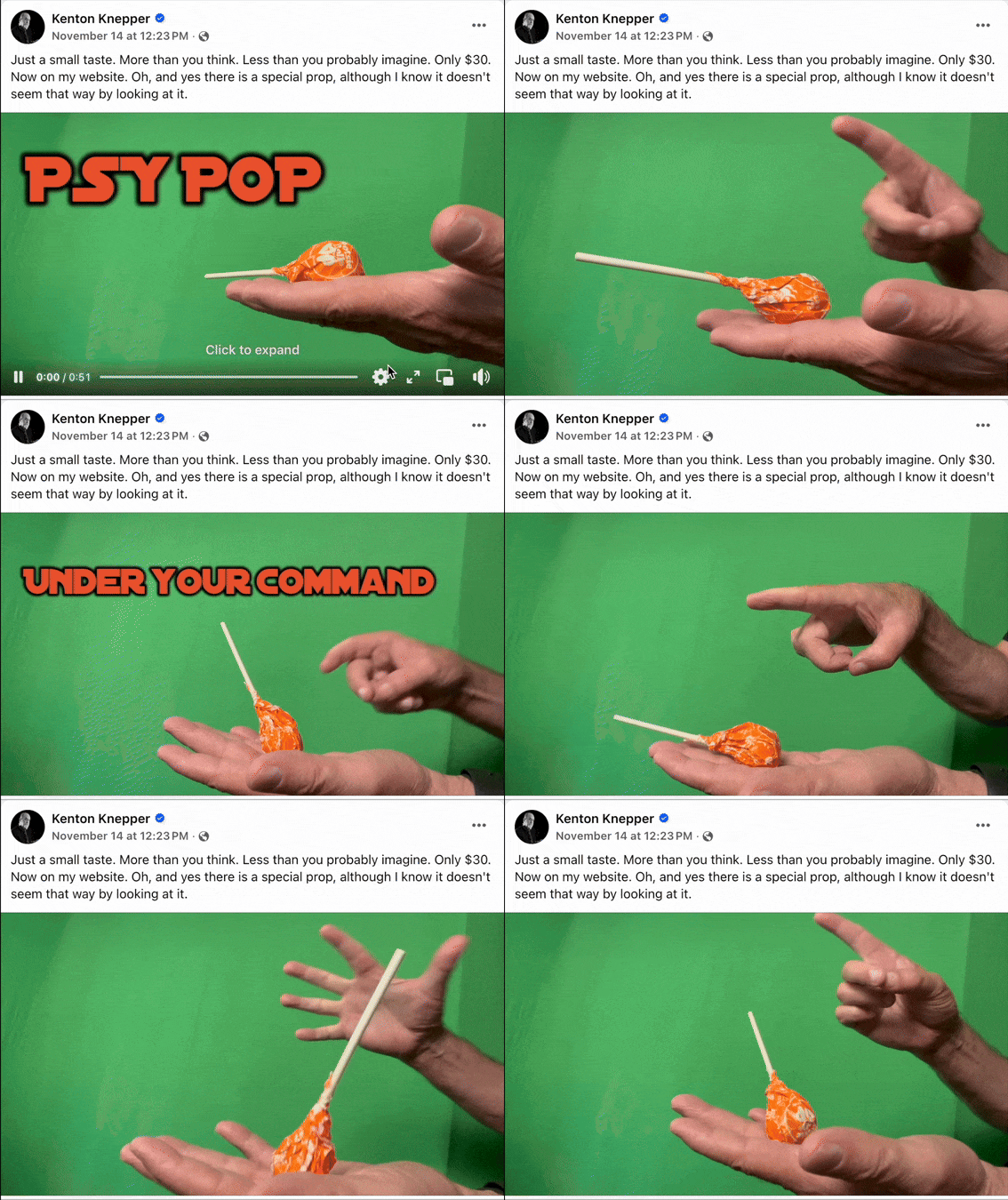
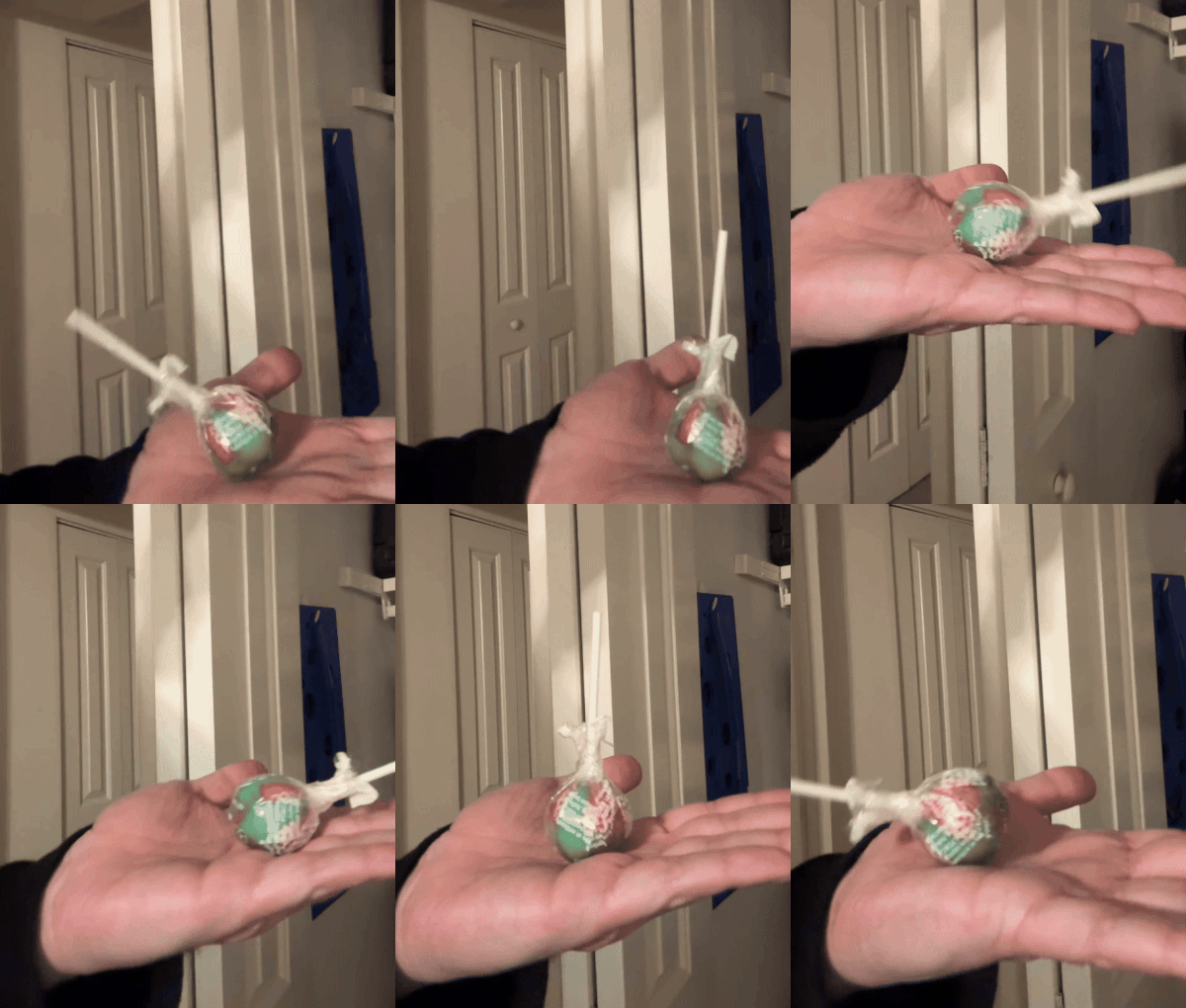
Just in time for three weeks after Halloween, Kenton Knepper has released this incredible effect with a lollipop.

Merely by tilting and wiggling your hand back and forth, you can get his special $30 lollipop to move as if by everyone’s understanding of basic physics magic.

Even more incredibly, Kenton has used his powerful “Wonder Words” to get every lollipop manufacturer to build this gimmick into every lollipop sold. Incredible.


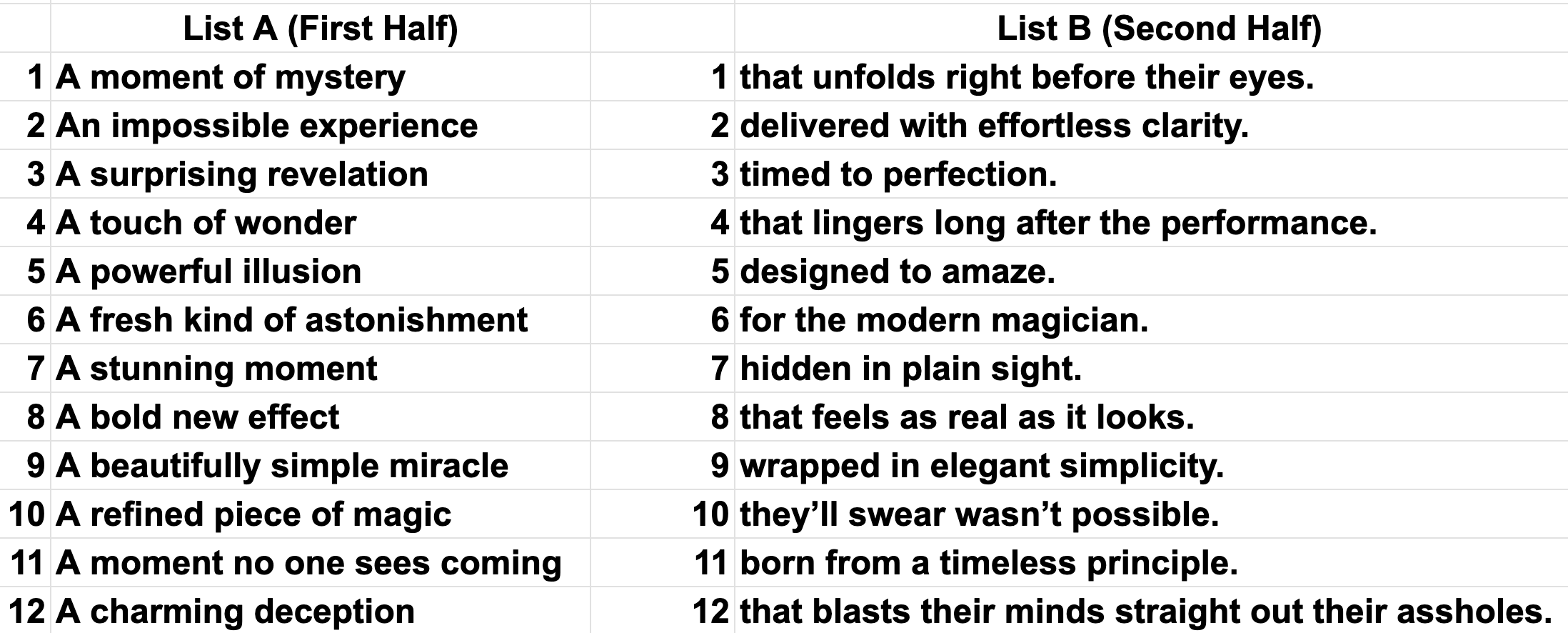
Thinking of the shitty tagline for Ghost Deck (An unexpected moment, perfectly timed), and the seeming desperation of Murphy’s to just throw that generic tagline on their trick, I thought I would help the magic community out with this tagline generator.

Now you can just choose a random number from list A, and pair it with a random number from list B, and you’ll have your own meaningless tagline.

“What’s this new trick from Murphy’s? Hmmm… A stunning moment, designed to amaze. Hey, now that sounds like my kind of trick!”


Darling friend, collaborator, and lady-artist (I’m doing what I can to bring back the early–mid 20th-century notion of gendering women in their professions—“she’s a lady doctor,” “she’s a woman lawyer”—I think it’s sweet) Stasia Burrington, who has done all the Jerx illustrations for over a decade now, has a couple of projects I want to bring your attention to.

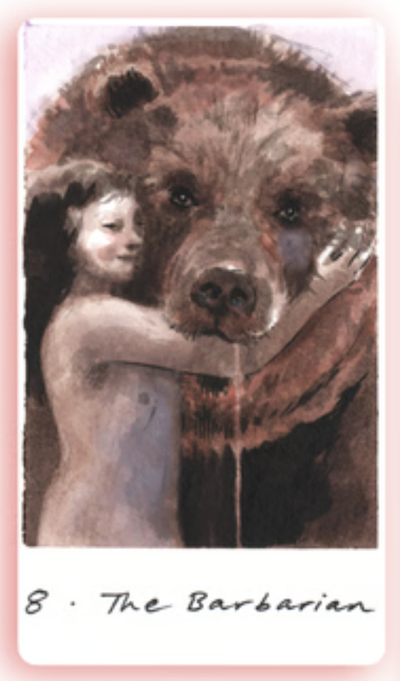
First is her Yukika Tarot deck, which is already funded on Kickstarter, but you can pre-order it at her Etsy shop.

For you tarot purists, know that she has “renamed and reframed” some of the cards in the deck.

I think they’re cool choices that make for a unique deck and add some more relatable concepts into the mix. But if you’re going to be like, “Oh, no, where’s my beloved Chariot!” then maybe this isn’t the deck for you.

Stasia has also released her second edition of the Magic Neko deck, which is her cat-focused playing cards and oracle deck.

In honor of that, I’ll reprint what I wrote about the original deck in 2018. It’s even more true for this version of the deck, which is even cuter and more eye-catching.

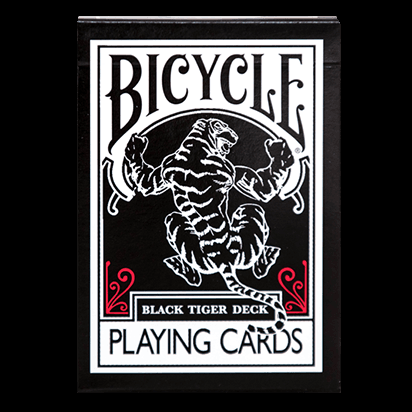
Now I've got a message for some of my younger male readers. About 15 or so years ago, Ellusionist put out something called the Black Tiger Deck. It was a black deck of playing cards and on the box there was a tiger who was...like... flexing or some shit? Like he was in a pose that no tiger has ever been in.

It was the epitome of Ellusionist's corniness. And I have no doubt they made a mint off these decks because Ellusionist knows their audience. A bunch of virgins definitely bought the deck thinking they'd take it to school and girls would be breathlessly fanning themselves, "Who is this sexy bad-boy with this black deck of cards with the super-ripped tiger on the case? I can't wait to get to know this virile rebel!"

Here's the deal, you want a girl to pay attention to you? Don't get the deck of cards that says, "I'm compensating for my low testosterone." Get Stasia's deck. Women (and men) of all ages are taken with her esthetic. You keep that out on the lunch table. A girl picks it up and oohs and ahhs over its cuteness. She asks why you have the deck. You say a friend of a friend designed it. (I'm your friend. Stasia's my friend. It's true enough.) And you grabbed it today because there's something you're working on with it. Then you point out that the case says it can be used as an oracle deck and there's this little fortune-telling ritual you'd like to try. Cute drawings, kittens, fortune-telling rituals: you'll be a girl magnet. 

Then do a trick in the guise of a fortune-telling routine. Make it positive. Don't be like, "Uhhhh... I think you're going to get cancer." There should be some sort of magic surprise/coincidence at the end. Don't take credit for it. Blame the deck or the universe or her "energy." Don't make it something about you or your "compatibility" with her. Too soon. When you're done, don't do any more tricks. Tell her you have to get going and excuse yourself. Be a little mysterious. Before you go, imply you might have something else you're working on that you'd like to show her in the future. "You have a very unique energy," you say. Then go on your way. Just plant the seed, baby. Trust me. I'll Cyrano your ass into going to prom with the head cheerleader if you just have a little faith.

More than ever, I appreciate being able to connect to the humanity in the work of the artists I follow, and that’s what I’ve always loved about Stasia’s work. You can feel the personality and the soul behind it. 

Check out her Etsy store to get these decks and other goodies.


Darling friend, collaborator, and boy-app-developer, Marc Kerstein sent out an email yesterday saying he would be offering 20% off some of his apps for Black Friday, including: Diverter, Streets Pro, ISO, and Subliminal.

I asked him why Xeno wasn’t on the list and he said, “Because I couldn’t find a good photo of someone using it to match the others. Then I just forgot.”

Uh, okay. Half-assed marketing aside, Marc creates the best apps in the magic sphere and doesn’t really do discounts often, so now is a good time to pick some of his apps up. Even some of the ones that are not on sale, as the price on those may be going up soon.

Xeno (which he has since added to the sale) is, I think, a mandatory iPhone utility for peeking something on a spectator’s phone. I would say the same for the non-discounted Inertia Pro which allows you to force anything on a website.

He’s also discounted the Xeno Anywhere in-app purchase that lets you do Xeno with any site. So if you already have the basic app, you still may want to check out the sale which can be found here. The sale goes until Dec. 2nd.

Oh, and Marc, so you’re never adrift in the future without a pic for Xeno, here’s me performing it for some chick I met.


Happy Thanksgiving to all my U.S. readers.

Thank you to everyone who supports the site and affords me the time to work on it, the newsletter, and the books year after year. You’re a delight.

See you all back here in December.

On Likability

I started watching Taskmaster earlier this year because an old friend was on a recent season.

For those who don’t know the show, five comedians compete in a series of absurd “tasks.” They’re awarded points depending on how well they accomplish the tasks and they “win” “prizes” contributed by the other contestants.

The same group stays together all season, so you really get to know them.

A couple of weeks ago, my friend who I watch the show with said, “The casting on this show is great. Everyone is very likable.”

And it’s true. I’ll start a season and look over the new cast and I might find myself drawn to a couple of them. But by the end of the season, in almost all cases, I like the contestants more than I anticipated I would.

Well, sure, it’s because you know them better.

No. Getting to know people better doesn’t make me like them more in most situations. Not in real life or TV. When I watch a season of Survivor, I don’t end the season liking most of the contestants.

Yes, but these are comedians, and funny people are likable.

Well, technically they’re not all “comedians.” But even so, I didn’t say that by the end of the season I found them all funny. I said I found them all likable.

Why? And what does this have to do with magic?

Here’s what I believe. The reason the Taskmaster contestants feel so generally likable, despite massive dissimilarities when it comes to race, gender, age, sexuality, temperament, is that a lot of the season is spent watching these people struggle and fail. And at times we see them have unexpected success, and we see them celebrate that.

These are very human moments, and they make people very likable.

And moments like these are almost completely missing from most magic performances.

If we fail, it’s in an obviously fake way, designed to build tension for our ultimate success.

When we succeed, there’s rarely any joy or surprise in it.

The magician changes five $1 bills into five $100s, and what does he do? He cocks his eyebrow, gives a small smile, and makes a joke.

What if instead he blurted out, “Holy shit. Holy shit! That worked? I can’t believe that worked! Shit… hold on… can we spend this? Will they somehow know it’s not real? Or… is it real? I don’t even… Oh, who cares. Let’s go out. I’m treating you to dinner. Let’s see if this stuff spends like the real deal.” That’s going to make the moment feel much different to the participant.

This sort of thing has to be done judiciously, of course.

But if you can mix in failures that don’t resolve themselves…

“Sorry. I’m not getting it. What word were you thinking? Carnation? Hmm… no, I wasn’t even close.”

And successes that leave you genuinely excited…

“We drew the same thing? Seriously?! That’s so wild! I genuinely felt like I was stepping into your mind. That’s crazy. I thought this imagination-syncing ritual was total bullshit.”

Then you’ll create moments of genuine humanity—rare in an art form that usually keeps the performer and audience at arm’s length.

As far as how often to use this technique, don’t overdo it or it will cease to mean anything to people.

I’ve never worked out how frequently I’ll do this sort of thing, but if I had to guess, I like to weave in something totally “not working” about once every ten times. This could be me failing to do what I was attempting, or whatever concept we’re exploring being a dud (“I knew this imagination-syncing ritual was nonsense.”)

The rest of the time, when the trick does work, I make sure to act at least a little surprised, pleased, confused, or freaked out. These are the reactions of a human, not an all-powerful wizard. And I can dial those reactions up or down so I’m not always acting the identical way after a trick.

For the most part, the only time I ever act like “I knew that would happen” is with the Spectator-As-Magician plot where (sometimes) my response will be, “See? I knew you’d be good at this.”

In magic, we tend to want to avoid an actual failure or looking excited by what happened. We think it will make us look less cool. Instead, we like things like “sucker tricks.” “I’ll pretend to fail, and then I’ll prove all along that I was the smart, talented one!” These shouldn’t be called sucker tricks. They should be called douchebag tricks. Because when done in casual settings they make you look like a douchebag.

Ghost Deck Thoughts

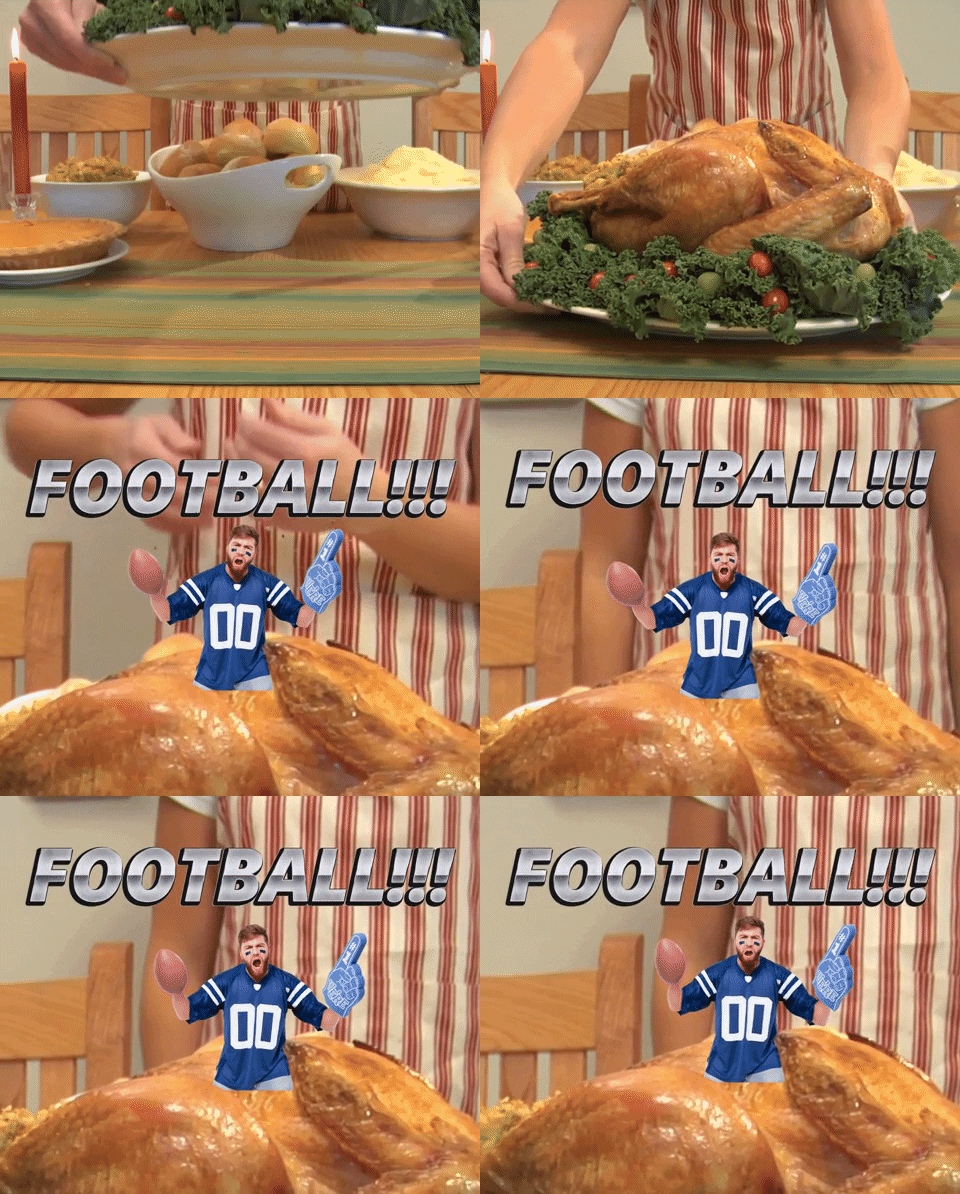
I don’t know why a bigger deal isn’t being made of this, but director Tony Scott is now putting together instructional downloads for Murphy’s Magic. At least, that’s my understanding based on the editing in the Ghost Deck tutorial. This is a real clip.


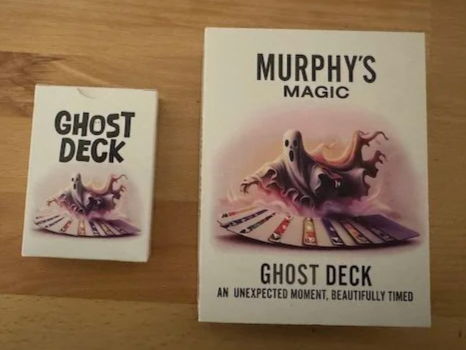
Other questionable choices by the Murphy’s crew is that the Ghost Deck comes in this card case.

What am I supposed to fucking do with that? A case with the name of the trick emblazoned on it (and Murphy’s Magic printed on the bottom)? This just might suggest to a savvy audience member that something isn’t quite normal with this deck.

In the instructions, they say to get a different box and put the cards in that. Why didn’t you just give me a different, nondescript box, geniuses?

Well, Andy, they can’t just send the trick out with no branded packaging.

Oh, I understand, but the thing is, that box came in this box.

So yes, they could have given a case to actually keep the deck in. One that would look like a normal card box and also keep it from blending in with all the other Bicycle decks you have lying around.


Also, magic product packaging is getting out of hand. Look, I get it, fuck the environment and all of that. But it’s a $15 deck (which would have been a $12 deck without the unnecessary expense of the fancy box). I don’t think we need this level of excess packaging and protection.

Magic products used to come in a ziplock bag. Sure, that too wasn’t great. But certainly there’s something between the packaging for an $1100 iPhone and a ham sandwich that makes sense for a deck of cards.


As for the trick itself… I don’t really do reviews here (when I do reviews, I only bother reviewing stuff I like, and you can find those in the monthly newsletter if you care about that), but I will state my experience with this because it’s semi-interesting.

The trick is a take on Gemini Twins, and more specifically Stolen Cards by Lennart Green—although that too likely has other predecessors.

It uses a Rainbow Deck (every card back is different). You give the spectator two “random” playing cards, the rest of the deck is dealt through face-down, and they place these two cards in the deck wherever they like, face-up. The deck is then spread and it’s revealed the two cards they put in the deck are right next to their mates. It’s then revealed that their backs match as well. And finally, the rest of the cards are shown to have blank faces.

One weird choice Murphy’s made (besides putting the cards in a case that says Ghost Deck) is that—for some reason—they gave the cards that you hand the spectator initially the same back design (different color, same design). Why they did this is beyond me. The card backs matching with their mates is part of the effect. But the two cards having any connection to each other is not. It’s just confusing. They should have had completely different backs.

You can rectify this yourself by switching them out for different normal cards, but it shouldn’t have been done that way in the first place. It suggests maybe not a lot of thought was put into this.


The bigger issue is the trick just doesn’t get as strong of a reaction as I would have hoped, which sort of surprised me. I’ve done a lot of Gemini Twins–based effects, and they always get a good response. And a blank-deck kicker ending is usually strong. But the reactions to this were very mild, by my standards.

Here’s my theory as to why… A Rainbow Deck is an unusual concept for people—a deck of cards made up of a single card from 52 other decks. A Blank Deck is also an unusual concept—a deck of cards where the faces weren’t printed.

These are weird concepts, but they’re not too difficult to wrap your head around.

A rainbow deck could be a special project you put together over time.

A blank deck could be some kind of mis-print or incomplete printing job.

However, a Blank Rainbow Deck is an order of magnitude more confusing. It’s no longer a deck where you took a card from other decks, because other decks don’t have cards with blank faces. And it’s not a misprinted deck, because these cards theoretically came from different packs. So it’s now a specially made deck with different backs and blank faces. That doesn’t resonate with people. It’s a confusing concept that seems made only for a magic trick.

Add to that the unnecessarily matching backs I mentioned before, and you just don’t have a very clean concept for a trick. That kind of muddiness sinks more tricks than you’d think. You can have a complex premise and get a good response. But you can’t have a confusing one.


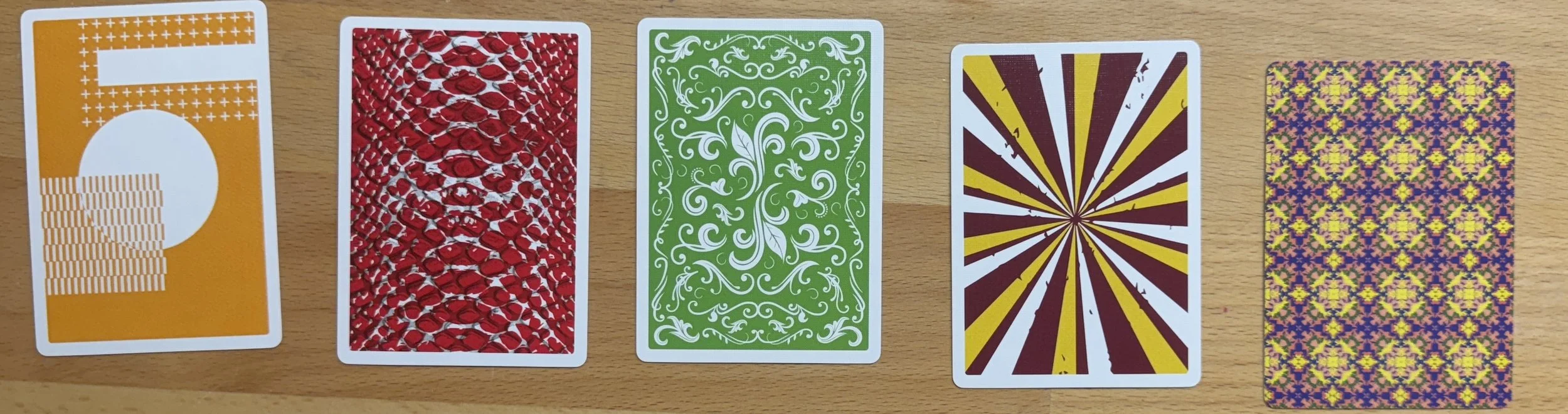
Also, these might be the ugliest card backs ever committed to cardstock. I’m hoping they were designed by AI or something, because if a human actually designed these, their graphic-design teacher deserves a quiet beating with a bag of oranges.

The only framing that even begins to justify these backs is something like, “I’ve been creating a deck with a single card from all the shittiest, least-inspired decks ever made.”


Speaking of how little care went into this thing, notice the tagline on the product box.

An unexpected moment, beautifully timed.

What?

It could not be more generic. “An unexpected moment.” Okay. That literally applies to 100% of magic effects. “Beautifully timed.” Again, totally generic. Or, if it is specific to this trick, I’m not sure what that means here. Is this a watch trick? Something happening with an hourglass?

I mean, couldn’t you have done something with the idea of a Rainbow Deck and an all-white finale?

The rainbow breaks…then the blizzard hits.

I know, it’s not great. I farted it out in three seconds. But at least it’s related to the trick. Unlike the tagline you used. And, for that matter, the name of the trick. “Ghost Deck”? How so? Because ghosts are white? Why not Cocaine Deck? “Cocaine Deck… Blow Their Minds.”

Obviously they asked AI to come up with a tagline and that one seemed “good enough.” A lot about this release feels that way.