Mailbag #162

So, I'm considering doing some small, informal testing of different variations of the same trick for a few people, to find out which they prefer. But, like Natalie Imbruglia, I'm torn:

On the one hand, it'd be logistically easier to show them all the variations together, as a group. 

On the other hand, to eliminate the possible primacy effect of people favouring whichever variation they see first, I should ideally do the test several times, with the variations in a different order each time.

Since you've done a bunch of focus group testing, I'd love to know whether you've generally found the primacy effect to be strong (in which case I should definitely do it multiple times), weak (in which case I could just do it once), or variable depending on the trick (e.g. if it contains a surprise)?—OM

In testing, you have to worry about both the primacy effect (which one they see first) and the recency effect (which one they see last). Both of these can affect the results and not addressing them would be, as Natalie Imbruglia said, a big mistake.

In our testing, we would let the variables we were testing determine if we could show them to the same person (or group) or if we needed different people for each variable.

So, for example, let's say the question was, "What do people like best? Card tricks, coin tricks, or mentalism?" These are different enough variables that we can show each person one of each, and just rotate the tricks with each person so no one trick is always first, middle, or last.

But if you're testing similar ideas/tricks, then you need to separate them completely. For example, "Is it more impossible if we frame this card trick as me reading their mind or them reading my mind?" You can't just do both tricks and then ask which they prefer. I mean, you can, but like Natalie Imbruglia said, you'd get the wrong impression.

That being said, we were trying to do testing on a broad scale with dozens or even hundreds of respondents. But I think a lot of these things you can test in very casual ways by just talking them out with a few friends and get decent enough information from that without even performing the trick. You can just talk through the variables—"Would you think it was more impossible if I picked a card and you guessed what it was? Or you freely named any card and it was the one card in my wallet?" This works as long as the differences are easily verbalized, not some subtle physical thing like a variation in a double turnover.

Testing out ideas is great, but the time and money it takes to do it “the right way” can be prohibitive. Talking through tricks with people is a worthwhile alternative to testing. And you don't have to concern yourself like we always tried to with things like primacy bias, recency bias, demand characteristics, fluency bias, contrast effect and other things that would make your head spin, like the titular character in the Neil Finn song, by way of Natalie Imbruglia, Pineapple Head.


I’m curious whether propless techniques such as hanging statements, making a statement and gauging reactions, and similar approaches work reliably in social environments. These techniques are often used in propless mentalism when the choices are narrowed down to two. —MG

In my experience, these techniques don't work great in social situations. At least not in ones where you know the other person.

Why? Because they're predicated on people acting in a generic way toward you. That's how people might act if they're audience members in a show or if they're strangers you've never spoken to. But that's not how people react when interacting with friends or even acquaintances.

For example, here's my conversation walking into a new cafe for the first time.

Me: Hello.
Counter-person: Hello. How are you today?
Me: Good. And you?
Counter-person: I'm good.
Me: I'll have a cold brew.
Counter-person: $5.19.
Me: Thanks.
Counter-person: Thank you.

It's a standard, generic interaction. And you could predict what each person will say next or how they'll react along the way.

But when I walked into this cafe a few moments ago, it went like this:

Me: Hello.
Sarah (barista): Oh god. What now.
Me: [hopping forward, step by step and making a farting sound each time my foot hits the ground] pfft, pfft, pfft.
Sarah: Actually, I was hoping you would come. I have a story for you. I had to call the cops on someone this morning.

If you tried to predict this interaction, you would be screwed.

Similarly, saying something like, "I want you to repeat your card over and over in your mind, like, 'Four of Spades. Four of Spades,'" and looking for the way they react can work when you're dealing with a stranger who reacts generically.

But friends and acquaintances might smile or be straight-faced or give a look that's contrary to what mentalism techniques would suggest, because they have a whole history and style of interaction with you that doesn't follow the rules of performer/audience.

That's why I prefer very concrete techniques that don't require me to pick up on a subtle look or reaction.


Your force bag conversation hearts trick is a great idea. I'll try it out with one change. Instead of them tossing it in your mouth, they will put the candy in their mouth, and you will determine the message by French kissing them. That could lead to a great Valentine's Day.—GT

Yes, this was the initial idea, but I don’t trust magicians to know when this is appropriate or not. Here’s the deal, if you’re already kissing this person outside of this trick, then feel free to perform it like this.

Until February...

This is the final post for January.

Keepers #2 will be sent to supporters on Sunday, February 1st.

Regular posting will resume here Monday, February 2nd.


There's been renewed interest in the Alphablocks concept after I wrote about it earlier this month.

I'm not sure if I ever stated this explicitly, but the best generic framing for this process is "casting" Boggle dice or Scrabble tiles. Similar to "casting" runes, this is framed as a more modern process using these game pieces.

I do it over the phone as I test out this weird technique I read about. They're thinking of a word from their favorite song or poem or whatever. I "cast" a handful of Scrabble tiles and tell them which ones are face up. And they tell me if any letters are accurate. (They don't actually tell me what those letters are.) We try again and see how accurate the letters are.

We try one last time: "Wait, that's wild. They're all face up. Okay, so we have a B… wait… hold on. This actually spells something." I then take a picture of the "random" letters that just came up, and they spell the exact word they're thinking of.

Of course, I'm just finding the letters to spell their word once I know what it is. But the sound of Scrabble tiles or Boggle dice being shaken up is so distinctive that it paints the scene in their mind. And if I find the letters to spell their word before shaking and dropping a different group of letters, they strongly associate the picture I send with the sound they just heard—creating the illusion that the letters in the picture are the ones that just hit the table.


Vanishing Inc. features a Community Questions section on their product pages, which is a helpful way for people to ask and answer questions about individual products.

For example, on the product page for "Coincidenc3," Dexter Yin has a question and Barry chimes in with this helpful information.

Now, just so you understand, Josh and Andi don't come to your house at gunpoint and make you answer questions on the product page. This was Barry going out of his way to answer the question.

It's a weird way to go through life—feeling compelled to contribute your two cents when your account balance is literally zero.

Priest: If anyone here knows of any reason why these two should not be joined in marriage, speak now or forever hold your peace.

Barry: [Slowly stands.] Yeah, so I just want to say I don't know any reason they shouldn't be married. [Sits, then stands quickly.] To be clear, I don't know Steve and… Angela? I thought I was coming into a real estate seminar.


See you all back here in February, my little Valentines.

Force of Hearts

Here’s a quick idea for a Valentine’s Day trick.

But, Andy, Valentine’s Day isn’t until next month.

Yes, I know. I’m giving you a head-start so you can prepare and do it during the Valentine’s Day season.

It’s always weird to me when magic companies will put out a trick that’s “perfect for Halloween” and they put it out on Oct. 26th.

Or this email I got on Christmas Eve at 8pm for this product.

Merry Christmas Eve!

 As you prepare for a night of festivities, family, and food, we wanted to send a quick note of holiday cheer and a way to make your gift-giving a little more miraculous tonight.

Gee, thanks. I was going to read my kid, ‘Twas the Night Before Christmas. But fuck him because I’ve got an instant download to watch and gimmick to make.

Even Penguin releasing their Christmas special on Christmas seems weird to me. If you’re watching a Penguin Live on Christmas day, you better hope you’re Jewish. If the Ghost of Christmas Future took me to someone’s house to show me how they were celebrating Christmas in the years to come and I peeked in their window and saw them at their computer watching Craig Petty, I’d be distraught. “Oh, no, kind Spirit! say it isn’t so!”

This is just to say… get with it, magic companies. Release your holiday magic in time to allow us to enjoy it during the season.

So here’s my Valentine’s Day idea…

You get a clear force bag and a couple of bags of conversation hearts.

Create one (or more, depending on how many chambers your force bag has) pile of hearts with matching phrases on them and load that in one of the sections. Put mixed hearts in the other.

Have your friend reach in and remove some at random, read the messages, and have them drop them back in. Shake up the bag. Close your eyes, turn your head away, blindfold yourself or whatever (fully gouge out your eyes if there are any true skeptics in the audience).

Now open the force chamber, have them remove a heart, read it to themselves and toss it in your mouth where you chew it and tell them what it says.

If you have something like Blake Vogt’s Fource Bag, you can repeat this two more times.

“My tongue is sensitive enough to read the ink on candy hearts” is a stupid enough power that it won’t come off like you’re trying to impress them. So they can just enjoy the absurdity and impossibility of it.

I had this idea years ago while watching an episode of Community.

Damsel Cull Force Version 4


Griffin Watt sent me along this trick that is based on Tomas Blomberg’s version of the Damsel Cull Force. It’s interesting because you’re doing the force with the deck face-up. There is a fairness to this in that they see exactly where they’re placing the card in the deck so you can’t seemingly change anything around, despite the fact there is still a free choice to come on where the predicted card will be relative to the card they inserted.

Does that make sense?

No.

But you’ll understand when you watch the video.

An idea of Michael Weber’s is to show them part of the prediction before you allow them to put the card into the deck.

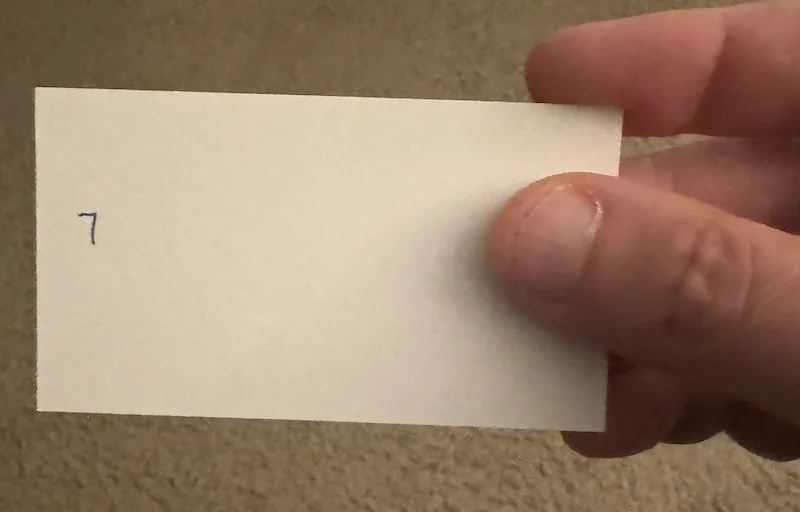
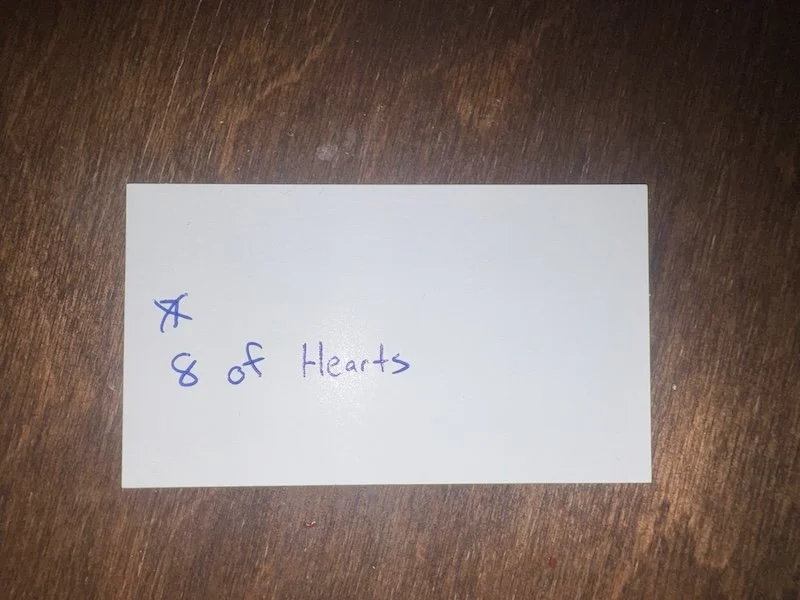
So you write this…

But before they insert the card, you only show them this…

Thanks to Griffin for sharing this handling. I think there is potential to build upon this and offer even more choices to the spectator. I have some ideas. I’ll let you know if those experiments bear any fruit.

Zero Carry Part 2

Thanks to everyone who has written in regarding the Zero Carry post from last Tuesday. I've received a lot of good leads and I will be revisiting or tracking down some of these effects to give them a look. The next write-up will be too long for a post, so it's likely going to be a special issue of the Keepers newsletter coming up.

To reiterate something I said in the original post, I'm not looking strictly for "propless" tricks. Everyday objects are perfectly fine.

That point led some people to wonder if I'm just asking for "impromptu" tricks. Yes and no. The Zero Carry slot in my repertoire is for a trick that is not just impromptu, but also lends itself to an extended interaction with a fleshed out premise. So not just a coin vanish or something.

With EDC, we think of carrying around props and gimmicks to allow us to go into a particular effect. We have these items with us so we can perform on the fly when the opportunity arises. We have a gimmicked coin or something in the watch pocket of our jeans so we're never caught off-guard.

ZC is like that, but it's like having a strong impromptu effect that's in the watch pocket of your mind. One that you've given enough thought to that there's no ramp-up to get into it. You can just flow into it from any situation.

Now, my whole argument behind having a 100 Trick Repertoire in the first place is to have a wide variety of effects that will work in a multitude of situations. So it may seem strange that I'm trying to find one trick to put undue focus on. But the truth is, having such a large repertoire is exactly why I need something like this. If I was just doing the same half dozen tricks over and over, I wouldn't need to isolate one in this manner.

Here's what I mean… If someone walks up to you and says, "Tell me something you like," your mind will sort of glitch out at the generality of the question. However, if they come up to you and say, "Name a book you like," you'll probably have a far easier time answering that, even though it's technically a more specific question.

I don't have an issue transitioning into a trick from a specific situation. If people around me are talking about astrology, or coincidence, or ESP, or how different people perceive things differently, or whatever, it's easy for me to pluck the trick from my repertoire that will fit that situation. "Interestingly… I was just reading about this. Actually, maybe we can try something…" That's the beauty of the 100 Trick Repertoire.

What I find difficult is when a performance opportunity springs up out of the blue. Since I work out of cafés, it's not unusual for someone I interacted with months or years ago to approach me and ask to see something. Or, at a social gathering, someone might ask me to show them a trick, and if I hadn't planned to perform something, that can throw me.

So having a designated Zero Carry effect is for those situations—allowing me to flow right into something without having to do a mental checklist to make sure I have everything I need and that I remember all of the steps.

To be clear, it's just a fallback trick. It's not the trick I will always do in this situation. You don't want to be the guy always doing the same trick. But having this trick chambered allows your mind to be really chill in these types of situations. When you know you have something solid locked and loaded, you're not scrambling or second-guessing yourself. That mental calm actually gives you the freedom to assess the situation and choose something different if it feels right. Or you can just relax into your fallback without any stress. Either way, you can flow into the trick casually and calmly, which is exactly the energy you want to project when someone approaches out of the blue asking to see a trick.

Mailbag #161

Matthew Wright just released The Artefact. It looks like it would be a good option for a Wonder Room display. I'm curious for your thoughts on it.—CY

The Wonder Room concept is something I haven't revisited in a while on this site, so this question is a good excuse to delve back into it.

Whatever you think of this trick, no, it's not ideal for a Wonder Room display (from what I gather, at least). Here are the two reasons why.

Examinability - This is the primary reason. Wonder Room tricks are on display, so you want someone to be able to pick it up and look at the props without finding anything unusual about them. Here, if they looked through the cards, they'd see most of them were blank—which is clearly not something you want them to discover before going into the trick.

Now, assuming the relic itself is examinable, you could just keep that on display and then grab the cards and the little parchment thing before your performance. But that feels too disjointed to me. These items are clearly meant to go together. This isn't a relic that has some strange properties that work with any pack of cards. It's meant to be presented with these cards. So the idea of storing them in different places makes no sense.

What Is It? This is the second issue with the effect.

A Wonder Room display should have a theme:

  • Cursed objects

  • Alien technology

  • Psychological tests

The theme can even be as general as "strange objects" and include any of the above and more.

But what you don't want is for it to appear to be just a shelf of your magic tricks. And the relic, in combination with the cards, comes across as just a magic trick. The only purpose it seems to have is so you can do this trick with the cards.

Compare this to something like a "divination pendulum" or "truth-telling compass." Those objects have an implied purpose that exists beyond your performance. Your friend could imagine a use for such an object. But a relic that only makes sense when paired with a specific deck of cards? That says: "magic prop," not "mysterious artifact."

In a situation where you're performing tricks, that's fine. But as part of a "collection" of unusual objects, you want that object to seem to have some sort of purpose or backstory beyond just: "It was made so I can do this trick."

When looking for a strong Wonder Room piece, focus on objects that could plausibly exist independently—things with their own story that happens to allow for an impossible demonstration.


Does the new Holestick effect fit into your “Zero Carry” category? Do you have any thoughts on the effect? —CM

No, it doesn't quite fit into the Zero Carry category. (More on this concept in tomorrow's post.) The fact that it requires a toothpick (or something of similar dimensions—a skewer, your erect penis) makes its requirements a little too specific for a ZC effect.

As for the trick itself, I think it's interesting and I don't know the full details of the secret, but I have experienced it as a spectator.

I was at a restaurant/bar with a friend who also does magic. He borrowed a bill, stuck a toothpick through it, and then restored it. I couldn't tell where the toothpick had gone through and neither could the women we were with.

But… then one of the women took the toothpick, stuck it through the dollar bill, licked her fingers, and pinched and massaged the hole…and the hole mostly disappeared for her too.

My friend's little hole was definitely more invisible. But the difference between his hole and the girl's hole—who just tried it with no method—was minuscule. (That's the end of me evaluating my friend's "little holes.")

So, in the end, the difference between the "magic trick" and someone going through the same motions with no trick was just a matter of microfibers. And while there's something kind of interesting about doing a trick on such a small scale, it would likely not be something I'd do much because I think that type of moment is of limited long-term impact.

(The variation where you move the hole across the bill feels much stronger.)

Dustings #139

Evan Cloyd, aka Jarek 1:20, aka “Disturb Reality” on youtube has been kicked out of the GLOMM.

Cloyd was a former wannabe professional wrestler and had quite a following on Youtube for his magic videos which pandered to the loneliest of losers hoping to find some way to coerce women into kissing them with magic tricks.

These videos are, of course, enough red flags to form a color guard. So you won’t be surprised to find out that he was recently sentenced to 15 years in prison after pleading guilty to aggravated sexual assault of a child under 14.

Congratulation to Evan. You have achieved your goal. You have disturbed reality. Now go get fucked.


This is the 5th time I got curious about something and ChatGPT assumed I was trying to kill myself in some needlessly complicated manner.


This is such bullshit. Craig Petty has started reviewing our lovemaking sessions. Now, when we were together and he was speaking to my face, he was saying how it was “incredible” “the most erotic night of my life” etc., etc.

But then, when he’s back home and in front of his little camera where he can spout off about it behind my back, this is what he says…

Yeah, “that’s it,” indeed. We’re through, Craig.