Coming Next Tuesday

Next week we'll be adding a new trick to the Jerx App based on the Wisdom of Crowds reveal I talked about yesterday. It's called:

Screen Shot 2017-10-25 at 1.53.56 PM.png

It's the same idea, but instead of a book, or a phone call, the information is revealed online. 

There's a significant issue with that idea though. You know what happens if you say to people, "Hey, there's this website that you plug some basic information into and it will tell you what random word you're likely thinking of based on a data mining process." Your friend will say, "Oh, cool. Give me the website. I want to try it out with my friends too."

To prevent that sort of thing, this is presented as some hidden section of the "dark web" that you have to have special access to. The Dark Web is the truly unregulated part of the internet that requires specific software and authorizations to access. Because I'm not a connoisseur of child pornography, I don't really know that it looks like or acts like. But that's good. That means your average spectator doesn't either. So when you have to use your phone and visit this weird URL, this actually adds to the intrigue. "This isn't a site that just anyone can access. What they're doing here... the shear volume of data they're collecting and processing... is insane. It's actually kind of disturbing." 

So you bring up this dark web site (in the process, you code in the word the spectator is thinking of) on your phone. 

You have the spectator enter their information in the form.

IMG_4315.PNG

After they hit submit there is a semi-long wait while the site processes the information against its vast databases.

IMG_4318.GIF

Then it spits out the results. In this case, the person had thought of the word "Coffee."

IMG_4316.PNG

One of the really clever things here—and I can say that because it was completely Marc Kerstein's idea—is that the third entry in the list will be a synonym for their thought-of word (assuming there is one). As if to suggest the algorithm knew it was likely you would be drawn to a particular idea, but just wasn't certain which word you would use to express that idea.

That part where it says, "If the thought-of word wasn't in the potential word list," etc., that's just there for verisimilitude. If the word isn't in the list, it's because you screwed up, dummy.

Thanks to Seth Raphael for allowing us to use his input method, and, of course, to Marc Kerstein who built and maintains The Jerx app.

The app update should be available on Tuesday. You'll be able to find instructions for it in the app itself. Swipe two fingers to the right on the L'il Jerxy opening screen to get to that.

Screen Shot 2017-10-25 at 3.06.05 PM.png


The Wisdom of Crowds Word Reveal

In the first few weeks of this site, I wrote this:

My hobby is coming up with ways to reveal a thought of word. I used to have a long subway commute and whenever my phone would die and I didn't have a book on me, I would fill my time by trying to come up with one interesting way to reveal a word before I got to my stop. 

I know what you're thinking:

Andy, I have a few different ways I like to reveal a thought of word. One is, I write it on a clipboard. But occasionally, for an older audience, I'll bust out a chalkboard. But when I'm performing at a bar, I write that shit straight-up on a whiteboard, my man! [hold for high-five]

Believe it or not, I'm not just talking about what surface you write the thought of word on. Or if you say it out loud. Or if you reveal it letter by letter. I'm talking more about the context in which the word is revealed

There was a time when I considered writing a book of just different ways to reveal a peeked or forced word. 202 Word Reveals, or something like that. But one thing I've learned is that the mass magic audience wants a book with 200 ways to peek a word, not 200 ways to reveal one. I would argue that's the problem with magic, but I'm done arguing that point.

Here's something I will argue. Let's say you know what word a spectator wrote down. I believe, for the amateur magician, the least interesting thing you can do with that information is to say, "And now I'll read your mind.... You're thinking of Clementine." Or any other variation where you claim to read their mind. 

For the professional it's a bit different. If the audience doesn't know the performer, then they can consider the idea that this person has some strange power of perception or of the mind that allows him/her to divine what someone is thinking.

But, when the spectator knows the performer, they know that's not the case. So to say "I'm going to read your mind," leads to one of two outcomes:

1. The effect is interesting to them, but it can only ever be an interesting puzzle. They know you didn't read their mind. So the trick becomes an unraveling of how you knew what was written on the paper. This ends up bringing a ton of heat onto the procedure. Why did he put it in the wallet? Why did he tear the paper?

2. They know it wasn't real mind-reading. And they're not interested. And they don't give it a second thought.

Obviously there are ways to make, "I'm reading your mind," more interesting and more resonant to a spectator, I won't deny that. But in a general sense, I still think it's fair to say that if you know a word someone is thinking, the least interesting thing you can do is then "read their mind" and reveal it. I don't even think that's a particularly controversial thing to say. And yet so much of magic/mentalism is that exact thing.

Screen Shot 2017-10-25 at 2.54.28 AM.png

Originally, the idea was this... I'd be at the library with someone and I'd ask her to think of a random word. When she settled on something I would say, "Is the word you're thinking of related to your life in any significant way, because we don't want it to be. So, if you were thinking of swimming that wouldn't be a good option because you were a swimmer in high school. Of course you can relate to almost any word in some way, but I just don't want it to be a strong correlation. So if it's something connected to you in some big way, switch to a different word." Once she's settled on something that seems truly random she would write it down (and I would figure out what it was). 

Then I'd bring her over to the reference section and pull out a large book called The Wisdom of Crowds 2017. It would be the size of one of the big phone books with the tissue-thin pages. I'd explain to her the publishers of this book have this huge database of information that pulls from all sorts of publicly available records and they claim that, with this information, they can make extremely educated guesses about the way people's minds work and the choices they make. All they need are three data points: your sex, where you were born, and when you were born. And then that gets cross-referenced with a bunch of different information: #1 songs and highest grossing movies from your teenage years, what books were the most popular at the public libraries in your city, keyword searches in your local newspaper, tv ratings, magazine circulation, local school curriculum—just an endless amount of data. 

The publisher's claim with just those three personal data points, and then the massive amount of local and national statistics, they can predict all sorts of things about you: the career you're likely to go into, how you'll vote, the number of kids you'll choose to have, the values that will matter to you, and so on. Of course, this is all expressed in percentages and probabilities—not every male born in Columbus, OH in 1972 went into the same career, for example—but they still claim an extremely high degree of insight based just on those bits of personal information.

They published this book, "The Wisdom of Crowds," as proof of the strength of their algorithm. In this book they suggest they can predict what "random" word a person is likely to think of.

So I would confirm with my friend that she was born in San Diego, in 1990. Then we'd flip to the San Diego section, then go to 1990, and look in the female column. It would list five likely words a person with those demographics might think of. And there, at the top of the list, would be her word: buttermilk.

I thought that would make for an interesting way to reveal a word. There was only one small issue, which was that I had no clue how you'd actually do it. Well, I could come up with a method if I was working on a tv special and had a crew with which to do it, but not really as a workable, reliable trick for a normal setting.

So I changed the premise slightly. 

My friend Sophie is visiting and I ask her if she wants to try something interesting. I have her write down a random word, fold up the paper and put it in her pocket. 

Then I tell her about a friend of mine who works for this gigantic data mining company. And I tell her how they examine all sorts of information (all the same stuff mentioned in the presentation above) and are able to make shockingly accurate predictions based on very little personal information. 

"We assume our personality and the decisions we make in life are a function of our DNA or something, but it turns out a lot of these external factors influence us in profound ways. You think you went into the health field because you have an innate desire to help people. But it might be because George Clooney was on the cover of People magazine with a high frequency during critical moments of your adolescent development."

So we call my other friend who works for this data mining company and give her Sophie's basic information. Then we ask what random word she is likely to have thought of. 

After 30 seconds of time for computation, my friend on the phone says:;

"Okay, here's what we've got. There are five 'highly likely' options for words she may have thought of. I'll go from least likely to most likely. #5 - train #4 - carton #3 - desire #2 - coupon #1... buttermilk."

Sophie freaks. 

"Seriously? Is that what you were thinking of?" I ask. Always play dumb.

When things settle down I say, "The fucked up thing is no one knows what this company is using this data for. It's actually kind of spooky to think of how they might be utilizing.... Oh well, let's go get something to eat."

Now, obviously you'd need a friend to help you out in this version, but it's a relatively easy thing for them. They don't have to remember some intricate code or something, like in some effects that require a partner. All you need to do is text them the word before you call. If you text with one thumb it will look like you're just navigating to where you need to be on your phone. 

No friends? Well, don't worry, you can do pretty much the same thing without a helper. You just fake a phone conversation. In this scenario you would just act as if you're relaying information you're hearing from someone else back to your spectator. I prefer involving another real human, but I've done it both ways and it goes over well regardless. 

The idea is not to try and convince your spectator that there really is this massive database that can predict what random word you're thinking of by aggregating all sorts of information like which Sega Genesis games were most rented in Blockbusters in your city when you were 13-15. It's just to give them a more interesting premise to think about, that can't be as easily dismissed as, "I'm a mindreader."

You might say, "Well, what difference does it make then? If in the end they know it's a trick, and they know it's not real, then that's no different than them knowing you can't really read minds. Right?"

No. That's not my experience. 

I've said it before: The world wants to be charmed.

People want to be seduced.

When you say: "Write down any word. I'm going to read your mind. It's apple."  You've given them nothing else to think about other than how you saw the word on the paper. There's no diversion there. "I'm going to read your mind" is immediately discarded because they know you and they know you're not psychic. People recognize "I'm going to read your mind" as the least you can do in that situation to justify things. There's no romance in saying, essentially: "Let's pretend I have super powers." 

But when you weave a story, or draw them into an interesting process, or create a unique visual image for them, then you give them other elements to think about. Combine that with other presentational tactics that I talk about here and you can create an experience that is, in many ways, diminished by asking too many questions about the reality of it all. 


Tomorrow! I'll describe how we built a variation of this idea into the upcoming release of the Jerx App. In that version you'll be consulting a secret data aggregating tool on the "dark web" to find out what word your spectator likely selected. It's some fun shit. The new release of the Jerx App is coming next week.

4200

A reader, J.W.S., emailed me the other day after having done some math. He determined that between this site, the X-Communication newsletter, the two books, and the JAMM, that I had created the equivalent of approximately 4200 pages of writing on magic in the last two years. That's bananas. What's even crazier is that Jerx completists have read over 4200 pages of my writing in that time. You—the guy who had to get the Cliffs Notes for Animal Farm—read 4200 pages of my gibberish/genius. 

The sad fact is, for many of you, if we go by the metric of level of engagement and time spent reading, I could make a convincing case that I'm your favorite author.

Take that, F. Scott Fitzgerald!

The White Wand Society and The Oscar Gamble Gambit

The White Wand Society

I was spending a lot of time with someone over the past few months and so I ended up showing her a lot of magic. "A lot" by my standards is 2 or 3 tricks a week. When you're showing someone that much stuff it can be overwhelming to try and make each experience completely unique and immersive. But, at the same time, if you just cruise through your performances without putting any thought into them, it can feel meaningless to the other person. 

In that type of circumstance I like to give all the effects some kind of context as a whole. That way, instead of seeing it as just 20 random tricks over time, they see it all as part of a complete story.

What I would do is I would set my phone to ring, or just act like it had vibrated or something. Then I'd pick it and have a conversation (with nobody). 

"Okay... yes... alright. Just once? Okay. How soon do you want it? Yeah, I don't think that should be a problem. What's that? It has to be a normal rubber band? Oh, okay. That is much more challenging. Uhm, okay, I'll try."

The first time I did this, my friend asked what it was about and I was like, "Oh, it's just this... thing... there's this... well... it's kind of a secret organization for magicians and I put my name on the waiting list about 12 years ago. It's called the White Wand Society. And now I'm being subjected to a series of trials to see if I can qualify for the group. It goes on for a couple months. That was my handler. He said I have to find a way to link a normal rubber band with a borrowed finger ring."

And then I'd come back a couple of days later, borrow her finger ring and try the trick out on her.

Now, this is essentially a fictionalized version of the Peek Backstage presentation style. And, at first, my friend didn't doubt what I was saying. You may think that's dumb of her, but remember that people don't know how the magic community works. You have to do a series of trials to be invited into some secret society? Not only does that seem possible, but fuck, that's how it SHOULD work. That would be cool. 

So, it went on for a few weeks. I'd occasionally fake a phone call or text. Or I might just say, "I have this new assignment for the White Wand Society that I have to work on." A couple of times I went above and beyond. I had a friend in England send me a box that was supposedly from this secret organization. "What am I going to do with this shit?" I said. (Meanwhile, it's precisely what I needed to do a trick.) Another time we were at a campground and there was a main area where people would get together at night. There was a payphone there and one time it started ringing. I picked it up, all tentative... "Hello? Wait... how did you— okay, sure.... A borrowed deck? Face-up and face-down?" As if they had somehow tracked me out to this campsite. (I had just dialed the payphone from my cellphone.)

After the first couple times, she began to realize this was all some kind of bit. And I pushed her in that direction by making more ludicrous claims about the group and the things they were making me do. So, over time she understands this is all just some harmless fun. And she gets that I'm talking to myself on the phone, I'm faking getting texts and so on and so on. But she's a smart person and she also gets that this is more interesting than just me showing her random tricks with no context. So it's our little game. 

It becomes a running joke. Me scratching my head about some new challenge I was given. Or she hears me in the other room yelling, "That's goddamn impossible!" And it creates anticipation when, a day or two before I say, "Yeah, so apparently they think I can come up with a way to figure out what word you're thinking of on Wikipedia. Like... not from a list of choices, but any subject." And then later it happens! It's fun, and it takes almost no more work than just peppering someone with random tricks. 

[Let me pause here to say you probably won't be able or willing to wrap this up the same way I did, but you can definitely do this much. You can set up the story of being tasked these effects to learn. And you can play it as real or fake as you want. I promise you it's more interesting to people than sitting through disconnected tricks.]

So we have this cute little interaction that goes on for a couple months. One day we're watching a movie and my phone rings. I pick it up and I'm like, "Yes. Oh... okay." I mouth to my friend that it's the secret magic society and I roll my eyes. Then I'm like, "What? When?!" And I start rushing around putting stuff away and cleaning up. She asks me what's going on, but I don't really give her an answer. 30 seconds later there is a knock on the door. 

I open the door and there's a guy, slicked back hair, little black mustache, nice suit. No cape, but still a real Mandrake-looking dude. It's my handler! He tells me I've passed all the challenges and there's only one thing left to do. He gives me a medallion strung on a ribbon. I put it around my neck like it's the end of Star Wars and he's like, "No, you moron, that's your final test, remove the coin from the ring." Oh... so it's a Chinese coin. Not a medallion. My bad. I give it some thought, pull it off, annnnnnnd... scene!

Now, I'm fortunate to be able to pull these types of things off because I have a lot of theater and comedian friends who love being part of dumb shit. Show up and pretend to be part of some clandestine magic organization that has been testing me for weeks? I probably could have found a dozen people who would be willing to play that part.

And it was worth it because when there was that knock at the door and an obvious, capital M, "Magician" walked in the place, my friend's jaw hit the floor. She was blown away. This was not what she had come to believe was happening. And you could see her try and put the pieces together. Who is this guy? Does this organization really exist? Was some of it real? Was it all real?

That was the trick I was pulling.

The Oscar Gamble Gambit

The idea above is somewhat related to another concept I've been thinking a lot about.

The Oscar Gamble Gambit (OGG) is based on the notion that you're never going to get a modern audience to believe something truly impossible actually happened. (I talked about this topic in the post "Feeling and Belief" last week.) At least I can't conceive of any of the people in my life coming to that conclusion. For better or for worse, the type of people I know, when presented with something impossible will think, "That's amazing! I have no idea how that could have happened." But they won't then go on to think, "So... I guess I was wrong... real magic exists. I'ma go catch me a leprechaun!"

So I don't think you can really mess with someone's beliefs too much, these days. But there's no denying that having your beliefs upended would be a fascinating feeling and a unique experience. 

The OGG is a way of doing that is both doable and ethical. 

You see, instead of trying to convince someone to believe something that isn't true, the idea here is to get them to disbelieve something that is true.

In this case of the White Wand Society, I was setting my friend up to think it was all just me being a goofball and to disbelieve that I was actually interacting with someone. So when another person entered the equation, her actual beliefs shifted. What she had believed was just a one-man show for her benefit, is now something bigger and more interesting.

I haven't quite cracked it yet, but I believe there is a lot that can be done with the idea of getting them to disbelieve something that is true.

I will tell you where the original idea came from. I hesitate to mention it here because the idea is kind of f'd up and because I'd still like to maybe do it someday.

In the past 18 months or so, I've been asked to lecture or perform at a handful of conventions. One idea I had (in the crazy, brainstorming phase) for something I might want to do was come out and do 10 minutes of a Rocky Raccoon type of routine. And do all the standard jokes and be like, "Oh, the little guy is really active today." And make him run across my body and "eat" from my hand. And then at the end I would set him down and he would walk away. 

You see, my idea was to drug a real raccoon and then do Rocky Raccoon style manipulation with his limp body. And then time it so he came to his senses near the end of the act. So the idea was to get the audience to disbelieve it was a real raccoon. And then later reveal it to be just that. 

This is, obviously, not the world's best idea. But, as I said, I think there is some value here in the concept of trying to create disbelief in something that is real. As opposed to trying to create belief in something that isn't. That way you can genuinely change someone's beliefs, just by revealing the truth. 

The situation you want is when they don't believe some aspect of your presentation, but that aspect is real.

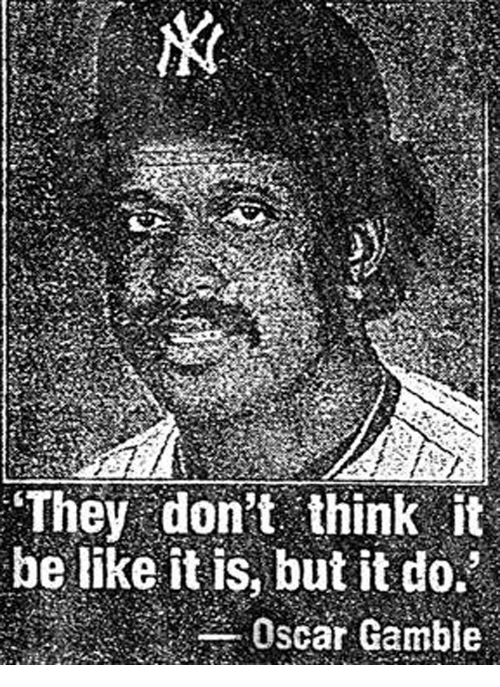
Or, as the great Oscar Gamble once said...

they-dont-think-it-be-like-it-is-but-it-19266426.png

Gardyloo #37

It's Gardyloo #37. Which means if you were thinking of a two digit number, under 50, with both digits being odd, and both digits being different... then there's a decent possibility you were thinking of this edition of Gardyloo. What a miraculous feeling that must have been to have me guess your freely thought of number! That freely thought of number between 1 and 50 with just a few simple restrictions that only eliminated a scant 42 of the possibilities you could have been thinking of.


Speaking of shitty forces, when prepping for the forcing focus group from a few weeks ago,  I was reading 202 Methods of Forcing by Annemann for the first time in a long time. There's a lot of garbage in that book. I think he had 22 methods of forcing and there was a typo in his pitch to the publisher that he was afraid to admit to.

This, for example, is the second force listed in the book.

Screen Shot 2017-10-19 at 2.49.50 PM.png

I'm kind of curious how that would play out.

"What you are about to witness is a miracle that is only possible due to the stunning powers of my mind! Please, name a number between 1 and 20....  Two? Okay. 1, 2, 3, 4, 5, 6. Oh crap, I screwed up counting to a number. There's nothing suspicious about that. Here, you count to the number instead. That's too much for me to handle. AHHH!! What's this thing in my hands! Oh... it's just a deck of card. Phew. I was confused for a minute. I should mention, most of my brain has rotted out due to syphilis."


Screen Shot 2017-10-19 at 4.47.46 PM.png

I've mentioned in the past about using a bloody nose as a Rep for any effect that supposedly relies on mind power. I've done it in the past, but it's not really my style any more. 

However, it's halloween time so now it's very easy to buy what you need to do this. Just get blood capsules with a top that breaks off or that you cut off. Have the top off and have the capsule hidden in the bathroom or another room away from where you're going to perform.

After your routine, immediately start sniffing and maybe rubbing your temple or something. You'll be needing to sniff later, so it's important to establish it now. Go to the bathroom to (supposedly) get yourself a tissue. 

When you're in there, squirt the capsule up your nose. You now can keep the liquid up there by snorting it back in. Like you would if you had a particularly runny nose. 

Walk back out to where everyone is. At some point, start talking so the focus is on you and just stop holding the blood in. It will come out in a nice stream. 

You can use a plastic syringe with fake blood if you want a larger stream, but you don't really need that much.

Here's what it looks like.

IMG_4313.GIF

Is there a way to do it where you don't have to leave the room? Yeah, probably. But keep in mind this isn't "The Trick Where You Make Your Nose Bleed." The nose bleed is intended as a repercussion of the trick. You don't want it to feel like part of the trick. "And look, there is nothing in my hands and nothing on my face, but if we just wait a moment... now my nose is bleeding!" That's not what we're going for. Reps are meant to be a post-trick event that occupies a space between reality and fiction. 

In fact, you could get much of the benefit of this by just excusing yourself to the bathroom, leaving a bloody tissue conspicuously in their wastepaper basket, and then coming back a few minutes later, like, "Sorry about that. My noise started bleeding." They wouldn't need to see anything. Seeing that bloody tissue sometime later would be enough to mess with their head a little.


When I stopped writing the Magic Circle Jerk blog, I had about 30-40 posts still half-written. And I swear to god this was one of them, Ellusionist Presents: Black Sponge Balls for the badboy magician. And holy shit if Ellusionist didn't actually go ahead and do it. 

Screen Shot 2017-10-19 at 3.30.43 PM.png

Honestly, the ad copy is much funnier than the mock ad copy I had written up for them.

"When we first explored the idea of carrying sponge balls our first requirement was, as it always is - they have to be cool." 

"[W]e knew we had to have something that looked edgy or classy. It was right there in front of us. A color we fully embrace here at Ellusionist. Black. A Black that truly 'pops' and makes sponge balls cool."

Uhm... the guys at Ellusionist are aware of what the word "cool" means, right?

And classy? "Oh, darling, look how classy this magician's sponge balls are! True, they blend right into his suit so the effect is somewhat diminished. But frankly it's a small price to pay for not having to subject myself to those utterly gauche red sponge balls. Honey, don't these remind you of the Rockefeller's sponge balls?"

The only thing the ad is missing is my joke about the black sponge ding-dong having 100% more length and girth than the traditional one.

Word of Mouth

Coming in the JAMM #10

Word of Mouth

Word of Mouth is a simple, absurdist, wildly fooling trick and one that your audience will remember for a very long time. 

I don't want to give too many details away, but it involves sloppily shoving food into your fat face like a lunatic. Something you're probably pretty good at.

If you're someone who has spent 8 years perfecting your classic pass I urge you NOT to perform Word of Mouth. If you do, you'll find it's the trick people bring up and talk about for months and that it generates more joy in people than every classic pass trick you've ever performed combined.  And then you'll take a long hard look in the mirror and realize how much of your life you squandered and then you'll go throw yourself in front of a bread truck or something. I don't want that. So please, don't even bother reading it.

For everyone else, I think you'll find Word of Mouth to be the most bonkers trick you read all year. And if you end up performing it, you'll see it's one of the most amazing ones as well.

Feeling and Belief

In the writing that follows I talk a bit about developing a "magic feeling" with your effects.

What do I mean with this term? It's easy to dismiss this as some kind of hokey Doug Henning horse-shit. 

The reason I can give wonder is that I feel wonder about the world: the stars, a tree, my body - everything.
— Doug Henning

That's not the type of thing I'm discussing. I mean, that's fine and all, but what I'm really talking about is crafting an experience or a moment that has a bizarrely enchanting, otherworldly feeling to it. Not the magic of a fucking tree.


I've heard it said that the unfortunate part about performing as a non-professional is that your audiences are usually people you know, so they're unlikely to believe whatever power you are professing to have. 

But this is not a bad thing. This is one of the benefits of performing for friends and family. 

Wanting someone to truly believe you can read their mind (for example) is a mental disorder. It's a cry for help. 

The moment someone believes something actually happened, you have lost the ability to create the feeling of "magic." The magic feeling occurs in the gulf between what they believe is true about the world and what felt true during the course of the effect.

If they believe you can read minds in real life and then you do an effect where you read minds, you have a magic feeling of zero. Your performance can be impressive or even amazing as a demonstration of skill, but you're probably undercutting people's enjoyment by aiming for "belief."


One of the very first things we ever tested with my NYC focus group crew was to see who enjoyed a mind-reading trick more: people who believe in mind-reading/ESP or people who don't. People rated their belief in the phenomenon on a scale of 1 to 100 and later they watched a demonstration of mind-reading and rated their enjoyment on a scale of 1 to 100. While everyone had a positive response to the performance, there was an inverse relationship between belief and enjoyment. That is to say, the more you believe in mind-reading, the less enjoyable you find watching it as entertainment.

That kind of makes sense. The non-believers are witnessing something that seems impossible. The believers are seeing a demonstration of what they already assume is possible. 


You see, belief implies possibility. 

Every time you do a trick you have two choices:

1. "I want my audience to believe I did something that is possible." 

2. "I want my audience to feel like I did something impossible." (Or, more towards my style, "I want my audience to feel like something impossible happened.")

What screws magicians up is that they think there's a third choice: "I want my audience to believe I did something impossible." This isn't an option. It's not on the table. Because to believe you did the impossible, would make you a god or a wizard. You are not going to get an intelligent adult to believe that. And you're certainly not going to get your friends and family to believe that. And if it seems like you want them to believe it, you're going to come off as a grade-A nutjob.


When I suggest magician's shouldn't strive for people's belief in their performances, there is a tendency to think I'm suggesting they should half-ass it and turn it into something meaningless and frivolous, but that's not what I'm suggesting.

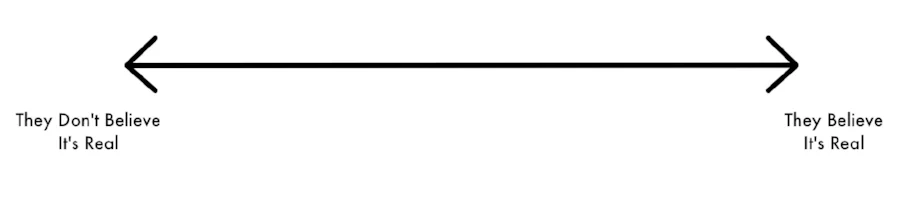
It's easy to think of "strong magic" as being synonymous with the spectator believing the trick really happened. So it can seem ridiculous for me to suggest that strong magic is when people don't believe it really happened. But it only seems ridiculous when you consider one axis of the equation.

believ.jpg

With just that variable, it would seem like you would want to push it as far to the right as possible.

What I'm proposing makes much more sense when you add the other axis. 

Feel.jpg


When you consider it like this, I think most would agree that something at point B on the chart ("I believe it was real and it felt 100% real") is probably less "magical" than something at point A on the chart ("I don't believe it was real but it felt 100% real"). 

That "magic" feeling is really that dissonance that exists when something feels real but you know it's not.

What makes magic unique from any other art is that it can create experiences that exist around point A in the chart. Most everything else in your life is at point B. "I believe the cable guy replaced my cable box. And it felt like the cable guy replaced my cable box." That's not the most marvelous type of experience.

This is why a lot of the theory type stuff on this site is all devoted to changing how an effect feels to the spectator. The smear technique, imps, reps, buy-ins, the different performance styles— all of that—affect how a trick feels. They don't, necessarily, affect the deceptiveness of the trick itself. We're not lacking in tools of deceptiveness. We're lacking in tools to make the effects feel authentic.

What does it mean to make an effect feel real? It means adding in these types of presentational approaches that are designed to fool their heart, not their brain. 


See, it's not a problem that your wife doesn't believe you can't really read her mind. If your performance for friends and family have gotten stale, it's not because of their lack of belief. It's because they don't feel anything.

It took me a while to figure out, but many of my least favorite performances were the ones where people bought into the reality of my "powers," even partially. The ones where people thought I might have really been able to read their mind or predict their actions or memorize a full deck in a minute. Sometimes they'd be impressed, but I don't need that validation, especially for a skill I don't actually possess. And sometimes they'd be a little weirded out, and that's somewhat enjoyable, but more so for me than them. So, in one way, those performance were "successful," but there wasn't really that sense of raucous fun that I feel my best (most "magical") performances generate.

It's not a bad thing when your audiences consist of people who don't believe it's real. That's good. That means you're on the left side of the graph. Now you just have to push the effect toward the top of the graph to generate a feeling of magic.


And think about it, if you could genuinely read minds, and your wife believed it, she would be 100 times more sick of your shit than she is now. Asking her to think of a three digit number or draw a "simple shape" for the goddamn 1000th time so you can demonstrate a skill she believes you actually have? How would that play out in the long run? Just get it over with and have your lawyer draft the divorce papers.