Gardyloo #51

I got pump-faked by my google alerts today.

Screen Shot 2018-03-22 at 3.11.27 PM.jpg

Uh-oh, who is it now? Whose GLOMMbership must I revoke?

And then I open the email...

Screen Shot 2018-03-22 at 2.43.44 PM.png

Ah, you got me, Association for Child Abuse Prevention, you tricky rascals!


[This will only make sense to those of you who have at a moderately extensive knowledge of magic. If you're one of the people that isn't that into magic, and you just come here for the outstanding humor and genius writing, this will be lost on you.]

I've been congested for the past day or two and last night I went to bed and I was just constantly blowing my nose. Blow, blow, blow... the airways feel clear... and then a moment later, more snot. I almost never get sick, so I'm a big baby when I do. And this was annoying the shit out of me. Where is this snot coming from that it can keep coming back after I blow my nose, time and time again?

It was with this thought running through my mind that I eventually fell asleep. When I awoke I found a note that I only half-remembered scribbling down in the middle of the night on a pad on my nightstand where I write down potential ideas (for this site or for other things).

I had written: Snota Bowl.

That's some pretty solid wordplay for 4am. Max Maven would be proud to have come up with it. I mean... he'd be ashamed too, but mostly ashamed of how proud he was.


Question:

Is there any literature on hypnotism that might be beneficial reading for someone who performs, primarily, one on one? That is to say, I'm not really interested in stage hypnotism stuff which seemingly amounts to "I'll pretend to hypnotize you and you pretend to be hypnotized and then we'll do some boring schtick for the audience."

But I'm wondering if there's a book any of you would recommend that might delve into inducing a relaxed or "open" state of mind, or something like that. Something that could then lead into a magic presentation. To that end, it doesn't really need to work. It would be an "Imp" leading to the effect.  I could just make something up, but I was wondering if there is something already established that I could build off of. Let me know.


Show Me Your Wonder Room

The Wonder Room is a broad presentational concept that can be summed up in the idea that you should have some effects on display, which can lead into performances in an organic, human way when you have people visiting.

Obviously not every effect is a candidate for being out in the open where people can look at and potentially handle it. But there are many effects that can withstand total or partial examination that could be used in this context. And as "someone with an interest in magic," it makes sense that you would have some of these curiosities you've come across in a place where people can see them and not just stuffed under your bed or in a closet. 

Reader Gary Einstein sent along these pictures of his Wonder Room (shelves). Presented below with his descriptions. 

He writes:

"I cycle items in and out but at the moment they hold an Astro Ball cabinet, a vintage Kreskin ESP game that I’ve tricked out, a Fogel Treasure Chest, Anverdi Mental Die, a glass tray with an Alice in Wonderland rabbit holding a six of spades, a CW Gift of Time clock, a slew of gaffed books and dictionaries, and a few other surprises."

Screen Shot 2018-03-22 at 5.17.40 PM.png

"The Premonition deck-switching box with the Aladdin cards, when closed and turned on its edge, is a bookend or is slid between books. Same with the Tommy Wonder card cubes game. 

The Anverdi Key Box I tend to cycle in and out for display with the Anverdi Mental Die box and with the non-electronic Key Box made by Bazar de Magia. Each of these boxes, as well as the Fogel Treasure Chest, house a number of smaller magic items, some of which relate to the box in which they are housed (as per the Kreskin Game). You might also recognize a couple of Richard Himber pieces and a set of Tommy Wonder Wandering Chimes."

IMG_2676 copy.jpeg

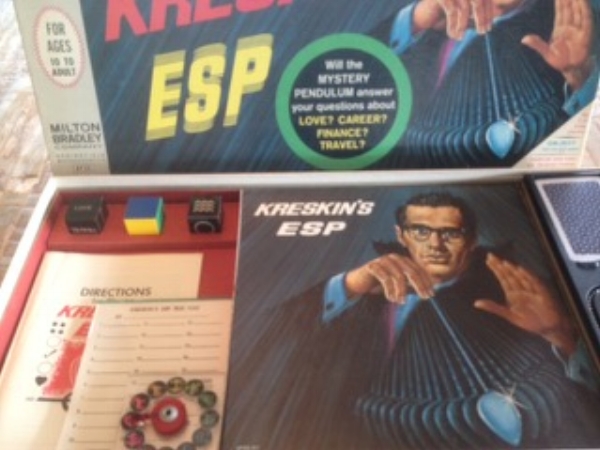
"Here’s a look inside the Kreskin game that I retrofitted with three Promystic MD cubes, a marked Royal ESP deck, and an old U.F. Grant Dial-X that is now a star sign guesser."
kreskin game_horizontal_medium.jpeg

If you have something similar to the Wonder Room concept, I'd be interested in seeing your pictures. To be clear, I have zero interest in seeing pictures of your magic collection. What I'm interested in are pictures of a display that is intended to lure in people and serve as a jumping off point for actually performing for people, as in the pics above and this post.


Magicians are Creeps: Part 755

image_01.png

... the fuck?

Look, I don't really have an issue with a squirting wand. Maybe there's some context where it could be funny. Really the question I have is... why did we have to bring "pee" into the equation? It couldn't have just been a squirting wand?

I'm guessing whoever put the ad together realized they'd sell more wands if they could get magicians to fantasize about giving the kids they perform for a golden shower. Sex sells, and these guys know their consumers. "A squirting wand? Hmm... no thanks. What's this? A pee wand? So it would be like I'm shooting my own salty lemonade all across those little kids' faces? Get out of my way, erection! I need to order this now!"

Andy, why must you always insist all magicians are perverted creeps?

I'm not saying that.

I'm saying all kid's magicians are.

What better gift for the kid's magician in your life than this? Not the gift of the wand itself, but the gift of plausible deniability. Now the next time they do that trick where you spoon a little kid so you can be their arms during the course of a magic trick...

hqdefault.jpg

...if the magician has an "accident" they can be like, "Gaahhhh!... oops... uhm... that was my squirting wand. I swear! Now go clean yourself up."

The ad says, "All the kids will want you to squirt them."

Suuuurrrrre... let me know how that victim blaming goes for you.

"But your honor, they were begging for it."

[Thanks to Ben Benjamins for sending the ad my way.]


IMG_4573.GIF

So You Want to Advertise on the Jerx

Well... you can't. I don't have advertising.

And if I did, you wouldn't pay the price it would cost to advertise here. (A couple years ago I had an advertising consultancy service determine what a fair price would be for a sponsored post written by me, given the readership figures and the level of engagement of readers on this site, and I just know it's more than people would be willing to pay.) 

But the good part about this site is that it has evolved to not need advertising to keep it going. The only advertiser is me. I write up my blog posts here, which sells the books and magazines, which then gives me the time to write more here, which keeps this site going. And so on.

It's the ciirrrrrrrrcle of liiiiiiffffeeee!

giphy.gif

Unsurprisingly, other people want in on the action, so I get a lot of people offering to send me stuff in exchange for me writing about it here. I understand the inclination. There is probably no more captive audience in magic than the people who read this site. But if I just started doing posts on the stuff that was sent to me, then that's all this site would become. And as nice as it is to receive a free ebook or get something in the mail, that would ultimately devalue this site to the readership if that's what I focused on. 

But, I'm the king of win-win situations, and I've come up with something that benefits people with a trick or book to sell and benefits the people who support this site. 

You can't advertise on this site, but you can advertise in X-Comm, the quarterly newsletter that supporters of this site will be receiving starting next month. And you can advertise in that for free. But your advertisement must take the form of something of value for the readers. What do I mean by that?

- If you're selling a book, then your "advertisement" might be in the form of an excerpt from the book. (And not the dumbest thing in your book either. It should be one of the best things in the book. Either way I'm going to say you consider it one of the best things in your book, so if it's a giant turd you're not going to help yourself.)

- If you're selling a trick, then your advertisement might be in the form of some sort of significant discount that is only available for Jerx supporters. 

Those are just a couple of examples. Essentially the deal is: I give you something free (an ad) in return for you giving something of value to this site's subscribers. I'm taking myself out of the equation, I'm just a middle-man between you and the Jerx supporters.

You can email me if you're interested. 

You might say, "But I want a post on the main site where it will get much more traffic." Yes, a post on the main site would reach significantly more people. And if you want to pay for that, that's fine. But what I'm offering is a way for you—with no upfront investment—to reach the non-freeloaders who keep this site running. That's a smaller group. But they're a group that has demonstrated they're willing to pay to support things that they like. These are the people you would be hoping to reach anyway. These are the Glengarry leads.

A Bad Marked Deck (and Why to Make One)

Following up on last week's post on the positive uses of exposure, here is a marked deck I made just for the purpose of exposing it. As I wrote in that post, if you "expose" a crappy marked deck to people, you are going to corrupt their understanding of what a marked deck is. They're going to assume it's something that requires a lot of scrutiny and not the sort of thing where cards can be coded in an easy way or in a way that is discernible from a distance.

Deception in the guise of openness is very powerful and disarming. And it's just fun to do. You come off as sort of a good guy, letting people in on some secrets. But what you're really doing is setting yourself up future success (and even setting up other magicians who may perform for these people in the future). As an amateur magician who performs for audiences consisting of the same people on a semi-regular basis, it makes sense to consider how things play out over the long term, rather than just fooling someone in the brief moment of a trick.

So let's say the subject of marked cards comes up. Occasionally a spectator will bring it up, even in a trick that would in no way benefit from the use of marked cards, just because they don't know enough about magic to bring up anything else. ("That red deck changed to a blue deck!... Does that used marked cards?") So the subject comes up, maybe you transition into it from talking about gambling, or maybe they mention it. Or perhaps you even ask for their help as you're trying to get better at identifying cards in this marked deck you just acquired.

When the topic comes up, I first start by feeding their head with a lot of untruths:

"Marked decks are kind of an urban legend. I mean, they exist, but they're hardly used by any magicians or gamblers."

"Think about it, the only area on the back of a card that is visible in many games is this top left corner of the back of the card."

"So while you can mark a card, you have such limited space to do it in. And you have to do it in a way that isn't obvious. Which means it has to be very small, so it's useless for magic because if they see you staring at the back of a card for any length of time, they'll know what's going on."

If someone talks about a marked deck they saw once where the value and suit were clear...

"Oh, yeah, they make those. But they're essentially gag gifts. You couldn't use them in a trick because anyone who wasn't braindead would spot them. And if you tried using them in a card game you'd get the shit kicked out of you."

"Do you want to see what a real marked deck looks like?" Which the always do. 

And then I present them with a bad marked deck.

Here's the five of hearts. Can you spot the markings?

IMG_5704.JPG

Don't bother.

Here is the marking system.

8006b.jpg

For Ace through 10, you will fill in the top half or the bottom half of those little triangles with a red marker. For J, Q, K you will blunt the ends of those little curl things.

For clubs, hearts, and spades you will block out the tips of the corresponding thingy at the top. For diamonds you'll leave it blank.

So the five of hearts will look like this...

IMG_5859.JPG

I've actually come up with much worse marked decks. Ones that required binary code and even smaller markings and things like that. But if the deck is too ridiculously marked, then it comes off as a joke. You need to come up with something that is next to useless, but not entirely so.

As it is, you might think this is a ridiculous concept to have such tiny markings and that no one would believe it, but I've found it seems to make more sense and is more interesting to people than the actual markings we often use, like the Boris Wild Marked Deck, or something like that. Of course we would want the markings to be almost invisible. For a layperson, that is the logical way for a deck to be marked, not in a way that just anyone can see what the card is.

If someone says, "How does anyone use these in a game?" You just suggest that it's the type of thing someone practices for hours a day for many years until they get to the point where they can read a card in just a few seconds. "Obviously you can't read every card in play from a significant distance. If you could do that, so could everyone else at the table. But if you can get a glimpse of a few cards coming off the deck, or in your opponent's hands, or what the next card on top of the deck is, that can be enough to give you a significant advantage."

Keep in mind, most people have seen ZERO marked decks in their life, they've just heard the term. So, going forward, their idea of what a marked deck is will be heavily influenced by this experience. Which means as long as you're not staring intently at the back of a card, they will generally assume marked cards aren't in play. This can be very helpful given that marked decks are one of the few magic secrets the general public has heard of. And the notion that maybe you created a bad version of a marked deck to taint their understanding of what they are and how they can be used is a level of deviousness I don't think most people will ever consider.

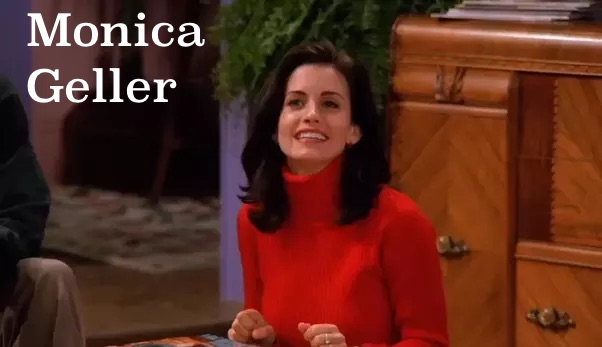
Monica Geller aka The One With the Bent Spoon

main-qimg-c5d54eded490766fd193e86fa130d074.jpg

Spoon bending isn't something I've ever done with much regularity. I have a friend who used to perform spoon bending rather frequently. Unfortunately, I corrupted his mind with some of the philosophy I've espoused here and he transitioned to a different style of performing that spoon bending didn't really fit into. It's very hard to fit spoon bending into the type of magic I write about on this site. What I mean by that is, while it usually gets a strong reaction, it's also the epitome of a useless, show-off-y skill. It's hard to make it about much else beyond the awesome power of your mind, which is a presentation that works okay on strangers, but not so much with your friends and family who know how dull your mind actually is.

The presentation that follows makes use of the idea of using exposure as presentation, meta-routining, Peek Backstage style, and confusing the nature of magic methods.


Monica Geller

At the start you mention that you're working on "that old fake psychic trick" of spoon bending. You ask if they'd mind helping you by giving you an outside perspective and you casually mention you'll teach them the basics of how to do it, if they're interested.

In your lap is a significantly bent spoon (your spectator doesn't know about this) and a normal spoon is on the table. Have your friend examine the spoon then take it back from him with your right hand. Draw attention to your left hand for some reason and extend it out to your friend. (Maybe say something about building up a callus on your hand when you first started to learn spoon bending by doing it from brute force.) As you lean in and show your hand, your right hand pulls back and off the table edge and switches its spoon for the bent one in your lap. (It's unlikely you'll get caught doing this because it shouldn't really feel like you've started yet. But it doesn't matter if you do get caught. This is all just part of the set-up. For now, let's assume you don't get caught.)

Hold the bent spoon (that the spectator thinks is still straight) in your right hand so the bend is hidden. Take the spoon between both hands, wait a moment and concentrate, and then show the spoon is bent.

"It's an old Uri Geller trick," you say. Pull out the normal spoon from your lap. "It's a switch. When you're looking at my left hand, I switch the spoon for one I bent at home with some pliers earlier. It requires strong misdirection or it's easy to get caught." (If you actually did get caught doing the switch, then you would just jump to this point in the presentation.) "That's just version 1 of the switch. The other versions are much harder, but also more deceptive. I'll show you. Here's version 4."

You put the bent spoon back in your lap, but as you do, you secretly unbend it. 

Now you take the normal spoon from the table and do any standard spoon bending sequence with it where it bends visibly.

Then you pull the straight spoon from your lap and set it on the table.

"And that would be the fourth version of the switch," you say.

Is this clear what we're going for here?

Step One: You show them a trick and then explain it for real. In so doing, you lead them to believe that spoon bending is done by switching a normal spoon for a bent spoon using misdirection.

Step Two: Now you show them a more "advanced version." Their mind is looking for a switch, but then you perform something that seemingly is not explained by such a switch. You're now fooling them on multiple levels. 

Step Three: So now they're thinking you did something completely different. They assume maybe they misunderstood, and maybe "version 4" is some other method altogether. And while they're coming to that conclusion, you're going to jerk their mind back the other way. They believe it wasn't a switch, but now you casually provide evidence that it was, by removing the now straight spoon from your lap. 

This is going to bring up some questions. How you handle those questions is up to you. Here is how I would deal with them.

Them: Wait... what? You didn't switch it.

Me: Sure I did. Remember, this spoon was straight?

Them: Yeah, I know. I mean, I saw it bend. 

Me: I don't understand. You saw it transition from the straight spoon to the bent spoon, right?

Them: Yes. That's what I mean. When did you switch it?

Me: Between when it was straight and when it bent.

Them: I didn't see the switch.

Me: Oh, well it's not like version 1, where you switch out the whole spoon on a macro level. It's... well, it's hard to explain. But it's a different sort of thing. 

Them: Show me.

Me: Well... I just did. You can't really slow it down. It doesn't work like that. If you want to learn it, I'll send you a book that explains the basics and once you've read that I'll help you learn it.

Then I'd send them a book on quantum physics.

Gardyloo #50

Some final thoughts, for now, on the subject of exposure.

First, let's talk about two groups of losers.

The first group: When the World's Greatest Magic specials were airing, and Mac King was teaching beginner's tricks on either side of the commercial breaks, there were some losers who would write in to the magic magazines (or maybe on some early magic forums) to express their displeasure that Mac had the temerity to teach Alan Thicke how to float a knife against the palm of his hand.

The second group: If you go on youtube and do a little bit of searching you can find losers artlessly exposing the methods behind most every trick you can think of. 

Question: Which of these groups of losers is bigger?

Answer: It's a trick question. They're the same group. Ideologically, at least. They're both of the opinion that the secret is the most valuable part of magic. One group believes they're so valuable that we can't ever let any secrets into the hands of the "layperson." And the other group believes they're so valuable that merely exposing them should be all that's needed to get people to give them some attention.

The truth is, more magic has been ruined by poor performers than by people exposing tricks. Probably 100 times more. But it's kind of easier to say, "Let's boycott the advertisers of the Masked Magician show!" than it is to say, "I should get a lot better at performing and entertaining people with magic."

If you combine the thoughts in Wednesday's post with this post on how to make your magic un-Google-able, and the ideas I've written up in the past weeks on "meta" presentations (which make the nature of the methods a bit more murky) as well as the concept of shifting the magic away from you and your abilities (which goes a long way towards defusing their inclination to "bust" you) then you will be so far ahead of the game to the point where exposure is not really a factor.

And finally, keep this in mind... If you're an amateur, you choose who you'll perform for. Freeze people out if they're just trying to make everything a puzzle to be solved. Cultivate an audience that is more interested in enjoying the experience than trying to search out how things are done on youtube. Exposure is much less of an issue if the people you invite into your performances are comfortable living with the fantasy. 


Screen Shot 2018-03-15 at 6.12.20 PM.png

There has been some questions as to how the Dead Rap device is hidden. I'll give you a clue. It's hidden in something that you would find in a "library". 

We thought that was great. Hiding the device in a book is ideal camouflage. Books are fairly innocent objects that would not look out of place in almost any performance environment.

So we ordered it and got the package a couple weeks later and were surprised by the size of the box.

We opened it up and that's when we realized...

It's hidden in a goddamn microfiche machine!

Screen Shot 2018-03-15 at 4.20.37 PM.png

(But seriously, though, if you want to let us know something is hidden in a book, just say it's hidden in a book. Saying, "It's hidden in something that you would find in a library," is moronic. You're not being circumspect. It's not like you're concealing what you're saying from any non-magician that might stumble upon that post. "Something you would find in a library? Hmmm...what could that possibly mean?... A librarian?!?! Did they make some poor librarian keister their knocking gimmick?")


I like these combination shadow/illustrations. I think there's probably a magic trick to be found in here as well.

Four Uses of Exposure

Exposure is not good or bad. Exposure is a knife.

"You take a knife, you use it to cut the bread, so you'll have strength to work; you use it to shave, so you'll look nice for your lover; on discovering her with another, you use it to cut out her lying heart." - Huddie Ledbetter

You can expose an effect and ruin the magical moment you've created. Or you can use exposure in an artful way to create a more powerful magic experience for people. 

I'm not defending people who just crudely expose tricks on youtube or in other forums. Nothing is gained by that. Wholesale exposure is not a good thing. But I do think you can let people in on some secrets in a way that makes them appreciate magic more and in a way that can lead to stronger magic moments. 

Using Exposure to Capture Their Attention

Secrets are not the most important thing in magic. Yes, they're required (generally) for a successful magic trick, but that's like saying the film projector is the most important part of movie-making because you can't show a movie without it. 

For a layperson though, secrets are the most immediately intriguing aspect of the art. Secrets are to laypeople what boobies are to a 13-year old boy. 

So being willing to talk about secrets is an easy way to get people engaged in something they might otherwise not be. And once you’ve lured them in with some mild “exposure,” you can transition on to more interesting and more rewarding magical experiences.

[It should go without saying that when I talk about exposure, I’m not talking about exposing double lifts or rough and smooth. I’m talking about letting them in on tricks that don’t have a method that has significant broader magical uses.]

Using Exposure to Lower Expectations

This is an idea that you’ll find explored in the magic literature, but I think it’s something that can be used more frequently. It’s the idea of exposing things but doing it poorly so people’s understanding of the concept or technique is diminished in some way. 

The classic example you’ll see is where the magician discusses palming cards and then does a really shitty palm with a stiff hand and part of the card peeking out. The hope here is that by “exposing” a bad palm then if someone sees your hand naturally curled with no part of a card poking out, they’ll assume you’re not palming a card (even if you are). 

You can do this with lots of things. Bad coin vanishes. Bad bottom deals. Bad deck switches. Bad misdirection. Bad anything. 

Now, of course, you don't want to introduce any new concepts to them. You don't want to be like, "Here's something called the gravity half pass," and then do it poorly. 

What we're actually doing here is using exposure to poison the knowledge that they already have. For example, most adults have heard of the concept of marked cards, but most have never seen a marked deck. If you “expose” a marked deck to someone, and it’s the kind of marked deck that you have to really study the back of the card and do a bunch of mental calculations to determine what the card is, then you’ve helped establish in their mind what a marked deck is. So if, at a later time, you use a different marked deck (one that allows you to know the card’s identity with just a glimpse, perhaps from a few feet away) and you somehow know what card they picked without studying the back of the card, they’ll assume it wasn’t a marked deck. 

In this way exposure can actually be used to make your magic stronger.

Using Exposure to Misdirect their Speculation

This is similar to the idea above, but here we’re going to expose a worse trick that’s similar in some way in order to get them thinking in a different direction on how a trick works and to emphasize the more impossible elements of the trick you don't expose.

I’ll give you an example.

About 6 years ago, Mickael Chatelain’s trick Ink came out. I bought it and performed it a number of times and always received a nice reaction. The version I performed was the one where you would draw one playing card on the outside of the box and it would visibly change to another playing card (the one the spectator picked). 

Then one day I preceded this trick by exposing another “moving ink” effect, one I thought wasn’t great. It's also by Chatelain and it's called Numberground.  It’s a trick where the 3 of diamonds drawn on the back of a card changes to the 5 of diamonds.

IMG_4563.GIF

In the ad for this trick it says: Show him what you drew, and then determine this does not even remotely look like the chosen card. "Not even remotely"? I mean, it looks identical other than a slightly tilted line. When they ask the question, "What would you do if you had real magic powers?" This is literally the last thing on that list.

When I'd perform Numberground alone, it would get a laugh because it seems more like a joke than magic. Obviously you have a special card where one piece moves. This is reinforced when you put it in your pocket and run away after you perform the trick. So this was a case where I thought the gimmick was much more interesting than the trick. And I would expose the gimmick and say it was the first trick I made when I was a kid or something. (It has that sort of look/feel to it.) I’d let them play with it a bit and then tell them I had been refining it for a few years now and I’d show them my newest version and I’d perform Ink for them. 

With the exposure of Numberground, I had conditioned them to expect a very simple animation of something that wasn’t really a drawn line of marker. But what they get is a much more intricate animation of something that can then be wiped off at the end, “proving” that what they saw was just a real time animation of dry erase marker. 

The reactions I got to Ink when prefaced with the exposure of the other trick were significantly stronger because I had set a baseline with that effect. Showing them how the first trick worked magnified the impossibility of the second. 

Using Exposure to Demystify and Remystify

I think needlessly exposing tricks comes across as sort of pathetic, even to the average layperson. 

But when discussing a method in the course of a genuine conversation it can be a very humanizing thing.  And this is helpful when transitioning into other effects, especially in a social magic setting. You're not some weirdo who thinks he's a wizard or a psychic. You're someone who's willing to talk about magic as they know it to be. That is, you're talking about tricks with concrete methods that someone with an interest in magic can learn. You're demystifying it. 

Now, in and of itself, that's not a particularly worthwhile goal. But I've found that by demystifying it you can get people to be less wary and more accepting of the magic. They let their guard down. So later when you remystify what you're showing them, it hits much harder because their defenses aren't up.

For example... If my first introduction to magic with people is me saying, "I have a bell that rings when a ghost is in the area," they're going to write that off as total nonsense and they may write me off as a corny dork. But if I introduce magic to people with an effect or two in the Peek Backstage style, and then maybe teach them a trick. And then I say, "It's a fun hobby. You meet a lot of... interesting people and see a lot of weird things. Especially when you get deep into it. You want to see something crazy I bought at this gathering of magicians I was at a few weeks ago? It's this bell...." And then I show them this bell I got that supposedly rings when this incantation is said and a spirit enters the room. Well, then I've caught them with their guard down. We were just talking about magic in a very sober, down-to-earth way and now the exact nature of this bell is much more questionable and the mystery much deeper. This is a technique I call demystifying and remystifying and it's very strong. Instead of introducing something weird up front, make people comfortable by letting them feel they have a grasp on what’s going on. 

In this instance, exposure is a helpful tool in creating a feeling of normality before ramping up to something truly weird.

But why can't we just keep the old rules? Never expose tricks.

It's important to recognize that this isn't 100 years ago, or even 20 years ago. If someone wants to know how a trick is done, they can figure it out in 2 minutes on a device that's in their pocket. It takes almost no effort. One of the ways to combat that is just to have more engrossing presentations that take the emphasis off of you and off of how the trick was done. You can defuse probably 70-80% of the "how'd you do that" response from people. But no matter how hard you try, you’re always going to have people who want to know more about the methods in magic. 

What I’ve found is that if I play the role of someone they can come to with this curiosity, then I can sort of guide their exposure to... well, exposure. And then I can use it to my own end—to make magic potentially even more powerful. I’m like the “cool parent.” “If you’re going to drink, I want you to do it in my house where I can keep watch.” “If you’re going to try to find out magic secrets, do it with me where I can keep an eye on you.” 

If you avoid the issue entirely, people will just search out methods online (if they’re inclined to). Whereas if you position yourself as someone willing to “expose” on some level, you can actually reshape their understanding of magic secrets, and present something much richer than what they can find on youtube. “Oh sure, you can learn some tricks online. But that’s just the sort of thing you would find in library books and on cereal boxes. The real stuff is only taught person to person after you’ve paid your dues. Fortunately, I’ve paid my dues, and I’m willing to show you some of the stranger stuff….” And you weave a tale from there, mixing fact and fiction, exposing and astounding along the way.

Coming In MFYL - In Search of the Castaways

Throughout the year I will be giving some small peeks into some of the effects that will be in the 2018 Jerx supporter bonus book, Magic For Young Lovers. 

In my trick, In Search of the Castaways, the Aces turn to Jacks and then find three selections.

No. I'm just shitting you. 

Here's the thing, it's hard for me to "tease" effects, because I want to create material where the most exciting part is the effect (not the method), so I want to save what the full effect is so you can enjoy the way it unfolds when your read it in full. I don't want to spoil the surprise. 

So I'll just be hinting at what the effects are in these preview posts.

In Search of the Castaways is one of my favorite new tricks. It's just a few months old. It's very much in line with a lot of the stuff I've been writing about recently about social magic and meta-effects. 

You tell your friend you want to show her this new trick you've been working on with a borrowed ring. You take her ring and vanish it. "Have I gone anywhere near that matchbox?" you ask. Smiling, you reach across the table and pick it up and shake it... but it makes no noise. "Aw, dammit," you say.

That's how the journey begins. What follows are two strong magical moments and a little mini-expedition as you demonstrate to your friend how you handle the situation when something vanishes but doesn't return.