Mailbag #13

giphy (2).gif

I've been thinking about your recent advice about context. I've always been the kind of social magician that waits for someone to ask me to do something rather than charging ahead; that's something I need to work on, and your ideas have helped. As much as I like it when someone seeks me out and brings someone for me to meet, they often say something like "can you show us a card trick?" So right off the bat the experience is capped as a "card trick" in their minds. Some older blog posts hint at ways to pivot from this starting point, but I'm wondering if you have any advice about this specific situation. —CC

This is obviously related very much to the subject of my last series of posts on transitioning. And my advice is going to be similar.

Here is what I would do:

Someone says, “Can you show us a card trick?”

Me: “Uhmmmm… yeah… I think.” I don’t want to say “yes” or we’re locked into a card trick. But I don’t want to be someone who says, “No” immediately either. So my attitude would suggest that yes, I’d like to show them a trick, but there is something preventing that.

“Actually, I have to be honest… I’m way out of practice. I haven’t really been doing any card tricks in a few weeks. Maybe another time?”

I want to push and pull a little here. I want to mess with their emotions a bit. It’s not quite an emotional rollercoaster. We’re talking about a magic trick, not waiting on the results of an AIDS test. It’s more of an emotional mechanical horsey.

giphy (3).gif

“Actually… you two would be perfect for this thing I’ve been working on. It’s not really a ‘magic trick’ in the sense you’re thinking. It’s a little weirder. Can we try it?”

That’s how I’d approach it.

  1. Tentatively agree

  2. Decline

  3. Transition to something else

If they come in asking for a card trick, they’re not expecting anything too weird. If you say you can’t give them a card trick but you can give them something sort of similar but a little stranger, then you’re telling them to set their expectations aside. I still probably wouldn’t go into something wayyyy out there. But you could definitely shift into something with a significantly different feel than “a card trick.”

You’re not giving them exactly what they asked for, but hopefully what you end up doing is as good or better. I think that would be a satisfying experience for them.

(Imagine your friend said, “Let’s drop by my friend Anna’s house. I want to say hi. Oh, and she makes amazing caramels.” You arrive at the house and your friend says, “Could we get some caramels?” Anna says, “Uhm… sure… actually… I think I’m all out. I haven’t really been doing the candy-making much recently. I’ve shifted to baking. I just made some cupcakes. Would you like one?” You’d have to be a real piece of shit to say, “But I asked for caramels!”)

After you’re done showing them whatever it is you want to show them, you can then say. “Next time we get together I promise to show you a card trick.”

This does two things:

First, it builds a little anticipation by planting a seed for “next time.”

Second, and very importantly in my opinion: It establishes a bifurcation of your interests between “magic tricks” and “some weirder sorts of things.” This means, in the future, you’re free to do any sort of thing you want. You can do sponge balls, or a gambling demonstration, or a “Traditional Apache Summoning of the Dead Ceremony.” If you have something really cool to show someone that feels like a trick, that’s fine. If you have something that is perhaps a little more intense and hits on a different level, that’s fine too. You’ve established an interest in both types of things so you’re not locked into any one thing.


I’m trying to reconcile a couple things. In your “Transitioning” series and elsewhere on your site, you’ve made the point that you want them to understand that the trick is fiction. But then in other posts you’ve talked about The Smear Technique where you try and make it unclear to them what is real and what isn’t. Doesn’t that technique undermine their understanding of the “reality” of the situation.—RA

It’s a good question. It’s somewhat confusing. Here are my goals.

- I want them to know the trick is a trick.

- I want them to ultimately understand that the context the trick is in is a fiction. But I’d like them to be open to getting immersed in the context and letting it feel real. And, ideally, the trick will be so strong they’ll have no easy answer other than the fantastical one I’ve given them.

- I want there to be elements of the experience that they will not know for sure if they’re part of the reality or the fiction.

That last point is where the techniques I’ve mentioned under the term “smearing” come in.

The next next book (i.e. the one after this coming next book) is likely going to be about this subject.


I’ve loved your posts on DFB. [Note: That’s the Digital Force Bag app] I was wondering if you switched to using ReaList and if you had any thoughts on that. If you’re not aware, it’s similar to DFB but has the advantage of the list being on the spectator’s phone. —SU

I haven’t purchased this yet, but I intend to.

I think I’ll still use DFB for the most part. For my purposes, ReaList would probably be a step backwards for a few reasons.

First—to be clear—the list isn’t exactly on the spectator’s phone. It’s on a website that the spectator visits on their phone. That’s quite different. Everyone knows websites can be changed and updated in real time.

The goal with most apps is to make the audience think technology is not involved. In my opinion, having them tap on the Notes app on your phone feels slightly more innocent than directing them to an unfamiliar website on their phone. Reasonable minds could disagree. So let’s call the Innocence Factor a draw

Here are the clear benefits of DFB for my purposes:

  • When performing magic in social situations I usually want to do things that feel personal and casual. For me, pulling up a list of local restaurants I want to try, or people I want to invite to a party, or gift ideas, or errands I need to run, or activities I want to do, or things I’m studying, or whatever, fits that personal/casual style better than, “Here’s a website with trending searches.” (Of course, if I performed professionally, then “personal and casual” would probably not be what I was going for.)

  • I don’t have to explain what a Notes app is or why we’re using it.

  • I can get in and out of DFB in less than 10 seconds, if I want. Which—depending on the routine—means the list itself can feel quite incidental to the effect (and in most of the “big” effects I do that use DFB, the focus is not on the list at all). With ReaList you need to get the spectator to go to a specific site and you need to explain the purpose of the site. This takes a bit more time and focus. So it’s going to be much harder to make the trick about something other than that list.

Those are the benefits for me of DFB.

On the other hand, I think ReaList is definitely a better way to do the worst possible tricks that people do with DFB, like a prediction of a celebrity. (And from the couple of times I’ve been on the DFB Facebook group it seems like that’s what the vast majority of DFB users want to do.) I don’t really have any desire to do that trick, but if I did, I would definitely use ReaList over DFB.

If we were smart, we wouldn’t even see these as competing apps. Does the audience see a list in a personal note as the same thing as a list of trending topics on a website? No. So it’s going to come down to what you’re forcing and why and then choosing the appropriate app. If I’m forcing a food, I’d rather choose something randomly from my “grocery list” than a list of the “top trending foods” or whatever. If I’m forcing a celebrity I’d rather force one from a list of trending actors than force one from a list of actors I keep in my personal notes app like a fucking psychopath.

Transitioning Part III

So, maybe every Friday you perform a card trick for some friends before your weekly poker game, or maybe you regularly show some co-workers a trick during lunch in the break room, or maybe you just perform a trick every now and then for your wife. Whatever your typical pattern is, you’ve decided you want to disrupt it in some way in order to transition into some different performance modalities. Here are some ways you might want to go about it that have worked for people I know. You probably won’t use them in isolation. These are elements that can be combined. I use these techniques as well, not for the purposes of transitioning into a new style of performance, but because I think it’s important for the amateur performer to mix things up with his usual audiences from time to time. (More on that in a future post.)

The Hard Reset

Just take a break from performing for people. This is the most blatant type of pattern interrupt because it is literally just an interruption. If they’re used to seeing you perform something once a week and you take a couple months off, then you’ll feel more freedom to come back with something different because rather than an abrupt change in performing styles, you get to establish a style from nothing as you reintroduce magic into your encounters.

Taking some time off has the additional benefit—as Erdnase tells us—that the spectator will regenerate their “magic hymen” and you get to pop their “astonishment cherry” all over again and fill them with your “wonder ejaculate.” Erdnase really had a way with metaphors.

Foreshadowing

You can ease people into a change in styles by leaving some evidence of an impeding shift in a place where they will see it.

Here’s the sort of thing I’ll do:

You and I are co-workers. Every week I show you a new card trick I’ve been working on. This is really straightforward card magic. Right out of Scarne on Card Tricks.

One day you stop by my cubicle and see a book called: Psychic Energy Manipulation. “What’s this?” you ask.

“Oh… nothing. It’s just…. I don’t know. I’m looking into it. I’ll let you know if it leads to anything.”

When a week passes and I come up to you and say, “Hey remember that book I was reading? Can we try something?” I can now transition into something very different from card tricks, but it doesn’t feel so abrupt because I introduced the potential change long before the actual performance.

The Declaration

At some point just announce that you’re going to be doing something different with your magic.

For example, if you’ve taken a break from performing, someone will say, “You haven’t shown us any tricks recently?”

“Oh, yeah. Well… I’m sort of re-learning a different style of magic. I’m not really concentrating on the sleight-of-hand stuff anymore. I’m learning some more esoteric stuff.”

Now you’ve perfectly set the stage for transitioning into a new style of performance in a way that won’t feel odd or out of the blue. In fact, they’ll be anticipating it.

An Example

Getting people open to a more immersive style of magic is just a matter of getting them accustomed to the idea that you’re going to be showing them magic in a less direct fashion. The relationship isn’t always going to be, “I’m the magician and I’m going to show you—the spectator—a magic trick.” They need to understand there’s going to be more to the “game” of the interaction.

Here’s a fun way that I would transition away from a traditional style with a context that is stupid yet gently immersive.

This would work well for me because I like saying dumb things seriously.

Let’s say I’m hanging out with some friends. They ask if I have any new tricks I’m working on.

“Magic tricks? No. That’s the old me. I’m not into that stuff any more. It’s just childish nonsense. It doesn’t help anyone. And it’s certainly not a viable business opportunity.”

I get up and walk over to the end table and remove something from the drawer. “I’ve got a new passion now. I guess you could say it’s still ‘magic’ related. But this is real magic. The magic of…,” I open my hand revealing a small vial, “essential oils.

My attitude is so completely humorless that I must be joking.

“Essential oils have been used for thousands of years to promote health and cure diseases and to help people in 100s of ways. I’m really just looking for some motivated people who want to join my team and make some money working from home in their spare time.

“Here, smell this. It’s bergamot and citrus. This is known to help with memory and focus. Let me show you how well it works. I just need something for you to focus on… hmmm…. I don’t really know… oh, a deck of cards. Perfect.”

And from there I’d go into a card trick but in the context of a demonstration of the memory benefits of this essential oil.

Obviously it would be clear what’s happening very early on (unless you’re the sort of person that would genuinely try and get your friends engulfed in a multi-level-marketing essential oil business) and they would get the “joke” of it. But that’s okay. What you want them to get used to is the idea of a trick being presented as something else. That the trick is going to exist within a broader fiction. And that you’re asking them to play along with it but you’re not asking them to believe it. They need to get that concept first before you move on. And doing your first few presentations of this style in a humorous manner will help make that point.

If you were a member of a remote tribe that had never interacted with the outside world for hundreds of years, I couldn’t sit you down at a movie theater and expect you to enjoy a film. You’d be wondering what was going on. Are those people on a stage? Are they gods? Is there really a battle going on or some monster coming towards us? Only after you understood that these were images projected on a screen and the people were acting out a story, could you learn to relax and allow yourself to get caught up in the experience.

It’s the same with this style of magic. You want them to fully understand the fictional element of the interaction. Once they do, you can approach it with a much more serious attitude and can create immersive presentations that aren’t just humorous. They can be scary, romantic, nostalgic, life-affirming, etc.

Transitioning Part II

This is now going to be a three part series with part three coming on Monday.

Before we get on to some practical suggestions in part three, I want to make two points in today’s post.

For the most part, this issue is in your head.

What I mean is, people will write me and say, “I really like your presentations, but I don’t know if it’s the sort of thing my friends would go for.” I usually reply, “Just try it. They’ll like it.” In every case I can think of they wrote back to say I was right.

If the people you perform for like you and seem to enjoy watching you perform card tricks in a somewhat traditional manner, they will almost certainly like something stranger, more fantastical, or more immersive. I said it early on: The world wants to be charmed. There are very few people who would think, “I’d prefer just to sit here quietly and watch you twist your aces.” No, people want to interact and want to get wrapped up in something. So your concern that they might not “accept” a change in style is mostly in your head.

Part of this is not in your head.

The part of the “transition” issue that’s not in your head is this… Immersive magic will usually require a greater investment of time or energy on the part of the spectator. This is something with which you need to start off gradually. Let’s be honest, the average amateur magic trick, done in a standard way, is probably not intensely rewarding for the spectator. But it doesn’t require much investment either. So that’s not a bad trade off for them. “I just have to stand here and sort of pay attention for a minute and I’ll see something mildly-cool? Okay, I’ll do that.”

So if you immediately jump to something like, “Hey, let’s take a four hour road trip, I have a trick I want to show you out at the national park.” They’re going to think “Huh? Four hours to see something mildly-cool? Yeah, no thanks.” Because that’s the reward they’re used to from seeing a trick. So you have to train them that reward will be equal to the investment.

So if they’re used to seeing tricks at the dinner table, you can make them invest just slightly more time/energy by coming to the backyard, or engaging in some “synchronization exercise.” You put a small impediment in their way (putting on a coat and going outside, or maybe feeling a little silly because of the synchronization exercise) but there is a payoff for them at the end. And the next time you can push things a little more and a little more. After a few situations like this, the spectator should have the feeling that they can trust you to make the experience worth their investment, regardless of what you ask (within reason).

Something to keep in mind is this: The moment of impossibility itself does not need to be significantly stronger with a 10 minute trick than it does with a 1 minute trick. If the 10 minutes are cohesive and interesting, then the effect can be the same, but the 10 minute trick will seem stronger.

I’m not suggesting you always make your tricks longer for no reason, but if you have a more in-depth presentation that warrants it then you shouldn’t be afraid to attempt it. The good thing about longer presentations is—as long as they’re not boring—they have a tendency to create their own momentum and boost the impact of the effect.

I wrote before about about a friend of mine who did a floating ring trick at a decommissioned nuclear power plant. He took an hour-long journey with people to do a trick that lasted a few seconds and he could have done it just as easily in the bar they were in originally. But the journey—the investment—was what made the trick more powerful. The audience has invested more and they want to perceive the outcome as more rewarding. It’s like that economic theory where if you give people a cookie, they may rate it as a 6 on a scale of 1 to 10. But you can take the same cookie and tell people it’s only made once a year by an award winning chef and charge $40 a piece for the cookies and now people rate them at a 9 or 10. (I’m making up the example, but you know what I’m talking about.)

With magic we can take advantage of a similar process but without actually taking anyone’s money, just by having them invest more time or energy into the performance.

But if you’ve established a pattern of performing quick tricks to the audience, and not asking them for much, as you might need to in an immersive presentation, then you will need to transition the spectators to that new style.

On Monday, in Part 3, I’ll give some concrete techniques I’ve seen others successfully use to transition to a non-traditional style. And I’ll tell you the dumb way I would probably go about it now if I was facing the issue.

Transitioning Part I

One issue that pops up in my email with some frequency is people wanting to adopt more offbeat presentations but not knowing how to transition into them with the people for whom they’ve been performing for some time.

This is understandable. If you’ve been performing card tricks, for example, in a fairly standard way for years for friends and family—to try and jump into a less-traditional performance style will feel awkward for both of you. If the people you regularly perform for are used to you showing them ace assemblies and things like that, it will be weird to one day say, “I was reading today about something called Color-Induced Amnesia. Apparently showing people a certain sequence of light at different wavelengths can affect memory,” and transitioning from there into a trick.

If you jump straight into that, you’re going to get one of three reactions:

  1. There is a small chance that they’ll believe what you’re saying the whole time. That may be what you want, but that’s not what I want. Belief is the opposite of magic.

  2. There’s a good chance they’ll believe what you’re saying initially and then they’ll be confused when it’s clear you’re going into a magic trick. Your tricks in the past have been more clearly delineated, so blurring the lines is going to seem strange. They’ll wonder what your motivation is. Are they supposed to know it’s a trick? Are you trying to fool them into believing this thing is real? What exactly is your end game?

  3. There’s also a good chance they’ll realize it’s a trick from the start, but they’re so used to magic’s typical frivolous “patter”-based presentations that they won’t engage with the trick in a meaningful way. Historically, magic presentations are intended to be disregarded. When you say, “The Ace of Spades is the leader of all the aces,” you expect them to brush that off. You don’t expect them to say, “Really? How were the dynamics of this relationship established amongst the aces? Was there a power struggle or did he just naturally emerge as the leader?“ We’ve trained our audiences to ignore our patter. If not to ignore it, then at least to dismiss it.

So if people are used to the rhythms of a traditional magic performance, when faced with an immersive style of presentation they may:

  • Believe it

  • Fight it

  • Ignore it.

None of those will lead to a particularly positive experience.

Instead, what I want when I offer an immersive presentation to someone, is for them to:

  • Disbelieve it

  • Accept it

  • Embrace it

Disbelieve it - I want them to know it’s a trick. And equally important, I want them to understand that I’m not trying to convince them that it’s anything other than a trick.

Accept it - I don’t mind an audience that looks at the trick itself with a critical eye, but I want them to realize there’s nothing to be gained by not accepting the context/the fiction/the game of the trick. What I mean is, if I say it’s an old gypsy ritual, they don’t gain anything by saying, “No it’s not. I bet it’s just a card trick.” I can usually get people on board because the story I’m presenting isn’t, “I’m powerful,” or “I have incredible skills.” It’s a lot easier for audiences to accept the “story” of a trick if that story is something other than, “Ain’t I incredible?”

Embrace it - I want them to realize that the more they allow themselves to get caught up in the trick, the more fun it will be for them. This attitude can really only develop after they’ve experienced this style of magic a couple times.

I’ve discussed my process on easing people into this style of performing before. But that post is about how I do it with people I’ve just met.

I think it’s much more challenging if your audience is already locked into their expectations for what a magic trick experience with you will be.

I said at the beginning of this post that this is an issue that has come up pretty frequently in emails. That’s true, and I’ve been slow to address it on the site because I wasn’t sure I had any good insight into it. But I’ve given it a lot of thought and worked with some other people on it and I think I have some decent ideas on how to address it.

You see, it wasn’t a problem I personally had because my own evolution was so slow on this that I sort of dragged my audience along with me. I performed magic in a fairly typical manner. Then I pushed things a little bit presentationally, and then a little more, then a little more. And over the course of years I got to a much different style of performance, but my friends never witnessed a particularly dramatic shift because I was sort of slowly clearing the path myself as I went.

If you feel locked into a traditional performing style with your friends/family, it’s because you’ve established a pattern with your performances in the past and now you need to break that pattern in order to reset their expectations.

In Part II (which will come out Friday or next week), I’ll talk about some ways to do that.

Ambitious Ghost Finale

In last Monday’s post I mentioned a presentation for ambitious card that involved the spectator drawing a ghost on a card and then that card “passing thru” the other cards like a ghost.

I mentioned it in the framework of presentation vs. context. It may seem like I was dismissing the idea, but I wasn’t. It’s just not the style of material I’m performing much these days. But it is a trick/presentation I’ve done in the past. It can be very fun/funny (if you’re a fun/funny person). And if I was performing currently in a restaurant or something along those lines, I could see myself doing the presentation again. (In a professional performing situation, your context is already established. You’re the guy who performs magic in a restaurant (or whatever). To layer another context on top of that would be confusing. So in a professional situation you would want to focus on presentation, not context.)

Here is the way I end the trick.

They’ve drawn a ghost on the face of a card and it has risen up through the deck a few (39 or so) times.

I then pause and look at their ghost drawing.

“This is really terrifying imagery.”

IMG_6310.JPG

“I’m curious. Is this the ghost of a male or a female?… A female? Hmm. Was she a child? An adult? Or an old woman when she died?… Oh… just a child? That’s so sad. How did she die?… Oh, she ate some of that sushi that’s made with the puffer fish and if you eat too much it’s poisonous? That’s terrible.”

I just go along with whatever they say here.

“What was her name? … Penny? Okay. Write her name on the back of the card. I think we can help Penny out.

“They say that ghosts get trapped in this world and can’t move on because they have ‘unfinished business.’ What was Penny’s unfinished business?… Oh, she wanted to kill the chef who gave her too much of the fish? That makes sense. She was just a little kid. She probably wanted a fish stick, not poisonous puffer fish sushi.”

I pause here and then do something to “finish” the ghosts unfinished business. In this case I could make a solemn vow to the ghost that I’d kill the chef or I could draw a chef’s hat on a Jack and then tear up the card, or I could make a phone call and put a hit on the chef. Whatever. It would all depend on what the ghost’s unfinished business is. You just want to do something to “finish” that business quickly so you can move on.

“Penny, you’re free! The chef is dead. You don’t have to be a ghost anymore.”

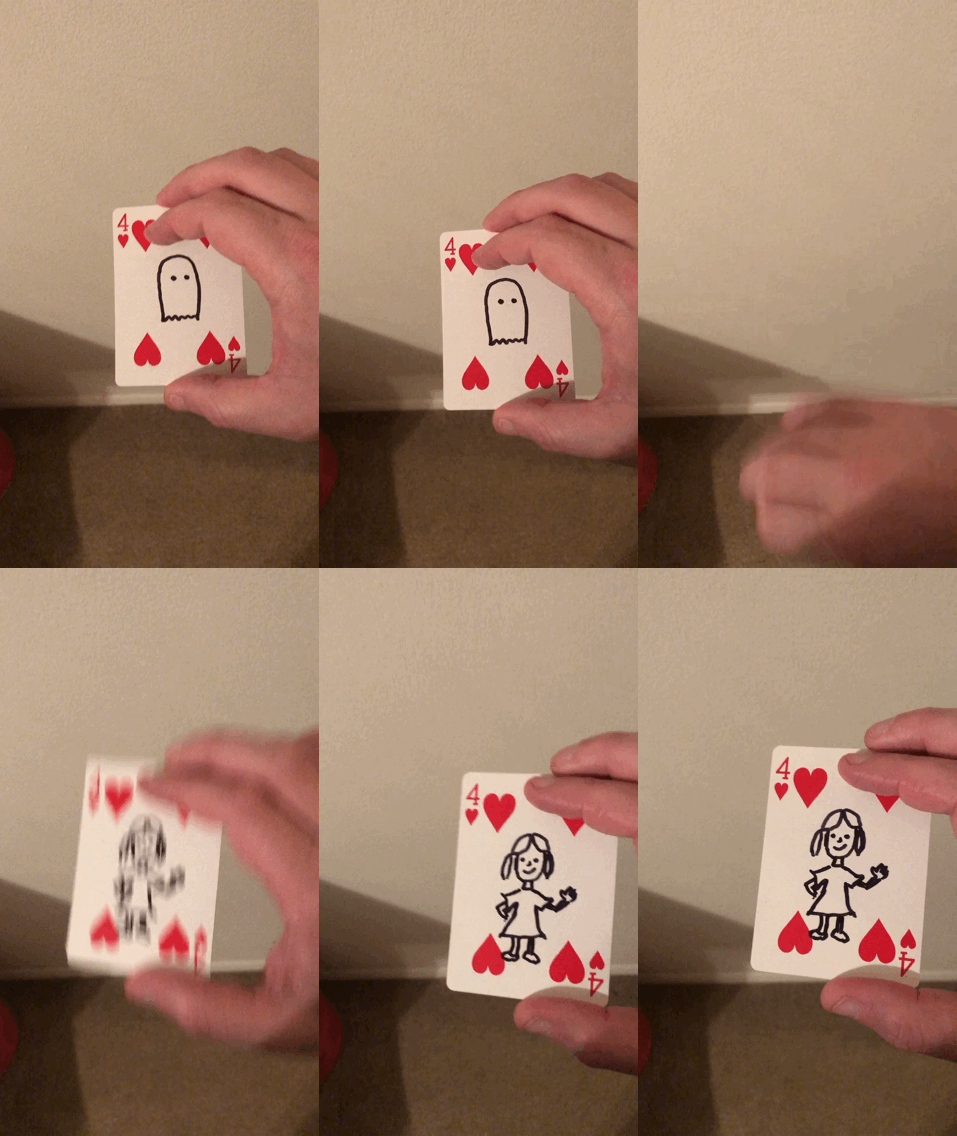
I take the spectator’s ghost card, wave it, and it the image transforms into a little girl.

IMG_6317.GIF

I take the card and toss it in the air. “Ascend, sweet princess!” I continue to look up and off into the distance as the card flips and flops to the ground a few feet away.

When the spectator retrieves the card they can verify it’s their selected card with their signature on the back.

Method

You will force a card with a lot of white space on it for the purposes of having a place to draw. Let’s say the 4 of Hearts.

You have a stack of six cards on the bottom of the deck, with one indifferent card covering them (so your stack is cards 2-7 from the face of the deck). This stack consists of 6 duplicates of your force card each with one of these images on the face :

  • Old man

  • Adult male

  • Young boy

  • Old woman

  • Adult female

  • Young girl

(Buy a one-way forcing deck for all your duplicate needs.)

You put them in the deck in an order you know. I would stack them young to old female, followed by young to old male, because that makes the most sense to me, but it doesn’t really matter as long as you know where the cards are.

You go through your normal ambitious routine with this stack of cards in position. They shouldn’t get in the way of anything.

You have the deck in your hands and the ghost card on the table at the end of the ambitious portion. Ask some questions about the ghost to elicit the sex and general age-range. As you further discuss this with the spectator, you’ll cull out the appropriate card with that image on it to the bottom of the deck.

Place the Ghost Card on the bottom of the deck and turn everything over. Ask about the ghosts name and double turn-over the two cards and have your spectator write the name. They’re writing on the back of the human drawing, they assume they’re writing on the back of the ghost card.

You need to get those two cards back-to-back in preparation for the Twirl Change (or whatever you call it). You can figure out some way to do it. Here’s how I usually did it. They just wrote the name on the back of the face-down double on the face-up deck. I would rub the ink a little as if to test if it was dry. In this process I’d get a little finger break under the two cards and pinch those two cards between my right fingers. I’d necktie the deck towards me and bring the cards up to my face pulling out just the bottom card (the ghost card) of the double that was pinched between my fingers. And I’d blow on the back of that card. There’s not actually anything on the back of that card, but from the spectator’s perspective, they drew on the back of the ghost card and now they see you blowing on the back of the ghost card. So it all makes sense..

I’d lower both hands as I replaced the face-up ghost card on the face down human card. Pause. Gesture or say something. Pick up the double in Twirl Change position. Turn over the deck in my left hand so it’s face down. Do the Twirl Change. Place the double back on the face-down deck. Say something. Then remove the single human card from the top and toss it into the air.

I’m not a huge fan of writing up the “do this, do that” part of magic, but I’m sure most of you have some idea of this choreography. If not, read it a few times with the cards in hand and you’ll figure it out.

When I do the Twirl Change, I hold the card from top and bottom, not the corners, so there isn’t an orientation discrepancy. But I’m sure no one cares. You can, of course, use any other color change that works there.

The presentation is meant to be goofy, but the trick itself can still be very fooling, especially if you have a solid force of the card initially. The ambitious sequence should be strong, and then you have their drawn ghost, transforming into the freely named age and sex person on their signed card. With a decent color change, there are a lot of layers going on to make it a deceptive trick. And you end clean.

End clean? Aren’t there 6 duplicates still in the deck?

No. When I toss the card at the end and I’m like, “Fly away, sweet angel!” The spectator always wants to see the card so when they go to get it. I just take a small chunk of cards from the bottom and slide the one off the top and put them all in my pocket and set the rest of the deck on the table.

Harvest Time Part Three: Short and Stupid(er)

https___cdn.cnn.com_cnnnext_dam_assets_160917140428-harvest-moon-2016-irpt.jpeg

Guys, it's Friday the 13th and the full harvest moon. That's definitely an ideal way to shift into autumn, my favorite season. And, as science has well established, when these two things happen on the same day, there is a greater likelihood of certain strange phenomena (or so you should tell people later tonight).

If you've been around for a while, you know that the harvest moon (the full moon closest to the Autumnal equinox) is a time I take to assess this site and its future and that sort of thing. It's a time for a "state of the site" sort of post, primarily aimed at the supporters who keep this site going.

Next year will bring some changes to the site and I want to talk about the factors that have affected my thinking on the direction things will go.

✿✿✿

The first thing to understand is my motivation for writing this site. Obviously it's not to be well known, or I wouldn't write it anonymously. And while I do want to be compensated for the time I invest into the site, I wouldn't say my primary motivation is money. I could make much more devoting this time to other types of work. And if money was my objective, I wouldn't have put a cap on the supporter slots. I would advertise. I would ask people to mention the site on message boards and facebook. I don’t do any of that. The next book sold out 11 months in advance of its release without me advertising it or a single tweet about it. I barely mentioned it on this site. If I prioritized money, I would be doing things much differently.

So people think, "Ah, he's not in it for fame. And not for money. I know! He must be in it... for the love of the art!"

Yeahhhhh… not really.

The reason this site exists is:

A) I like performing magic for my friends and family.

B) I like sharing the ideas with likeminded people. And if their appetite for these ideas is enough to buy my time to work on the ideas, then I'm happy to do so. Creative work and writing work is what I do in a non-magic capacity as well. So it's all the same sort of thing to me.

The key word there is "likeminded" people. I'm not trying to win people over to my perspective or style of performance. I'm just trying to present those ideas for people who might be on a similar wavelength.

✿✿✿

Why don’t I want to win people over to this style of magic?

Imagine it's the early 2000s. You're a decent looking guy and, more importantly, you have a good rapport with women. You're easy to talk to. Your posture demonstrates confidence. When you meet a woman in a bar, you have no problem going up to her and introducing yourself. You have a very playful interaction with her. You're able to tease her in a way that feels fun. And communicate with her in a way that is flirty but not creepy. You're doing really well on the dating scene. You're a natural with women.

Flash forward just a few years later. You suddenly find women are turned off by some of the same attitudes and actions that have worked for you for years. And have, in fact, worked for guys for decades or centuries.

What happened?

What happened was the emergence and mainstream-ization of the Pick Up Artist movement.

Guys who were terrible with women looked at what guys who were good with women did, and then they started co-opting those traits. And for a little while it worked for some of them. But eventually it stopped working. Women realized guys where pretending to be confident and comfortable. These verbal or physical traits that many women had been attracted to on an instinctual level were now being done by guys who didn't come to these behaviors naturally. So the behavior was incongruous with their "real" personality. Something was off. And one thing humans (and I would guess especially women) are sensitive to is incongruity.

"Playful teasing" had originally come across as a demonstration of friendliness and non-neediness in the guy to whom it came natural. But for the guy who was using it as a "technique," he would often botch it and it would come across as obviously pre-planned or even cruel.

Naturally confident people tend to sit and stand in a way that takes up a little more space. Noting this, people who aren't naturally confident would try and mimic it and end up with their legs at a 140 degree angle and their arms sprawled across the bar.

So these traits that were once perhaps subconsciously positive symbols began to be associated with weirdos. And those weirdos didn't just spoil it for themselves, they spoiled it for the normal guy who acted that way naturally.

✿✿✿

This is why I never want to push this style of magic on other performers. I know how powerful it can be when amateur magic is presented in a more casual and less performative way, but if it doesn’t feel natural to you, I would never suggest you adopt that style. You’ll just fuck it up for yourself and, potentially, others. If you’re more comfortable with a traditional magician/spectator dynamic, that’s what you should stick with.

I like that when I perform for people it's different than the type of magic they're accustomed to seeing. I have no desire for this style of magic to be the norm. I'm sure you're thinking, "Don't worry, Andy. You're not that influential." This is what I tell myself too, but I still feel uncomfortable when I see a demo video or something like that from someone who has clearly been influenced by the stuff I write, but the casual/social style doesn’t mesh with their natural personality. I don’t want the social/casual style to get overexposed by bad magicians. I don't want them Pick-Up-Artist'ing this shit.

✿✿✿

That’s why, as the primary voice on this style of magic, I will be pulling back on the public availability of some of my ideas in this realm of performing.

This should sound familiar because it’s something I said would happen a while ago. Going into this year, I said that I would take anything of value and save it for the publications for supporters. But I didn't really end up doing that as I intended. I did save the best tricks for them, but I still published a lot of theory stuff that I know to be extremely valuable.

So here is my plan for next year.

  • As I intended to do this year, the site will be the home for content which is either stupid or short.

  • The newsletter is going to be expanded either in page count or in the frequency of release. And much of the type of material that would appear on the site this year will be in the newsletter next year. (The newsletter will be included in the reward package for full supporters, but will also be available separately for people who couldn't get a full supporter slot for a nominal cost.)

Why do I think this is a good idea?

Because I think putting a few barriers to entry to the information will increase its value for supporters.

And I mean this in a couple ways.

First, the information is slightly more exclusive, hence more valuable.

Second, while it shouldn’t matter, I think seeing the material in different contexts affects how we view it and assess it.

When you know the site is intended for small or stupid ideas, then you’ll approach the material in that mindset. That’s the sort of stuff you can absorb every day.

When you know the newsletter contains stuff I thought was particularly worthwhile, then you can set aside some time when you're in the mood to sit with that type of material and give it whatever consideration you feel it warrants.

Then, the stuff that gets published in the books is the stuff that has proven to be incredibly strong for me over and over in actual practice. So it's not just a potentially strong concept, but whatever the amateur version of a "worker" is.

One of the weirder things that happened repeatedly after the two big books were released is that people would write me praising some routine from the book that had been on the blog for months or years. And I’d hear something like, “The trick didn’t really resonate with me until I saw it in the context of the book.” I kind of wondered how someone could like a trick so much in a book that they’d write the author about it, but when it was posted for free they kind of glossed over it.

Part of it is probably “perceived value.” I know if I see a trick for free on a blog then I'm probably not going to consider it the same way I would if It was a limited edition manuscript for $50 or a video download. It's just not the way we're wired.

But another part of it is probably this… I did a survey a month or so ago asking people how frequently they stop by the site. 80% of the responses were either “every day” or “a few times a week (the days the site is updated).” And if your routine is to come here when the site is updated then there are times you’re coming here and getting an in depth discussion about presentation or theory when that’s just not what you’re in the frame of mind for. And you might overlook something that, on another day, you might have really connected with. Maybe you remember to come back to it at some point, or maybe it gets lost in the shuffle.

But with the newsletter or the book, you’re only going to crack that open when you’re in the mood for that sort of thing. So by channeling different types of material into different outputs, I’m better able to match the content to your state-of-mind—giving you a better experience of the same material.

Some will say I’m “overthinking” this. I’m not. Trust me. I consulted the world’s best and most successful magic blogger and he agrees with me completely, 100%. On everything. (He’s me.)

The previous “Harvest Time” posts have been about prioritizing the experience and exclusivity for supporters. Which only makes sense, because those are the people prioritizing me by supporting the site. And this post is just confirming that’s going to continue to be the direction in which things move. The site will continue on, just becoming a bit more frivolous. And hopefully supporters will find the content that comes in newsletters and books to be as worthwhile as ever, if not more so.

I will keep along this path until one day I just have one “master supporter” who will have sole exclusivity to any tricks/presentation/theory I generate, which I will gently whisper into his ear every night as he drifts off to sleep. And thejerx.com will just consist of a serially released 600-chapter erotic fan-fiction novel about the L&L audience.

Mailbag #12

giphy.gif

Lately I've been trying to rework my presentation for the tricks I perform to make them more interesting and unique. The other day, I came up with a sort of half-baked presentation for Out of This World […]

So, you start by asking your spectator for if they know what a marked deck is. If they don't you give a brief explanation of how some decks have small markings on the back that are barely perceivable. Then you go into how you always hated using them because the marks would always be in code and were usually too small to read effectively. So, you decided to develop your own subliminal marking system that anyone could read quickly with almost no effort. You explain that you've started to create it but right now the marks only work for color and not value or suit. You then ask if they'll test it to see if it's easy for them to use. Then you tell them to deal it into two piles without looking for anything specific on the backs and to just go with whatever comes to mind first.

Anyway, what do you think? Is it too convoluted? I feel like there's something there but maybe I'm over-complicating the effect. I have this bad habit of making my patter more cerebral than it needs to be. I'd love to hear any tips you may have to develop or rework this idea. —AO

I don’t think it’s too convoluted. I believe I’ve seen other presentations along these lines, so presumably it has worked for others. I haven’t tried it myself so I don’t know how it comes across.

I’d probably want to squeeze an extra moment out of it, so here is how I’d probably perform it. I’d bring out the deck of cards and ask for their help with something and tell them to deal the deck in two piles of about the same size.

Then, after they’ve dealt, is when I’d introduce the subject of marked cards.

“I’ll tell you why I asked you to do that. You’ve heard of marked cards, yes? Well, I’ve been experimenting with a different style of marked cards. Instead of having markings on the back to give me information about what’s on the front. They have markings on the back that guide other people to do what I want them to do.

“So, for example, if we were playing poker and I wanted you to fold, because I didn’t think I had your hand beat. Then I could draw your attention to the back of a card that had the word Fold embedded on the back. You’d sense the word, and you would feel like it was your idea to fold.

“The markings themselves are interesting. They’re done with an ink that is not in the spectrum that the eye can see, but it’s still something the brain can register in the subconscious. But only if you don’t know the markings are there. You actually have to not know they’re there to absorb the hidden messages. If you actively look for them, that engages another part of your brain which effectively blocks out the signal from the hidden message. It’s crazy.

“So here’s the cool part. We shuffled the cards and you dealt them in two piles. These cards are marked on the back using this special ink with the words Left and Right. If this worked, you should have dealt all the Left cards here and all the Right cards here, to the right. Now, if I just claimed you actually did it, you’d probably never believe me. But I can prove it because I wrote Left on the black cards and Right on the red cards.”

During this bit I would start revealing the cards and doing the necessary adjustment to make the display work out right. Since the focus is on the back of the cards initially, I may be able to get everything in the right position before the reveal starts.

Here is the “extra moment” I said I’d add. And the reason I’d add it is because the presentation is bordering on too believable to me. Even though it’s pretty unbelievable. I want to make it more so.

After showing that they did in fact deal the Left/Right cards correctly, I’d pull out a black light to show them the markings on the back of the cards, but there wouldn’t be any. Then I’d notice, on a table off to the side, another similar deck. “Oh wait, this must be the marked one,” I’d say and grab it, shine the light on it, and show them the Left/Right markings. Then I’d let it hit me that there is now no explanation for how they separated the other deck.

That is, of course, even more convoluted than your original idea. But I think it could still be a coherent trick and leave them with a nice, unexplained mystery.


I received a couple emails about a subject I didn’t think I had much to say about: close-up pads.

How do you feel about carrying close up pads around? I almost never do because they seem inorganic/eager, and also arouse some suspicion. But, obviously handy for certain tricks.

Was wondering if you had any ways to introduce them in a not-so-cheesy way. —AG

I don’t do too many tricks that require a close-up pad. If I need that type of surface, I will do the trick while sitting on the couch with someone and using the cushion between us, or while sitting on a carpeted floor. Occasionally I’ll use a table with a table cloth. But I’m more of an Arby’s guy than a fancy table-clothed place guy, so that’s not too often.

As far as a non-cheesy way to introduce them, I don’t really have one. My friend gave me a nice small close-up pad from Dan and Dave. It’s the type of thing I probably never would have bought myself, but I do use it sometimes while practicing something when I’m out and about. And I think it actually does draw some attention in a way that just a deck of cards sitting on a table by itself would not. And it makes people more inclined to ask, “What are you doing there?” or “What are the cards for?” So it can be useful to sort of pique someone’s interest and then transition into a trick.

About three weeks ago I performed Tiki and Ronde for my girlfriend […] but I changed one thing that I normally do when I’m performing card tricks. I ditched the close up pad. Now I know that might seem like an obvious thing to you, but it wasn’t to me and I feel it made a big difference to the effect. […] I think I’ve been conditioning my normal spectators (friends, family, people at the bar) with the close up pad. It’s magic time now. Maybe I’ve conditioned myself with it. I think I have even read somewhere that the close up pad is your stage for close up magic. Which is fine I guess for professional performances, but doesn’t help when you’re trying to immerse people into a magical fiction. So ditching the pad worked for me. I hope this tip will help others who are trying to transition to more immersive audience centric magic. My girlfriend really liked the effect. She said this was some spooky X-Files level shit and I couldn’t have asked for a better reaction.—NT

This is an interesting idea. We assume a close-up pad is just an item we use when we need to secretly pick up our coins for a Matrix routine. But this email sort of demonstrates a way that it can used to adjust people’s expectations.

If people are used to seeing you perform at a table with a close-up pad with your special coin-purse and your aged half-dollars, they are used to seeing you doing magic as a “performance.” And that’s great if that’s what you’re going for. But this also means it’s going to be extra interesting and feel very spontaneous when you show them something on the trunk of your car using a borrowed cigarette. So you should take advantage of that opportunity from time to time.

I have sort of the opposite situation going on. I try to present my tricks so they don’t feel like formal performances. But what that means is that I can occasionally pull out a close-up pad and coins or cups and balls, and that can feel special to people. I would still try to come up with a context that made sense. I’d frame it as me practicing my “audition piece” to get into some secret magic club or something.


Just a heads-up… I’ve been getting a number of emails where people will send me a link to a trick and then ask, “Do you have any good way to present this?” I have no problem getting those emails. I’m glad there is a subset of people who like the style of performance I talk about here. But just know that more often than not I’ll probably have no good ideas. If I think a trick looks interesting, I generally buy it myself. And if I stumble upon a good presentational angle, then I write that up and put it in the newsletter. So if you’re approaching me with a trick out of the blue it’s probably going to be something I didn’t think looked interesting enough to buy in the first place or that I had no particular insights on once I got it.

So it’s not that I’m ignoring your question, it just means I’m as lost as you are about a way to make it good.