Monday Mailbag #35

giphy.gif

Two of your dealbreakers were a) tricks involving faro shuffles and b) timing forces.

Basically you were saying that once you knew an effect involved either of those, you eliminated it from consideration.

But I think it's a bad idea to eliminate consideration of a trick just because you don't yet have the skill yet to do the sleights well. Which is essentially what you are saying. Because there are many magicians who can perform both sleights with no suspicion. Yes, of course it takes a lot of practice to get it right. *But more practice should not be a reason to eliminate consideration of a trick*

Look, remember when you first started out in card magic and palming and a good strike double lift seemed unattainable? So quite naturally when a person starts out s/he keeps away from effects with such sleights because the magician doesn't want to screw up.

But why then do people eventually learn those skills? Because they make the calculation that on balance there are certain effects strong enough that it would be worth it to put in the time and practice to learn the skills properly to do the effect. But if such effects were immediately eliminated from consideration, that impetus to learn something new would be squelched. And that's what you are doing to yourself now. You've already said there are some great faro tricks out there. The problem now is to get your faro decent enough to do them so that they overcome your objections. I'm not saying you *have to*, just you might want to, just like attaining anything else hard, like a second or bottom deal. Probably the best motivation for learning a sleight is because there is a freakin cool trick that you can't do because you can't do the sleight yet.

And as a bonus, some sleights/techniques are much easier than one first imagines them to be--like a a timing force and a classic force. It's mainly about confidence and doing it enough times to see how it works in the real world with people. A good technique to practice such things with people is to have an out prepared. There are lots of outs for timing forces--see Dani DaOrtiz's stuff for example. —JS

I was probably unclear about my reasons for making these particular techniques dealbreakers. It’s not because I can’t do them, it’s because I don’t want to do them.

In regards to the faro shuffle, I have never seen a non-magician shuffle cards in this way. And my personal priority is to keep my card handling as close to a non-magician’s as possible, with the exception of situations where I want to draw attention to what I’m doing. So, using the faro shuffle for Paul Gertner’s Unshuffled would be less of an issue for me, because he’s suggesting that what he’s doing isn’t your normal shuffle. But, for me, it just doesn’t work for other routines where you’re supposedly mixing the cards guilelessly. It doesn’t mesh with my standards for what looks innocent.

But I realize a lot of people don’t share this concern/objection, however, and I don’t really expect them to. I’m the guy who spent years recording people turning over the top card of a deck so I could make my double lift as psychologically innocent as possible. So I’m a little extreme about these things.

And sadly, there is no level of skill involved that could overcome that objection. To say that you can get good enough to execute a faro shuffle so that it elicits “no suspicion” is just not accurate. Do you remember the first time you saw a faro shuffle? Did you think it was perfectly normal? Maybe you did, but I didn’t. So I suspect a certain percentage of non-magicians might feel the same way.

As far as timing forces go, I just feel I have other forces that are less restrictive and feel more fair. I also think it’s a force that works better in more formal work, or at least with a larger group of people. When you’re sitting one-on-one with people, they’re not reluctant at all about dealing through half the deck or more. They’re in no hurry.

I’ve had people say, “Yes, but what about Dani DaOrtiz? His style couldn’t be more casual. And he does a ton of timing stuff. So obviously it works in those situations.”

Really? I find Dani’s style to be loose, free-flowing, and fun. But not casual. Maybe it’s theatrically casual, but not normal-human casual.

At 4:15 in this video you can watch how he handles a timing force failure. Ultimately he does get to the card he wants. And it works for him because of his personality and he plays the, “I don’t speak English too well,” card. But without Dani’s personality, I don’t think the technique would go over nearly as well. (To be honest, I’m not sure it goes over that well here either. There’s no chance this woman thought, “Yes, that’s precisely where I wanted to stop.” But the force of Dani’s charm covers for it.)

If he spoke to that woman in a casual situation like he does in this show situation, she’d think he was a goddamn lunatic. It just doesn’t mach normal human casual conversation..

Normal-Human Casual: Where do you want to go for lunch?

vs.

Dani-DaOrtiz Casual: Where should we go for lunch? KFC? Burger King? Subway? McDonalds?

Dani’s Friend: Burger King

Dani: McDonald’s?

Friend: No. Burger King.

Dani: Okay. I don’t care either way. So you want a burger. Where’s the closest place around here for burgers? McDonald’s I guess?

Friend: No. I want to go to Burger King. Do you want to go to McDonald’s?

Dani: Me? No. I don’t care. It’s up to you. Where should we go?

Friend: Burger King.

Dani: Okay. We get in the car and drive in that direction and we stop at the first restaurant we see along the way.

My point is simply that this type of timing force is somewhat personality dependent. And I’d rather change the technique used to match my performance personality, than change my personality to allow for a particular technique.


I was thinking that a faro shuffle done weaving the long sides of the deck looks similar to a layman’s shuffle. If practiced enough to make sure you can quickly cut the deck in half and do the weaving without looking, you could have a “normal” looking faro. Especially if done in an off-beat moment.

I’ve tried a few times in the mirror and it’s way better than the normal way, and if you finish the shuffle with a messy square up to it looks quite amateurish.

I did some research on conjuring archive and it seems like it’s a very old idea. This is the oldest reference I found on there, but the idea could be even older:

1968 - The Batchelor Side Faro Shuffle - to simulate an amateur card shuffle

I don’t have the book, but it seems like it’s the same idea, and even the reasoning behind it is the same. —AF [Who wrote about this in the 4th issue of his newsletter. I haven’t read it (It’s behind a paywall), but if you’re interested, you might want to track it down.]

I love this idea. And it does take away my issue with the faro shuffle.

Has anyone out there mastered a side faro shuffle? If so, let me know where you learned it and any tips you might have.


You mentioned in a recent post that you found it harder than expected to come up with groupings of letters to use for the Ascrabbological Sign trick. I love combinatorial puzzles like that! Years ago I worked on software tools that were good at solving those kinds of problems, and I still enjoy dragging out those tools and applying them to fun new problems. So if you ever have need of a solution to this kind of thing, I'd be happy to hear from you.

Anyway, one thing I didn't like about the groupings you came up with was that B and P appeared in both groups. I imagined that somebody who was (say) a Libra, upon seeing the second B, might be unsure as to whether or not they should take it the second time ("There's only one B in Libra, and I already have one, so..."). Of course, one could address this issue in the patter to make sure that they take it both times, but I figured it would be neater to just side-step the issue by not having any repeated letters, and it turns out that there are lots of groupings that can be used that don't have repeated letters (I give a couple of examples below).

Here are a couple of the solutions without duplicates that I found while messing around. The first is one (of two) minimal solutions, i.e. having as few tiles as possible in the groupings. Though it's probably not the best choice in practice, since Libra and Aries might find it suspicious that they get 4/5 of their letters out of just 7, and Taurus gets them all (discounting the second U). It could be padded with D, K, etc., but still...

Group 1: I S U
Group 2: A L R T
0 1 Leo
0 2 Cancer
1 0 Gemini
1 1 Virgo
1 2 Capricorn
1 3 Libra
2 0 Pisces
2 1 Scorpio
2 2 Aries
2 3 Taurus
3 2 Aquarius
3 3 Sagittarius

And just for fun, here's a maximal one (having as many tiles as possible in the groupings - ignoring D, K, etc.).

Group 1: C G N P Q S
Group 2: A B L O T U V
0 2 Leo
0 3 Libra
1 1 Aries
1 2 Virgo
1 3 Taurus
2 0 Gemini
2 1 Cancer
2 2 Aquarius
2 3 Sagittarius
3 0 Pisces
3 1 Scorpio
3 2 Capricorn

—WH

Hey, do I have the smartest readers in magic, or what?

Just kidding. Most of you are just as dumb as I am.

Thanks to WH for using a targeted method at coming up with the letters for the Ascrabbological Sign trick. That definitely gets a better result than my method which consisted of, “Hmm… I wonder if these letters will work.”

I still think it’s a fairly dumb trick. Other than a formal show, I can’t imagine many situations where you’d be sitting with someone whose birthday you don’t know and have a scrabble board handy. But I found it interesting to see how he cut down the needed letters to just three and four.

I’ll continue to think about this trick and other groups of words that might be more useful/interesting presentationally, and I’ll report back if I come up with anything.

O.P.P.

I have a rule of not promoting other people’s magic releases on this site. Even the work of friends and supporters of the site. I mean, I’ll talk about it if I have something I specifically want to say about it. But I just don’t do it as a matter of course. What I don’t want is a situation where people write me and say, “I have this new trick coming out. Can you mention it on the site?” Not that there’s anything wrong with that sort of arrangement necessarily. But the problem is that it makes every mention of something suspect. You would wonder, “Wait… is he saying he likes this because he really likes this? Or because this is his friend’s release? Or because he was given a free copy? Or what?” I think this site would feel different if you had to question my motivation when I mention other people’s stuff. So to eliminate that question, my rule is simply to not do outright promotion of other people’s magic, unless it comes up naturally.

But when it comes to non-magic releases, I’m more than happy to promote the work of people who support this site. It’s my pleasure to do so, in fact. If you think, “Hey, he’s only mentioning this because the person is a supporter of his site.” Yup. You may be right. I don’t care. I’m completely in the tank for the people who support this site. If you’re a supporter with a non-magic release you want me to mention here, just ask. I probably won’t use your full name, just because I generally don’t want to make this site show up in a google search of your name (for your sake). But I’ll happily direct people to your stuff.

Here are a few recent projects from friends of the site. None of these people asked to be mentioned here, I just did so because I’m a sweetheart.

How to Remember Everything: Tips & Tricks to Become a Memory Master!

Screen Shot 2020-11-14 at 10.02.21 AM.png

This is a recent book release by supporter Jacob SW. It’s a book aimed at a younger audience, but I bought a copy and, while I haven’t read it yet, I have flipped through it, and it looks to be right in my intellectual wheelhouse. This looks like the kind of book I would have returned to again and again when I was a kid. And, even as an adult, this is actually the type of book I would prefer to learn new skills from.

For the right kid, this would make a good, inexpensive Christmas gift. And if you want to improve your memory, this feels like a good place to start at any age.


Half Empty/Half Full

Supporter Andy G’s movie was just released on Amazon Prime in September.

I have to say, I was wary about this one. It’s a movie that takes place in one room in real time and it’s about two couples having dinner together. I thought it might be a bit too arty for my unsophisticated tastes. But while it never veered into the territory of a proper horror or thriller, there was enough tension to make it compelling. And I was interested the whole way through in seeing how things would unfold. I definitely think it’s worth the watch.

It’s currently available for free on Amazon Prime.


Ted Lasso

Another friend of the site is working on this show which can be found on Apple TV. I’m five episodes into the first season and this is easily my favorite show on TV at the moment. It’s just funny and good-hearted and Jason Sudeikis plays my favorite type of person—the unflappably optimistic kind. (As I said, I’m five episodes in. If his character turns into a serial-rapist later on in the show, that’s not what I was referring to when I said he played “my favorite type of person.”)

There are only 10 episodes at the moment, but it’s already been picked up for a 2nd and 3rd season, which I’m pretty psyched about.

The Juxe: Opening Lines

If you search for “best opening lines in songs” online, you’ll get things like, Across the Universe, by The Beatles. “Words are flowing out like endless rain into a paper cup.” Uhm, okay. That’s fine and all. But if you like that, then the opening lyrics to these songs are really going to knock you on your fat ass.

Here are three songs where I heard the opening line and thought, “Okay… let’s see where this goes.”

Potwash by Canshaker Pi (The Netherlands)

Radio by Alkaline Trio (Chicago, Illinois)

Best Shape of My Life by Kleenex Girl Wonder (Brooklyn, New York)

Squared Anagrams and Fuzzy Processes

Last Friday I wrote about Squared Anagrams and how you can build your anagrams in such a way that you get more information with seemingly less guesses.

In that post I used a Ouija board as the divining instrument, but that’s not the only way to use it (it was just the easiest to illustrate).

Before I get to some alternative ideas, I want to emphasize why this works so well.

Let’s say you have a 16-item traditional anagram.

That means you need to have four letter guesses to sort out which one they picked (either four guesses on average, or four guesses exactly depending on how you build the anagram).

So you might have

Yes, No, Yes, No
Yes, No, No, No
No, Yes, Yes, No

And 13 other potential

With the squared anagram, and just two “volleys” you only have four potential outcomes:

Yes, Yes
Yes, No
No, Yes
No, No

Each of these outcomes has a simple “story” that goes along with it:

Yes, Yes = “This is working!”
No, No = “Ok, this isn’t working. Let’s try something else.”
Yes, No = “I thought it was working, but that must have been luck. Let’s try something else.”
No, Yes = “Something wasn’t right the first time. But now it’s working!”

Coming up with a “story” for four guesses can be a little wonky, depending on how they fall out.

Yes, No, Yes, No = “It’s working! No, it’s not. It’s working! Nope, it’s not”
No, No, No, Yes = “It’s not working. It’s not working. Seriously, this isn’t working at all but I’m still going to ask one more letter. As if getting a Yes on this last letter could possibly be meaningful in any way at all that would be discernible from dumb luck.”

It’s because of the potential for these up and down types of responses that I always felt it was better to use some kind of oracle or process (other than straight mind reading) to “receive” the letters. This way, if a letter is wrong, it can be the oracle/process that is wrong. Or the oracle/process that you misinterpreted. That makes a little more sense than, “I can read your mind, but for some reason I thought there was a B and an M in the word ‘little.’”

With “Squared Anagrams,” the idea is just to use an oracle/process that is fuzzy in some way in order to cut down your guesses dramatically. (A six-guess standard anagram would cover 64 outcomes. A six-guess squared anagram would cover 4096 outcomes.)

The Ouija board is a fuzzy oracle because you can’t always be certain which letter is being indicated.


Here is a more useful “fuzzy” process.

The Sweep

This is the method my friend uses for his Squared Anagram routine and it goes over very well. The spectator is thinking of a word. My friend takes his right hand so it’s across his body, palm out, at his left shoulder. “I’m going to go through the alphabet, from A-Z. When I say a letter that’s in your word, I want you to think ‘Yes.’ Just think it. Try not to move your mouth or anything else.” He now starts reciting the alphabet and sweeping his arm from left to right as if he’s spreading out the alphabet in the air in front of him.

“A-B-C-D-E-F-G-H-I-J-K-L-M- ooh… something around here,” he says, stopping his sweeping motion and going back just a bit, moving his hand in a circular motion in the air around where he stopped.

“An L?” he asks.

If he gets a Yes: “And an M?”

If he gets a No: “It must be an M then.”

Now he knows if it’s an L, M, Both, or Neither. Four options with just one “impulse” from the spectator. And it makes complete sense that this “impulse” might not be exact. The person isn’t mentally sending him a letter. She’s sending him the thought, “Yes.” But she’s sending out that thought as the alphabet is passing by. It would be like throwing a tennis ball at cars in a line of moving traffic. Did you intend to hit the one that just passed or the one that was coming?

If he gets a “Neither,” then he pauses here, and he repeats the process with a known word. The spectator’s name. “Okay, something’s not right here. I’m not picking up on the right thing. Let’s try this. I’m going to go through the alphabet again—forget the word you’re thinking, for now—instead, when I get to the letters in your name, Dana, I want you to think Yes. That should help calibrate things, if this is going to work at all.”

So he goes through the alphabet again, with them thinking Yes on the letters of their name.

Now that they’re properly “calibrated” he resets and goes through the process again. This time getting a hit somewhere between R and S.

Now, if we call a “hit” getting one or the other letter correct (or both), that means:

After two guesses, you’ll know the word and…

9/16ths of the time you’ll get two hits- “This is working!”
3/16ths of the time you’ll get a hit followed by a miss - “I thought it was working, but that must have been luck. Let’s try something else.”
3/16ths of the time you’ll get a miss followed by a hit - “Something wasn’t right at first. But now it’s working!”
1/16th of the time you’ll get two misses - “Ok, this isn’t working. Let’s try something else.”

To build this anagram, you just need two sets of adjacent letters anywhere in the alphabet, and then fill it out with words (or names) using that criteria.


What other types of fuzzy guesses could work?

Fuzzy Alphabet

Lowercase letters offer a number of 2-for-1 guesses like m and w.

Do these letters says buph? Or something much, much more wonderful?

IMG_6822.jpg

If you had some homemade alphabet flash-cards—maybe something your kid drew, or you drew as a kid—you could have two “randomly” selected letters and from them you could unpack 16 potential possibilities.

Fuzzy Sounds

“Sound the letters out for me in your head, one-by-one. Let’s see… I’m getting a…hmm a muh or a nuh, I think. Are you thinking of an M or a N? Both?”

You can also use B and P, S and Z, and C and K.

Fuzzy Visuals

“Picture the letters in your head for me. Cycle through them for me one-by-one. Hmmm. Okay, I’m going to really need you to concentrate for me, if you can. I think I’m getting something but it’s out of focus. I think I’m getting a C or maybe an O? I can’t tell if it’s a closed circle or not. Were you thinking of one of those? Both?”


And, of course, you could (perhaps should) combine these ideas. Maybe at first you have them think of the way the letters look. But since that wasn’t very clear, you then go on to how the letters sound.

If you think guessing letters is boring, you’re right. But I still think this is a tool that can be used for some non-boring effects. I’ve watched my friend really fry people with his own routine (which he tells me he’ll let me share here next year at some point). And I’ve recently come up with my own routine that I’ve only performed a couple of times, but if the reactions continue to hold up, it’s going to be a “book worthy” effect, so supporters of the site will see it some day in the future.


Dustings of Woofle #27

Did you guys see this unsettling image put out by the World Health Organization to demonstrate the horrifying effects of disuse-induced muscular atrophy over time?

Screen Shot 2020-11-08 at 8.53.54 PM.png

To see the sad progression—from a robust healthy specimen; to someone who has lost so much muscle mass in his chest that he can no longer fill out the shirt collar that droops flaccidly around his neck; to, finally, a hunched crone whose limbs you could crack like kindling—is devastating.

Drink your milk, folks. And hit the gym.


Here’s some more bad equivoque for you. This is what happens when you get caught up in the idea that equivoque is inherently fooling. It’s not. And when you take 90 seconds to force one side of an invisible die in a meandering nonsensical way, you’re not going to be able to convince anyone it’s anything other than verbal ambiguity.

No one would experience that and say, “You’ll never believe what happened! I freely chose which two sides of an invisible die to cover up. Then I freely chose which two of the remaining numbers to give to the magician. Then we hung the remaining numbers invisibly in the air, and again I freely chose which one to hand to the magician. And he knew I’d keep the three!”

To be fair, any type of equivoque used to force a number on a die is probably not going to go over well. Any manner of choosing the number on a die (visible or invisible) that doesn’t involve simply rolling it is going to feel needlessly complicated.

This video also reminds me of a conclusion I came to a little while ago that equivoque doesn’t work well with 3-6 items. It works well with a lot of items. And it works well with 2 (and it’s really effective with 1). But with just a handful of options, it makes less sense to break up the selection process into steps (which is usually what equivoque requires).


If you have a little time to burn, check out this video that Calen Morelli put out late last year. I found it to be a really worthwhile watch and it hasn’t gotten nearly enough views.

I mentioned in this post an idea I had to float someone’s hair with a loop, and how I gave up on the idea. But Calen actually does it in this video and gets a good reaction, so maybe I was too quick to abandon the idea. [Update: Calen tells me he published the idea in 2014, which makes sense. Looking back now, I think I got the idea to float someone’s hair with loops after doing Calen’s floating hoodie string from his Penguin lecture. So I was circling the same thought process he was playing around with a few years earlier.]

There is a lovely coins through sheet of glass effect around 6:40 into the video. I was really blown away by it when I saw it initially. When I showed it to some non-magician friends, they liked it, but not nearly as much as I did. That experience was the impetus for me writing The Bubble series of posts from back in February. Magicians will have the understanding to appreciate how pretty this version is, even more so than laypeople. That’s not to say it’s a trick “for” magicians, just that there are elements of it that magicians might be more amazed at than non-magicians.

The whole thing is a good watch, with a bunch of nice magic moments throughout. And it’s really well shot and produced. (Although the audio drops out at one point (due to a copyright claim) so be prepared to do some a cappella singing on your own at that point to keep the groove going. Might I recommend this hot beat? skee-dop-doo doo doo doo skee-dop-doo dee!)

Dealbreakers

I watch most of the online magic lectures that are released. I buy a number of magic books every year. I read a few different magic publications. And in the last week I’ve received 60 emails from magic companies informing me about their new releases.

When there is so much magic material released all the time, it can be overwhelming to try and mentally process it all. I find it helpful to come up with a set of “dealbreakers” so that you can more quickly move through tricks without worrying if you’ve given them the proper consideration or not. If the trick includes a dealbreaker in its premise or methodology, then I can just reject it automatically without having to give it much thought. Just automate it. Make it like one of those machines that uses cameras and little battering arms to sort out the unripe tomatoes.

an_amazing_tomato_sorting_machine_01.gif

With so many tricks available, it makes sense to have the highest standards for the material to which you’ll devote your time. I don’t mean every trick needs to be a 100% unfathomable miracle. I just mean why not pick tricks that are built on premises and methods you like?

Today I thought I’d start a series where I share some of my dealbreakers. Not because I think you should have the same ones, but just as examples and inspiration for others out there who might want to generate their own list.

To be clear, I’m not suggesting any of these dealbreakers are things that make the trick inherently flawed. They are just things that I, personally, don’t use. But there are plenty of other magicians who have plenty of success with them.

Dealbreakers

1. Book tests where the magician is holding the book while the spectator looks at the page.

If I wanted you to look at a word in the book, I’d give you the book and have you look at a word. The thing where the magician holds the book open and the spectator looks at a word is not a normal way to do such a thing. And it’s impossible for the spectator to find the word and read it and be certain that you weren’t looking at something or tilting the book a certain way to get a peek at the same time.

The best book test reactions I’ve received are one the person is across the room looking up the word.

2. Peeks using a stack of business cards.

All those peeks where a business card gets buried in a stack of business cards are a no-go for me.

Some of these peeks are very nicely constructed, but in a social situation, people don’t carry a stack of 40 business cards with them.

3. Tricks using a faro shuffle

The faro shuffle is somewhat abnormal looking and requires a level of concentration that is not compatible with the concept of “mixing” (an action that is meant to be unstudied and random).

I’m not suggesting that you’re making a mistake if you use the faro shuffle in your tricks, or that regular people even see it as weird. I’m just saying for my personal preference—where I’m placing a very high value on card handling that looks as normal and unstudied as possible—it doesn’t really fit.

It’s a bummer because I miss out on a lot of great tricks that use the faro shuffle.

4. Tricks that rely on very narrow timing forces

It’s one thing if the person has to stop somewhere within a packet of 13 cards. That’s fine. But the common timing force you see where you get them to stop on the 6th or 7th card (or something similar)—that’s something I tend to avoid. Not because I think it doesn’t work, but because I feel it requires an amount of intensity or focus that I try to avoid in the moment. You need to get them to deal at a certain pace and time your phrasing just right. It tends to stick out when compared to the rest of my delivery.

5. Tricks with more than three moments of magic

I’m a little looser with this rule than with others, but generally, if the routine has a bunch of phases, I skip it. Magic is odd that way. You would think the more magical moments, the more magical the routine would feel. But usually it’s the exact opposite, in my experience.

giphy (2).gif

Dumb Tricks: Ascrabbological Sign

Sure, the trick might be dumb, but that name is…

giphy (1).gif

This is an astrology sign reveal using Scrabble tiles. It’s more of a proof-of-concept idea than anything else. You could likely come up with something similar for another group of words, I just chose astrological signs because I was inspired by a reader who was doing something similar.

I don’t really do astrology sign reveals much. It wouldn’t make too much sense with the people I perform for.

“I’ve consulted my psychic powers, and I believe your astrological sign is… Virgo”

“No shit. We celebrated my birthday together just the other month.”

The way it would work is you would have a bunch of scrabble tiles in a bag and have the spectator shake the bag to mix them up. You’d dump some in their hand and tell them to keep any letters in their zodiac sign and put them in their pocket and to set the other letters aside face-down. You don’t see the letters they keep or discard at any point.

Then you do another round of this. After which you know their sign.

You need to deliver them a certain group of letters each round. You could do that with a force bag or change bag. It wouldn’t even need to have multiple chambers for each round. You could just have the second round’s letters in your pocket and set them up in the bag while the person is looking through the first round’s letters.

Or you could have the necessary letters finger-palmed and reach in and pretend to just grab a small handful of letters from the mixed bag.

Or you could do something like this, where the force letters are in your right fingers holding the top edge of the bag and you’re shaking the bag mixing the loose letters at the bottom of the bag. Then you grab the bag in a way that isolates the loose letters and drop the tiles from your right hand into the bag. They wouldn’t intermingle with the other letters due to the way your left hand would lock off that part of the bag. Then you apparently dump out a few random letters out of the bag. (Here my friend is demonstrating with coins, because he doesn’t have Scrabble.)

IMG_6816.GIF

Either way, in the first round they get these letters: B, C, P, S, T, U

You don’t have to know what letters they keep, just how many letters they keep. You do this just by looking at how many they discard.

In round 2 they get these letters: B, I, M, O, P, V

In each round you can also include letters that don’t appear in any signs, like D,K,W,X,Y,Z.

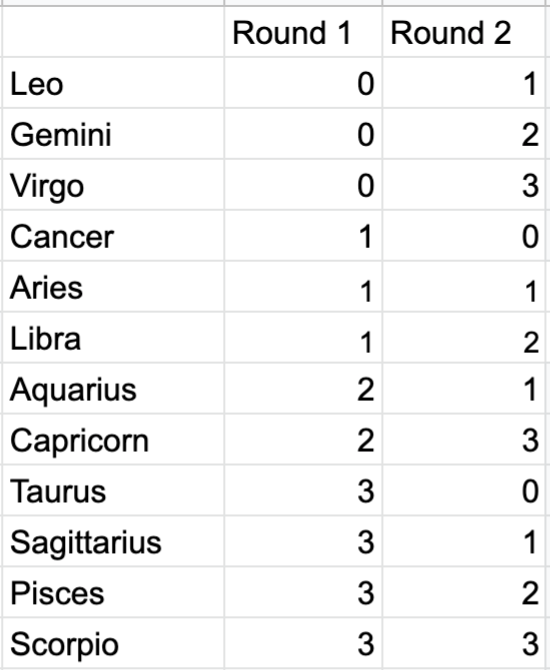
By consulting this chart and seeing how many letters they kept each round, you’d know their sign

Screen Shot 2020-11-09 at 2.54.29 PM.png

Now, does it make a lot of sense to do this with astrological signs? No, not really. Not if you don’t have a larger-scale premise for the whole interaction. But, as I said, I’m just using this as an example.

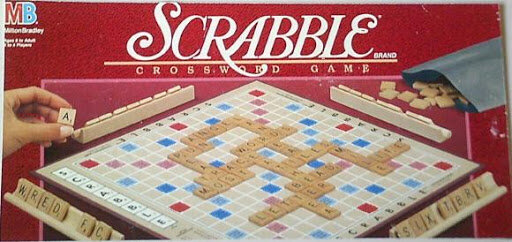
You could perhaps come up with a similar system to determine what word they’re thinking of from the top of this Scrabble box (you’d probably have to eliminate the 2-letter words).

unnamed.jpg

I have to say that it was much more difficult coming up with the groupings of letters than I had anticipated. Every time you change one letter around, it potentially changes everything else as well.

If I was going to use this technique, what I would probably do is first come up with my two groupings of letters, then create my list of words (if they keep 0, 1, 2, or 3 letters in each round, that would give you 16 possible words total). And then I’d put those words onto a Scrabble board and take a picture of some friends around the board like they just finished a game. Then I’d have that picture in my house and I’d be able to use that as a Hook to go into the trick. “Hey, think of any word you see on that Scrabble board.” This way there would be some correlation between what they’re thinking of and the “tool” being used to divine their word.

If you end up doing anything interesting with this idea, let me know.