What's the Worst Thing About: The Invoked Marked Deck
/The What’s the Worst Thing About posts are a form of free advertising I allow on the site, where people can send me their product and I’ll let everyone know the worst thing about it.
This has not proven to be popular, and most people have suggested the exact opposite: they send me their product, and I tell everyone only the best things about it. That’s understandable, but then this site would turn into pretty much only that.
Today we’re talking about the Invoked Marked Deck from Magic and Cards.
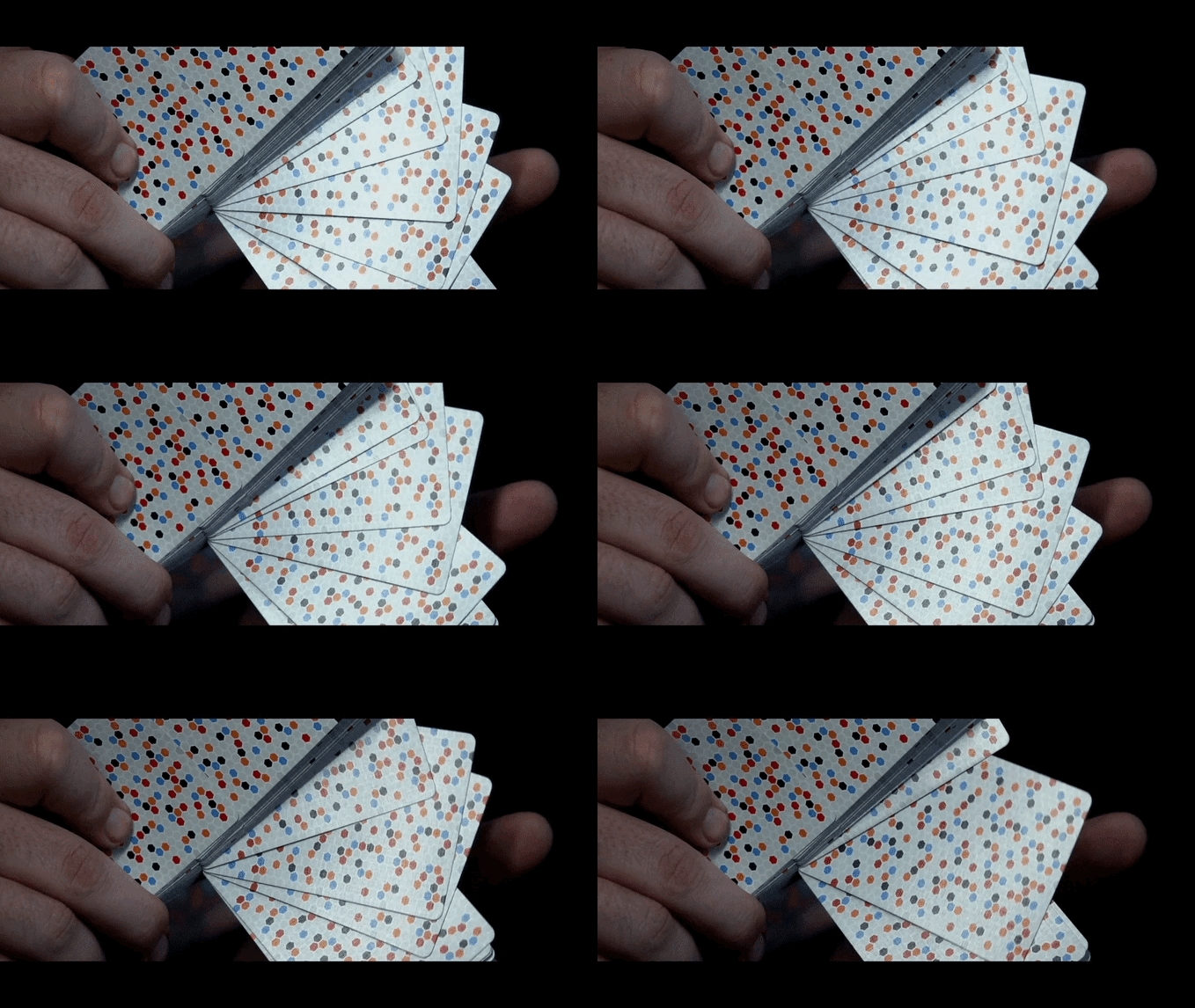
When I first saw these cards online, I thought the “worst” part about them would be clear—and that is, that the markings were too obvious. That would make this a very easy article to write.
Q: What’s the worst thing about this marked deck?
A: That everyone can see the markings.

Fortunately, that’s not the case with these. Yes, the markings stand out when you’re looking for them; if not, they just fade into a random scattering of dots on the back of the deck.
So I don’t think the markings are bad or “too obvious.” In fact, this might be my favorite marked deck in the “reader” style.
It’s both the fastest read and the easiest to see from a distance of any marked deck in my collection. That’s a powerful combination.
But, you’ll say, I saw those markings within seconds. I’m sure others could too.
I get it, but I think the markings walk the line perfectly between readable and hidden.
When you get into magic, you think the best marked deck is the one with the most invisible markings. But if you use marked decks ever, you learn the best one is the one you can read the fastest.
People don’t bust you with a marked deck because they spot the markings. They bust you with a marked deck because they see you staring at the back of the card.
Personally, I’d prefer a deck that takes half a second to read—where the markings are somewhat hidden—to a deck that takes two seconds to read and the marks are completely invisible.
This is the Carefree-style approach to a marked deck: I want the information in a glance.
I don’t want them thinking, “I don’t think he’s using marked cards because I examined the backs with a magnifying glass and didn’t see anything.”
I want them thinking, “I don’t think he’s using marked cards because I didn’t see him really look at the deck, and he’s all the way over there.”
The thing is, it almost doesn’t matter how “hidden” the markings are. If they suspect you’re using marked cards and they look at the back and don’t see anything, they’ll still think you’re using marked cards—they’ll just assume they can’t see the markings.
This deck eliminates the need for a studied look at the back of the card or for you to be particularly close to the card you’re reading. Combine that with other ploys like a Gypsy Peek, stacking the deck (so you don’t even have to read the card they’re looking at), and things like that, and you’ll have the best chance to avoid them thinking a marked deck is in play.
Of course, if you have them pick a card and place it on the table in front of you and you say, “It’s the 10 of Diamonds!” they’ll assume the deck is marked whether it is or not.
The deck is also edge-marked in two different ways—one on the short end and one on the long end.
I’m not an expert in edge-marked decks, but these markings feel easier to read than most I’ve played around with.
I still doubt I’d ever use them to find a named playing card or anything like that—it just takes too much studied attention to the edge of the deck, in my opinion.
But using this marking to determine which card has been reversed in the deck can be done quickly and leaves no clue to a lay audience as to how it was done, because the concept of “edge marking” isn’t something they know about.
Here, he gains the information in a brief moment while touching the deck in the spectator’s hands.
Just judging solely on its use as a marked deck, I’m a fan. And the quality of the deck itself is excellent.
So what’s the worst thing about the Invoked Marked Deck?
For me, it’s the box the cards come in. It calls attention to itself in a not-great way.
The design on the card back is reminiscent of a mid-century modern pattern like you might see in the 1950’s and 60s.
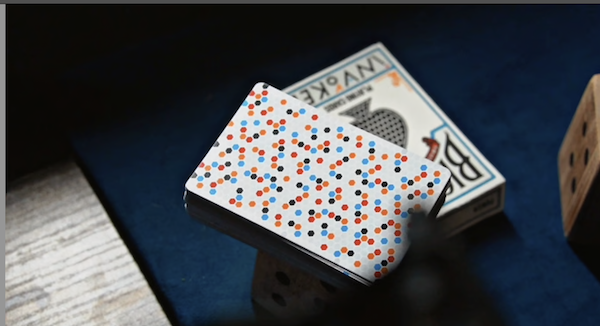
The card case is something else though.

The name “Invoked” implies something almost ritualistic, and in that context the oddly angled font and extra marks read less playful and more like a strange sigil. It doesn’t pair naturally with the upbeat, geometric pattern on the back.
The design of the writing gives you a little Easter egg: the reflection of the deck’s name says, “Marked.”
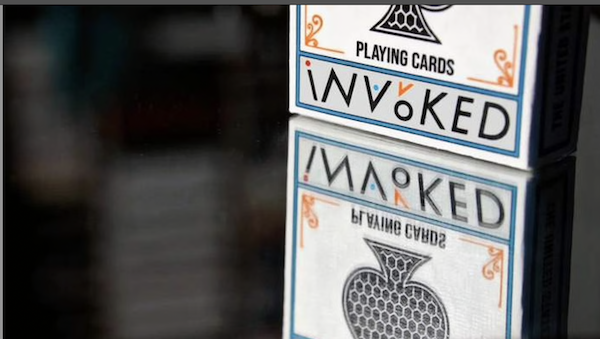
Which is cute and all—but who gives a shit? I mean, it’s not like you’d use that in performance. “And… ta-dah! All along this deck was… Marked!”
I’d personally prefer something that matched the cards better. Even something more generic. I don’t think the Bicycle name helps make the deck seem more normal. If anything, it draws more suspicion from anyone familiar with Bicycle cards: “Here’s a name I know, but a box that looks unlike any Bicycle deck I’ve seen before.” That draws more scrutiny than a generic deck.
A box of “Cheese Crackers” can look like anything—but if it says “Cheez-It” and doesn’t look like the typical box, that’s going to draw people’s attention.

So you have a box that:
Doesn’t match the card’s aesthetic.
Doesn’t look like a normal Bicycle deck.
Has the marked deck’s commercial name printed on it for easy Googling.
What’s the worst thing about the Invoked Marked Deck?
The box.
Outside of that, I recommend them. They’re available through Magic and Cards for $27.