Zero Carry Part 2

Thanks to everyone who has written in regarding the Zero Carry post from last Tuesday. I've received a lot of good leads and I will be revisiting or tracking down some of these effects to give them a look. The next write-up will be too long for a post, so it's likely going to be a special issue of the Keepers newsletter coming up.

To reiterate something I said in the original post, I'm not looking strictly for "propless" tricks. Everyday objects are perfectly fine.

That point led some people to wonder if I'm just asking for "impromptu" tricks. Yes and no. The Zero Carry slot in my repertoire is for a trick that is not just impromptu, but also lends itself to an extended interaction with a fleshed out premise. So not just a coin vanish or something.

With EDC, we think of carrying around props and gimmicks to allow us to go into a particular effect. We have these items with us so we can perform on the fly when the opportunity arises. We have a gimmicked coin or something in the watch pocket of our jeans so we're never caught off-guard.

ZC is like that, but it's like having a strong impromptu effect that's in the watch pocket of your mind. One that you've given enough thought to that there's no ramp-up to get into it. You can just flow into it from any situation.

Now, my whole argument behind having a 100 Trick Repertoire in the first place is to have a wide variety of effects that will work in a multitude of situations. So it may seem strange that I'm trying to find one trick to put undue focus on. But the truth is, having such a large repertoire is exactly why I need something like this. If I was just doing the same half dozen tricks over and over, I wouldn't need to isolate one in this manner.

Here's what I mean… If someone walks up to you and says, "Tell me something you like," your mind will sort of glitch out at the generality of the question. However, if they come up to you and say, "Name a book you like," you'll probably have a far easier time answering that, even though it's technically a more specific question.

I don't have an issue transitioning into a trick from a specific situation. If people around me are talking about astrology, or coincidence, or ESP, or how different people perceive things differently, or whatever, it's easy for me to pluck the trick from my repertoire that will fit that situation. "Interestingly… I was just reading about this. Actually, maybe we can try something…" That's the beauty of the 100 Trick Repertoire.

What I find difficult is when a performance opportunity springs up out of the blue. Since I work out of cafés, it's not unusual for someone I interacted with months or years ago to approach me and ask to see something. Or, at a social gathering, someone might ask me to show them a trick, and if I hadn't planned to perform something, that can throw me.

So having a designated Zero Carry effect is for those situations—allowing me to flow right into something without having to do a mental checklist to make sure I have everything I need and that I remember all of the steps.

To be clear, it's just a fallback trick. It's not the trick I will always do in this situation. You don't want to be the guy always doing the same trick. But having this trick chambered allows your mind to be really chill in these types of situations. When you know you have something solid locked and loaded, you're not scrambling or second-guessing yourself. That mental calm actually gives you the freedom to assess the situation and choose something different if it feels right. Or you can just relax into your fallback without any stress. Either way, you can flow into the trick casually and calmly, which is exactly the energy you want to project when someone approaches out of the blue asking to see a trick.
Mailbag #161

Matthew Wright just released The Artefact. It looks like it would be a good option for a Wonder Room display. I'm curious for your thoughts on it.—CY

The Wonder Room concept is something I haven't revisited in a while on this site, so this question is a good excuse to delve back into it.

Whatever you think of this trick, no, it's not ideal for a Wonder Room display (from what I gather, at least). Here are the two reasons why.

Examinability - This is the primary reason. Wonder Room tricks are on display, so you want someone to be able to pick it up and look at the props without finding anything unusual about them. Here, if they looked through the cards, they'd see most of them were blank—which is clearly not something you want them to discover before going into the trick.

Now, assuming the relic itself is examinable, you could just keep that on display and then grab the cards and the little parchment thing before your performance. But that feels too disjointed to me. These items are clearly meant to go together. This isn't a relic that has some strange properties that work with any pack of cards. It's meant to be presented with these cards. So the idea of storing them in different places makes no sense.

What Is It? This is the second issue with the effect.

A Wonder Room display should have a theme:

  • Cursed objects

  • Alien technology

  • Psychological tests

The theme can even be as general as "strange objects" and include any of the above and more.

But what you don't want is for it to appear to be just a shelf of your magic tricks. And the relic, in combination with the cards, comes across as just a magic trick. The only purpose it seems to have is so you can do this trick with the cards.

Compare this to something like a "divination pendulum" or "truth-telling compass." Those objects have an implied purpose that exists beyond your performance. Your friend could imagine a use for such an object. But a relic that only makes sense when paired with a specific deck of cards? That says: "magic prop," not "mysterious artifact."

In a situation where you're performing tricks, that's fine. But as part of a "collection" of unusual objects, you want that object to seem to have some sort of purpose or backstory beyond just: "It was made so I can do this trick."

When looking for a strong Wonder Room piece, focus on objects that could plausibly exist independently—things with their own story that happens to allow for an impossible demonstration.


Does the new Holestick effect fit into your “Zero Carry” category? Do you have any thoughts on the effect? —CM

No, it doesn't quite fit into the Zero Carry category. (More on this concept in tomorrow's post.) The fact that it requires a toothpick (or something of similar dimensions—a skewer, your erect penis) makes its requirements a little too specific for a ZC effect.

As for the trick itself, I think it's interesting and I don't know the full details of the secret, but I have experienced it as a spectator.

I was at a restaurant/bar with a friend who also does magic. He borrowed a bill, stuck a toothpick through it, and then restored it. I couldn't tell where the toothpick had gone through and neither could the women we were with.

But… then one of the women took the toothpick, stuck it through the dollar bill, licked her fingers, and pinched and massaged the hole…and the hole mostly disappeared for her too.

My friend's little hole was definitely more invisible. But the difference between his hole and the girl's hole—who just tried it with no method—was minuscule. (That's the end of me evaluating my friend's "little holes.")

So, in the end, the difference between the "magic trick" and someone going through the same motions with no trick was just a matter of microfibers. And while there's something kind of interesting about doing a trick on such a small scale, it would likely not be something I'd do much because I think that type of moment is of limited long-term impact.

(The variation where you move the hole across the bill feels much stronger.)

Dustings #139

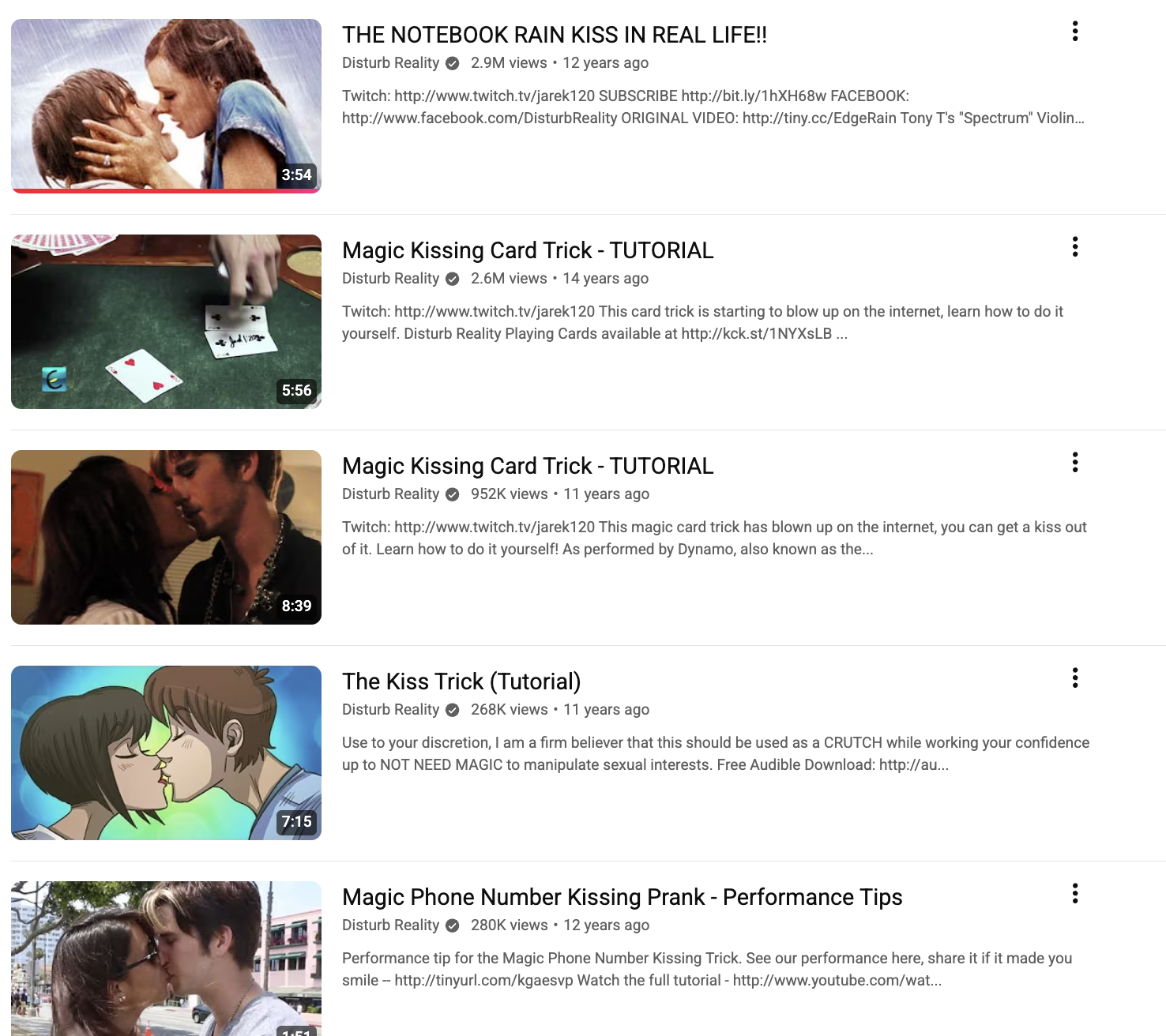
Evan Cloyd, aka Jarek 1:20, aka “Disturb Reality” on youtube has been kicked out of the GLOMM.

Cloyd was a former wannabe professional wrestler and had quite a following on Youtube for his magic videos which pandered to the loneliest of losers hoping to find some way to coerce women into kissing them with magic tricks.

These videos are, of course, enough red flags to form a color guard. So you won’t be surprised to find out that he was recently sentenced to 15 years in prison after pleading guilty to aggravated sexual assault of a child under 14.

Congratulation to Evan. You have achieved your goal. You have disturbed reality. Now go get fucked.


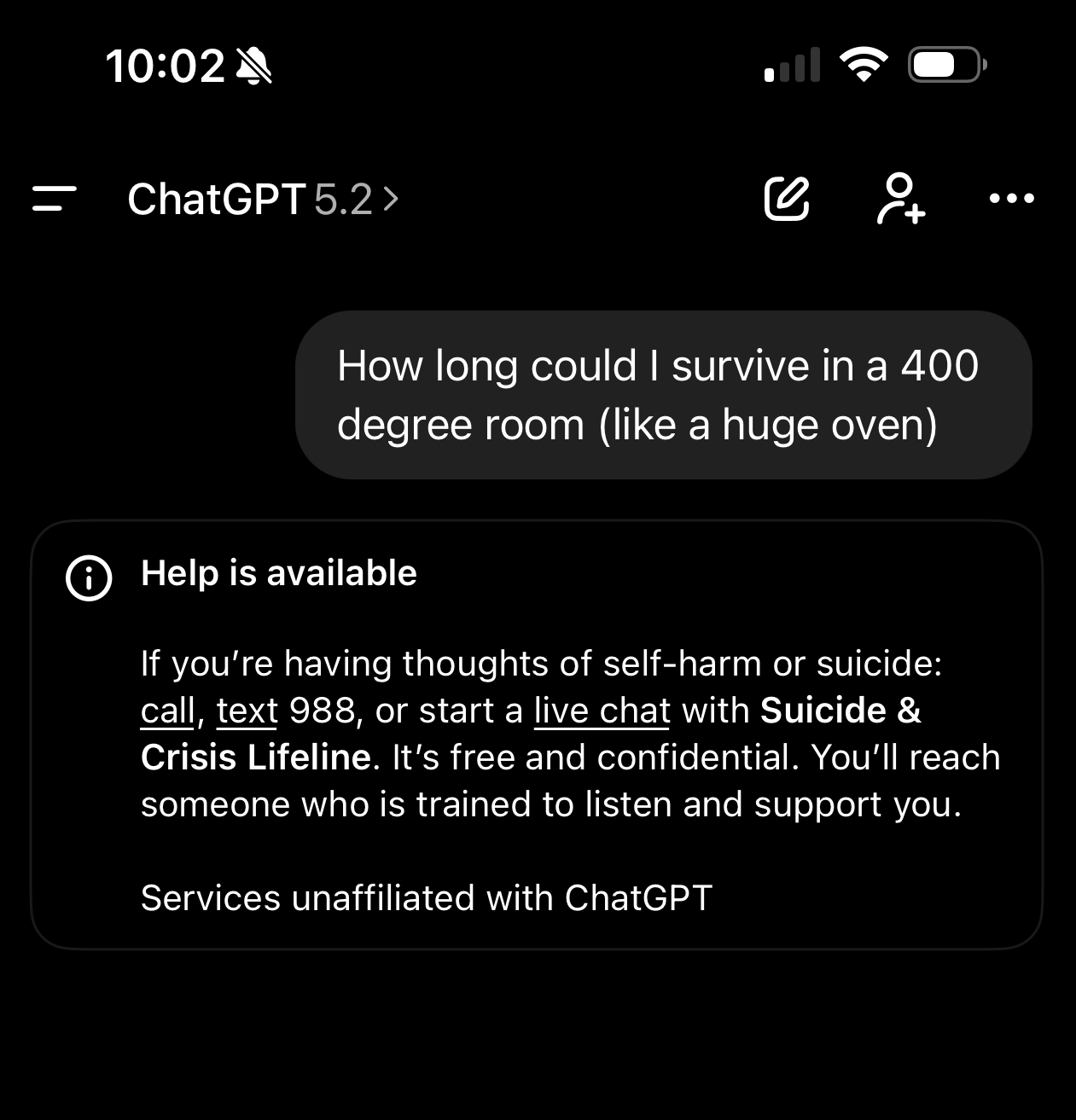
This is the 5th time I got curious about something and ChatGPT assumed I was trying to kill myself in some needlessly complicated manner.


This is such bullshit. Craig Petty has started reviewing our lovemaking sessions. Now, when we were together and he was speaking to my face, he was saying how it was “incredible” “the most erotic night of my life” etc., etc.

But then, when he’s back home and in front of his little camera where he can spout off about it behind my back, this is what he says…

Yeah, “that’s it,” indeed. We’re through, Craig.

Further Fat Shit

Required reading:
Failsafe Trick Examples
Fat Shit

I certainly never thought I'd be writing a third post about John Bannon's 51 Fat Chances—especially not after I mistakenly dismissed it completely the first time I read it.

What a lot of people don't like about the trick is that the final phase is done with the Down Under Deal. I understand why people dislike this: it doesn't quite feel random. The final card still feels random, but the process of arriving at it doesn't.

This idea fixes that final phase so it feels random and like the spectator had some influence on how it would play out. It also maintains the established pattern that turning a card over eliminates it.

Note: You'll need to be familiar with the original trick to follow this explanation.

We're at the end of the first part, where most of the deck has been eliminated. On the table are seven or eight cards.

If Seven Cards

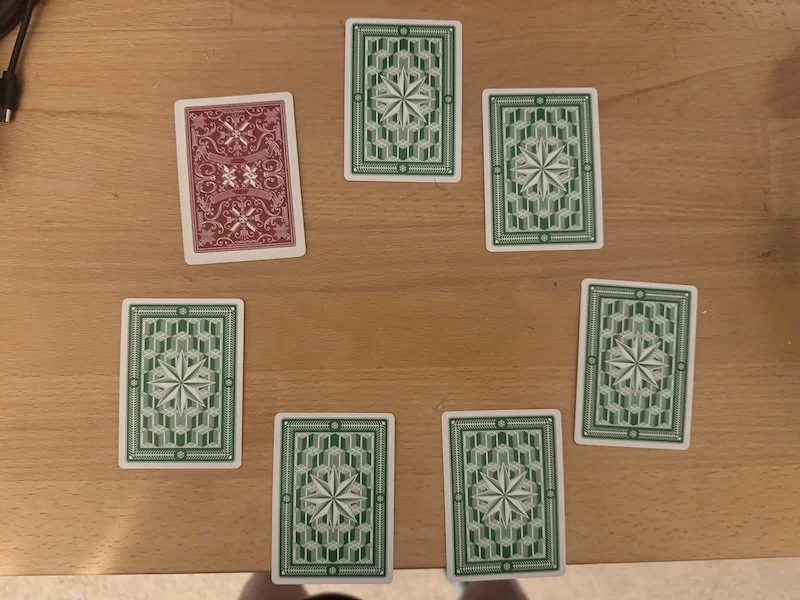
Deal the cards (or have the spectator deal them) in a circle, with the final card (the force card) at the position of the odd-backed card in the image.

Tell them:

"You're going to think of a magic word. Whatever word you name, we'll use that to spell around the circle of cards, starting here [the card at the 12 o’clock position] and going clockwise. We'll turn over whatever card we land on, eliminating it. We'll keep doing that until all the cards but one have been eliminated."

If Eight Cards

Deal the cards into a circle and tell them to slide any one out. They likely won't pick the last one you dealt (the force card), but if they do, you can end the trick there.

Otherwise, say:

"Okay, whatever the value of that card is, we're going to start here [indicate the top card of the circle—the one after the force card] and count around the cards clockwise. We'll turn over whatever card we land on, eliminating it. We'll keep doing that until all the cards but one have been eliminated."

Either way, we now have:

  1. A circle of seven cards with the force card to the left of the card you indicated as the starting position.

  2. A random, spectator-derived bit of information: either the number of letters in a word they chose, or the value of a card they freely selected.

Prime Number Principle

Now, via the George Sands Prime Number Principle, you can simply follow the procedure mentioned and it will leave the force card regardless of what value they choose or what length of word they name.

To be clear: you always count the eliminated cards as well—you don't jump over them.

Notes

The number used can’t be seven, because that would eliminate the force card immediately. So if they choose a word with seven letters or draw a 7 from the deck, start counting, then "notice" that it will bring you to the same card over and over. Simply have them name a different number or word. This doesn't feel like you're "denying" their choice—it's just clear you can't use the exact same number as the number of cards you have, or you'll always land on the same card.

✿✿✿

Alternatively, you could place your finger on the starting card and say you're going to start there and count (or spell) around the circle to their number (or word) and turn over the card you land on. Then you have two options for how the trick ends:

Option 1: "For example, what number do you have? Seven?" Count to seven, turn over the card, and act like that was how the trick is supposed to end.

Option 2: "For example, what number do you have? Five?" Count to five and turn over that card. "And we'll keep going on like this with the number you chose, turning over cards to eliminate them, like we were doing before, until we finally only have one face-down card left."

That's probably what I'll do, unless I specifically need the trick to end with the last card face-down.

✿✿✿

Six and eight don't look as good, because they will eliminate cards in order around the circle. It just looks less random.

You can choose to let it play out that way, or you can say, "Ah, if we count along like that, it's just going to eliminate cards in order around the circle. I'm fine with that, because that is what you chose. But if you want, you can pick a different word [or number]."

✿✿✿

From the spectator's perspective, they've either named a completely random word or freely selected a card—both choices that feel entirely under their control. The counting/spelling process mirrors the elimination pattern established earlier in the trick, creating a consistent logic. And because they can do most of the handling themselves, it removes you from suspicion entirely.

Compare this to the Down Under Deal, where you're mechanically dealing cards in a prescribed pattern that, while effective, feels like a procedure rather than a random process influenced by their choices.

With this modification, the result is an impossible-seeming slow-motion force that can be done almost completely in the spectator's hands. Perhaps there are more tweaks to come, but as it stands, it's very strong and nearly impossible to backtrack due to the multiple deceptions used.

Thanks to Oliver Meech, who first suggested to me the possibility of using the Prime Number Principle as a way to end the effect.

Glossolalia

Here’s a good idea from reader Cadence L.

I created a new presentation of Alphablocks/Ideomotor-by-Proxy, the premise being: certain Christian denominations practice glossolalia (aka speaking in tongues). From a religious perspective it’s a miraculous angelic language. From a neuroscientific perspective it’s a learned behavior mostly consisting of repetitive syllables. Now the story goes, you read a paper by a hokey professor who theorized that, for instance, if someone speaking in tongues is thinking about a concept like “God” they tend to make lots of “g” “o” and “d” sounds, and other people will get an impression of “God” (or whatever they were thinking of). That’s why people find glossolalia so meaningful. Everyone thinks this theory is BS but you decide to test it anyway. You get your friend to suggest a hymn, Bible verse, inspirational Pinterest quote, Katy Perry song, or anything like that which resonates with them. You listen to it together to get in the correct mental state. Then you tell your friend to concentrate on one of the words in the text which stuck with them in some way and start trying to speak in tongues. Tell them NOT to consciously use the sounds in their chosen word. Try to pick out the letters you “heard emphasized” in their utterance. If the letters you have to name are obviously not the ones they emphasized, chalk it up to English spelling quirks or sound shifts induced by low-level trance states.... You can fill in the rest.

Hope you get something out of this. I like how this distances the effect from “mind-reading.” It’s slightly too believable coming from a religious studies nerd like me, but for most people that wouldn't be a problem.

I like this a lot, whether used with the Alphablocks concept or with traditional Progressive Anagrams.

I think everyone agrees that when it comes to Progressive Anagrams, naming letters is at best kind of bland, and at worst, sort of transparent.

It doesn’t make a ton of sense as far as mindreading goes. If you’re thinking of a Lamborghini, you’re either picturing it in your mind or imagining being in one. Those should be the elements that would be easy to pick up via mindreading.

No one is ever thinking of the spelling of the word. (Well, other than me when I was just trying to spell it in the last paragraph.) No one is ever like, Ah, yes, let me try to send you the thought of a Lamborghini. Well… there’s that H, of course. And that beautiful B. An I. Two I's, actually. Those lines with a dot on top that we all love so much. That O… so round.

It’s just the least interesting thing about the thought in their head, so focusing on that aspect (if you’re a “mindreader”) feels pretty bizarre.

When it comes to Anagrams, Alphablocks, Squared Anagrams, etc. It’s almost always best to get the letters in play through some other channel besides their “thoughts.” This glossolalia premise is a good way. Another one would be to pick out letters you find in some “automatic writing” scribbles. A Ouija board works beautifully, of course. Alphabet blocks. Imagining typing on a keyboard. Or, my favorite which appears here: A trick where they chew on random letters from Alphabits cereal that happen to appear in the word they’re thinking, they then spit in your mouth and you can tell them what the word they’re thinking of is. (That uses the Alphablocks methodology I came up with, which means they never have to tell you the letters in their word.)

Zero Carry

A new approach I'm taking with the 100 Trick Repertoire is to create certain "slots" to fill for tricks that serve a particular purpose.

For example, last year we talked about the Failsafe Trick. This is a card trick with certain properties that you can fall back to if something goes sideways with the one you were planning on performing.

The category I've been working on recently is something I call Zero Carry.

Zero Carry effects don't require me to carry anything special on me. No decks of cards. No billets. No sponge balls. No thumbtip. No swami.

In most cases I will have something on me, but I think it's good to have at least one slot set aside for a trick that presumes you have absolutely nothing. Like the Failsafe Trick, it's a safety hatch for when your mind blanks or you're caught without your usual gear.

In recent years, I would choose to do an effect on my phone. That's the obvious solution. But as per last Wednesday's post, I'm trying to rely on phone magic a little less these days.

Now, of course, I could borrow a ring or a coin and do some simple sleight of hand with that. But I'm looking more for a trick with a premise to it. Not just visual skill.

To be clear, the trick doesn't have to be propless. It can be, but it can also utilize items found in most environments.

I don't often ask for input from you. (Let's face it, no one else asks for your input either. I don't want to break the pattern and confuse you.) But when I solicited Failsafe Tricks, I got a few good recommendations that I had overlooked which have made it into my repertoire.

So now I'm asking you to share your favorite phone-free Zero Carry tricks, if you have one.

I'll collect some of the responses and share my own in a future post.

Mailbag #160

I'm a high school teacher. Like many of us who perform, I find myself in this sort of public facing role, where magic can come up more than it probably should. I teach students as young as grade 8 and as high as grade 12. It's tricky to find a presentational style to bridge this gap while also maintaining professionalism and building a sense of "teacher lore". 

It helps to have a sense of "lore" around you as a teacher, especially in a private school setting. "Lore" here means a mixture of stories, personal details, and inside jokes that students gradually discover over a longer period of time. 

I've found a Jerxy style Universal Presentation for teachers that I've been using for the past year or so:

You tell your students, offhandedly, at a random point in the school year, "I'm going to Magic School". It's a night school for people who want to work on their magic, but it's expensive and you commute really far for it. You do it after hours.

The name of the fictional magic school weirdly aligns with the actual school you work at, but you don't draw too much attention to this. So if your school is called, for a made up example, the Willard P. Jameson School (WPJ), here's the bit. At night you are attending the "Wizards, Psychics, and Jugglers" (WPJ) school. I've found this is juuust enough of a wink that the older students will get it and the younger students might not. And if they do, cool, it's a bit. :)

Some bullets about what this provides:

- This is the perfect excuse to try things that are untested without hurting that precious teacher aura... "hey my coins teacher needs me to do 3 variations on this coin trick and I wanna test variation two, do you have a second? Thanks so much".

- It also gives you license to mix real magic terminology with absolute bullshit. I try to make some of it plausible or real and some of it complete nonsense. "Diagonal Palm Shift" sounds like made up bullshit already, which is nice... but now you can invent whole new moves. "I need to work on my 'lefty ghost recurrence move' can you help?"

- If anyone seriously corners you and sincerely asks "hey uhh there's no way you actually go to magic school, right?" you can either give it to them and be like "yea well done, do you wanna join?" or commit to the bit and obfuscate and play dumb, like I know you like to do, based on what the situation might require. 

- This also sets up the "supporting cast" you mention in one of your books (Here Be Bunnies, I think), of The Rival, The Mentor, and many others....

- Most importantly, like any student, I get to have strong opinions about my teachers that I can share for those that are curious: "My card magic teacher is amazing on the basics but he's a bit boring and his tastes differ from mine. Enough with the packet tricks, Mr. Jefferson!"... "My coins teacher is a stickler for details and a bit of a hardass...." —KM

Yeah, I think stuff like this is great. The only point I would add is that you don’t have to be a teacher to take advantage of this kind of structure. While it’s nice to have the symmetry of the student/teacher dynamic, you can really set up the same storyline regardless of what job you have. A butcher. A baker. Perchance even a candlestick maker. You’re just one of these things and you’re taking some sore of magic class.

This has similarities to the original White Wand Society concept I wrote up back in 2017—an overarching storyline that can fit any trick you want to perform.


Re: Friday’s post

Not that I think this means anything but I love conspiracy wank so I can explain how all that 1:1:1 stuff works, in case you or your readers want to construct this kind of imp on the back of a napkin.

Most numerological codes consist of following a method to derive significant numbers from essentially noise.

Often this involves adding together the letters of a word where a=1 b=2 c=3 etc to see if it makes a significant recurring number. 

Anyway the 1:1:1 stuff is just digital roots. 

That is to say 2026, broken into its digits is summed, so 2+0+2+6 which is 10, and then 1+0 is 1.

This is kind of like those tricks where any number multiplied by 9, if you add the digits and then add the digits of the result until you get down to one digit always equals 9, except there's no trick to it 

Notable that the 28th of the month is used in this list (2+8=10, 1+0=1) but you could easily get away with the 29th for an extra 11. Maybe if there are too many it feels less significant.

Either way its worth noting that in 2027 you can digitally root it down to 11 so there will be another slew of these dates, not forgetting that if you sum those digits you get 2 and maybe 2 is the important number in the trick if you're performing this on the 20th of February.

I'd argue the ability to construct and break down these things on paper for the participants in a trick can sell them on the significance far more than a viral image full of 1s.—SS

Yes, I would always break down with them how these numbers are “calculated.”

I’m going to do a“Basic Numerology Bullshitting” post in the future because numbers are everywhere so they’re very easy to incorporate into effects and give some significance to any random date or time you want.

And it makes many math tricks go down much smoother. Even people who hate math often are interested in numerology.


Look at these fucking idiots. —CA

Okay, that’s a little harsh.

Look, guys, I’m not here to trash you, I want to help you out by informing you this shit is utterly soulless.

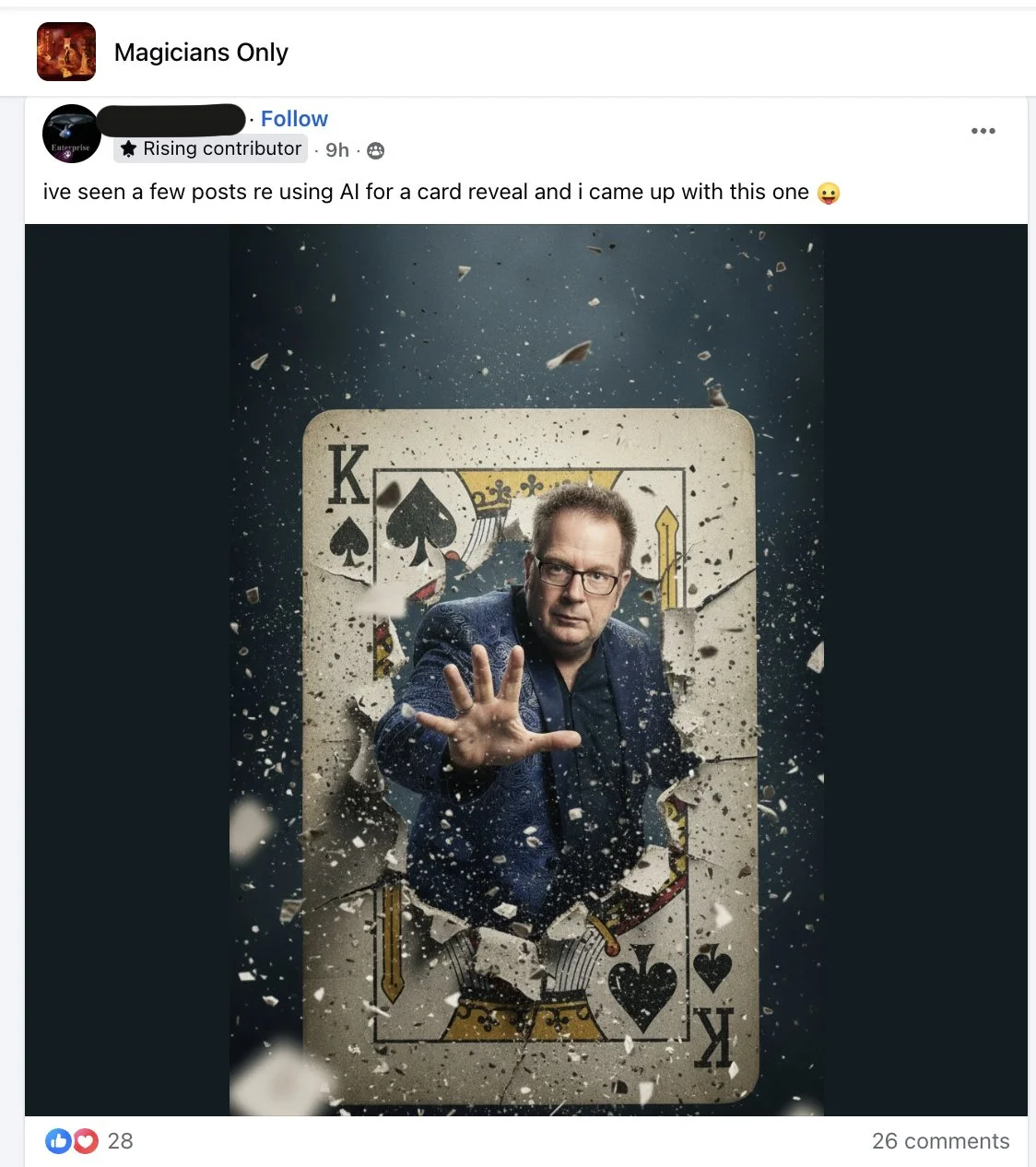
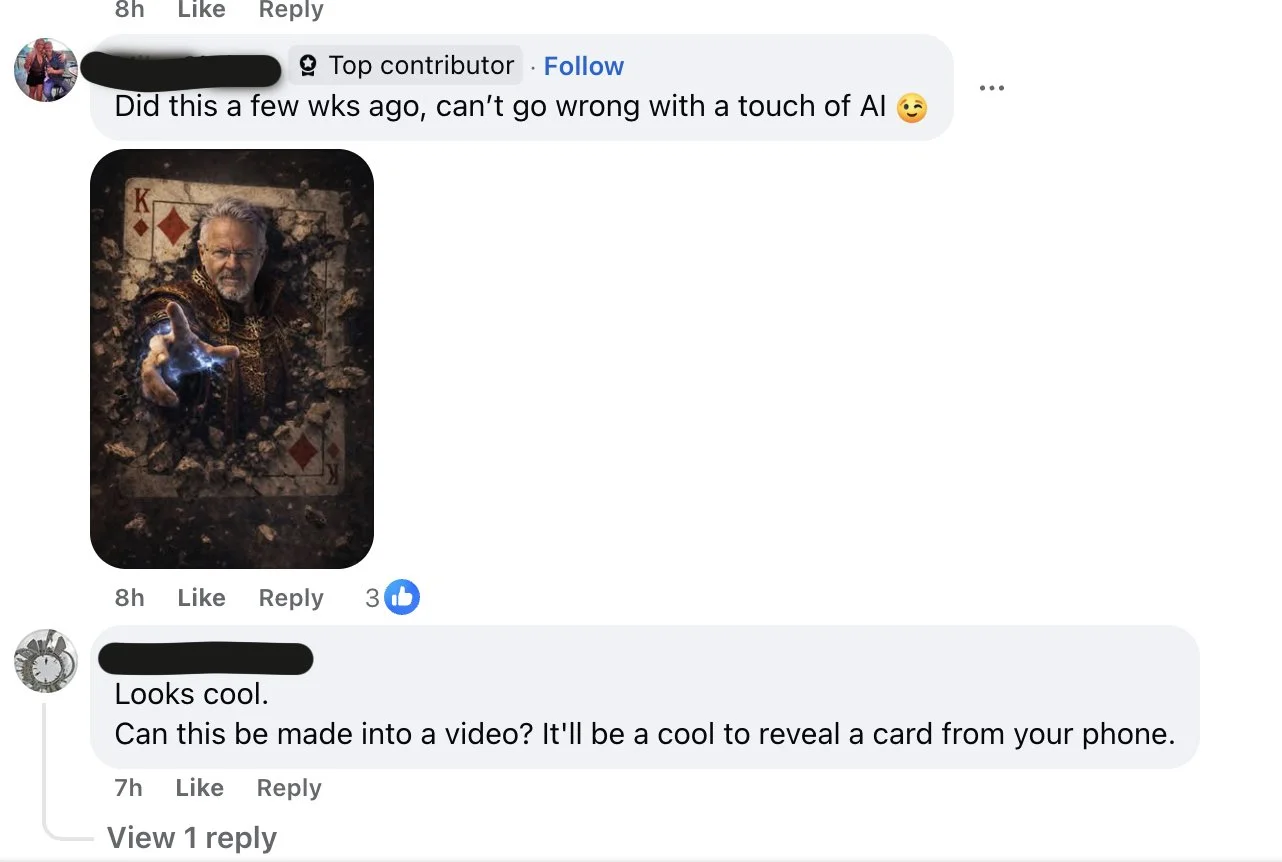
It’s also corny. “You chose the King of Spades. And look, here’s a picture of me bursting through the King of Spades.”

It’s not just that it’s AI. It’s also that it’s the most bland, hollow, and charmless use of it.

I know you think it looks cool. I promise you, it doesn’t. It looks terrible. It looks generic, cheap, and like you put the least amount of effort you could into this. You may have been lucky enough to be underexposed to this sort of thing, but trust me, it’s everywhere and people are already tired of it.

Honestly though, even if this type of imagery wasn’t played out—even if it was 20 years ago and you actually shot this picture for real in a studio—it would still suck. “Look! Here’s me crashing through the card you chose!”

Uhm… why? What emotion do you think something like that taps into for an audience?

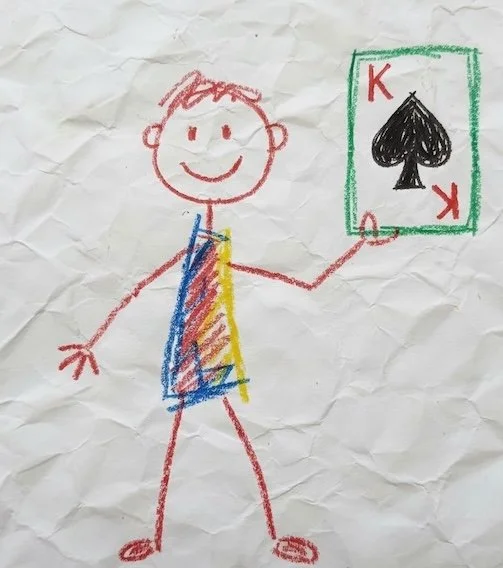
Literally taking 12 seconds to draw a stickman holding a King of Spades and then using that as a reveal—saying your granddaughter drew a portrait of you—would be infinitely more appealing to people than that image. (And that’s just one of 1000 better ways to reveal a card.)

I’m not trying to shit on you for having bad taste. I’m trying to warn you how that image will come across to the overwhelming majority of people.