Mailbag #20

giphy.gif

Please tell me you’re going to do a full review of Ellusionist’s How to Read Minds Kit. Your writing on that has made my December.

I got my own kit a few days ago. Here are my thoughts:

  • The thumb-writer is a grease pencil. What beginner is using a grease pencil when they perform?

  • The ESP cards have the most visible marking system I've ever seen on marked cards. You couldn’t even call it hidden, it’s the ONLY noticeable part of the design. AND you can see right through the cards!

  • The book test uses the first method a spectator would guess. It was the first method my daughter (who has no magic training) guessed after watching the performance. Also, for some reason they didn't cut the book to one of the standard dimensions a book comes in so it doesn't look or feel like a normal book.

  • The wallet is oriented like no wallet I’ve ever seen. On the Cafe, Geraint from Ellusionist says it’s a leather hip pocket style wallet but he didn't mention that it folds open along the LONG edge. No real wallet is made like this. It's too big for a business card or credit card wallet and too small to hold money. Also, it’s not real leather, that’s just a bizarre lie.

  • As you noted, the custom credit-card looks completely fake and that’s true whether you look at it from the front or the back. It's a clear magic prop.

  • The notepad is okay if you’re the sort of person who carries around a faux-leather notebook with you (I’m not).

  • The marked deck is fine.

  • Everything else in the kit is filler.

The quality of the items is about what I expected, but the decision making that went into them is so poor that I won't be using this at all. I'm not an Ellusionist hater by any means. I like a lot of the things they put out, but not this.

Can’t wait to hear your thoughts. —JR

Actually, you can wait to hear my thoughts, and you will, because I won’t be giving my thoughts.

Originally my plan was to make my final post of the year (on Monday) a big unboxing and review of this kit. I thought that would be fun. And then I got the kit and opened it and it’s just… not that fun. I found it depressing, in some weird way. And I don’t want to spend hours of my life writing any more about it.

Hey, I don’t know, man! I’m a complicated little bitch! I love talking shit, but it’s got to be fun. And writing more about this kit just feels like a drag. It’s not so good or so bad that it would be enjoyable to write about in full. I’m glad it was a successful project for Ellusionist. And I hope the people who purchased it are happy with what they received. I haven’t watched the teaching yet, and I’m sure that’s the best part of the kit. So I’m not in a position to talk about the overall value of it.

You don’t need me anyways. There are surely other reviews to be found online. One way to know if they’re legitimate or not is if they mention that the ESP cards are unusable. This is not a question of opinion, it’s a matter of fact. You can see the ESP symbols through the cards. They used too cheap a card stock. If the review doesn’t mention this, then you know the rest of the comments are bought and paid for.


Do you ever worry about not being able to pull off something “as good” as the last thing you did for a person/group? —DI

No. There’s no benefit to thinking like that. 

First, because it’s impossible to maintain long-term. There’s no way to consistently do something “better” each time you perform. So why torture yourself with that goal? This isn’t running a marathon where you can improve your time each go-around. There aren’t quantifiable metrics that you can shoot for to strive for “better” each time.

In fact, when I do something that really hits someone hard, I usually intentionally show them something much less significant the next time I perform for them. I want them to realize that this is not a game of “can you top this?” that is going to go on eternally. As long as everything you show them is interesting and impressive in its own right, then you’re fine.

If you had a friend who cooked for you and one day made a gigantic 14-course dinner that was one of the highlights of your life, you’d still really enjoy them making some pancakes for you a month later, assuming the pancakes were good. 

Even if I could do something a little better each time, I wouldn’t want to. It would feel too polished and prepared to me. I want these things to have a casual air to them, and showing someone 20 trick over the course of two years that gradually increase in impressiveness doesn’t have that feeling. In fact, I think it would start to feel predictable to anyone who saw it. Whereas, if you’re constantly mixing up the type of stuff you show people, it’s easier to keep them on the hook. And since you haven’t established a pattern of constantly one-upping yourself, there is not a .sense of “failure” if you do something that isn’t as impressive as the last thing you did.


You have mentioned many times that you keep track of which tricks you perform for which people. This is so you don’t do the same trick for the same person twice. Since you keep track of this info, I was wondering if you also pay attention to make sure you never will do a trick for someone where the PREMISE would contradict the premise of a previous trick that you once did for them. I would need an example to best illustrate what I mean, so here is the first one I could come up with, although there’s probably better examples in your work:

In a very early post (June 5, 2015- “Free Magic Giveaway – EVP by Alan Rorrison”), as part of your presentation, you mention the idea that it’s very difficult to read someone’s mind because everyone is trying so hard to guard their own thoughts. More recently (March 15 2019- “Earn the Elements”), you mentioned a presentation where you introduce the premise with the exact opposite premise: that when someone tries to guard a certain thought, it actually becomes easier to figure out because their conscious effort to hide it sets off all sorts of tells.

So, I was just wondering if this is something you pay any attention to, to never do both of these for the same person, or at least not without a lot of time in between them. —YR

No, I don’t really look for consistency in that way. Most people aren’t going to be super pedantic about these sorts of things. And even if they are, I just assume I can talk myself out of—or around—anything they may bring up.

For example, if they said, “Hey, in one trick you said guarded information is harder to read and in another you said trying to guard information makes it easier to read.” 

I would just say something like, “Yeah, well both things are true. It’s like if you had a safe in your house. The safe protects your valuables, but it also tells me exactly where your valuables are. If I have one minute to rob your house, do I want a safe or no safe? I probably actually want you to have one. A minute isn’t enough time search through your whole house, but it is enough time to crack a safe, if I’ve learned those skills. The tools of mind reading are the tools of cracking the lock guarding the secrets in your head.” Just weaving a web of bullshit. 

If I’m doing something long-form that unfolds over the course of weeks or months, I wouldn’t do anything that contradicts it during that time. But outside of that, it’s not really something I consider.


How do your performance styles as discussed in Amateur at the Kitchen Table (peek backstage, romantic adventure, distracted artist) relate to Presentation and Context? —DW

Performing Styles and Context vs Presentation are concepts I wrote about a few years apart and they came sort of in the reverse order they should have. Because I’m writing about this stuff in, essentially, real time, you’re seeing the way these ideas actually developed rather than necessarily seeing them in the most intuitive order to understand those concepts.

I’ll get to where they intersect, but first, here’s a brief overview of Context vs Presentation.

Triumph Presentation - “One time this guy walked into a bar and shuffled my deck face-up into face-down. Like this.”

Triumph Context - You drop the deck creating a big mess of cards face-up and face-down. “Goddammit,” you say, picking up the cards. You start to separate them. “Eh, it will be quicker to reset the deck.” You call a number on your phone and read off a few digits from the bottom of the card case. After a couple seconds you spread the deck and they’re all facing the same way.

Presentations are stories laid on top of a trick. Contexts are present-tense situations in which the trick occurs.

The Performing Styles, are these:

Distracted Artist
Peek Backstage
Wonder Room
Engagement Ceremony
Romantic Adventure

More information on them can be found in the glossary on the right (or at the bottom of the page if you’re on your phone).

The Performing Styles are just very broad Contexts.

Distracted Artist is when a trick occurs in the context of an absentminded action.

Peek Backstage is when a trick occurs in the context of you showing them “something you’re working on.”

Wonder Room is when a trick occurs in the context of you showing them an interesting object from a collection.

Engagement Ceremony is when a trick occurs in the course of some kind of ritual.

Romantic Adventure is just another name for a long-form immersive context.

What makes something a “Performing Style” rather than just a general context is that it could conceivably be the only pretense you use to show people magic; it’s that broad. You could, for example, only ever show people magic items from the walls of your Wonder Room. Or only show them different rituals you’ve collected over the years. Or whatever. 

That’s the relationship between those ideas.


I’ve been thinking about Simon Aronson a lot since his passing. Which of his effects did you perform most often? —BR

None of these are deep cuts. They’re all on his DVD set.

Shuffle-bored - Obviously. Simon and John Bannon allowed me to put my presentational variation in the first book. And I’ve performed at least half a dozen variations on it over the years.

Among the Discards - This is one that has cycled in and out of my borrowed deck repertoire for 15 years now.

Self Control Lie Speller - If you have a smart spectator who can follow directions, this is a great one to do over Skype, where they have the deck on their end and you just talk them through it.

Side-Swiped - I created my own variation on the gimmicks used in this trick and a slightly different handling as well. But the heart of the trick is the same, and it kills.

Eight Benefits of Playing Dumb

In an earlier post I wrote, “Playing dumb (even when the audience knows you’re just ‘playing’) is incredibly disarming.”

Today I want to write about the benefits I see to playing dumb for the amateur performer. By “playing dumb,” I mean any sort of presentation or presentational technique that suggests there are aspects of what you’re showing them that you don’t fully understand or aren’t completely under your control. This is something I think should be done subtly. i’m not saying your “character” should be “wacky confused magician.” I’m just saying I’ve found benefits to presenting magic in a way that underplays my power and/or knowledge

(I’m not recommending these types of presentations for professionals or to be put on youtube or facebook or whatever. They really only works in amateur performances done in real life, in my opinion.)

Here are 8 of those benefits that work regardless of the spectator’s level of belief in your “dumbness.”

1. It subverts one of the bad magician stereotypes.

There are two primary stereotypes people have about magicians, as you see represented in pop-culture. First is that they’re creepy weirdos. Second is that they’re losers trying to impress people with their fake powers. (I guess there’s some overlap there.) If you “play dumb” a little you will come off as someone who is not motivated by looking like the smartest/most powerful guy in the room. That undermines the stereotype of needing attention and affirmation. So now you just need to worry about the creepy weirdo thing, which hopefully you have already defeated in your interaction with the people.

2. It’s a safety net should things go wrong.

It doesn’t bother me much if a trick fails. I just don’t feel embarrassment very keenly. But it’s still nice to have a presentational safety-net should things not go right. If you say, “I will light that candle with just the power of my mind,” and it doesn’t light, then the audience has nowhere to go but, “Oh, did your fake-y candle not work?”

But if you say, “I’m working on some pyrokinesis stuff. I want to try something. Would you mind standing behind me in case I pass out?” And then, if the candle doesn’t light, you can say, “Damn, this is really hard. I’ll get there.” And your failure doesn’t up-end the narrative you’ve established.

3. It puts you in a position to lead reactions.

See this post on leading reactions.

There’s nothing weirder than a person who is acting the role of “magician” but also acts surprised by the magic around them. Why did you get on stage in that tuxedo only to be surprised by the cards that keep coming from your hands? What did you think you were going to do on that stage?

But, by “playing dumb” you can often put yourself and your spectator on the same side of the experience. This allows you to guide their reactions in a way.

So, if you say you want to try to manifest a spirit, maybe you dim the lights and read an incantation and a picture falls from the wall. “Ah, fuck that shit,” you say. You turn on the lights. You’re spooked. The incantation is cancelled. If you’re freaked out, that can freak them out.

Or if you’re amazed or confused or shocked by something, you can end up amplifying those feelings in others. But that doesn’t work if you’re presenting yourself as completely in control.

4. It suggests confidence.

More often than not, people will understand that you’re playing dumb. But that’s a good look. Traditionally in magic we’re acting more powerful than we really are. Often (not always) when you’re playing dumb you’re acting as if you deserve less credit for what’s happening. This is an attractive trait in people.

5. It frees people up to react to the magic rather than reacting to you.

If you’re, “The Magician,” then everything that happens is a result of your powers and therefore the way they react to the trick is a referendum on you and your performance. By shifting the focus off yourself, you’re able to make it more about the experience than about you.

For people who want to give you credit, they’re still able to do so, as they will realize that regardless of the approach you took to what you were showing them, you were ultimately the person behind what happened.

For people who want to get a little more caught up in the magic and the impossibility, then you’ve given them something they can entertain in their mind besides the idea that you have super-powers.

6. It feels more spontaneous.

“I’m going to show you my powers via this trick,” feel much less spontaneous than, “I want to try something out.” The first suggest you know exactly how it will play out and this is just a demonstration of something you’ve done many times before. The second suggests that you’re all going to discover something together.

7. It implies a broader world of secrets.

If you, the person performing the trick, don’t understand exactly how it works, then that suggests that there are aspects to magic methodologies that are a little more “out there” and fascinating than someone might normally imagine.

8. It’s more consistent with a small demonstration.

“I have the powers of the mages of yore. Behold my awesome gifts, mortals. Watch as I float this match above this card.”

vs.

“What the heck? I swear, this matchstick just floated off this card a little. How the hell? I can’t believe that telekinesis pill worked. No, I swear it happened. I’ve been concentrating on it for five minutes. Shit… why won’t it go up again. Oh wait… there it goes!”

A final, potential benefit is this…

It clouds the waters.

You: “Look! I have magic powers!”

Them: “That was cool. But, no, you don’t.”

End of discussion

As opposed to this…

You: “I’m trying something out.” “I’m learning something.” “I read this weird thing.” “Check out this thing I found.” “There’s this woman I know who claims she can read mind. I want to test her.”

Them: “Hmmm… really? Oh… you’re just kidding around. Wait… are you serious?”

My goal (and I’m not saying it should be yours, which is why I only call this a “potential benefit”) is to make it a little harder to dismiss what I showed them as “just a trick.” By playing dumb I’m able to complicate the story of the effect to give them more to consider, and hopefully amp up the mystery of the entire interaction.

Dustings of Woofle #22

This is a warning to any well-known magicians/magic creators who are supporters of mine.

There is a decent chance that when you die my acknowledgement of your passing will come right between a mention of a pedophile clown and a gif of a cartoon mailman shoving letters in his ass crack. This is just the danger of supporting such a stupid site.

Sorry, Simon.

One more quick story on the generosity/quirkiness of Simon Aronson.

When he started supporting this site, he sent an additional payment to me under the name of Mergel Funsky. Who or what is Mergel Funsky? Wel, he’s a character Simon created—illustrated in a style that can only be defined as “first day on MS Paint”—who is sort of a manifestation of the power of imagination. You can read all about him on his own website, which has to be one of the strangest sites on the internet.

U87_O02t.jpg

I’m not sure I ever completely wrapped my head around Mergel Funsky. I once asked Simon if this was him laying the groundwork for a diagnosis of dissociative identity disorder. Were we going to find a bunch of strangled runaways buried in his basement someday? “It wasn’t me, officer! I was sleeping. It was Mergel Funsky!”

I just like that this 70+ year old man was getting a kick out of doing silly photoshops. I hope I retain that spirit when I’m that age.

Back when I was asking people to destroy copies of the Expert at the Card Table (which is an ongoing request), Simon sent this along, which he entitled “Cannon vs Canon.”

Cannon vs. Canon.jpg

What a goofball. He’ll be missed.


Here’s a fun thing to do with your magic friends. Whenever you sit down to show them a trick—whether it be an intense gambling demonstration, a jack-the-ripper inspired exhibition of bizarre magick, or a heart breaking living and dead test—before you get into the trick, do this little hand flourish and say…

Hell yeah, baby. “Let’s do ninja.” I started doing this years ago. First with my magic friends, then with my normal friends, then just by myself. Whenever i was about to initiate anything at all. Are we leaving to get dinner? Starting a game of darts? About to have sex?

“Let’s do ninja.”


From the Mouths of Laymen

I’m making an effort to keep track of more direct quotes from laymen friends. These aren’t necessarily things I agree with, but they’re comments that gave me something to think about.

After watching another friend do a word reveal using a peek from a stack of business cards, a friend of mine said, “Nobody carries around a big stack of business cards. So it has something to do with that. It was like a card trick.”

I didn’t push her too much on this. If the comment was about my own performance, I would have really dug in on it more, but I didn’t want to undermine my friend’s trick.

I have to agree with her that I haven’t ever seen anyone carry around a stack of business cards. They may have a few in their wallet, but that’s it. Even at networking events. But that may be more a function of the type of networking events I’ve been to (more entertainment people than business people).

Either way, I think her point is something to be considered. In 2019, is a stack of business cards no longer an “ordinary object”? If you’re a mentalist, and you don’t want to be associated with magic, are you undermining that by carrying around something (a stack of business cards) that is more reminiscent of playing cards/magic tricks than it is a normal object that a modern person would have on them?

I dunno. Just posing the question.


I have spies inside all of the major magic companies. My mole inside Vanishing Inc wrote to give some background on this recent photo from Joshua Jay’s instagram.

Thought you might want to hear the story behind that photo. So Josh was overheard saying he wanted to make an appearance with “the common slobs in the warehouse.” He showed up half-drunk and got to work. Or whatever his understanding of work is. He picked up a cardboard box and a tape dispenser and rubbed the HANDLE of the tape dispenser against the box for eight minutes before declaring “My tape is broke!” He’s super sensitive about being corrected in regards to anything, so one of the guys just took it from him and said, “Sure is, boss. Don’t worry. I’ll fix it.” He went in the other room and came back a couple minutes later and put it in Josh’s hand the right way. Josh proceeded to use about 45 feet of tape to assemble a small box while simultaneously getting himself all wrapped up in the tape. He started screaming like a dying pig and demanded we call 911 to set him free. We were able to calm him down by playing some Phil Collins (The “greatest musician of all time,” according to Josh. “He was doing what Kendrick Lamar did way before he did what he did.” Huh? Don’t question him about it, though. He doesn’t like being questioned.) After we cut him out of the tape he immediately started chewing on a discarded piece. “If we eat it, it can’t hurt us again,” he said. He was clearly going to make himself sick, so we distracted him and threw away the tape and pretended that we ate it.

He goes back to the box and starts wrapping it in more tape. Then he says, “Uh-oh, spaghettios. I forgotted to put the thing in the box,.” That’s right, he forgot to put the order in the box. So he starts fighting with the taped up empty box to get it open, and we were just like, “Josh, forget about it. Just use a different box. It doesn’t matter.” To which he replied, “I didn’t win the International Brotherhood of Magician’s Little Mister, Junior Magic Gentleman of 1989 by saying things ‘don’t matter.’” Okay, whatever. We let him struggle with the box for another 45 minutes, looking for the end of the tape until he tuckered himself out and took a nap on the warehouse floor.

When he awoke, the box was forgotten. He said, “Gather ‘round everyone, it’s time for your Christmas bonus.” And he took a selfie with each of us. THAT was the bonus.

Good lord. What a tale. I want to thank my guy on the inside for sharing that with me. I won’t reveal his identity but here is a pixelated photograph of him.

D7h3n8PR_400x400.jpg

Good and Bad

Good Advertising

This is probably the best ad I’ve seen for a magic product this year. It’s artfully shot but that doesn’t get in the way of the ad being informative. Every few seconds you are seeing the trick, seeing a reaction to the trick, or getting information about the trick (or—more accuately—getting information about the upgrade to the previous version of the trick).

You might say, “I just want to see a demo performed straight to the camera.” Fair enough. But I’m drawing a distinction between a “demo” and an “ad.” As far as ads go, I think this was the best one I saw this year.

Bad Advertising

Contrast that with this ad, which is three minutes of nothing, followed by the guy talking straight to the camera for another minute.

Here’s the thing, if you want to make an ad, make an ad. If you want to make a short-film, make a short-film. Don’t try and do both, because your magic product isn’t an interesting subject for a short film.

I’m not commenting on either trick (because I don’t own either one) just the advertising. Why work so hard putting a trick together and then stumble at the finish line with an ad that doesn’t showcase the effect in any way that would make someone want to buy it? You see this constantly in magic. I don’t get it.


Good SansMinds

SansMinds gets a lot of shit, but I will give them some credit where it’s due. On their youtube channel they are providing “full performances” of some of their new releases. So you get to see the effect in one take, as you would if you were the spectator. For a company that has been called out for its deceptive advertising in the past, this should be seen as a positive step.

Bad SansMinds

They also recently released the least convincing illusion of the 21st century where you jam a pencil through your hand, which is in a paper bag. You “prove” this as you put your phone’s flashlight behind the bag so you can see the shadow of your hand.

If you wondered if it’s possible to tell that an item casting a shadow was 2-dimensional, it turns out the answer is yes. It also doesn’t help at all that the shadow has no life to it whatsoever.

Don’t expect them to do a “Full performance” of this one.

I’m happy to say their ad copy maintains that bizarre quality of meaningless word salad that bears the stink of having cycled through google translate a few times.

Some say the concept of illusions is the core spirit of magic. The wisdom of illusion effect not only fools the eyes but also fools the mind.

Audiences love the visual, more so, the process of witnessing the impossible that defies their sense of reality built upon experience learned over their lifetime.

A piece of knowledge any miracle worker will be able to master and perform in no time.

“Piece of knowledge”? Hey, whoever is reading this from SansMinds. Take your phone to the Apple store. There’s something wrong. It’s auto-correcting “shit” to “knowledge.”


Good Clown

Screen+Shot+2019-12-13+at+4.35.49+PM.jpg

Congratulations, Jane! We’re all very happy for you.

Bad Clown

Fortunately, there are no bad clowns. Clowns are simply happiness manifested in human form! Special people who would never do anything to——

Screen Shot 2019-12-13 at 4.54.20 PM.png

Ah, sweet shit, goddammit. What the fuck is wrong with you maniacs?

This loser would have been suspect in my eyes all along. Look how lazy this cunt is with the makeup. Two white rectangles above his eyes and a dab of make-up on his nose that looks more like he got a little on him while sniffing a discarded maxi-pad than it does anything like a clown nose. This is clearly a guy who didn’t get in it for the love of clowning. No. He thought, “What type of job could I get my hands on pre-teens?” And then worked backwards.

Well, rot in hell, bitch.

Mailbag #19

mailman.gif

You mentioned a different schedule and content for next year. Can you give us any idea as to what that might be? —RG

Sure, but don’t hold me to this.

As I’ve mentioned before, my thinking is that the website is going to be for shorter, timelier, and stupider stuff.

The newsletter will contain more in-depth ideas, reviews, and effects.

And tricks/theory/testing that is fully completed or that has proven to be particularly valuable to me will be in whatever the annual publication is.

I actually planned on making this change last year, as described in this post. But the idea didn’t really stick because I didn’t have things set up properly. I needed to have more issues of the newsletter and more scheduled breaks from the site (to devote more time to the newsletter). That’s why next year the newsletter will go from four quarterly issues to ten issues monthly from March-December. And to make time for that ,the site will work on a schedule of, like, three weeks on, one week off. Or 20 days on, 10 days off. The “off time” will be when I’ll prepare that month’s newsletter.

This is all up in the air, of course, but that’s the plan as of now.


Here’s a question I’m hoping you can shed some light on. When spectators watch a card manipulator act are they thinking, “oh my, he’s materialising cards from thin air”, or are they thinking “oh my, how is he hiding those cards on his hands and pulling them out one by one?”

I genuinely have pondered about this and have no idea what an audience makes of manip acts of this kind.—NA

I think you probably know the answer to this, but you may have been in magic so long that your perception is clouded.

The combination of an adult so naive that they believe in the physical manifestation of objects from thin air, and a manipulation act so fooling that it would support that delusion, would be a rare thing indeed.

I sometimes think, what if there was a guy who could genuinely produce and vanish billiard balls or playing cards? I mean, someone who could do it for real. Would we watch that shit for more than 30 seconds? Probably not. We would want that guy in a lab being studied by scientists, not boring us on a stage.

I’m not saying manipulation acts are boring. I’m saying the thing that makes one watchable is the fact that it’s fake.

(If you know of any great manipulation acts of any sort from the past 5 years or so, send me an email and let me know about them. I’d be interested in checking them out.)


I assume you’ve seen people change their style of performing to a more casual, conversational style from the standard presentational style. If that’s the case, what is the biggest stumbling block or mistake you see them make?—MM

Hmmm… good question. The first thing that comes to mind is that they present the material in a way that is too tongue-in-cheek. There is too much of a wink and a nod to their presentation.

I was watching the download for one of Gregory Wilson’s coffee-shop tricks the other day and he and David Gripenwaldt were discussing the motivation for why they would do a torn and restored sugar packet. They mentioned a time-travel presentation. Then Greg said:

“I think the key is, you don't want it to sound like fantasy patter. You don't want to make it look like, 'Welcome to my little romper room, sesame street story, that only exists in my head.' So you do it with tongue firmly planted in cheek.”

This is the exact wrong advice. (Perhaps it’s the right advice for the situation Greg was performing in, where he was a stranger approaching random people in a coffee shop for the purpose of showing them a magic trick, but so few people are actually performing in that circumstance that it’s almost not worth mentioning).

If you’re showing a trick to friends, acquaintances, or anyone who has known you for at least 60 seconds, you don’t need put your tongue in your cheek when you tell them that you can travel back in time 15 seconds. Give them a little credit for being able to discern it’s not meant to be taken seriously and give yourself a little credit that you don’t come off like a fucking lunatic to people.

There’s really no purpose in doing such a presentation if you’re not going to take it seriously.

You might say, “But I want it to be funny, not serious.”

Ah, there’s the problem. You have a magician’s understanding of humor. You think letting everyone know you’re not serious is going to make it funny. That’s the opposite of how it works. If your premise is ludicrous (like using time-travel to reseal a sugar packet) then it’s only funny if you take it incredibly seriously. The more humorless you are, the funnier it is.

So that’s the mistake I see people make when they’re transitioning away from a traditional style of performance. It’s almost as if they feel like—since they’re not using close-up mats and scripted patter—they need to go out of their way to let people know that this is still “just a show” or “just a trick.” This sort of leads to the worst of both worlds. The audience isn’t getting the polish and professionalism of a formal presentation, and they’re not getting the immersive aspect of a social interaction because the magician is too busy winking at them and letting them know it’s just a goof.

Gremlins Pacing

A few weeks ago I was traveling for a non-magic-related project. I was also working on a new trick. I was in a situation where I had a few minutes with a number of different people so I was getting the opportunity to try it out rather quickly. After the fourth time performing it, I was ready to give it a rest. It was getting good reactions, but “good” reactions doesn’t do it for me. At least not with a 2-3 minute trick. If it’s something quick and visual, then I’m fine with “good.” If it’s just meant to be a semi-weird oddity, then I’m fine with “good” too. But if it’s intended to be something I really want them to take an interest in and capture their imagination with in some way, then it really needs to be better than just “good,” in my opinion.

So, after abandoning the new trick, I went back to some old standards. Effects that I know are very strong and have used for a significant period of time.

But those were just getting “good” reactions too.

I wasn’t sure what was going on. Was I off my game? Was it something about the people in the part of the country I was in that they didn’t respond as intensely as I was used to?

I quickly processed the situation and realized what it was.

I was with these people for just a few minutes, and I was trying out some tricks on them that took just a few minutes from start to finish. And because of that, I was violating one of the precepts that had slowly evolved in my performing over the years.

Let me take a quick detour.

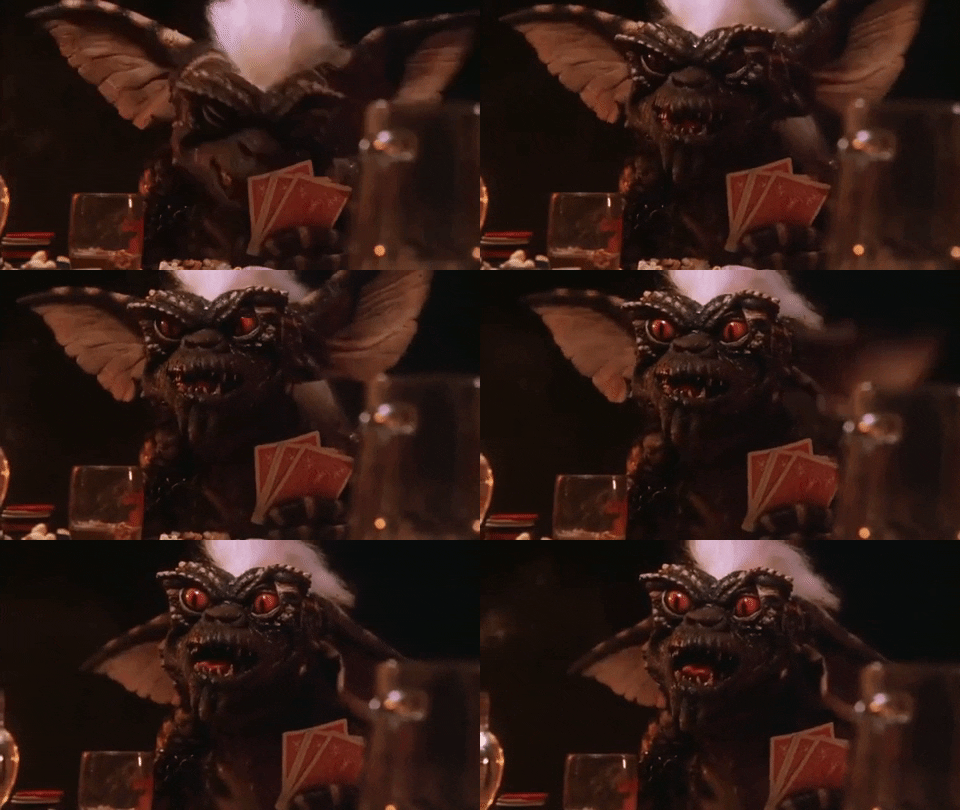
The other day I was watching the movie Gremlins. The movie is one hour and 47 minutes long. Do you know at what point the Gremlins actually appear?

giphy.gif

An hour into the movie.

More than half the movie is build-up.

I’m convinced that this is the proportion of build-up you need to really get the most out of magic in a social situation. I feel you should have at least as much time leading up to the trick as the trick itself.

For the sake of the point I’m making, I’m not talking about quick/eye-candy style tricks. Nor am I talking about tricks that are presented as a straightforward card or coin trick, or something like that. I’m talking about if you’re presenting a trick where you’re trying to establish some mythos behind what’s happening.

This is the mistake I was making with the performances I mentioned at the beginning of this post. I had a three minute trick to show them and I was trying to squeeze that into three minutes. It threw off the pacing I believe you need to establish if you’re trying to get people to engage with your performance in a deeper way.

Think of it like this. If I tossed a photo down in front of you and said, “Look, I took a picture of an alien.” You’d say, “Oh, that’s cool. Is that a mask? Or is it that a doll or something?” You would make some assumptions that what you were seeing wasn’t really that interesting, because I hadn’t built it up in the manner people do with interesting things. I hadn’t given it any weight.

But if I sat you down and said, “Okay… remember how I went hiking last weekend? Well, I took a wrong turn on the trail and ended up in an area of the forest that I had never seen before. I was totally disoriented, but I saw a light in the distance and I started following it.” And I went on to tell you the story of stumbling across this creature and here was this photo I took of it. You still may think my photo is fake, but it’s going to capture your attention to some degree because it’s presented in a way that interesting, compelling, important things are presented.

You might feel you already do this. You might say, “When I read someone’s mind, it’s one minute of build-up followed by a couple seconds where I read their mind.” But that’s not what I’m talking about. I’m not talking about the process of the trick itself. That doesn’t count as the build-up. That’s the performance time. So if it takes three minutes to perform the trick, then I think you need at least three minutes of build-up.

What would that look like?

Well, I’m not suggesting you do three-minutes of promotion like a carnival barker leading up to the trick. “Gather round everyone. In three minutes–three short minutes—I’m going to read your mind in the most amazing, the most incredible, the most unbelievable way you’ve ever seen in your life.” That’s not what I’m saying.

I’m saying you should at least plant the seed that will lead to the effect, a few minutes ahead of time.

For example. Let’s say you’re doing a mind reading trick.

No build-up — “I’m going to read your mind. I want you to write down a word on this card. Now I’m going to put it in my wallet.” Blah, blah.

Build-up (Direct) —“I’ve been looking into the subject of mind-reading recently. There’s no such thing, really. But there are some exercises you can do to build up synchronicity that can lead to something that looks like mind-reading.” You engage in these exercises for a couple minutes and then say, “Okay, let’s try it. I want you to write down a word on this card.”

Build-up (Indirect) — “Can I turn the lights down? My head hurts. I’ve been studying this book on mind-reading all weekend and my head is throbbing. I don’t know if it’s just because it’s got me thinking a lot or if it’s the actual process of practicing it that’s causing my head to hurt.” The seed is now planted. A little while later you say, “My head is a little better. Can I try something with you?”

Build-up (Long-term) — Via text: I can’t come out tonight, unfortunately. I’m going to this workshop on mind-reading. 😜 I’ll let you know how it goes. Later: Ok, that was weird as hell. I’m still not sure if it was a scam or not, but some strange stuff happened. Next time we hang out, I have something I want to try with you.

Regardless of how you present your effects (as psychic powers, as magic, as psychology, as examples of occult phenomena, or demonstrations of extreme skill, or whatever) you are almost certainly presenting them as something unusual, impossible, strange, or incredible in some way. And the way to present such things is with a slow-build before hand.

What I mean is, that’s how we present such things in the real world. So if you want to pull them in and make them feel like they’re about to see something special, then build to it as if it was.

Jumping right into the effect makes the whole thing seem rote and much less interesting. When I find myself doing it, it also feels apologetic and desperate. You might think slow-playing things would be dull. But I find it to be just the opposite. It takes confidence to not rush to the climax. And I think spectator’s sense this and get a feeling of, “Oh, this must be good.” And that colors their impression of what they see.

I’m not telling you to bore people with a five minute speech before getting to the trick. I’m just suggesting you give it the sort of build-up as you would anything of interest.

If you’re making a movie about puppies, then you introduce puppies in the first scene. Puppies are cute, but they’re also normal. If you’re making a movie about Gremlins, you wait an hour and ratchet up the tension and the interest until you unveil this weird/scary/strange thing.

Ideally, I think you want at least a 1:1 ratio of build-up to performance. That’s what I’ve found to be the minimum. But I will often start the build up in some subtle way weeks or even months in advance.

If you aren’t out there performing, you will undervalue how powerful this is. You will say, “I don’t see anyone else doing that. It can’t have that much of an effect.” The reason you don’t see anyone else doing it is because this sort of pacing doesn’t work on television, or youtube, or Instagram, or if you’re doing restaurant magic.

But if you’re showing people in your life some magic in the real world, then this type of pacing can significantly increase the overall power of your tricks.

giphy (1).gif