
Fundamentals: The Eight Pillars of The Carefree Philosophy
/If I was a reader of this blog, rather than the writer, I think one of the things that would be interesting to me is seeing ideas start from their most nascent stages, grow, evolve, get dismissed, etc. It's great to read a book with a fully-formed concept, clearly explained. But a blog is not a book. The fun of a blog is to see the day to day fluctuations in someone's focus and interests and see how a passing notion becomes something fundamental to their thinking.
The issue with that is that if the concept you're building isn't fully understood by yourself when you start talking about it, people can misunderstand what you're saying and just move forward with their own interpretation of what you were trying to get at.
This happened when I started talking about the Carefree Philosophy.
A lot of people who write me about it, since I first talked about it on the site almost two years ago, interpret it as me suggesting you just do self-working tricks or something. But that's not accurate. So today I want to revisit exactly what I mean with the term "Carefree."
Carefree Magic is based on this simple premise: Unintended tension kills magic.
If we are walking outside at night and I say, "Want to see something crazy?" And I have you look at the sky as I casually wipe my hand through the air and the moon disappears, that will feel like the most magical thing you've ever seen.
Now think of this. Same exact effect. Same method. But…
I tell you to look at the moon. Then I'm like, "No, like this," and I grab your shoulders and turn you at an exact orientation. Then I tilt your chin up to look at the moon from a precise angle. "Don't move. Stay just like that."
I'm breathing heavy. My mind is clearly preoccupied.
I step in front of you and say in a rushed monotone:
"Since the dawn of recorded human history, mankind has gazed upward at the night sky and marveled at the celestial bodies therein. Chief among these bodies—and I think you'll agree is the moon. The moon has been a source of mystery, wonder, and also inspiration, for poets, sailors, and lovers throughout the ages. Tonight, however, I would like to invite you to consider the possibility that the moon, despite its long and storied history as an object in the sky, is not as permanent as we have perhaps come to assume. If you will maintain your attention upward, to where the moon currently is, I think you will find what happens next to be... surprising. Please enjoy."
Then the moon disappears.
You would likely still be stunned and feel it's a very fooling trick. But it's a profoundly less magical-feeling experience because of all the areas of tension that shouldn't be there if this was a genuine impossibility.
And while my goal is not at all to make people think what's happening is actual magic. The goal is certainly to make it feel like that. Otherwise, what's the point?
The 8 Pillars of the Carefree Philosophy
Carefree Magic is Easy
Does this mean self-working? Not necessarily. Just whatever is easy for you. It's a trick you can do without focusing on the sleights.
Some magicians can't do any sleights without creating tension at the moment the sleight occurs. For them, self-working magic probably is the best route to take.
Some magicians can do a lot of sleights flawlessly. But these magicians are very, very rare. I'm not one of them. You're probably not either. Most of the magicians touted as being "great" at sleight-of-hand aren't. Not that I've seen. I watch them on video and can almost always tell when they're doing a sleight.
We often talk about "invisible" sleights. And what we mean is that if you look at the deck of cards (for example), you don't see the magician doing the sleight. But that's just one aspect of it. If someone sees tension in your face, your shoulders, your forearms, or wherever, then the sleight isn't invisible even if you can't see it in the hands and cards.
If you feel mentally engaged in a sleight when you're doing it, then it almost certainly shows as tension somewhere. I try to only do tricks that have sleights I can do without thinking about them. That's what I mean by "easy."
Carefree Magic is Present
This one is related to "Easy," but it's not the same thing.
A trick can be technically simple regarding sleights, but still require you to keep track of a lot of moving parts. Maybe you're using a memorized deck. Or a trick that requires a bunch of mental math.
Whatever it is—if part of your brain is occupied with something other than the actual interaction you're having, it shows.
Sometimes it’s fine. If your premise is about how much mental focus something takes, then it’s not an issue.
But if the mental gymnastics are part of the method and not the premise—and if you’re not comfortable doing them under fire—it’s going to feel awkward and tense in performance.
Carefree Magic asks you to be in the room, responding to the person in front of you. Actually present for the moment you're supposedly creating.
If your trick requires you to mentally duck out of the conversation while you do some bookkeeping in the back of your head, it's not Carefree.
Carefree Magic is Unscripted
And by that I mean it is unscripted or it feels unscripted.
Scripting your presentation can be great for helping you guide the experience in a way that makes it as compelling as possible.
But it's dangerous too, because if you're performing casual magic and someone senses you're reciting something, you no longer have something that feels magical.
It also means you can't adequately respond to the things your friend might say to you. You see this a lot when you watch magic demos. The performer is "on book" and if the spectator says something that isn't in the script, the performer ends up brushing past it. Or, just as bad, they'll engage with the spectator for a bit and then switch back into performance mode and continue on with what they planned to say. So you get this abrupt shift between scripted presentation and casual conversation.
Carefree Magic should feel like a genuine interaction. Even if the content of what you're talking about is clearly theatrical or unbelievable.
I will talk more about what I think you should script for a Carefree presentation and how to do so in a future post.
Carefree Magic is Unmanaged
"Spectator management" is a term magicians use which means, "Imposing your will on the spectator to get them to do something they wouldn't normally do."
Examples:
Rushing them through a selection procedure.
Removing an object from them before they've looked at it as much as they want.
Giving them minute, unjustified directions on how you want them to do something they would normally do differently.
We usually think of 'spectator management' as a good thing. We've given it a professional-sounding name and convinced ourselves it's craft. But in most cases it’s just weird and unnatural.
Carefree Magic is Hands-Off
The less you have to touch the items that are in play, the freer and less tense the effect feels.
"I'm going to deal the cards. I'm going to stop. I'm going to turn over a card. I'm going to shuffle it back into the deck."
Carries much more tension than:
"You deal the cards. Stop where you want. Turn over the card you stopped at. Then shuffle it back into the deck."
The reason this works is that your hands on an object keep you in the causal chain. You remain the person responsible for what happens, and on some level, the spectator knows that. When they're the ones handling everything, you're removed as a suspect. There's nothing to control. And when there's nothing to control, there's no tension around the controlling of it.
Carefree Magic is Unprepared
Seemingly unprepared.
When you're carrying around a pocket full of props, there is a psychological weight to that. You're locking yourself into those tricks that you have with you. You're not like a shortstop in baseball, "light on your feet" ready to go in any direction the ball might be hit. It's not that you don't know other routines that don't require that stuff. It's just that if you're bothering to carry that stuff around with you, you're naturally going to default to those tricks. It's the sunk cost fallacy.
Also, when you start emptying your pockets of little props and gimmicks to show people, you put pressure on the moment. It's no longer a seemingly spontaneous moment of impossibility. Now it's this thing you prepared for and bothered to carry around things with you so you could show it to them. It better be worth it.
Stand-up and sketch comedians often dislike improv comedians, because they'll frequently get bigger laughs from less funny jokes. But that's because improv is unprepared, so people are more impressed when it seems like you weren't practicing for this moment.
Similarly, if you can give your magic an improvisational flair, it will get a greater reaction than a technically stronger trick that you've clearly been carrying props around for.
Carefree Magic is Examinable
Introducing objects of interest into an interaction and then not letting someone get an unbothered look at them is a source of tension.
Think of it in any other situation. "Look at this beautiful rock I found!"
"Oh, cool," your friend says. "Let me see."
"Hold on a minute, buster. Keep your hands to yourself," you say as you put the rock in your pocket and walk away.
Does that sound crazy? Uhm, you realize that's how almost all magicians handle unexaminable objects in magic, yes? "Here, pay attention to this interesting object. Now, I'm going to put it away where you can't see it."
Carefree Magic is Comfortable
A fully Carefree performance requires you to be fully comfortable with the audience, and the audience to be fully comfortable with you.
The other pillars of the Carefree Philosophy are going to go a long way toward allowing the person you perform for to feel comfortable with you. They release the tension that makes magic feel awkward.
But what if you are nervous? That will create tension that an audience picks up on and lead to a less Carefree interaction.
Now, obviously the other pillars will mitigate some of the reasons you might have to be nervous. If you're doing a trick that is easy for you and you're not sticking to a rigid script, there will be less reason for performance anxiety.
But what if you're just nervous performing for people in general, regardless of the material?
That's rough, because that's the hardest thing to do something about and the hardest thing to hide from a spectator. I don't know what the answer is, because I don't have that issue. I'm pretty comfortable around people generally—performing a trick or not.
But I will think about it some more and see if I have any techniques beyond reducing the tension in the other areas of your performance. And if anyone has experience getting over generalized discomfort when performing, let me know your tips and I'll pass them on.
One final thing: these pillars are all on a spectrum. They're not binary. And you're unlikely to find a given trick that is fully Carefree. These are dials, not switches. The goal isn't to find a perfect 8-for-8 effect. It's to understand where the tension is coming from so you can make conscious choices about it.
The pillars don't even necessarily support each other. The easiest tricks are often the least examinable. The most hands-off tricks often require the most spectator management. The eight pillars could be seen as eight horses—not always pulling in the same direction.
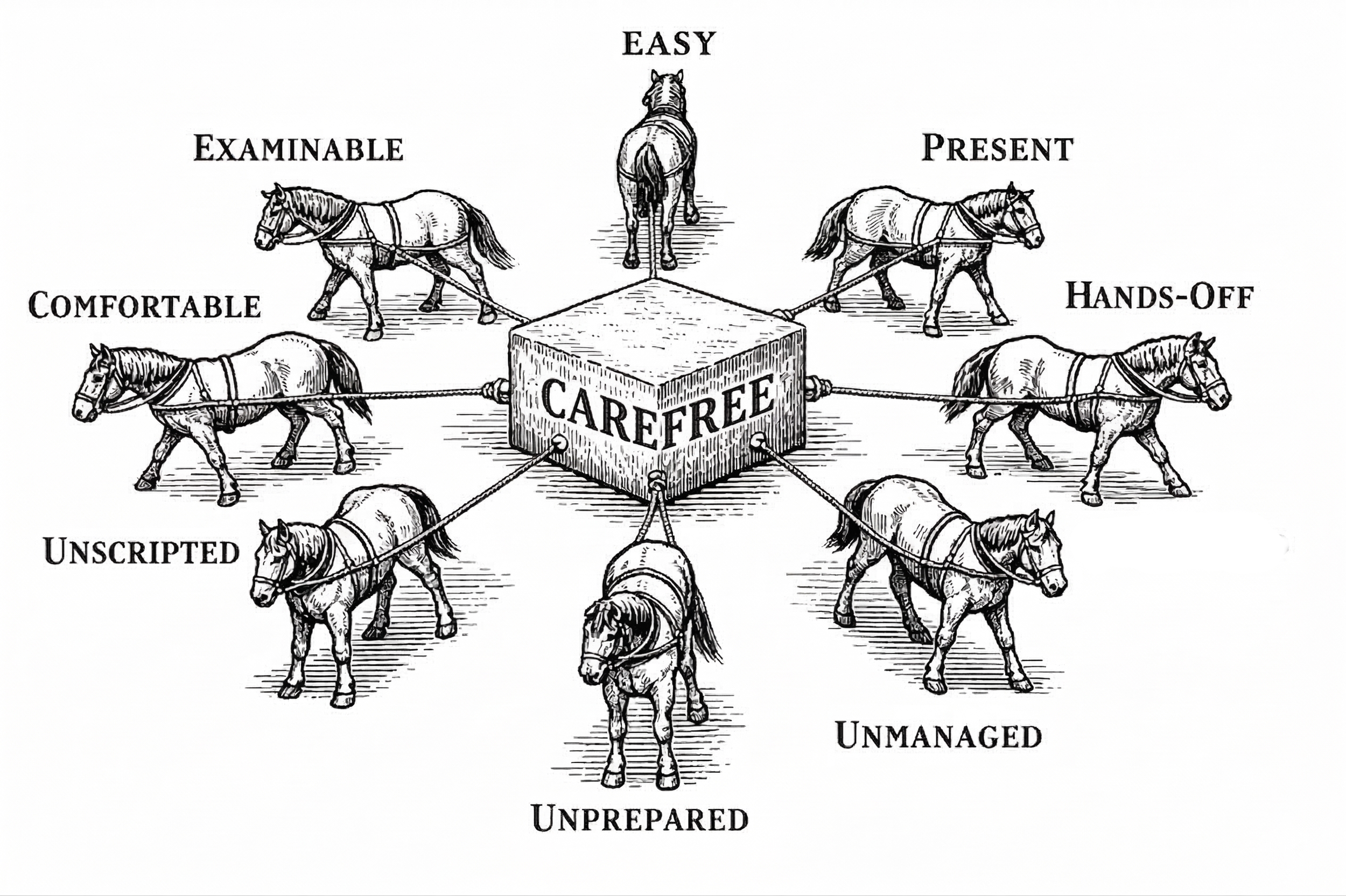
It's difficult to find a completely Carefree effect, and it would be impossible to construct a completely Carefree repertoire. But I’m not chasing perfection, I’m chasing a particular feeling. And every bit of tension I remove gets me closer to it.