Sundry Drive No. 6

I was looking through some old Copperfield specials to see how funny it would be to switch out the music so he would be floating over the grand canyon, for example, to I Want A Hippopotamus For Christmas (Answer: mildly funny.) I had never seen this Copperfield special before, The Magic of David Copperfield VII: Familiares. Below is the climax of the show. I found it very fascinating, specifically because this was the moment the show was building towards, not the vanish of a lear jet or whatever a tornado of fire is -- but this long, kind of hokey, pseudo-nostalgic, Spielberg-inspired, vignette. I bet if you're young you might find it hard to sit through, the pace will seem really slow. But it's interesting too, because it's so different than anything that would close a modern magic special with. If you haven't seen it, check it out below...


I enjoyed this episode of the Freakonomics podcast about surprise and suspense. I don't know that there's anything particularly applicable to magic, but I do think suspense and surprise seem like good, audience-centric goals for a performance that will lead to more entertaining magic. It seems to me we often think of magic in terms that are too small (i.e., here's a new sleight that will fool people) or in terms that are too grandiose (i.e. "Magic gets people questioning the nature or reality and removes all preconceptions of how the world works.") I feel like both of these views are an attempt to ignore the idea that magic is supposed to be entertaining. And that's a disservice to the people you're performing for. What I mean is, if you think playing music is only about how quickly you can work your fingers on the guitar, or you define music as some lofty exercise where the beat of the music is a reflection of the heartbeat we felt in the womb, neither of these attitudes are going to help you belt out some catchy songs.


Dear Gays,

Are there more of you in magic? For a long time I've told people there are. And that my theory was it had something to do with keeping secrets, i.e. they had become accustomed to it in their personal life and so magic was a way of creating art from secrets (as opposed to maybe feeling shame from them). Is my hypothesis bullshit? And is my feeling that there are more gay people in magic than in the general population bullshit? You might say, "Well, it's not magic per se, it's show business, so that draws in more gay people." Which makes sense, but I don't think there are more gay jugglers.

If you want to set me straight (so to speak) send me an email. You can write it anonymously or just tell me that it's not for publication. Don't worry, I value privacy.


I signed up to be a volunteer for Donald Trump's presidential campaign. Everyone is horrified when I tell them this, but I think it seems like it would be hilarious. Sadly, I don't think he's genuinely running because I haven't heard back from them yet and it's been a couple of weeks. I feel like a real presidential campaign would be so hungry for volunteers that they would be all over you after you signed up. Oh well.


We're at two and a half months now of daily posts. I've received a ton of very positive emails since launching this site. So thanks to everyone who wrote. I'd like to specifically thank Joe Mckay and Rob Dobson who have both provided a number of ideas that have or will become posts on this site.


Happy Sunday.


Field Report: The Rubik's Cube Trick

One time I was hired to teach improv comedy skills to a "bootcamp" for guys who can't get laid. I had watched the Pickup Artist show on Vh1, so I knew what I was getting into, but in doing some research on this subculture, the true, sad, nature of it really came through. If you think magic is filled with social rejects, just find your way to a pickup artist bootcamp. One thing the leader of this workshop encouraged the guys to do was to write up "field reports" and post them online about how they tried to get women's numbers or get a kiss when they went out that night. I made the suggestion that it's probably hard to think of yourself as a confident, attractive man when you're writing up detailed accounts of how you asked for a phone number or leaned in for a kiss, so it probably does more harm than good.  But what do I know. I also suggested that wearing a top hat and aviator glasses is a desperate, pathetic look but these guys certainly felt different.

I'd like to take the concept of a Field Report and use it in my writing on this site. Not in the "seduction community" sense of the word, but in the sense that there are some tricks I've performed that I think people might find interesting to read about, but that they are unlikely to be able to do because these performances required something specific to me, the people I was with, the place I was performing, etc. Believe it or not, I consider the effects I normally write up to be very practical and doable in the real world. I know a number of people disagree, but that's just because they're used to a very particular style of trick, a style where you take some coins or a deck of cards, and you do something for two minutes, and that's the end of it. And so when they read something that's like, "Oh, this trick takes three days," or, "Mail half a bill 2000 miles away," it seems like I'm fantasticating the things. But I'm not, I'm just advocating for a different style of informal performance.

On the other hand, these Field Reports are likely not applicable to you and your situation. However, there may be something you can take from them. 

The Rubik's Cube Trick

I was standing on stage at an open-mic night in upstate New York last week. I hadn't planned to be on stage. I have no desire to be on stage ever. But the "winner" of the open-mic got $200 and a free dinner and I saw an opportunity. Everyone, everyone, so far had been a singer with an acoustic guitar. "If I do something even mildly interesting that's not some shitty original song, I will win this thing," I said to my friend.

We went out to my car to see what stuff we had on us. I had a change of clothes and a deck of cards and a sharpie. My friend had a Rubik's cube and a paperback book. I eyed the Rubik's cube and came up with an idea.

20 minutes later I'm on stage with the Rubik's cube. I talk about Rubik's solving competitions and how the new rage in the psychic community is try to solve the cube by psychic powers without ever seeing it. (I was pressed for time, I didn't have a great presentation. But I put it in some jokes -- it was okay.) I talked about how some people fake solving a cube blindfolded by just using a see-thru blindfold. These scumbags were tainting the good name of psychics everywhere. Others will pretend to get the cube mixed up but will then switch it for a cube that's mixed in a predetermined order so that they can solve it without looking at it. I would do neither of those things. To prevent switching the cube I had six people in the front row each sign a side of the cube twice, once in an individual square, and once so their signature covered the entire side. I then had them take turns mixing up the cube and passing it down the line to the next person.To prevent using some phony blindfold or some other way for me to peak at the cube, I would solve it with the Rubik's cube behind my back, my back facing stage-left and my face looking at the audience at stage right.

One of the audience members placed the mixed-up cube in my hands which were behind my back. I gave the people who signed it one last look to verify it was the cube with their signatures, all mixed up, without ever looking at it myself. I took a few moments, kind of weighing the cube behind my back as if each of the 43 quintillion possible configurations for the cube had their own unique weight. I had someone time me. As I worked on the cube I told the audience that the record for solving the cube is just a few seconds. The record for solving it while blindfolded is about 25 seconds, but that person got to see the cube before he started. "The record for solving the cube psychically is... well, there is no record," I said, "because no one has ever been able to do it. They could only fake it. If there were to ba record it would probably be... where are we at right now?" I asked the timekeeper. 

"55 seconds," he says.

"About 55 seconds," I say and hold the now solved cube out in front of me. I give it to the front row to verify their signatures. 

The End

Now, this may be a known trick in the Rubik's magic world, but I don't know anything about the Rubik's magic world, so it was a new idea to me. 

How did I do it?

Try to guess. Only one cube is used. There are no switches. The cube is genuinely mixed up by strangers. It's normal and could be borrowed. They see it mixed up in my hands, and then they see it solved. I never see the cube once it's been mixed. I could have been legitimately blindfolded, or, for that matter, legitimately blind. And the fastest I've ever solved the Rubik's cube while looking at it is about three minutes. So how could I do it psychically faster than I could in real life?

Here’s how. I'm no great Rubik's cube solver, but my friend who was with me is. He's not world class, but he can solve one in about 30 seconds. So, all I did was have the cube signed then have the cube mixed up by members of the audience, making sure it went to my friend last of all. As I was talking he first solved the cube then from there he put it into a known configuration that I could solve with a few moves. So when he placed the cube in my hands behind my back (which he needed to do with my thumb and forefinger on specific center colors so I could orient it in my hands) I knew I just needed to do the few memorized moves in order to get the cube back to solved. And now I'm a psychic cube solver. 

If you ever do this trick, you should split the $200 you win and the dinner of stuffed shells with your friend.

Dear Jerxy

Dear Jerxy: I'm this creep on The Magic Cafe. You need to have 50 posts to read that section. That's the Cafe's high-tech security to keep laymen from finding out our secrets. Anyway, I was wondering how long I should lead my girlfriends on to believe I have special powers. If you don't have 50 posts, then let me quote the heart of my questions:

My two previous girlfriends got to know instantely (while dating) what I was working with and I showed them, windowdressed as I would with a layman. Of course they were amazed and of course it was yet another bonus for a potential relationship that I (their date) had these abilites. The first of the two girlfriends mentioned, really loved psychology and read a lot of books on the topic. She thought I was a freakin master of psychology (psychological mentalism approach) so surely that made her even more interested in me. What they both had in common was that part of their first impression of me was that I was good at psychology. 

Long story short, we fell in love, became a couple and after sometime, with all honesty that comes through a relationship they got to know how it really was. I don't hide when I create my routines, I really want to be open with my partner that I love and therefor it comes to a point where I stop windowdressing and tell them that it is presentations
.

Nowadays both those relationship has ended, not because they knew the true colors but because of other reasons. 

But I do not know if it was a disapointment for them that their first impression proved to be not what it was presented?
   

What do you think?

Not Creepless, Not In Seattle

Dear Creepless: It blows my fucking gourd that you even need to ask this question. Here's how it works: If you are going to take something of value from someone (their money, their time, their affection) outside the context of a performance, then you need to make it clear what the nature of your abilities are or you're a scumbag. If you want to present yourself when you perform as a "freakin master of psychology," then knock yourself out. I have no doubt you are dull as dishwater using that style of performance but that's your choice. But once you're off stage, or the trick is over, you can't let people invest their feelings in you under false pretenses. You know how to prevent this issue? When you're not performing and someone says, "Wow, you're really like a freakin' master of psychology." You say, "Oh no, I'm just an entertainer." Problem solved. 

Ah, but the problem isn't solved, is it? Because you don't want to be seen as an entertainer. Many mentalists don't, because that would require them being entertaining. It's so much easier to fool people than it is to be entertaining. 

Does this mean you need to correct everyone's misperceptions of the nature of your skills? No. But if they're a person you might see again, especially someone you might pursue a relationship with, then yes. Think of it this way, if you would correct the person if they got your name wrong, then you should correct them if they get the substance of your abilities wrong. I mean, if the guy who takes my train ticket reads my name wrong and says, "Have a good trip, Adam." I don't bother correcting him. But if I'm hitting it off with the person sitting next to me and they called me Adam, then I would correct them immediately. Or else you have that awkward situation where you let someone call you the wrong name for three weeks until they end up calling you that name in front of a third party who knows your name and then it's just super weird all around. I've watched people do this. I don't know how they live that way.

I know what you're thinking, you're thinking you don't want to disclose that it's all an act. Obviously you don't or you wouldn't have fallen into the same trap with at least two different women. You think it will eliminate the mystery and the intrigue and make you less appealing to women. Well, maybe it will, but trying to win their affection through deception isn't doing yourself any favors in the long run either. What should you say when she comes up to you later in the evening and says, "You must be a psychological genius," or, "You must have a hypersensitive 6th sense"? You find away to turn the truth into something better than the fiction. How? Oh, for fuck's sake, do I have to Cyrano de Bergerac the whole thing for the uncreative lot of you? OK. You just say something like, "You know, with most anyone else I'd probably just let you believe I was a master psychological manipulator. Because... I mean, who really cares what other people think? But there's something about you... I have no desire to be dishonest with you. Can you keep a secret? [You lean in close] It's actually just the illusion of psychological control. I mean, there is some psychology involved, but it's a little more esoteric than that. It started off as an interest in magic as a kid, but over the years I just kind of went further and further down the rabbit-hole and learned all these strange techniques and weird quirky things from some really cool and bizarre characters. It's hard to explain. Let me buy you dinner sometime and tell you about it." Boom. Done. It's more interesting, intriguing, mysterious, and truthful than saying, "Why yes, I'm a psychological mastermind, and my talent is being able to tell when you're lying about what hand you're holding a coin in. Behold my awesome power!!!" Cut-to four weeks later. She's laying there wondering where your keen senses of observation and ability to detect deception have gone as she fakes yet another orgasm.

Impromptu

Today I'm going to settle a debate that comes up from time to time on The Magic Cafe and in other places. It's one of those questions that comes up frequently enough that I think, "Wow, we're a bunch of idiots," because as a sub-culture we haven't settled the issue yet. But now I'm going to settle it so the next time it comes up you can be like, "Oh, that's settled, let's shut up about it."

And that issue is: What is impromptu magic?

You would think we would have figured this shit out, given that it's a term used in magic advertising. But no, in fact, the definitions are so broad that virtually any trick you can think of will fit in someone's definition of impromptu. That's a shitty usage of the word when it can be used to mean absolutely anything.

No more. Here is what "impromptu" means in the context of magic

An impromptu effect is one that requires no secret props or gimmicks of any kind and could be immediately performed with borrowed objects common to the performing environment.

There you go. So that's settled.

"no secret props or gimmicks" - When people say, "This trick is impromptu as long as you have a loop on your wrist." That is like saying, "That would have been consensual sex if she had just said 'yes' when I asked her to fuck." Or, "This dish is vegetarian except for the ground beef." You can't exclude the one thing that makes something NOT something and then claim that it is that something, except for that one thing you're excluding. Yes, I know that sentence is super confusing. For something to be impromptu then the only objects in play are the ones the spectator knows about. 

"Immediately performed" - Meaning the objects in play don't require any secret preparation that can't be done in front of the audience. A full-deck stack would eliminate a trick from being impromptu, but one where a couple of cards had to be set-up or a card reversed without the audience knowing could be considered impromptu because these are "set-ups" that can be done in the process of performing.

"borrowed objects" - The items don't have to be borrowed. But for an effect to be considered impromptu, then everything could theoretically be borrowed. 

"objects common to the performing environment" - In a way this broadens the definition of impromptu. Impromptu does not necessarily mean that it can be done anywhere at anytime. It's not a judgment on the practicality of a trick. For example, a trick that requires a secret extra penny would not be considered impromptu even though there's a good chance you already have one on you or could acquire one very easily. It's a secret prop, so that's not impromptu. On the other hand, a trick that requires a ukulele and a jar of mayonnaise can be impromptu if you could borrow those items and go right into the trick.

Impromptu does not mean that the trick "appears spontaneous." That is a stylistic performance decision on your part. It's not an inherent quality of a trick.

Impromptu does not mean that it doesn't require practice. The amount of practice something requires is unique to each performer. If you release a book test and the method requires the performer to have memorized the Bible, that trick still might be impromptu. Impromptu is a description of performance conditions, not an indication of the level of practice or rehearsal needed.

Again, we're talking about the usage of the word in magic and as a magic marketing term. 

The purpose of defining the word so strictly is so we can actually use it and allow it to have some meaning. "Impromptu" is not a word that you should slap on a product and have it be meaningless, like "tasty" or "delicious." It should be something like "no dairy" or "this product contains nuts" or something that actually helps you make an informed buying decision. 

Of course this is all predicated on my definition becoming universally accepted, which is unlikely because magicians would rather stumble around and not come up with anything useful than listen to me because I'm a bad man who uses naughty words. So unfortunately you can't just direct people who abuse that word to read this post.

However, we can trick those people. I've put the same definition up here and attributed it to Martin Gardner and Dai Vernon. Now we can use that as the official definition and move on with our lives.

Statistically, Who is the Cafe's Shittiest Guest of Honor?

Sometimes I get a bug up my ass to figure out something completely meaningless. Recently I decided to take a look at all the Guests of Honor in the history of the Cafe and to determine which one stank up the joint the most. To do this I looked at the stats for their "Chef's Special" week and gave each Guest of Honor a score according to this formula: 5*(the number of topics)+the number of posts = total score. I think it's safe to say this formula will not only determine who was the best Magic Cafe Guest of Honor, but without question it will also indicate who the 10 greatest living magicians are.

Here are the 10 best.

There you have it. Those are the best our art has to offer. "Really, Andy? You're suggesting Randy Wakeman is the third best magician on the planet? This list doesn't include Copperfield, David Blaine, Penn & Teller." Yeah, no crap. If those guys are so great, then how come they've never been invited to be the Chef's Special on the Cafe? Use your head, ya dummy.

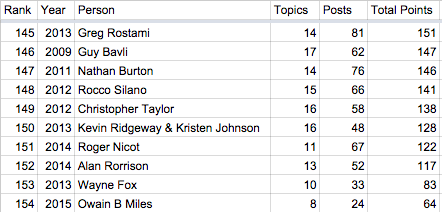
On the other end of the spectrum, here are the 10 lowest ranked Guests of Honor. Sorry, you guys, but you all stink.

And that answers the questions of who the shittiest Guest of Honor of all time was. It's Owain B. Miles. Or, as he's known in the magic world: Who?

You can see the whole ranking of all 154 Guests of Honor here. Finally we have a mathematical proof of who the greatest magicians of our time are. "But Andy, doesn't this score just reflect how well their 'Chef's Special' week went? It doesn't really reflect how good a magician they are." Oh, it doesn't? How dare you question me. Go. Leave. You're not allowed to read this site anymore. If this score is so meaningless then how come it accurately reflects what everyone says about these magicians? Like what do people say about David Regal all the time? "Yeah, he's not quite as good as Rudy Coby, but he's a little better than Michael Rubinstein." Everyone says that. It used to be on his promotional poster, for the love of god.

And you know how everyone confuses Jade and Troy Hooser? Well, surprise surprise, they just happen to have the same total score.

You can also compare their scores to see their relative greatness. For example, Joshua Jay has a total score of 342. Dan Harlan has a total score of 1915. Therefore Dan Harlan is 460% better a magician than Joshua Jay. Sorry, Josh, that's just math. If you've got a problem with it, take it up with Pythagoras.

FMK

In our emails talking about Hide, Keep and Give Away, Pete McCabe wrote:

I can’t believe you didn’t take this just one more step and show the spectator a series of photos of celebrities, and ask them who they would fuck/marry/kill. Now that would be a trick.

Yes, that would be a trick. And now it is.

Effect

You predict someone's choices in a game of Fuck, Marry, Kill.

Method

I want to talk about the method first before getting into a detailed description of how I've performed this. (I've only done it one time.) The method I used is the app iForce by Greg Rostami. What iForce is, essentially, is a way to display any one of 8 drawn or written predictions on your iphone in a manner that seems like you're just turning over the phone or opening the app. Unfortunately, I can't tell if this app is still available. If it is, pick it up, it's a great app. If it's not and you don't already have it, don't worry. In a game of Fuck/Marry/Kill there are only 6 possible outcomes. So you just need an index that can hold six predictions (a pocket index, a wallet index, or whatever). I prefer iForce because it's easy, there's nothing more to carry, and I can do multiple-phases. However if I was doing it without the phone I would make a fake prediction on a business card then switch in the correct one while talking things through with the spectator. [Update 2022: I now use the Draw Cycle feature on the Jerx App.]

Imagine

I send this picture to my friend's phone. 

"Take a good look at those dudes," I say. "Is there a row you prefer?"

"Prefer?" she says.

"Yeah," I say. "Like which one has the hotter guys?"

"I don't know... the lower one, I guess." 

"You think those guys are hot? Wow, you've got issues." [Judging her based on her choices when she only has the choice of shitty options is a running bit in this routine. It's fun.]

"Okay," I say, "Let's make this harder and use the top row. I don't want your burning desire to make things too obvious. And I don't want to have to reupholster my couch if you get it wet from whoever you're hot for in the bottom row. So just take a real close look at each guy in the top row. Give me a minute while I do something."

I fuss around with my phone for about a minute and then set it down. 

"You know, scientists believe attraction is most often based on how we think our features will mesh, genetically, with those of another. This is an evolutionary trait intended to produce the most attractive offspring. So I think I can tell by your facial features what features you would find most attractive in someone as a long-term mate or a sexual partner. Can you smile for me? Okay, now pout. Now crinkle your nose. Perfect. Can you raise one eyebrow? It doesn't matter, just try anyway. Great."

I then maneuver myself over to her so I can look at her phone with her. I look down at the picture and back up at her a few times as if I'm sizing things up. Then I say, "Okay, just do me a favor, can you try and make this face that Charlie Manson is making here?" I go back to looking at the picture and then back at her. "I think I've got it now," I say.

I pick up my phone, make some quick annotations and set it back on the table face down.

"We're going to play Fuck/Marry/Kill with these guys in the top row. Which is only appropriate because I'm sure they'd like to fuck, marry, and kill you. Just probably not in that order. And I believe I have been able to predict which person you would assign to each of those roles, just based on your facial features and how I think that you perceive your own face, and in turn, these faces." 

"So let's start," I say. "Which of these guys do you want to fuck?"

She considers it. "Ugh... I don't know. David Berkowitz."

"Wow," I say. "What is it you find so attractive? That he killed six people or that he's a fucking lunatic who thought a dog was talking to him? You really need to up your standards. Whatever. Who would you marry?"

"I guess this guy. Gacy."

"ooooookayyyyy... uhm, sweetheart, he killed 34 people. And worse than that, he was a clown. That's what you consider marriage material? Look, you're free to make your own decisions, but you have self-esteem issues. This is real talk. Okay, let's move on. So you would kill Henry Lee Lucas? What's the problem? He didn't murder enough people to be your type?" 

"So you'd marry John Wayne Gacy; you'd fuck the Son of Sam, David Berkowitz; and you'd kill Henry Lee Lucas. Correct?"

She agrees. I turn over my phone and she sees this picture.


That is where I ended the trick this weekend and it went over well. It's not a huge miracle, but it's a fun little trick. The nice thing about iForce is that you can instantly repeat it with a different group of three things. I think in the future I will repeat it with two more phases that are increasingly strange. I might suggest that it's almost too easy to run this test with people as the objects, so let's try to go a little deeper, and the second round would be Fuck, Marry, Kill: Apple, Pear, Banana. Then after I successfully predict that I'd suggest that even that is too easy because the shapes and symbolism behind those objects are so ingrained in us by our culture, so let's go with something more abstract. Fuck, Marry, Kill - This, That, or The Other Thing? "Just as I predicted," I'd say, "You chose to Marry This, Fuck That, and Kill The Other Thing."

Method Part 2

[2022 Update Again; Draw Cycle makes this part of the method 1000 times easier.]

Here's how to keep track of your predictions. There is probably an easier way to do this, but it didn't occur to me, so this is how I did it. In iForce the prediction will have a value of 1-6. Or if you're using an index, you'll have each prediction in a position that corresponds with the numbers 1-6.

Whatever the options in the game are, think of these as 1, 2, and 3 going from left to right. Your prediction are as follows.

  1. Prediction One: F1, M2, K3

  2. Prediction Two: F1, M3, K2

  3. Prediction Three: F2, M1, K3

  4. Prediction Four: F2, M3, K2

  5. Prediction Five: F3, M1, K2

  6. Prediction Six: F3, M2, K1

This might sound complicated but if so, it's only because my writing is unclear. In reality it's pretty straightforward. You present the three possibilities to the person in the same 1, 2, 3 order that your predictions were based on. 

For the first round, Fuck, each object has a value of 0, 2, and 4 going from left to right. After they choose their Fuck-target, remember the number associated with it. Then in the second round, Marry, whatever objects are left have a value of 1 and 2, going from left to right. You just add the fuck-value to the marry-value and that will tell you which prediction to use.

So, in the example above, you show her three serial killers. You mentally label them 0, 2, and 4 for the Fuck round. She picked the middle one, so you remember the value 2. For the Marry round, whatever is left has a value of 1 and 2 from left to right. She chose the person on the left to marry, so that's a value of 1. Added to the 2 from the first round, that gives you a total of 3, so you show prediction 3. 

In the example above I present 6 images to them at first. I do this just because it's more people to talk about initially with the spectator, so it's more stuff to joke around about. You could easily set up iForce so you could give them a free choice of either row, but I don't even bother. I just ask them which row they find more attractive, and then depending on which they choose, I will say that we want to use the row they find more attractive or we don't.

Thanks again to Pete McCabe for suggesting the effect and Greg Rostami for creating the app that makes the whole thing self-contained.

The Sealed Room With the Little Door

I spent much of the last 10 years working on my presentations for effects. And I've tested a lot of concepts with real people and one of the concepts I've tested the most is what my spectators respond to the strongest in regards to the implied method behind the trick. So, I looked at:

  1. A strong trick with no implied method.
  2. A strong trick with a believable implied method.
  3. A strong trick with an UNbelievable implied method.

And I consistently get the best initial reactions with 1 and 3. The most mild reactions with 2. And the most long-term reactions with number 3.

Here is why I think this is. I'm not saying the analogy I'm about to give is necessarily true, but it's how I picture things in my mind and it's true when I perform.

A very strong magic trick (where the spectators don't have any insight into the actual method) is like taking a person and sealing them in a square room with no windows or doors or any means of exit. When you give no explanation, people become trapped. They are amazed, but often, after a little while, they give up because there's no where for them to go. 

However, when you give them a believable explanation it's like putting them in a room with a door for them to walk out of. When you say, for instance, "I know where the coin is because I read your body language," you are giving them an exit. And they have two choices: 1. Feel trapped or 2. Walk through the exit you've given them. And so they will do number 2. (Not shit, I mean, they will go through the exit.) They may still be amazed ("That guy can read my body language!") but you are kind of sacrificing the mystery, in a way. And the mystery is the beguiling, interesting, frustrating, and long-lasting part of the magic trick.

Now imagine this, you're in a sealed room with a little tiny door the size of a cereal box. You're trapped, but there's this thing that beckons you as if it's an exit. Your rational mind knows it's not. You know you'll never fit through it, but you can't help but keep returning to it and shoving a hand or a leg out and seeing if maybe there's some way to work your way through. Rationally, you know it's not the way out, but it's the only thing that even suggests a way out, so your mind keeps returning to it. (In the same way you keep looking in your jacket pocket when you can't find your keys, even though you've already checked it five times. You know they're not there, but you can't imagine where else they could be.) This is, I think, the cruelest way to trap someone because they have the hope of escape and each time they reach out that little door and feel around in hopes of finding something that will let them out, it reinforces that they're trapped.

This is how I believe presenting magic with an unbelievable (yet internally logical) implied method affects people too. They know it doesn't provide the escape they need but it's something for them to explore when they feel they have no other option. And I feel like it's a way of fooling people multiple times with the same trick. You show them the trick and fool them, and then their mind looks for a logical explanation and when no logical explanation presents itself, they start poking around your unbelievable explanation (the little door) in their mind. "Okay, I know he didn't really stop time like he said... but maybe he stopped me perceiving the passing of time for a moment? Like maybe when he twirled that card he hypnotized me to not notice time passing? What the fuck am I saying, that's nonsense too." And every time they consider your unbelievable explanation, even partially, they are fooled again.

With a believable explanation you have two possibilities. 1. The spectator believes it, which is good for your ego, but not great entertainment, I don't think. 2. The spectator doesn't believe it and is put into the awkward position of wondering if you really want them to believe this somewhat believable explanation. For these people the believable explanation often seems less like a "presentation" and more like you're lying in order to impress them with some skill/power your don't really possess. Which a lot of you are, of course.

With an unbelievable presentation, you don't have this issue. They understand that you're doing this to entertain them, not to get them to "believe" anything. At least that's my experience. Do they still get caught up in it? Yes. You'll know this because they'll come back an hour later to poke some hole into your bogus explanation. "You said you found that metal disc in the wreckage of an alien spaceship when we were camping. But you couldn't have because I was with you the entire time." To which I'll either say, "Yeah, no shit, I was goofing around. It was just a magic trick." Or, "What are you talking about? I went for an hour hike by myself that night. Wait... you don't think they sent some kind of replicant in my place, did they? Oh my god, please tell me you didn't have sex with my alien cyborg doppleganger." 

Again, I'm not suggesting this is the right way to do things. Just my preferred way of doing things. For me it's more interesting and definitely more entertaining. Of course this is all on a spectrum. Some of my presentations are completely unbelievable, and some are partially believable. Some of the doors I give them will be just big enough to get their pinky through, and some they'll be able to poke their head through. But I always stop short of giving them something they could comfortably walk through.