Dustings #63

There is a moment of sheer terror I face once a year. It’s the moment when my new book gets delivered to my publisher’s house. I meet up with him there and we crack open the first box. What will we find? Will it look as we planned or will it be totally jacked up in some way I didn’t expect? You might think, “Well, Andy, don’t you see some sort of proof copy of the book before they print all of them?” No, not really. There is certainly some way to do this, but my publishing schedule is so tight that taking the time for this step never seems worth it. So we just look at a pdf proof and roll the dice from there.

I think I have PTSD from my second book, Magic For Young Lovers. I can’t remember if I told this story before. Probably. But anyway, the cover for MFYL had a silhouette of a couple looking at each other.

It seemed like a fairly simple cover. But what no one at the book printer mentioned to us was that some of the detail on the cover was too fine for the pigment stamping process that we were using. So when the books were delivered to us, instead of looking like they do above, they looked something like this. (This is just a bad photoshop recreation)

So details in the hair and lips were covered over. And it was clear pigment was in areas it shouldn’t be in because the stamping process debosses the image and there was splotches of color all over the raised areas as well. (You don’t need to be able to picture it. Just trust me that it looked jacked up.)

So when I opened the first box of books to see how they came out, I was like:

So what do you do at that point? It’s not the sort of issue you would get the printer to fix. Even if you did send back a pallet of books, you’d end up waiting weeks or months to get them back. Do you just ship the book off to people and tell them to deal with it? I had no clue. What we ended up doing was getting some small knives and razor blades and painstakingly scraping off the excess pigment on the areas of each and every cover where it shouldn’t be. It sucked.

That’s why book #3 had such a simple cover. I wasn’t going to fall into that trap again.

I got my balls back with book #4 and we did our most intricate cover yet.

With the upcoming book we changed the type of cover, printing and binding we did with previous books. So I was once again holding my breath when we cracked open the box to see what we would find. I was relieved to see the books looking almost perfect. (There was an issue of something not being perfectly centered on the spine due to the inexactness of the book printing/binding process, but I can deal with that.)

All in all, I think the new book looks dope, and I’m excited for supporters to receive their copy.

I’m waiting for the shipping supplies to arrive. An email will go out to supporters collecting their shipping fee and current address next week. Then the books will be sent out over the course of the rest of the month.

(For those who have been wanting a supporter slot for upcoming seasons of the Jerx, I will be launching the new support structure later this month. I’m not going to be adding any more full-supporter slots. But some current supporters are very likely to drop out due to the change in structure. So if you’re interested, that will likely be your time to grab a spot.)


Supporters will also be receiving the next Jerx Deck.
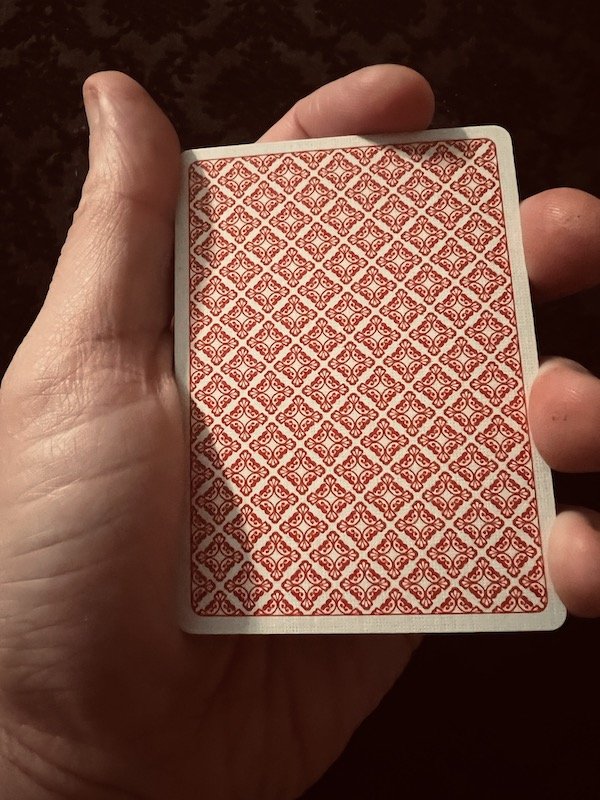
It’s a very bad marked deck. A concept I first described four years ago in this post. But unlike the deck I mentioned in that post, the markings aren’t small. They’re simultaneously obvious, and also completely incomprehensible. It does work as a marked deck. It’s just a terrible one.

If anyone ever accuses you of using a marked deck you say, “Are you kidding? Have you ever actually seen a marked deck? They’re really not like you imagine. The type of marked deck where you can just immediately know the card by looking at the back is the stuff out of movies not real life. In reality, marked decks aren’t that useful. I think I have one I can show you. Hold on.”

You come back holding a deck.

“Okay, first thing to do in order to determine if someone is using a marked deck is to check the case. By law they have to mention that it’s a marked deck on the card box. See here?”

And you take it from there to explain to them how a “real” marked deck works.


Our boys over at Vanishing Inc are going to solve the Ukraine issue this weekend in the only way it can be solved… with a virtual magic convention! So long, Mr. Putin, your days are numbered!

Actually it looks like a good line-up and it’s a good cause. The schedule is here. And you can sign-up here.

I mean, what else do you got going on this weekend? A date with some attractive guy or girl you won over with your charming personality? Let’s get real, we both know that’s not the case. Your options for this weekend are either this, Elden Ring, or that thing you do where you go to a public bathroom and you “accidentally” forget to lock the door so you can get your sick thrill when someone walks in on you with your pants around your ankles.


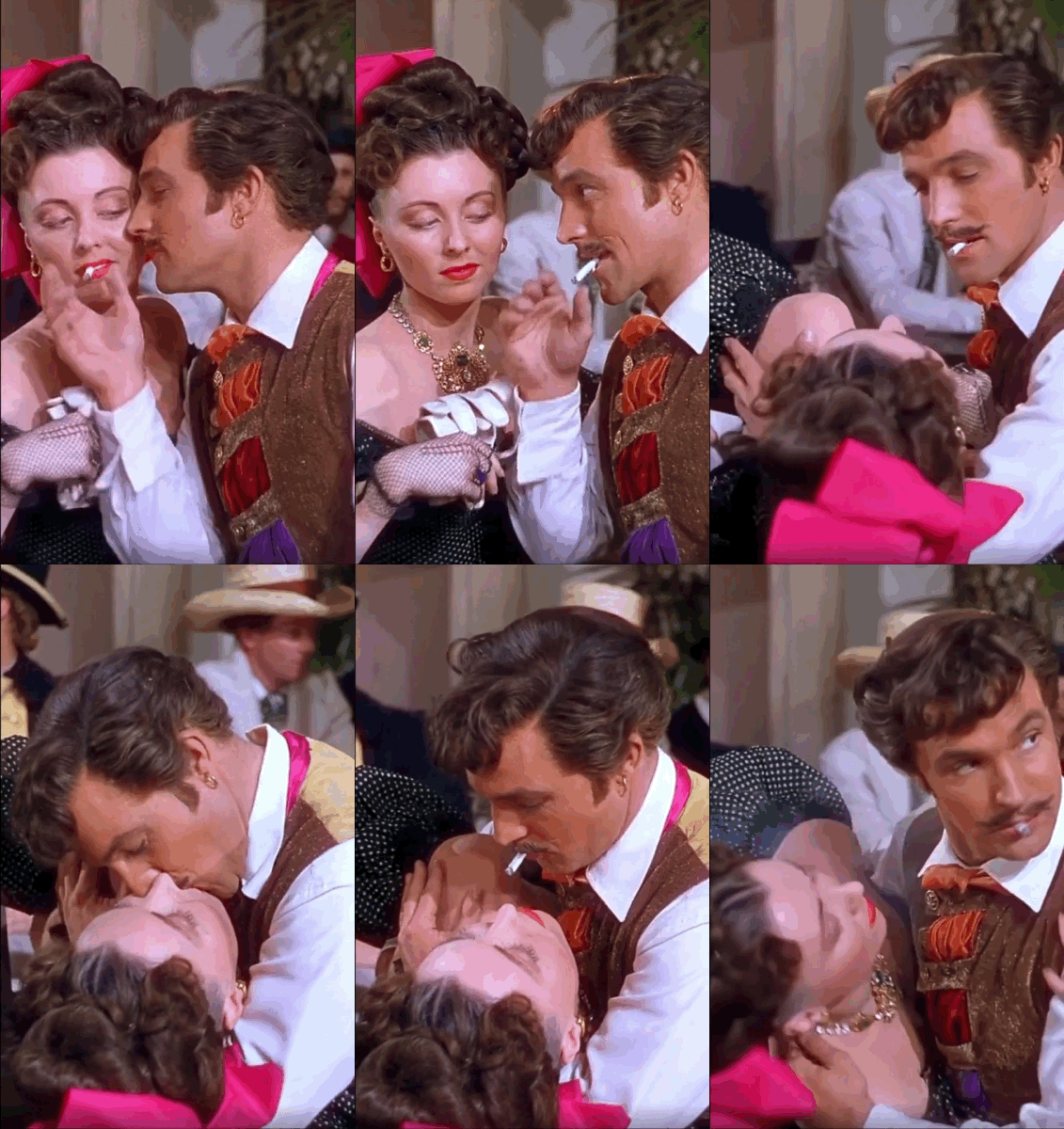
How awesome would it have been to see Tom Mullica redo this scene, except with like 40 cigarettes crammed into his undoubtedly disgusting mouth? That would have been the best.
Quinta Ideas

If you don’t have Phill Smith’s Quinta, in one of the many forms it has been released, you can skip this post. It won’t make much sense. I’m not going to explain everything because I assume if you own it then you’ll be able to put two and two together. (Or instead of skipping this post you can buy Quinta. His Penguin Live lecture gives the basics of the effect. And his ebook gives a real deep dive into it.)

When I perform Quinta, I like to have the rules of the procedure clarified verbally (or printed somewhere) so that I can’t change anything. So the audience always know I’m counting from the left and starting with the first object as number 1. If you know Quinta, you know that requires me to control two variables. I have a number of techniques I use to control those variables. Here are a few…

[I’m almost positive these are my ideas, but I’ve learned Quinta from Phill in a bunch of different formats, so it’s possible one of these ideas was mentioned there and I forgot that’s where I learned it and thought I made it up. In which case, Phill, let me know so I can update this post.]

Idea #1

Number choice for two spectators.

“We’re going to try and create a synchronicity. Adam, think of a number between 1 and 50. Bob, I want you to try and focus in on Adam’s number. Adam, give him a hint. Is it odd or even. Okay… now Bob. Do you have something in mind? 40? Adam… what were you thinking of? 8. Hmm….

“Okay, that’s not actually the synchronicity I had in mind. I was just hoping for some dumb luck. As you can see on this sheet. Before the show I wrote some instruction. The first line says to add up your two thought of numbers…”

Idea #2

Number choice for one or more spectators

“Okay, we’re all going to write down a secret number from 1-30 on your napkin. Don’t let me see. Then we’re going to add up our numbers so we have one ‘group number’ none of us could have foreseen.”

Everyone (including you) writes down a number and places their napkin face down on the table. You go around the table with each person turning over their napkin to reveal their numbers.

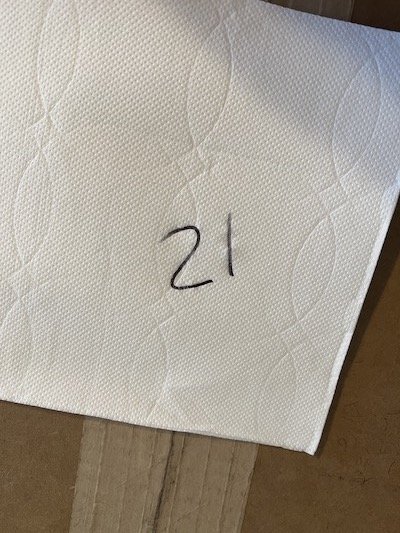
By paying attention to how many odd numbers are revealed you’ll know if you have to say, “And my number was 12,” or, “And my number was 21.”

You can do this with just one other spectator. Or, however many you have. But after four or so people, the number could get pretty high. I don’t actually mind a high number myself. I like the time it takes to count. But I’m weird that way.

Idea #3

Pre Count Positioning Technique

This is an idea that can be used on its own, but for the sake of this description, presume it’s used with the previous idea.

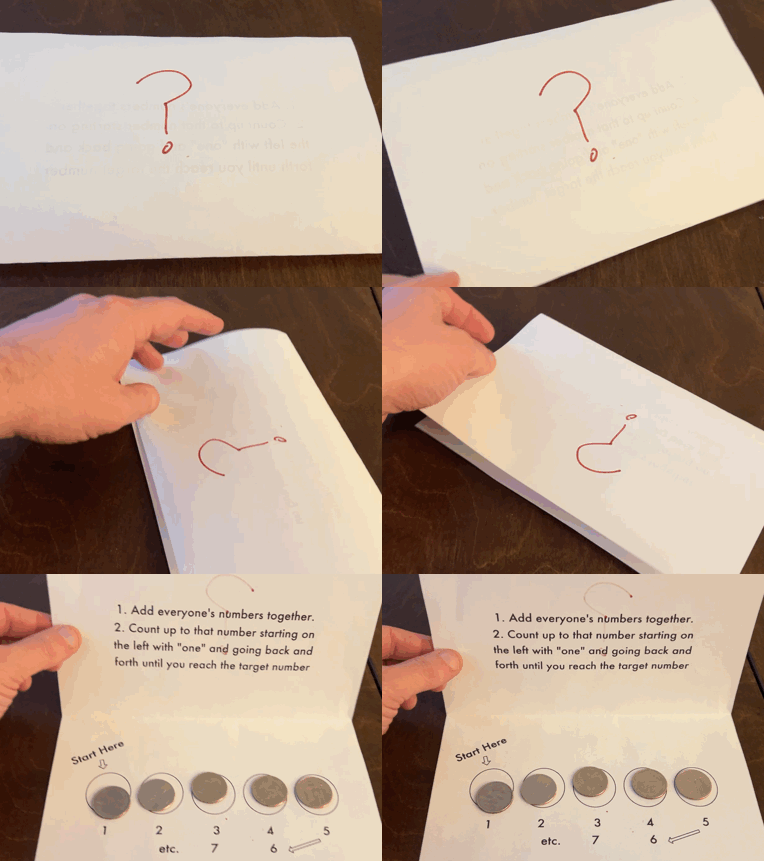
On the table is a set of instructions that look like this

In each circle is a coin. The instructions are folded over so you can’t read them.

Now, depending on what the total is, you either do this

In which case the circles on the sheets are seen as placeholders for where to set the coins.

Or you do this

You let the coins slide out, and now those circles are just an illustration of what the spectator sees before them.

Either way, the instructions are so direct and definitive it would seem very unlikely the spectator would be able to think of this as a force.

Now, would I go to this trouble to force one in five coins? No, most likely not. I’m just explaining a basic concept here that can be extrapolated into a routine that has some meaning. This particular technique with the paper doesn’t need to force coins, of course. it could force any small flat object (which could be representative of some larger object or concept).

I have a similar technique to this that I use which works with any small non-flat object too. But that’s for another day.

Monday Mailbag #64

I recently performed Any Man Behind Any Curtain [From the JAMM #5] for family. I couldn't convince anyone to be the magician so instead I used an auto text app on my phone to send the texts at different periods throughout the night (with options to adjust the final message). To be honest no-one even looked at the texts it was just enough that I checked my phone occasionally. Everyone was blown away by it, including me! So refreshing to perform without being the centre of attention. The magician in question is now a legend in my family!

There was one interesting ruffle in that the pack of cards I found had the jokers in. I chose to leave them in, adjusting the positioning of the cards accordingly. What I didn't count on was that the person dealing through the deck got to the joker (they went with Clubs so were dealing face up) and went to put them aside as if they didn't "count". I just said "Oh I think we should include the jokers" and put it back on the pile. Funnily enough this increased the mystery as on the reveal they said "we even changed our minds about including the jokers!". My participation did not occur to them in the slightest, wonderful. —TC

Thanks for sharing your experience. Any Man Behind Any Curtain is an ACAAN effect done with a Third Party presentation (meaning, a presentation where someone else besides you is apparently behind the trick, and you are just another spectator).

This is one of my favorite ways to perform a trick. It takes the heat off all kinds of moves or techniques that might otherwise be questionable if I was taking credit for the trick myself. Things that would never fly with a Magician-Centric presentation are often completely unnoticed when your role is also “spectator.”

Third Party presentations allows us to capitalize on the idea that magic tricks are frequently done to serve the magician’s ego. When people believe that, on any level, they are completely disarmed when you are are seemingly someone who is equally confused and amazed. It just doesn’t occur to most people that you would be behind a trick and not take credit for it.

Third Party presentations are particularly useful when you have a person in your life who you feel might be holding back a little with their reactions. You get to model being fooled and find excitement in it, and they will see that succumbing to a magic trick doesn’t have to make them feel dumb. It can be a joyous thing.

Once you try it, you’ll likely want to do Third Party presentations a lot. I would recommend against it. At least don’t do it too often for the same audience. As I was writing last week about breaking up Magician/Audience-Centric presentations, if you do this too much it won’t be special. It will soon be just “the way he shows people magic tricks” by pretending someone else is doing them. Two, maybe three, times a years is a good limit for how often you show the same spectators something in this style.


[What are] your thoughts on [the] new trick, Minted?

I bought this at Blackpool a few weeks ago partially on the basis that I own Industrial Revelation but don’t use it very much because of its weight and (in the hands on determined alpha male types) its secret mechanism is discoverable. Minted solved both of those problems for me by being lighter, more portable and the tube shape makes it even harder to pull apart unless you know exactly what you’re doing).

For those of you who are unfamiliar with the trick and can’t watch the video above at the moment, Minted is a trick where you push an object down the middle of a roll of Lifesavers (or something similar). Then you reveal that what’s inside the roll is actually a solid brass tube.

The predecessors to this trick are things like the traditional Matchbox Penetration and Industrial Revelation. I don’t own Minted, but I have owned those tricks and other similar ones in the past. And I’ve always gotten a smaller reaction with these tricks than I would have expected. These effects excite magicians but there is a weakness for them with laymen. And that weakness is that it’s a trick that completely happens in the spectator’s memory. It doesn’t happen in real time. The trick is only a trick retroactively. In the moment, you’re just pushing something through a matchbox, or a card box, or a roll of lifesavers. All things which are totally possible. It’s only when you say, “Ah, but there is a brass thingy in here!” that they’re supposed to be impressed.

This feels like it should be a strong structure for a trick. And in a way it is. But when you talk to people after they’ve seen a trick like this you will very often hear something like, “I must have missed something. I didn’t know what to look for.” They will give this answer regardless of how clean the effect/handling is.

You need to tell people what to notice. “Don’t say the card box is empty, just flash the empty box.” This type of standard magic advice can only come from people who have never really talked to their audience about what they’re thinking after the effect. You can’t just assume people remember everything. Especially in casual situations. (For more information on this, read this post on establishing the condition of your effect.)

So here are a couple of different ways I’ve performed the Matchbox Penetration to eliminate the Easy Answer of “Oh, I didn’t know what to look for. I must have missed something.”

Version 1: Eliminate the Surprise - I would say during the penetration, “You might think this matchbox has matches in it. Or that it’s empty. But actually there’s a solid brass block that fills the whole thing. Yup. A solid brass block. Impressed much?”

Yes, you lose the surprise element here. But not completely. If you act like you’re not going to show it to them and you just want them to take your word on it, then it can still be a surprise at the end when there really is a thing of brass inside there. And, importantly, by telling them what the effect is, they know to look closely. Your hands are empty. There’s nothing poking out the back of the box. The match is really going through the middle, etc.

Version 2: Filmic Evidence - This is how I’ve performed these types of tricks in recent years. Here’s the thing, this sort of trick tends to be VERY CLEAN. But then we end up performing it in a way that doesn’t take advantage of that fact, because the spectator doesn’t know to notice how clean it is in the moment.

So what I do is I ask them to record a video on their phone of something I’m working on. Then I make sure they have a good close-up on everything. I show them the match penetrating the box. “That’s clear, yes? You can see the match going through the center of the box, yeah?” Then, without the box ever leaving the frame, I will take the phone and drop the box in their hand where they can open it and reveal the brass block.

So they still get the surprise of the brass block, but now they can’t say, “Oh, I must have missed something.” Well, they can still say that, but now they have the recording on their phone to rewatch. I would say at least 75% of the time they immediately go to watch it. Which is absolutely fine because there’s nothing to see, so they just end up more fooled.

I’ll admit, this doesn’t make for the most “enchanting” presentation. For whatever reason, it’s very difficult to pull any emotional resonance out of a penetration effect, so I don’t particularly bother. But in situations where I’m looking for a quick, solid fooler, this is a good option. (Sadly, it’s very googleable.)

The Three Act Immersion Strategy

No post today. Sorry guys.

April Fools. There is a post. And you’re reading it right now. Oh my god. You totally believed it. You big dumb dummy! You were like, “Duhr, okay… I guess I’ll go to some other site because there’s no post today.” Holy shit. You should see your face.

No… seriously. You should see your face. See it like I do. See the beauty I see in you. You are beautiful.

And that’s NO joke. That’s just a scientific fact. You’re beautiful, Dave.

(Oh, man. Can you imagine if your name is Dave and your favorite magic blogger just called you beautiful? I bet you’d be freaking out. And you’d feel ready to take on the world. But I know your name isn’t really Dave. It’s Matt.)

(Holy shit. Can you imagine if your name is Matt? And you just read that thing about Dave and you’re thinking, “Did he just throw a random name in here so it would apply to some certain percentage of his readers?” And then I specifically call you out and say, “No, that’s not what I did. This message is for you, Matt.” You probably don’t know what to think right now. But yes, I have to admit, I did just throw a random name in there so it would hit for some of you. The truth is I actually know your name is Chris.)

Where was I…

Wednesday’s post, which talks about how I split up Audience-Centric vs Magician-Centric material, also offers you a very, very simple, fast—but not abrupt—way to introduce alternative types of magic presentations to your spectators.

Now, this is a process that I normally take my time with, just because that’s what I prefer. But this is a way you can do it much more quickly. In fact, you could even do this over the course of one interaction with someone who hasn’t seen you perform before.

It would be a three-step process.

  1. Magician-Centric Trick

  2. Unfinished Magician-Centric Trick

  3. Audience-Centric Trick

So you start with, whatever, Ring Flight, for example. You perform it in a standard sort of way. Borrow the ring, make it vanish, and it reappears on your keyring. Your spectator applauds this useless skill.

Now, it’s very rare to perform a trick for someone and have them immediately change the subject to something else. If you find this happening a lot. that suggests an issue with your performance.

So after the initial Magic-Centric trick, while the subject of magic is still in the air, that’s when you say something like. “Actually… would it be possible to get your help with something I’ve been working on? That thing with the keys and the ring is just an old sleight-of-hand trick. I’ve been trying to branch out and learn some…. more unusual…types of tricks. But I sort of need an outsider’s feedback to see if it works.” You’re setting up the idea that you want to show them something else (either now or at a later point in time). This thing you want to show them is something unfinished. They’re getting a peek at something that others haven’t really seen yet. And this is something stranger than the type of trick they just saw. All of this is going to build upon the interest you generated with the first trick.

So now you do your Unfinished Magician-Centric Trick. Let’s say you read their mind of a word they’re thinking. It’s a little rough, and not completely direct, but you bring it to a successful conclusion.

Now, because they’re seeing the “behind the scenes” of a “work in progress” it makes perfect sense that you’d be talking about how you go about learning these things or how you initially got into magic or something tangential to your actual performance.

That makes it very simple to transition into an Audience-Centric trick.

  • “If you liked that, you should see what my mentor can do. It’s insane. He can do mind reading stuff even when he’s not in the same room. Wait, let me text him.”

  • “I guess I initially got started when I was a kid and my neighbor taught me how to… intuit, I guess you’d say… the colors of playing cards. We wanted to get good enough so we could cheat at cards. We never got that good with the technique to know full cards. But being able to sort of feel the colors isn’t too difficult. I could probably teach you.”

  • “Actually, I was at a convention they hold for magicians recently, and there was this one guy off in a corner with a folding table who was selling something really strange. I have no clue how this works. If you ever stop over my place, I’ll show it to you. Oh, actually… wait. I think it might be out in my car.”

Or whatever your Audience-Centric presentation might consist of.

The nice thing about this is that each trick provides a Hook for the next trick. It’s a little three-act structure where the tricks don’t need to be tied together thematically. Instead they’re tied together by just all being part of the same world. “Here’s a finished trick. Oh, you liked that? Well, maybe you’d like to see this work in progress. Oh, you like that? Well, maybe you’d be interested in a further peek into the workings of magic, or the interests of someone who studies magic.”

The power of this structure is that it allows you to get to some far-out places pretty quickly without it being too jarring for the spectator who has only been exposed to magic presented in a traditional manner. Does that make sense, Chris?

Dear Jerxy: Magician/Audience Balance

Dear Jerxy: For the past few months I’ve been incorporating a lot more story-centric/audience-centric pieces in the the tricks I perform and I’ve been enjoying the different types of reactions I’m getting from these. Is there a particular proportion of audience-centric to magician-centric effects you like to have in your repertoire? Or do you not worry about that?

Signed,
Seeking the Right Balance in San Francisco

Dear Seeking: First, some quick definitions for newer readers.

Magician-Centric Magic: Is when the trick is (supposedly) achieved due to the magician’s skills or “powers” or abilities. This might be a legitimate skill - “Watch how I stack a winning poker hand in just three shuffles.” A legitimate-sounding, but fake skill - “I know where the coin is by reading your body language.” Or a more obviously fictional power - “With the wave of my hand, I can change the 3 of Hearts into your card, the Ace of Diamonds.”

Audience-Centric or Story-Centric Magic or Experience-Centric Magic: Is when the magician is showing something but not taking credit for it. Since magic tricks are inherently magician-centric, to not take credit for it the magician will have to create some alternative story for why what’s happening is happening. And in the process of crafting that story, the audience’s role should change from just watching a demonstration or a “show,” to one where they’re playing a more active role, even if the magician is still guiding the experience along.

Most magic is performed in the Magician-Centric style. That’s just the default that exists when people watch magic. If a dollar bill changes to $100, unless you come up with some sort of story about why this isn’t because of something you’ve done, then they’re going to give you the credit. That’s how magic works with people in this century.

To explain where I am now with incorporating these two different modes of performing, I’ll tell you the journey I took.

Phase One - All Magician-Centric

For the first couple of decades that I was interested in magic, I performed almost everything in a Magician-Centric style. That’s how most tricks are written up and performed by others, so that was what I knew. I didn’t even really consider there to be another way to perform. Magic was synonymous with “pretending you have a power that you don’t really possess.”

Phase Two - 95% Magician-Centric, 5% Audience-Centric

In the mid-2000s, I found myself really appreciating tricks where I wasn’t the focus of the effect—tricks where it wasn’t a demonstration of my own power. Or tricks like Chad Long’s Shuffling Lesson where the magician is knocked down a peg by the spectator. That type of trick felt really good to me and I would collect them whenever I came across them. But still, these tricks felt like an exception to how magic should be presented. And so I didn’t really strive to find as many different ways as possible for how to pull focus from the magician because these types of tricks still felt like anomalies to me.

But as I incorporated more and more into my repertoire I realized the strength of these routines. To whatever extent people have a negative view of magicians, it’s largely built around the Magician-Centric performance mode. “I can do something you can’t do,” is not an attitude that garners a lot of love. And it comes off even more ridiculous when people know you’re pretending to be able to do something they can’t do. Magician-Centric magic can very easily come off as an exercise in validation-seeking. In fact, for adults, it’s probably more likely to come off as that. As an amateur performer, if you’re not performing for someone who is predisposed to like you, it can seem more like “showing off” than entertainment. And after a while, even the people who do like you can get sick of “entertainment” that is built around the idea of how special you are.

And what I was finding at this time was that Audience-Centric magic seemed to prevent a lot of the negative assessments people had toward magic. They didn’t need to believe the Audience-Centric premise. You could blame what was happening on a “magic crystal.” Just the fact that you weren’t actively taking credit for it interrupted people’s knee-jerk reaction to see the trick as an extension of your ego.

Phase Three - 95% Audience-Centric, 5% Magician-Centric

So then I pretty much switched all my tricks or presentations to be more Audience/Story-Centric, as much as possible. Some tricks don’t fit that particular mode so I mostly discarded them from my repertoire and held onto a few that I just enjoyed too much to stop doing completely.

Phase Four - Present Day

On a trick-by-trick basis, going primarily Audience-Centric worked well. But after a while I realized that, for me, trying to make almost everything I performed seem like it was coming from somewhere outside of myself made everything feel sort of disjointed. Because I was removing myself from the equation as much as possible, there wasn’t any connective tissue between everything I was showing people.

These days I try to have the tricks I perform built off the central premise that I’m someone with an interest in learning about and performing magic. So to establish that premise, about 15% of the time, the tricks I perform are standard Magician-Centric effects and presentations.

Another 35% of the tricks I perform come across as somewhat Unfinished Magician-Centric effects. These are tricks I’m actually quite confident in performing, but I perform them in a way that suggests I’m still working on them. This is, primarily, the Peek-Backstage style I’ve written about in the past. Now I’m asking for their help as I work on a trick. So instead of saying, “Ta-dah! The coin has vanished.” I would say something like, “Okay, can you see the coin still? You can’t? Really? Are you messing with me? Oh, sweet. I didn’t think that would work.”

I find that asking people to play the role of “helper” or “a second set of eyes” while you “work on something,” takes a lot of the ego out of performing. And generally it’s a lot more comfortable in social situations for someone to “help” you with something than it is for them to sit and be entertained by you.

But this type of presentation (“Help me while I work on something”) really only makes sense if they’ve seen you perform tricks in a more traditional style. They understand what you’re building towards. You’re building towards being able to perform this trick in a manner similar to the “polished” tricks they’ve seen from you in the past.

The other 50% of my material is done in the Audience-Centric mode. They know of my interest in magic. They’ve seen me perform tricks and they’ve even helped me as I worked on tricks in their early stages. They’ve seen “behind the scenes,” and now they’re seeing even further behind the scenes. They’re taking part in a process that will allow them to briefly be able to read someone’s mind. They’re joining me as an audience member for a trick a third party does over text. They’re taking part in this odd ritual I discovered while reading some old magic books. They’re following these instructions that came with this unusual game I bought while digging through stuff at this weirdo’s garage sale.

The overarching “story” that I tell through my performances is that I had an initial interest in magic when I was young, and I just held onto that interest longer and took it further than most people do. I’ve pursued it far beyond the magic section of the library and tutorial videos on youtube. And that has led to meeting some really odd people, and discovering arcane information in old books, and learning psychological principles that aren’t widely known, and joining secret societies with weird rules, and getting my hands on strange objects that seem to do the impossible. All of these things can lead to “audience-centric” premises. But they really only make sense narratively if you know that I like to do the occasional magic trick.

So that’s my current proportion:

15% - Magician-Centric, 35% Unfinished Magician-Centric, 50% Audience-Centric.

Now, not every individual person who sees me perform sees things in that proportion, that’s just what I shoot for generally as an overall balance of effects.

This ratio allows me to tell the most believable story. That story being: I like to do tricks. Which requires learning and working on tricks. Which requires branching out into these other weird areas, because that’s how you learn the stuff that you can’t find online or at the bookstore.

I want to tell a “believable” story not because I want people to believe it, but because I like the idea of a cohesive narrative that ties everything together. Just as with any other art form, a storyline that makes sense allows people to more easily get wrapped up in the fiction. I said many years ago on this site that I try to see all the tricks I show people as part of one long performance. And I see this blend of performance modes as the overarching structure for that performance.

Without my interest in magic and without me performing the occasional standard trick for them, then all the Audience-Centric presentations would come down to, “Hey I found this weird book,” “Hey, I found this weird pendulum,” “Hey, I found this weird coin.” And it quickly becomes clear this is just a way to present different magic tricks, because no one just finds all that weird stuff.

But by having these various different modes of performance, I can have each one lend credence to the others, while also deepening the mystery of everything I do. If I never took credit for anything, then they would become accustomed to me not taking credit and that becomes just the “standard” way I do magic tricks. But, if I sometimes show people a magic trick in the traditional Magician-Centric style, then that suggests that the other times—when I’m claiming it’s something outside of myself that is responsible for what we’re witnessing—that maybe there actually is something more going on there.

GLOMM Charity Auction Wrap-Up

I had an unexpected work project come up this weekend which will prevent me from putting out a full post today, but I did want to wrap up the details on the GLOMM Charity Auction which ended this weekend.

The final bid was for $2450.

We took in an additional $873 from just straight donations. For a grand total of $3323 raised for the Rape, Abuse & Incest National Network. That’s considerably more than I had anticipated, so I’m very happy.

Thanks to Timon K for offering up the book at the heart of this auction.

Thanks to Bobby H, Tim T, and Michael W for providing me with some bonuses items to sweeten the pot.

Thanks to Meadow P for inspiring this and for pointing me in the direction of a worthy charity.

And finally thanks to everyone who bid on the auction or donated to through the GLOMM link to RAINN

Dustings #62

Supporters, the final issue of this volume of the newsletter will be in your email box tonight.


The GLOMM Charity Auction will end this weekend. We are currently up over $1000, with another $300 or so worth of donations on top of that. Thanks to everyone who has contributed so far.

If you’d like to bid, you can still do so until the the auction ends, which will be at some point on Sunday. Just email me with your bid.

If you’d just like to contribute to the charity and recognize the GLOMM at the same time, you can do so on this donation page.


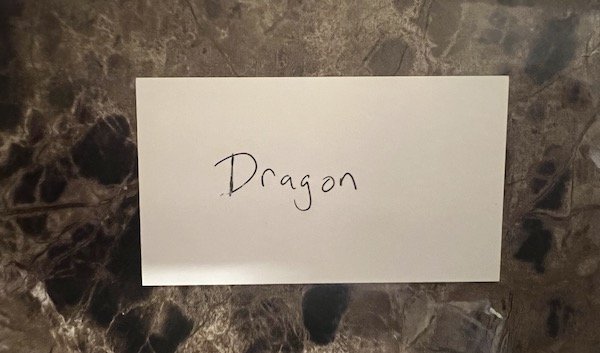
I need your help. Could you write (or have someone else write) a word on the back of a business card and then send me a picture of it? Similar to this?

The card doesn’t have to be on the table. Someone can be holding it or it can be resting on some other surface.

What I’m looking for is ultimately about 50 different pictures, with different words, different hand-writings, and different backgrounds. So if I could get 50 of you to send along a single pic, that should be all I need.

I’ll let you know what I’m using them for when I’ve collected them all.

Ideally, there will be a variety of hand writing styles, including some traditionally more “feminine” styles. So if there’s someone in your life with that style of handwriting, maybe ask them to write the word. But don’t go out of your way to do so. We only need a few words written in that style.

I’d like a good mix of shorter, simpler words, e.g., fish or dance. As well as longer more “interesting” words like jealousy or tablecloth.

If your date of birth is ODD, submit a simpler word.

If your date of birth is EVEN, submit a more complex word.

It doesn’t matter if you forget to do this, I’m just trying to get a good mix.

Don’t try to be too clever with the word you choose.

You can email me your pic when you have it. Put BC Project in the subject line so I can easily sort out those emails.

Thanks.


I had a very unusual experience the other day.

I was sitting at a coffee shop doing some work and there were two guys next to me who were talking. This is a small coffee shop, one where if anyone is talking, everyone is pretty much included in the conversation.

One of the guys was saying he was working his way through the Brittanica Great Books of the Wester World series. Which, from what I’ve learned, is a series of 54 volumes put out in 1952 collecting everything from Plato, to Don Quixote, to The Communist Manifesto. Essentially the sort of books that I, as an intellectual lightweight, can’t make it through two pages of before I fall asleep or get up to see what kind of snacks are in the cupboard.

I truly never feel dumber than when I try and read this sort of stuff.

Anyway, they were talking about this and from there got onto Carl Jung (who doesn’t seem to be represented in that series of books, but I wasn’t following their discussion too closely). Then one of the guys said, “It’s like the ‘collective unconscious’ theory. Do you know about that? Like if there was a jar of jellybeans down at the mall and you could win a prize by guessing how many were in the jar. If you took my guess, and your guess, and Andy’s guess [he gestured over to me, even though I wasn’t taking part in the conversation], and everyone else’s guess here, and you averaged them together, you would get very close to the number of jellybeans in the jar.”

Now, look, I don’t think that’s really an example of the “collective unconscious.” I mean… maybe it is. As I said, I don’t know about smart shit. But regardless, I perked up at this conversation. Was it happening? Was it really finally happening? Was someone really broaching a topic I could do a trick with?

I said to them, “Actually, I think it’s weirder than that. Knowing the jellybeans kind of makes sense, because at least that’s something we can all assess in some way. But my understanding is that the collective unconscious works even with things we can’t perceive. Like….” I wrote something down in my notebook. I told everyone it was a 2-digit number and asked everyone in the small shop to concentrate on what the number might be. Everyone offered up their guesses and I had Evan, the barista, average them on his calculator. Surprisingly (to everyone in the room not wearing a thumbwriter) the average of their guesses (when rounded) matched the number I had written down. The power of the collective unconscious.

Now, I’m not telling you that story because it’s that brilliant of a trick. And I’m not telling you it because it’s a good example of why you should keep a thumbwriter in your bag.

I’m mentioning this because I’m thinking of all the old books and how infrequently social magic was mentioned. But when it was they would sometimes say things like, “This is a good trick for when someone brings up the subject of ESP.” As if that’s a common subject people stumble upon all the time. “Yes, I have to pick Timmy up from baseball practice. Then I’m going to the grocery story. Also, do you think ESP can be learned, or is it something you’re born with?”

Unfortunately, unless you’re hanging out with deranged lunatics who say stuff like, “I wish dollars could float,” the subjects that would easily lead into tricks are rarely brought up in normal conversation, with a couple exceptions (gambling and astrology come to mind).

This story I just told is one of the few times in my life I’ve ever been handed an “in” for a trick on a silver platter. And I’m someone who is constantly looking for opportunities to perform, and trying to capitalize on discussions happening around me. But the truth is that was one of the rare times a “natural” conversation led me right to the doorstep of a trick. Sometimes a subject will come up that will get me 60% of the way there, but I really need to give it a significant nudge to transition into a trick smoothly.

This is why I say it’s so important to let people know you’re interested in magic or “strange phenomena” or psychological quirks or long-lost rituals or unusual games. (Or all these things, as I do.) This way you don’t have to wait around for decades for an appropriate subject to come up “naturally” in conversation. You will have your “natural” opening to get into a trick when someone asks you what you’re looking into these days or when they recount a previous trick you showed them. There was certainly a time where I thought it would be cool if no one knew I did magic and I just sprung these experiences on them out of the blue when certain subjects came up, but that’s not really a viable way to perform if you’d like to perform frequently.

There’s definitely a stigma that comes with saying, “I like magic!!” So I can understand why you might want to avoid saying it that baldly. But it’s worth it to come up with some way you’re comfortable saying it in order to allow other people to open the door for more frequent performance opportunities.


Does anyone have the full-length porn this clip is from? This is all I can find online. This is right in my wheelhouse pornographically. But it’s too short and inexplicit for me to…finish…to. Thanks for any help you can provide.