Re-Tweak: Sort of Psychic Part 3

Sort of Psychic, by John Bannon is a trick I’ve written about a couple of times before. Here and here, specifically.

This is likely going to be a trick that is always in my repertoire. It’s a very straightforward entry point into the Spectator as Magician plot that audience’s seem to easily grasp. The arc to the effect feels pretty natural. The spectator thinks of any card in a deck and sort of “tunes” themself to that card by trying to guess which packet it’s in. After a few rounds of this—and after becoming accustomed to the feeling of being right or wrong in regards to the sense of where their card is—they’re now able to cut a shuffled deck directly at their thought of card (despite never naming it out loud).

I’m not going to get into the method or the previous tweaks I’ve mentioned. You can track down John’s trick and read my other posts above if you’re not caught up.

Today I want to offer a tweak for the effect that comes from Tomas Blomberg. This makes the part of the effect where the 16-card pile is divided into two packets feel even more casual. That was the weakness in the original effect. The 16 cards would be coalesced and then every other card would be stripped out. It felt too regimented, and my previous tweaks were an attempt to address that issue.

Here is Tomas’ handling. We pick up at the point where the 16 card packet has been split in two 8-card portions and the spectator has just indicated which packet contains their card for the first time. You’ll need a thorough understanding of the trick, and to follow along with cards in hand, for this to make much sense.

A - Once they’ve indicated which pile has their card in it, drop the other pile on top.

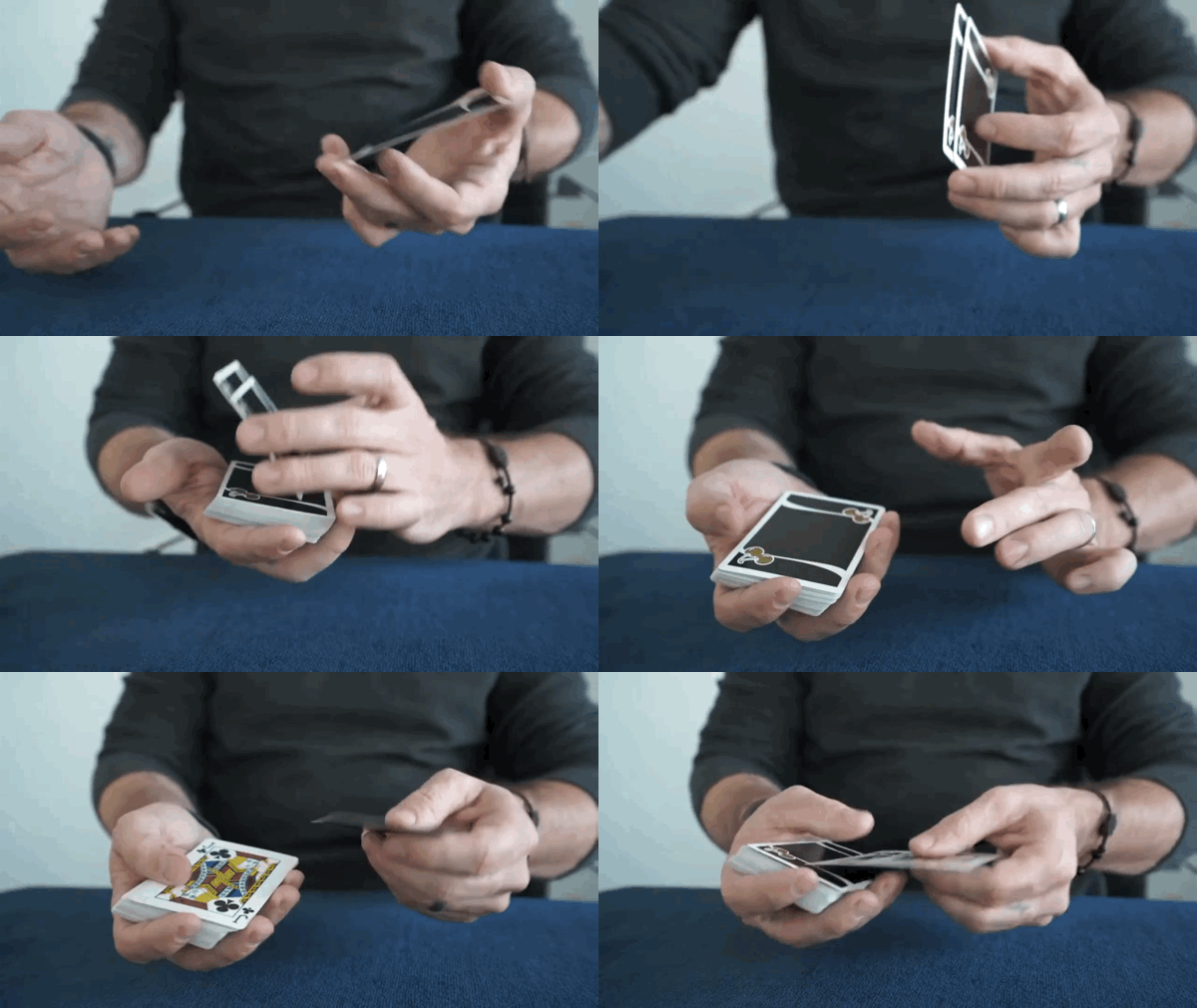
B - Now do an overhand shuffle in this manner: Run three singly, and toss the rest on top. Run four singly, toss the rest on top. Run five singly, then pull off all the remaining cards as a chunk, except the bottom card in the right hand’s packet. Drop that last card on top.

You now have four options on top and four options on the bottom, with one cover card on top, and one cover card on the bottom.

Adding these cover cards prevents the issue where the spectator’s card is continually on the top or bottom each round.

C - Ask your spectator to cut the pile into two packets. These don’t have to be even packets. So long as the pile is cut somewhat evenly, the trick will work. If they cut off anywhere from 5 to 11 cards, the trick works. Keep track of where the top of the deck is.

D - Have them try and psychically find their card. Make note of which pile holds their cards. And reassemble the packet into the orientation it was in before it was cut. In other words, put the top portion back on top.

E - If they said their card was in the top half, you’re going to shuffle face down. If they said it was in the bottom half you’ll turn your wrist and do a face-up overhand shuffle. Either way you do the same thing. Run three card singly, and then pull off everything above the bottom card on the right hand’s portion and drop that last card on top.

F - The four remaining options are now 2nd and 3rd from the top or 2nd and 3rd from the bottom. Again have the spectator cut the pile in half. Again, it doesn’t have to be anywhere near perfectly in half.

G - Once they’ve indicated where their card is for the final time, reassemble the packet by putting the top portion of the packet back on the bottom portion. If their card was in the top portion, place the 16-card packet on top of the rest of the deck. If their cards was in the bottom portion, place rest of the deck on top of the packet. Either way you now have the full deck together and you know which one of two cards are theirs.

H - Riffle shuffle, retaining the options in position. Then cut/shuffle the cards to be set up for the finale. You can figure that part out.

Letting them cut the pile into two packets really makes it feel like you can’t possibly know or care which cards are in which pile. That, in turn, makes the whole thing feel extra-casual, which is exactly what you should be going for with this trick.

Thanks to Tomas for sending this along and allowing me to share it with you.

Monday Mailbag #70

In today's post [WWJD If Someone Googled the Secret to a Trick I Had Performed?}, you provide more (false) info to the spectator about what you're doing, as they teach you their method. In a normal interaction of course, they would continue to ask questions based on the information you provided them. For instance, for the below example: "What do you mean"; "where is the money going"; "how much have you lost" etc. How would you continue the interaction?

Quote for context:

"You know the best part about doing it this way? You could do this all night. The way I was doing it is really a once a week thing. Also, you don’t lose any money this way.” [Implication: The way I was doing it… the money really disappears or something? And you can only do it once a week? Huh?']—RK

Well my goal is to make talking about methods as unsatisfying as possible. So I would give them bland answers.

“Where is the money going?”

“I’m not sure.”

“How much have you lost?”

“Eh, a few bucks. As I said, it’s not something you can do all that often. For the first few months of practicing, the coin never went anywhere, so it wasn’t an issue.”

You don’t want interesting answers because you don’t want to reward them for harping on the method.

The idea here is not to imply, “You found the secret to a trick on google. But what I did for you was real magic.”

My implication is simply that they found a method via google that relied on sleight of hand or gimmicks. I’m happy to talk about those sorts of methods, but what I was using in this circumstance was something a little more arcane.

If they were to press me on what exactly I was doing I’d say “Do you know Ohm’s law?” Or something else they don’t understand. “Read up on that, and that will give you the general idea.”

If they say, “You weren’t doing anything crazy. You were just using that sleight-of-hand method that I learned.”

Then I’d say, “Okay. That doesn’t bother me if you think that. I’d prefer you think that, actually.”

Social magic is about cultivating an audience of people who enjoy seeing something that feels unexplainable. When you find someone who doesn’t, just don’t perform for them in the future. It’s that simple.


I saw Derren Brown’s very fine ‘Showman’ performance at Liverpool on Friday night and I couldn’t help notice the similarities between one of his effects and your effect 'In Search of Lost Time', which I love and have used on friends to great success. I was wondering if you’d had any direct or indirect involvement in Derren’s show? —TH

There was some minor direct involvement early on in the writing of that show. But I don’t think the thing I was involved with ever went anywhere.

Indirectly, Derren would have been reading the book with In Search of Lost Time in it right around the time he was writing Showman. So it’s certainly possible there was some incidental influence. But I don’t really know the trick you’re talking about. So it’s hard to say for sure.

By the way, the thing I was working on for Derren (which is more a technique than a trick) will be found in the next book.


[Regarding] this: https://www.thejerx.com/blog/2022/6/14/the-artist-distracted-in-the-wild ?

Yes, distracted artist at his best. However, now I’m expecting a complete flood of fake videos from all of those Julius Dein-ish account where a fake hidden camera discovers something incredible made by a random bad dressed up magician.

Hope not. At least for my stomach. —FDM

The power of that video is that it doesn’t come from the magician’s account, and we don’t even really see who is performing the effect. Yes, it’s true that you’ll probably see some corny instagram/tiktok magician attempt to capitalize on this idea. It will be difficult though, because the strength of this idea is found in the premise that this is something that wasn’t meant to be captured and broadcast in any way. While it’s possible to fake that, it will be hard to do so in a way that brings the magician any notoriety. So the social-media magicians are likely to avoid it.

New Release Roundup #2

Howdy, Buckaroos.

Time for another new release roundup, where I quickly give my worthless, uneducated opinion on new releases based solely on the advertising copy and first impressions.

I’m just plucking items off Penguins “50 New Arrivals List.”

Color Match by Tony Anverdi

This is essentially $300 to know what color marker someone is holding.

There is one truly brilliant trick you can do with these. And that’s this one that Justin Willman did on Ellen.

(Although I think the “duplicate predictions” part was a mistake, but whatever.)

I’m sure there are other good effects to come be accomplished wit this, but the ones shown in the demo look pretty dull.

Still, it’s very tempting to pick this up. What’s keeping me from pulling the trigger on this is that I’ve found I tend to abandon tricks that at any point need to be plugged in. No matter how good they are. My desire to perform the trick and the battery charge never seem to be in sync.

Plus… would I carry these markers around with me? Probably not. So it would purely be an at-home trick. Which is fine, especially if I’m taking my clothes off at some point during the trick. But it is a mild strike against it.

And while I feel like I could probably come up with a few tricks I’d really enjoy performing with this if I bought it, I feel like word would get around with my friends, “He sure is doing a lot of marker-based magic recently. What’s up with that?”

I don’t know… I think I’m posting about this because I want one of you to talk me into, or out of, getting this. If you have it and it’s really good (or not so good) or you have a particularly strong use-case for it, let me know.

Polite by Raphael Macho

Honestly, I think this looks dope.

Unfortunately it has a big warning sign on it when it says: “Perfect for Social Media.” And whenever I see that I’m like…

Because it means it looks like dogshit in real life.

Red Pill

The ad copy says,

“The magician displays a bottle of pills, and has a spectator hold on to it. The spectator can freely name any playing card, and choose either the red pill or the blue one. When they open the bottle, the chosen color pill will predict the spectator's card perfectly.”

Huh? This is the type of magic I don’t understand at all. “They name a card and it’s found written on a piece of paper inside a pill.” Well… why? Why would you do such a thing? Predicting the card they would name is a magic trick. Rolling up that prediction and putting it inside a pill isn’t a better magic trick. It’s just a needlessly complicated way of giving that prediction to them.

It’s not like pills and cards have anything to do with each other. It would be like putting your prediction in a ravioli. Yes, you could do it… but why?

I mean… maybe ask them how many prescription drug overdoses there were in 2021 and have their guess predicted in a pill. That would at least be thematically consistent.

Then you can follow that up with another new release. This “prank” Covid test. And all your friends can be like, “Hey, does anyone know what the fuck is up with Bob? His magic tricks have taken a real dark turn.”

Nudes Playing Cards

“Hell yeah,” I though, unbuttoning my pants.

Sadly this was a big pump-fake as it turns out the “nudes” on these playing cards are some bullshit artwork from the Metropolitan Museum of Art.

Sorry, that’s going to be a big “no thank you” from me. Here’s the deal… I CAN’T WHACK OFF TO “SEATED NUDE WITH A FLOWER” FROM 1906.

Hmmm…

Or can I?

Dealing With Bad Intentions

After Tuesday’s post I received a few emails asking what I would do if the person who was googling and looking for secrets was trying to be an asshole about it. (As opposed to the question in that post, which suggested the spectator wasn’t ill-intentioned.)

Well, first, on a general note, you may need to look inward first. It’s not uncommon for someone to want to figure out how a trick is done and for them to take to google to try and find an answer. However, it is uncommon for someone to come back to you and try and take you down a peg. If that’s happening with any regularity, then you are likely performing in a way that makes it seem like you’re showing off or trying to impress people.

If people get the sense your ego isn’t wrapped up in this, they don’t tend to come back and try and bust you.

So keep that in mind if this is something you’re dealing with regularly.

But, every now and then, you do just run into someone who’s kind of an asshole.

If that happens, you might try something like this…

Them: I looked up that trick you did the other day. The one with the aces. I totally know how you did that.

You: The trick with the aces?

Yeah, I googled it and figured it out.

Are you kidding?

[Your attitude at this point: Mildly Confused.]

No. I know that the aces were on the bottom. So when I dealt onto those piles, they ended up on top.

[As they describe “how you did it,” your attitude shifts to mild amusement.]

Well… yeah, that’s it. You figured it out. [Pause] Sorry… you looked that up?

Yeah, I found it online. There was no “psychological manipulation” involved. That’s bullshit. It was just the way the cards were set up..

I love that. By the way, you could have just asked me. I would have told you how it was done. I mean… I thought you already knew how it was done. That’s a trick from… hmm… I can’t even remember. I think I got it off the back of a cereal box when I was a kid. I’m really surprised you were fooled by that. I was just trying to kill some time when I showed that to you. I wanted to run through it because I told my niece I’d teach her a trick she could show to her Girl Scout troop. Remember I mentioned that? [You didn’t actually say that.] Hey, but that’s really kind of cool. I never thought something made to fool kids would fool an adult too. You just made my week. That’s delightful. Thank you.

[Your attitude at this point: You’re satisfied. You’re in a good mood.]

If someone’s intention is to be an asshole, then acting genuinely pleased with what they have to say, while simultaneously suggesting they’re an idiot in the process, is a solid way to parry their remarks.

But going forward, try to have better A-hole detection. You can develop it. And once you do you can pretty much avoid them altogether. I haven’t performed for an asshole in years.

The Artist Distracted in the Wild

4.3+ million likes (not just views, but likes) on this Instagram post of a magician in the wild performing in the Artist Distracted style. (The Artist Distracted is a variation on the Distracted Artist style. In this style the magician is in his own world, focused on the trick and not those around him.)

How many likes would this trick have if he was performing for the camera. “Hi everyone. I’ve got a little miracle I’d like to show you with just a simple piece of tissue. Nothing more, nothing less.” Like two dozen, maybe?

This video is just one example. And the Artist Distracted is just one style you can do this with. The broader point goes to what I’ve been writing about for 7 years. The more you remove the trappings of a “performance,” the stronger your magic is (in casual settings) The memorized patter, the highly “routined” tricks, the scripted jokes, the close-up mat, and so on. All of this stuff undermines your ability to create something “magical.”

—Thanks to Nick S. for the link.

WWJD If Someone Googled the Secret to a Trick I Had Performed?

What Would Jerx Do? Is a new feature here at the Jerx that will look at some examples of how I would handle specific situations that come to me via reader mail.

I certainly don’t have all the answers on how to deal with every situation, but I do usually have a pretty clear manner in which I would approach the situation that may work for others as well.

Our first question in this series comes from Z.A.

How do you normally respond when someone says they have googled a trick?

Context: Did Nineteen [A trick from the JAMM #3] probably a month ago, ran into someone who watched it and they privately said oh I enjoyed the trick today, but I looked up how you did the one from last time.

I wasn’t sure the best way to respond, clearly they had come across some description of the TOXIC force.

I mumbled something about it being on someone else’s phone and that I hadn’t touched it before hand ..but clearly wasn’t a satisfactory answer, more he seemed kinda bummed?

I’m wondering if it would have been better just to be like, “oh nice man yup thats it” or something. Just cop to it since he clearly wasn’t trying to ruin others enjoyment as well?

I fortunately don’t get this sort of thing too often. But when I do, this is the tactic I’ll take…

I don’t want it to become a debate about whether they figured out the trick or not. If you do that, it reinforces that that’s the purpose of the interaction. “I’m going to trick you. And if I do, I win. And if you figure it out, you win.” I want to get away from that feel altogether.

For explanation purposes, let’s say I vanished a coin with a French drop. Then a week later someone comes up to me and says, “I googled it. I know how you vanished that coin.” I wouldn’t say, “No you don’t” Nor would I say, “Alright, you got me. I’m busted.”

I would say something like. “You do? Wait… you found it on google? That would be surprising. I don’t think the guy who taught me would put it online anywhere. But wait… let me see what you got. I’m curious.”

I would then make them teach me a French drop or whatever method they learned online. I would stumble my way through it. My attitude would be like, “This is cool. Thanks for showing me this.”

I would say things like:

“This is fun. I haven’t done this sleight-of-hand type stuff since I was a kid. The type of vanishes I’ve been working on aren’t nearly this much fun to practice.” [Implication: I’m doing something other than sleight-of-hand.]

“Did it say what to do if they ask to see your other hand? This way to vanish a coin is cool because it doesn’t hurt at all. But the nice thing about the way I was doing it is that it leaves both your hands empty.” [Now, that’s a lie, of course. If I did a standard French drop previously, then my other hand was dirty at the end. But there’s no way for him to go back now and determine that. Also… what was I implying when I said this way, “Didn’t hurt at all”? What was I doing that hurt?]

“You know the best part about doing it this way? You could do this all night. The way I was doing it is really a once a week thing. Also, you don’t lose any money this way.” [Implication: The way I was doing it… the money really disappears or something? And you can only do it once a week? Huh?]

So that’s my approach. If someone comes to me with the “solution” for how I did something, I have them teach me that method. I want them to get the sense that I’m enjoying what they’re teaching me. And then as I’m “learning” it, I make comments comparing and contrasting what they’re teaching me to the method I actually used.

You see what I’m doing here, yes? They went searching for answers. And I want to impress upon them that doing that is only going to lead to more questions for them. I’m going to deny them the satisfaction of figuring it out. Not for the sake of my ego, but because I don’t want that to be the nature of our interactions going forward. In social magic, you usually have to think long-term. “I show you something and then you google it to try and figure it out,” is not the basis for satisfying magic performances.

Now, of course, this tactic won’t work very well with a super-specific trick. If someone says, “I googled it and I learned that top that floats and vanishes wasn’t your grandpa’s old top. It’s a magic trick you can buy.” Then I’m busted and I just gotta shrug and say, “Yeah, you got me.” But that’s why I generally avoid tricks like that.

In regards to the specific trick mentioned, Nineteen—when presented as I write it up in that issue of the magazine—really can’t be busted. In that trick you make a prediction of the outcome of a series of mathematical operations. But your prediction is wildly incorrect. In the end, however, there is an outrageously fortunate “coincidence” that makes your prediction correct in a way. But the way I present it, I never take credit for the prediction being right.

So if someone came up to me and said, “I know how you did that trick last time.” The interaction would go something like this.

I’d say, “Huh? How I did it? But I didn’t do it. I fucked that trick up big time. I was way off.”

Them: “No, but I know how you got it so the number would match in the end.”

Me: “I got the number to match? I’m lost. That was a lucky coincidence. Do you think if I knew what number you would have gotten in the end, I wouldn’t have just wrote that down in the first place? But I’m curious… show me what you’re talking about.”

And then I’d let them try to teach me the TOXIC force.


If you have a specific situation you’d like my thoughts on for a future WWJD post, feel free to send it along via email.

Privacy Protection

Okay, once again I’m going to take a look at a trick with a bad presentation and attempt to improve it by giving it a context that is more interesting.

I haven’t done one of these posts in a while, so here again are the basic definitions I’m using.

Presentation: Is a motif or subject matter that is laid over a trick.

Context: Is a “real life” situation into which a trick is placed.

If, for example, you do an ace assembly and you say the Ace of Spades is the “leader” ace. And he calls all the other aces to join his pile. That’s your (shitty) presentation for an ace assembly.

If, however, you perform an ace assembly and you talk about a new cheating technique you’re working on that allows you to steal cards out of other people’s poker hand and swap them invisibly for cards in your own, then that would be an ace assembly done within the context of the demonstration of a gambling technique.

Contexts are integral to the nature of the interaction. Presentations are usually just slapped onto a trick so the performer has something to say.

Let’s take a look at a trick that was described recently during a free event hosted by Murphy’s Magic to pimp their decks of Cherries playing cards.

The trick we’re going to look at is at 10:30 in this video. Here Jeremy Griffith teaches a trick where two cards lose their faces.

Here is the presentation he uses for this trick. (In the longer version of the trick, the two cards start off on the deck and then lose their faces once they are removed from the deck).

“If you ever seperate a small amount of cards from the rest of the deck, it can make them very nervous. And it makes them want to hide their faces from you. And they are very good at hiding their faces.”

So this is a trick with a presentation that is about “cards getting nervous.”

This is as bad as presentations get.

You’re anthropomorphizing the cards to say something totally boring. It would be one thing if you were doing that type of hokey “these cards are like people” presentation and you had something interesting to say. But to just be like, “Cards get nervous,” that’s no good. Many people already find watching magic to be an infantilizing thing to do. These types of presentations make it doubly so.

Now let’s imagine the same trick, but with a Context instead.

A deck of cards is sitting on the table.

“Have you seen these types of cards yet?”

You take out the deck and spread it for your friend face up and face down. It looks like a normal deck.

You have them touch a couple face up cards. Or just remove any random pair.

“These things are pretty cool. When all the cards are together, you can see them just fine. But if we take a couple of cards away from the deck…. you’ll see that after a few moments the privacy protection kicks in and you can’t see what cards they are.”

I can still see the faces—whoever is holding the cards can still see the faces—but you just see…what exactly? Blank faces? Or the back design on the front too, I guess.”

You’re implying you’re not seeing the same thing they’re seeing in this moment.

“So if these were my hole cards in poker, I wouldn’t have to be overly cautious of you seeing them, because they’re attuned in such a way that after a few seconds, only the holder of the cards can see them once they’re away from the deck. And, of course, it would work the same for a full hand of poker, or gin rummy, or whatever. No one but you can see the cards in your hand.

“Not until they’re back with the other cards does the privacy protection drop away.”

Now, the goal—as I’ve said a million times—is not that you’re hoping they’ll believe the premise. The hope is just that your premise adds to the effect. “This inanimate object is nervous.” Doesn’t add anything to the faces vanishing. In fact, I’d say it makes it worse.

But demonstrating a new technology that allows cards to only be seen by the person who is holding them is at least a somewhat interesting concept. If you did have such a deck, you likely would show it to people.

Okay, when you’re done with the trick, set the deck on the table face-up. Your spectator will be almost certain you’re bullshitting them, but they may still take a look at some of the cards. If they pick up a few cards, you can now pretend like you can’t see what the faces of the cards are that they hold.

“Yeah, I can’t see those cards at all. It’s pretty amazing technology. I guess each card vibrates at a certain frequency when away from the deck and it tunes into the vibration on the ocular nerve of the person who is holding it. Something like that. Science is amazing.”

If they ask you to demonstrate it again, take a few cards off the deck and act like they can’t see them. When they say they can see the faces, just be like, “What the heck? Damn, these things are flakey. That’s why the World Poker Tour hasn’t adopted them yet.” Reassemble the deck and smack the edge on the table, as if you’re trying to jar the deck into working again. Half-pass the bottom of the deck and go into a very brief all-backs display. As if now none of the faces are showing even when the deck is back together. Smack the cards again on the table again. And now the deck is normal again, but the privacy protection seems broken for good. Toss the deck in the trash. “There’s $240 down the drain.”

If at any point they pick up the deck and look through it and happen to find the double-backer that’s used, that’s fine. That doesn’t expose any part of the trick. You just say, “What are you talking about? That’s the joker. You don’t see the face of the joker here? And his hat here?” Pointing as if you’re seeing these things on the “face” of the card. “Hmm… I don’t know why you’re not seeing it, since you’re holding it. As I said, these things are pretty flakey.”

The nice thing about a premise that suggests: “We’ re perceiving these cards differently,” is that there’s really nothing the other person can do to prove that’s not the case.