Hallmark

Effect

A card is torn in pieces and one piece is held by the spectator. The other pieces vanish. The restored card is now found in a sealed envelope.

Method

Yeah, I know, it doesn't sound like much, but there's more going on here than it might first appear. 

The first thing you need to do is take a duplicate card, tear a corner off the card, then put the playing card inside a birthday (or upcoming holiday) card and mail it to you friend. The next time you speak to them tell them you sent them something in the mail but that they shouldn't open it until you two get together this coming weekend (for example).

Put the torn corner somewhere where you won't lose it before the weekend.

My Baby, She Wrote Me A Letter

I've always liked the structure of a headline prediction where you mail it days ahead and ask someone to hold onto it for you. I wanted to incorporate that into a magic trick because I think it's inherently intriguing -- at least mildly intriguing. For a couple days your spectator will see the envelope sitting on their kitchen counter and wonder what that's going to be about. Anything that extends a trick out from the few moments it takes to perform is good in my book. Using the mail makes the effect bigger and test-conditions-y, in a way. Not only that, but receiving a card or letter in the mail is a less and less common phenomenon. So just the act of getting something interesting in the mail that isn't a bill or junk mail is a small treat for most people. 

On the day of your performance, bring a deck of cards and the torn corner to your friend's place. The torn corner should be in your left pocket.

Tell your friend, "I want to do something special for you, because it's your special day." Tell her to get the birthday card you sent.

Have her shuffle the deck in preparation for the Reverse Psychology Force. Force the duplicate of the card in the envelope on her. 

"You're sure that's the one you want?" you ask. "Okay. Great. Well... there you go. Now you've got your own personal card. And actually the 7 of hearts -- if you look into the meaning of playing cards and fortune telling-- the 7 of hearts means the coming year will be an extremely happy one for you." You look at the card. "I know it's not much of a gift, but it's unique to you, because you chose it. I mean, I guess I could have gone to the mall and gotten you some store-bought bullshit, but what kind of present would that be? This [you point to the card] is at least something unique and personal. Of course society will say it's not a great gift because it's just a playing card. Some people just don't understand what's really valuable in this day and age. Okay... see you later," you say and start walking out. You stop and turn back.

"Okay, I admit, it's kind of a weak gift. I'm sorry. Things have been pretty tight down at the Chevron station."

"You don't work at a Chevron station," your friend says.

"Well, I certainly won't be if things continue the way they're going." You point to the playing card. "I'm sorry. I should have gotten you more. Wait... I know what to do." You ask your friend to tear it into 8ths and give it back to you. When she does you toss all 8 pieces in the air. "Hooray!" you say. "Whew! A shower of confetti. What an amazing experience that must have been for you. I hope you enjoyed my gift. What better experience than to stand there as 1000s of pieces of confetti fall down all around you."

"8 pieces," she says.

"What an amazing moment that must have been. Confetti... it's nature's rainstorm."

"Wouldn't a regular rainstorm be nature's rainstorm?" she asks.

"We should clean this up," you say, and pick up the pieces. "Actually," you say, "I want to try something legitimately special for your birthday."

You now go into The Jerx Torn-Corner Handling.

The Jerx Torn-Corner Handling

I will describe this in the context of this trick but you can figure out how to use it with other tricks. I came across this method a few years ago and it's the only one I've used since. It's the simplest and most convincing vanish of the pieces as far as I'm concerned. And it's fun because the spectator essentially switches in the matching corner and assists in the vanish of the pieces. 

Here's how it's done. You ask your spectator to grab the birthday card for you. As she does you take the matching piece out of your left pocket and hold it in your curled left fingers at your side. All the other pieces are in your right hand at the base of your fingers in a relatively tidy little pile. When she goes to hand you the birthday card, you are going to do a shuttle pass action and pretend to place the pieces from your right hand into your left, but actually retain them in your right. You're holding back all the pieces in a clump like they're one object. Then with your palm down right-hand, and the pieces in Ramsay Subtlety, you will take the envelope from your friend. Simultaneously you will cup your left hand and jiggle it a little like you're trying to get the pieces to settle in some way. Your fingers should be slight spread so the piece that's in your hand can be seen. This piece is masquerading as all the torn pieces, so you don't want to show too much, but just a flash of it. Close your left hand into a fist, and place the envelope on top of your left fist. You put all your attention on your left hand and tell her to concentrate on it as your right hand ditches the pieces.

Now you act as if you changed your mind about how you want to proceed. You lift the envelope off of your left hand and tell the person to reach into your left fist and remove one of the pieces. You keep your left fist fairly tightly closed. Just loose enough for her to barely reach in. You say, "If you get more than one piece, just put the others back." Of course, they can't get more than one piece. There's only one piece to get. And as they remove this one piece as a "receipt" they have just switched in your torn corner, removed the only trace of a card, and reinforced the idea that the hand is full of pieces. 

Look at this vanish from the spectator's perspective. The shuttle pass is a very natural action which is immediately reinforced when they see an empty right hand, and apparently pieces of card in your left hand. At this point suspicion should be low to non-existent. They then clean up the situation for you when they remove the piece from your hand. Only after that do the pieces vanish. In this case I would place the envelope back on top of my left fist, then with my right hand I would press down on it as I opened my left hand, so the envelope was sandwich between my palms, as if I was pushing the pieces into it. 

I would then hand them the envelope to open and find -- inside a birthday card -- their "freely" chosen card restored except for their "freely" chosen piece.
 

Follow-Up: Reverse Psychology Force

I received a number of emails about the Reverse Psychology Force. Half of them were hyped-up and super complimentary about the idea. The other half didn't get it. 

The half that loved it included some magicians whose work I really admire. So that reinforced the notion that I was on to something with the idea.

The half that didn't get it were a bunch of nobodies. So what do I care what they think? No, but I did receive some emails that said things like, "What's the big deal? You force a card and ask someone if they want to change their mind? How is that new?"

Which makes me think I didn't quite explain well enough the moment in the force that makes it so powerful. The moment which makes it, honestly, more powerful than any force I could do even with a gimmicked deck. 

If you haven't read the original post, scroll down a few day, you'll find it. The rest of this post assumes you're familiar with it.

So, you get to the moment in the force where the spectator is looking at the force card and you ask them if they like the card they have or if they want to start over and get a new card. How does this differ from just doing the classic force and then asking them if they want to change their mind? It differs in subtle but big ways.

The multiple, legitimate, free choices during the face down selection of the card
+
The psychological force card
+
The length of the selection procedure
=
The absolute illusion to the spectator that they are making a genuine decision to keep this card over any other one in the deck

Like many of you, I used to do the thing where I'd force a card on someone and then say, "And you're happy with that card? Okay so we'll take your card..." Where you kind of pretend to give them the option to change, but really you're just rushing them along and not even giving them any time to consider changing out of fear they'll say, "Yes, I want to pick a different card." With the Reverse Psychology Force there is no rushing. In fact, not only is there no rushing, you must slow everything down at the point you ask them. You are giving them the option to change and not ushering them on to something else, but letting them sit with the decision. So it feels for all the world like a genuine choice. It is a genuine choice but it's structured so they'll never take it. And it's this moment -- this moment where you slow down the process to wait for their final choice of a card after they've seen the face of the force card -- that can't be replicated in any other force. I mean, you can replicate it, but in that case you're just hoping to be lucky. This force doesn't require luck. The Reverse Psychology Force is like a three-legged stool. In a spectator's mind, in that moment of decision, they're thinking (at least on a subconscious level):

  1. I've already made multiple free choices during this selection
  2. I like this card I've selected
  3. I don't want to "start over" because this process takes a bit of time and I want to get on with it

It tics all three of those boxes. And it's all those together that makes the result of their "free choice" always, "I'll keep this card."  That's what I feel makes it the strongest force there is. The opposite of a force, is a free choice. And this is the only force I know of where the biggest free choice is apparently made after the force card is known. It's 100% disarming.

I wish I was able to express to everyone how much stronger this has made my tricks that involve a card revelation. It really allows me to do anything. And after any reveal you want, you get to backtrack to that moment. "You shuffled. You selected any card. And you even had the choice to change your mind after you picked this card." It's unexplainable to people.

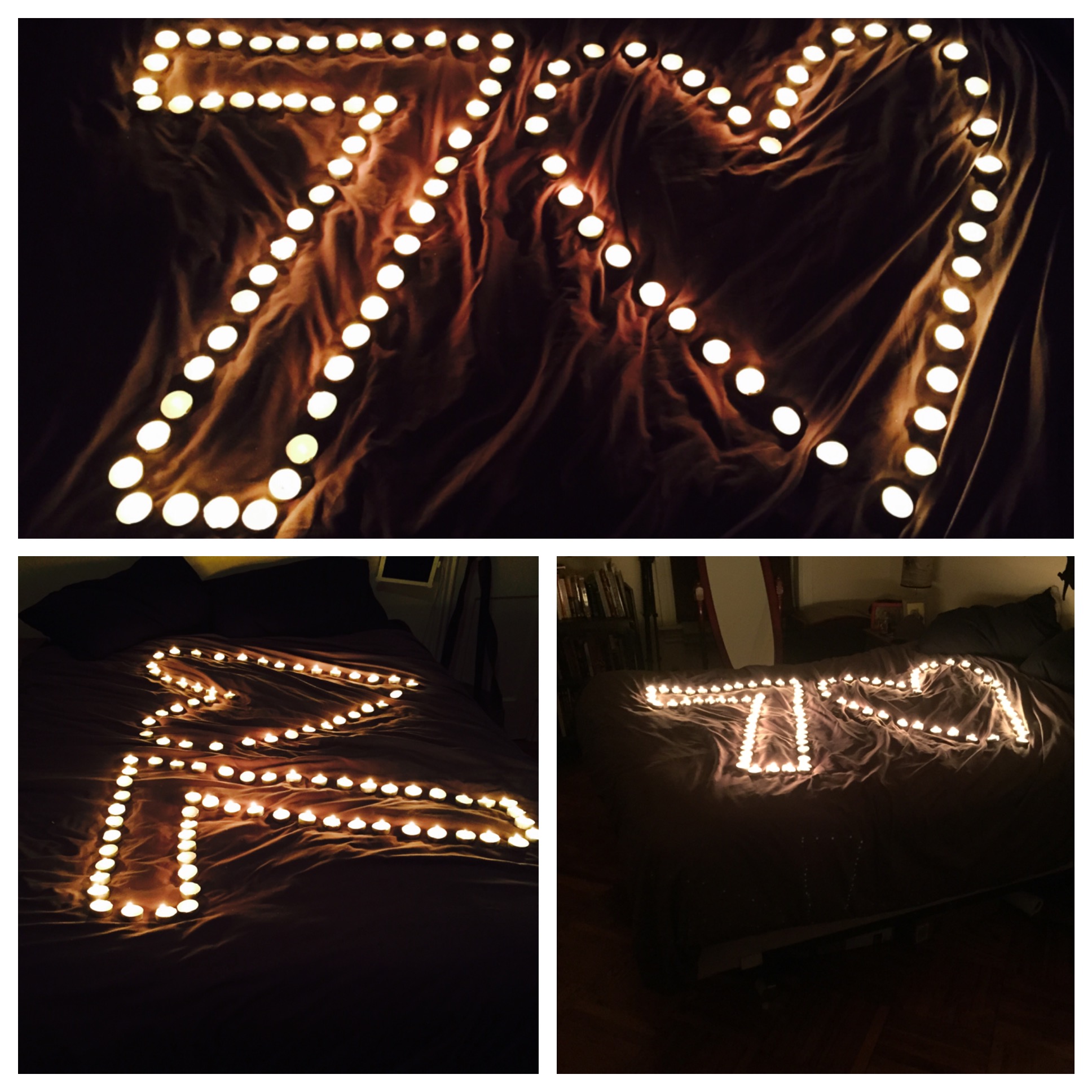
This weekend I performed it with 100 tea-light candles in my bedroom indicating the card. I have french doors between my living room and bedroom and I had black-out shades on the bedroom side of the doors, so at night, when you looked through the door's windows into the bedroom it looked like a completely dark room. I performed this force on my friend in my living room, had her look into my bedroom, we walked over to the doors of my bedroom, I pushed them inward and it was almost like the room was painted with light as the doors swept open. It was essentially a black-art principle and looked very magical. (Although I wasn't trying to imply that the candles "magically appeared," or anything. It was just a neat looking effect in the moment.) And there was her card, the one she had just "freely" decided to keep.

And yes, I'm an idiot, and I left 100 candles burning on my bed unsupervised leading up to the performance of this trick. 

Sundry Drive No. 8

Do you want to release an effect, but the method is a hot piece of shit? Well, something that works really well -- especially in the mentalism community -- is to say that your method is "bold." So just write out an honest description of your method, but substitute "bold" in for "shitty." Like if you have a method that works only 60% of the time, and even when it does it's the most blatant, obvious method, just be like, "This method is pretty bold." 

Another hot tip is to say your method is "a little cheeky." If you say your method is "bold, and a little cheeky," that means it sucks shit, isn't reliable, and a 6-year-old could have thought of it.


There are certain goals in life that I don't understand. Like running a marathon. I understand it's an accomplishment, but whenever someone I know says, "I ran a marathon!" I always think, "You should have ran twenty-eight miles. That would be more impressive." Because 26.2 is just an arbitrary number, and you can always theoretically run a little further, so with any running based accomplishment I'm always like, "Huh, you should have kept running. You stopped just short of doing something even more impressive."

That's why I like binary goals. Dunk a basketball. Do a backflip. Be able to bench-press as much as you weigh.

I especially like that last goal because you can attack it from two ways, either build your muscles or lose weight.

I've decided on a goal for myself recently. I want to be able to solve a Rubik's cube underwater. Not for the sake of other people, but just for my own entertainment. So do I increase my lung capacity or do I try and solve a Rubik's cube quicker? I don't know. I think it's important to have stupid goals in your life.

What does this have to do with magic? Nothing really. I'm trying to give you a peek into my soul, man. My Soul!!!!


Speaking of a peek into my soul, one thing that made me happy this week was when I googled the phrase "Cram it up your buttholes, bitches," and saw that it had never been used before (at least online). Kind of hard to believe for a phrase that has such a lovely rhythm and poetry to it.


Inspiration for a self-referential magic trick.

"This sentence has five words. Here are five more words. Five-word sentences are fine. But several together become monotonous. Listen to what is happening. The writing is getting boring. The sound of it drones. It’s like a stuck record. The ear demands some variety. Now listen. I vary the sentence length, and I create music. Music. The writing sings. It has a pleasant rhythm, a lilt, a harmony. I use short sentences. And I use sentences of medium length. And sometimes, when I am certain the reader is rested, I will engage him with a sentence of considerable length, a sentence that burns with energy and builds with all the impetus of a crescendo, the roll of the drums, the crash of the cymbals–sounds that say listen to this, it is important."  -- Gary Provost

Field Report: The Light House

This is one of the few things I've ever performed that came to me in the spur of the moment and I was able to execute it in the moment as well. There was no planning involved, but I was only able to accomplish it due to a very specific circumstance.

I was meeting up with a potential collaborator on something that is non-magic related. We were having coffee at a place near my apartment. She was slightly older than me, in her mid-40s, and worked in publishing. As the conversation evolved from the subject we were originally there to talk about, she began telling me about her house in the Hamptons that she had does redone with her husband. They were putting the finishing touches on it right now like choosing the lighting, the window treatments, some final painting options, etc. I told her that sounded like a lot of work for a big house. I had just redone the lighting in my apartment and even that was a lot of effort.

As we continued to talk she began asking me what other types of projects I'm involved with and I mentioned that often I use my background in magic when working on a project. She seemed very intrigued by this and asked to see something. The coffee shop we were at had decks of cards and other objects that would have lent themselves to being used in a magic trick, but I was struck with inspiration and I took the box of crayons and a sheet of paper from the stack of stuff they had set aside for kids who came in with their parents. (This is near Park Slope, Brooklyn, an area famous for people lugging their kids around while they get their expensive coffees or buy yoga-pants.)

I drew four squares on the paper, with the second one being smaller than the others. Then I took an orange crayon and printed the word "BLUE" at the top of the page. I told her to take any four different colored crayons out of the box and then color in each of the squares one of those colors. She had a free choice of any crayons and a free choice of which color she would use for which square. I then gave her the black crayon and told her to scribble over one of the squares she had already colored in. She scribbled over the third square which she had originally colored red with the black crayon.

We were left with the image below. I told her to hold onto that drawing for now.


We stopped by my apartment and before we went in I asked her to take out the picture we made at the coffee shop. "You may wonder what this is," I said. "It may seem like some psychological test to see what colors you would choose. [The project I'm working on with her has its roots in psychology.] You might think there was a psychological reason I made the one square smaller or that I printed the word Blue at the top but I did it with an orange crayon. And you might think that I could tell something about you by which color choices you made, and then which square you chose to black out. But this isn't psychology at all. It's all very straightforward. I printed the word Blue at the top, because that's what this is, a blueprint. This is my apartment. On the left is my kitchen, the small square is my bathroom, the next square is my living room, followed by my bedroom. Remember when I said I just changed the lighting in my apartment?"

I gave her my key and had her go inside. The lights were on in the kitchen, glowing purple. The bathroom was lit up with yellow light. The lights in the living room were off. And blue light was shining from the bedroom. When I flipped on the living room lights, everything was bathed in a deep red glow.

The method here will be obvious to some of you, but other people are completely oblivious to it. I knew after talking to this woman, her relationship with technology was not one where she would be familiar with what was going on behind the scenes.

The method is that my apartment is completely decked out in Philips Hue lights, these lightbulbs can pretty much emit any type of light you want and they are controlled with your phone. Below is a video of the lamp on my nightstand going from a standard lightbulb, to fluorescent, to red, blue, and finally purple.

It takes under 20 seconds to set the lights via an app on my phone. So in the process of checking a text after leaving the coffee shop, I set all the lights in my apartment to match her drawing. Presto.

These lightbulbs are pretty cool. They can be pretty much any color, they can mimic any type of lighting (halogen, skylight, antique, etc.), they can flicker like candles, they can be set to go off like lightning, they can synchronize to whatever music you play. You can have it so they emit a very natural light and if you have multiple bulbs set-up you can set it so it will appear as if clouds are passing in front of the sun. What I mean is that intermittently the lights will dim in sequence as if something is traveling across the sky blocking out the sun. There are dozens of apps you can buy to do different things with them. You can have it so any time you start a movie the lights dim to a particular "theater" setting automatically. You can really set them to do anything you want. If you wanted all of the lights in your house to glow blood red whenever you said, "I am Satan, Lord of the underworld," you could do that.

I use them frequently in the context of other tricks, but this was the first time I used them as a secret method. I doubt I'll use them again like that, but who knows. One of the things I'll do with these lights is give my spectator the four aces and ask her to separate the reds from the blacks without looking at the faces. I'll have her try it over and over, in different colored lights, until she gets it right. If she gets it right under blue light I'll say, "Hmm, yeah, this is probably around the same color as your aura. So in this light you'll have a hypersensitivity and you'll be able to do all sorts of seemingly extra-sensory things." To "prove" this I'll perform OOTW for her under the same colored light and then show her that she separated the entire deck perfectly. "You should really buy some blue lightbulbs," I say. "Obviously it's a color that makes you extra perceptive and usually that brings about increased creativity and concentration as well." I'll take any chance I can get to spout nonsense in a very rational way.

Another thing you can do with these lights is set them to glow in any color that you pull from any picture on your phone. For example, I will sometimes take a picture of the person I'm performing for and then set the lights in my living room so one light is the color of her lips, one the color of her eyes, one the color of her hair, and the other color of her flesh. I haven't found a great rationale for doing this, but people find it interesting to be in a room that's illuminated in the colors of their own body. And you can certainly come up with some bogus reason for why this helps you reach into their mind, or fool their eyes, or whatever. 

The bad news is the lightbulbs are like $60 a pop, so if you want to deck out your whole home and you have a wife you have to justify your purchases to, you're screwed.

What Do You Do?

How do you answer that question? I mean, if you're a full-time or semi-professional magician, how do you answer it?

I'm fortunate enough to be involved in a lot of different types of things, but most can be boiled down to "writer" or "consultant" so I'll usually give one of those answers. Sometimes I want to talk about the work I do that's related to magic, but I would never say, "I'm a magician." Do you say that? I have a hard time saying that. It's not that you're all a bunch of losers and I don't want to be associated with you. I mean, you are all a bunch of losers and I don't want to be associated with you, but that's not the reason. To me it sounds so awkward to define yourself as the thing that you pretend to be. It just brings to mind the image of a mentally retarded person with a traffic cone on his head bellowing, "I'M A WIZARD!!!!!" 

I think that's why some people were more comfortable calling themselves "Illusionists." It seems more honest. But then, of course, the differentiation between "magic" and "illusion" became a joke itself.

You might think that when you say, "I'm a magician," that it goes without saying that what you mean is that you're an entertainer who performs magic effects, but I don't know if that's true. I've watched too many friends in a bar talking to a woman and when the woman asks, "So what do you do?" and my friend says, "I'm a magician," the woman will turn to her friend and grab her shoulder and say, "Ooohh he's a magician," as if it's the most hilarious thing in the world. It's always met with a comment like, "Are you going to make me disappear, Mr. Magician?" It's never met with a question like, "Ah, interesting, close-up or stage? What's the busy season for a magician?" It's always treated as a goof. Other occupations don't get this. If you say, "I'm a pilot," people don't say, "Ooohhh... you're a pilot. Zoom, zoom, up in the air! Are you like, Wilbur Wright, or something? Are you going to crash me into a mountain so I have to eat my soccer team, Mr. Pilot?" No. They just say, "Oh, interesting. Airline or commercial?" 

One tip I might offer is taken from the world of wrestling. If someone asks "What do you do." Don't say, "Magician." Say, "I'm a professional magician." If you say you're a wrestler, people are a little confused. They wonder if you were in the olympics or something. If you say, "I'm a professional wrestler," then it's clear that you put on the leotard and jump around; that you're faking it. I think if you say, "I'm a professional magician," you are inherently saying, "I do this fake thing for entertainment purposes," which I think people have an easier time accepting. I'm not 100% sure if that will be better, but I think it would be. I'd be interested in your thoughts on what you call yourself -- if you've put any particular thought into it.

Magic plays a big part in the work I do, but I'm not a professional performer so I can get away without mentioning it up front. My business cards are so general that they look like something a hitman would use in some old noir film.

I tend to bring up magic with people the same way I would... oh... say, a fetish for having women shit on a glass coffee table while I lay underneath. I'm all like, "So... are you into anything weird? Oh... come on... you must have done some strange stuff in your life. Not even in college? Huh... Me? Oh, no, I'm not into anything weird. Nope. Well... sometimes... and this is only when I've been drinking.... no, never mind. You know, it's so fucked up the way society will judge people for what they're interested in. Am I right? I mean, what people do behind closed doors is nobody's business. Okay... I have a confession to make... when I was a kid I did something a little bit, hmmm, a little bit 'silly,' I guess you'd say, and I bought The Amateur Magician's Handbook...."

Another Thought Experiment

Two performers.

Performer #1 - Shows the audience a quarter. He places it on the center of a circular table. It is heads-side up and the face is pointing directly to the left. He covers the coin with a small brass cup and waits 30 seconds, then he lifts the cup and shows that the quarter has rotated slightly.

"Thank you," he says.

Performer #2 - Shows the audience a quarter. He places it on the center of a circular table. It is heads-side up and the face is pointing directly to the left. He covers the coin with a small brass cup and waits 30 seconds, then he lifts the cup and shows that the quarter has rotated slightly.

Then he invites the audience up on stage to show them how it's done.

The table, you see, is not just a table. It's a shell of a table built on top of another table. And the top shell that the cup rests on has a hole in it that allows you to see the coin that's on the bottom table (this is all disguised by the wood grain). 

There is also an elaborate series of mirrors that makes it seem like you're seeing under the table when you're really not.

When the magician sets the brass cup over the coin, the bottom table under the shell table, slides down on a pole, behind the series of mirrors, into a basement below the stage. But not just a regular basement. This one is easily 100 feet below the stage and it sparkles with gold and jeweled decorations. As the audience gathers around the hole to look in, they see a gorgeous blond woman in a flowing baby-blue gown giggling and running in circles around where the table will ultimately come to rest once it has been fully retracted down into the basement. Behind the laughing woman is a short, elfin, man with olive skin on the back of a small horse chasing the woman in circles around the table.

The magician says, "On the horse is Quinn. He is in love with the princess. And she is in love with him if she would ever admit it. Instead she runs in circles all day so he will chase her. He can only keep up with her on the back of that pony." You look down the hole and you can see all of this play out, 100 feet blow your eyes as the princess runs around the table with Quinn on a pony following her. 

The magician hands out some small brass telescopes and tells you to look at the coin on the table at the bottom of the hole. Everyone peers in and you finally locate the coin and you notice that after a few moments it turns slightly, then a few moments later it turns again, and again. "How is that happening?" you ask. The magician tells you to focus your telescope on the pony's tail. "The pony's tail is braided with gold thread," he tells you. "One piece of that thread is longer than all the others. In fact the length of that thread is the exact length of the radius of the circle from where the coin lays in the center of that table to the arc the horse is running along. You might be able to find that thread if you look close enough. At the very end of that thread you will see a spider hanging on for dear life, his back legs kicking in the breeze." You are able to look down the hole and see all of this through your telescope.

"The way the trick works," the magician says, "is that the table is lowered down that hole to the bottom of the basement floor, all the way down there. As the princess runs around the table, Quinn chases her on the pony. The pony's tail is at the exact same height as the top of the table. As the pony runs in circles its tail swings back and forth, slinging the gold thread from side to side. When the thread is slung inside the circle, towards the table, the little spider who is hanging on to the thread kicks its legs behind him, and those legs knock the coin into a new orientation. Then we raise the table back up under the shell table, I lift the cup, and you see that the coin has shifted slightly."

"Thank you," he says.


Who is the better magician?

I think it's number 1, right? I mean, because he didn't expose the trick.


But perhaps you think number 2 is the better magician. I think maybe I might agree with you. Number 2 obviously brought more happiness and awe to his audience and gave them a better experience by exposing the trick. Now you might say that's an unfair example because I chose a deliberately mundane trick with a fantastical method. And yes, that's true, but it was just to establish that it is possible to give the audience a better experience through exposing the mystery.

I said the other day that the way Penn and Teller used to sometimes be denounced as "exposers" is embarrassing to magic. It's embarrassing because there is a fairly significant population of magicians who do not understand the difference between "exposure" and the artistic revelation of magic methods for an esthetic purpose. And that's because, for those people, all that matters is the secret -- the entertainment or experience of the audience is a non issue. So for them, some dipshit giving out secrets on youtube because he has nothing worthwhile to post is the same as Penn and Teller doing the cups and balls with clear cups. 

I'm bringing this up now to set the groundwork for future posts. I think "exposure" can be used to entertain an audience, enrich their understanding for and appreciation of magic, and to create stronger effects. Exposure is a tool in your toolbox. And if you use it correctly you can captivate people with this type of knowledge and you can use it to devastate them with an even more clever method on top of the one you expose. Now please kick me out of whatever corny club it is that pees their pants whenever Mac King teaches you how to pull your thumb off before the commercial break on World's Greatest Magic.

The Reverse Psychology Force

This is the strongest card force there is.

Yeah, yeah, I know. Here's the thing, when you write a blog and half the time you're "in character" talking about what a genius you are and the other half of the time you think you're truly giving out genius ideas, it can be a bit confusing. Most of the time I'm not sure myself if I'm being serious or not. I read through old tricks and see a million ways for them to be improved. I read articles on theory and think I have better and more creative ideas on this blog multiple times a week. So when I write something on this blog about how this is the next evolution of magical thought, I'm doing it as a goof, but then part of me is like, "Actually, I kind of believe that."

At any rate, I was never going to write about this force. For me it is one of the most valuable things I've ever come up with. But when you give something away for free on a blog then I think everyone just thinks, "Aw, well here's another hunk of nothing, if it was anything good he'd sell it as a limited edition manuscript." Because we're all familiar with people selling half-baked shit for $600. And it's kind of easy to just assume anything without a price-tag like that is probably not all that worthwhile. Fine. The truth is, if this blog was a private, subscription-based thing that you had to pay for, then some of you would feel you got your money's worth based solely on this. 

I had originally written this up as part of a trick I'm posting next week. It's a trick you can do for someone's birthday, but it demands a really good force. I was going to hide this force in that write-up, but I'm already hiding a really strong addition to the torn corner ruse in that trick (which involves a spectator assist in the switch and vanish) and I didn't want the explanation to get overwhelmed.

So, I'm shining a spotlight on this force. As usual, my magic knowledge is not vast enough to know if it's original to me, but I feel like I would have read about it if it wasn't. It may seem like just a few small tweaks, and that's really all it is. But it's like if you had a boat with three small holes in the bottom and I plugged those holes with three small corks, then you'd see the value in those "small tweaks" to the bottom of your boat.

What are the strongest card forces you can do in magic? I think many people would argue they're the classic force and some version of a psychological force. But the problem with both of these forces is that the stronger your revelation is, the more heat is put on the force, and the "obvious" solution occurs to the spectator. "I guess he must have made me pick that card," or "I guess everyone says 7 of hearts."

I wanted to create a card force that I could use for even the most insane revelations and yet the card force would be beyond question. It had to be so strong that I could force the card on someone, walk outside, see the card up in the air in skywriting, and for them to still not question the fairness of the force. 

I came up with a handful of ideas and would test them with the following trick. I would have a duplicate of the force card in my pants pocket or my shirt pocket. I would stand my spectator directly in front of me and give her the deck to shuffle. When she was done I would take her right hand, curl her three fingers in so just her index and thumb were out, then I'd guide those fingers into my pocket and tell her to hold onto the item that was in there (the duplicate force card). Then I'd force a card on her and tell her to remove the item from my pocket. This might not seem like much of a trick to you, and with most forces, it's not. But if you have a force that is structured in a way that it couldn't possibly be a force, then this is an AMAZING trick. A classic force or a psychological force will crumble under the weight of this revelation, it's just too strong and direct. I knew once I had a force that could withstand this revelation, then it could withstand anything. 

And that's what led to the The Reverse Psychology force. It's a force that is essentially 100% effective, theoretically it could fail and I'm sure it will for some of you, but in the maybe 80 times I've done it in a performance situation, it has never not worked. And even if it did, like any other force, you could just perform a different trick -- there's no risk in a potential "failure." So the force is essentially 100%, and yet no layperson would ever feel it was a force, and, in fact, the few magicians who have seen this didn't understand how it could be a force. 

Haha, have I built it up enough yet? I think I'm just procrastinating from actually giving it away.

Okay, here we go. 

Let's build the force from its elements.

- The foundation of the force is an under the spread, cull style of force. You need to have that force in your arsenal. 

- This part isn't necessary, but to me it's part of what makes this force seemingly perfect. Palm out your force card and give the deck out to be shuffled. When it's returned to you, replace the palmed card and get it into position for your under the spread force with a little additional mix on your part. For me that means it's the fourth card down. Get it into position without looking at the deck. You might consider not palming out the card and just having them shuffle and then doing that thing where you look at the cards and spread them between your hands and say "Does this look well mixed," spotting the card and culling it out. I don't like that. It feels suspicious. Palm out the card, or don't bother with the spectator shuffle.

- Start your force, asking the spectator to touch any card at all. Tell them to keep their finger on the card. Ask them if they want to change their mind. Spread a little further and say that you can go further down if they want. Then indicate the cards in your right hand and say, "Or we can also go back and pick an earlier card, it's completely up to you. When we're done I don't want you to say, 'Duhhhh... I think you made me pick that card.'" You don't have to say that last part, but if you do, say it like a true fucking dimwit. You're planting a seed here that only a moron would think you could make them pick a specific card. Really give them time to consider this choice. It's the first of two apparently free choices in this force, and it's important they recognize it's up to them how the selection of this card proceeds.

- Once they've decided exactly which card they want (again, give them a beat longer than you normally would to decide this), you show them the card or remove it from the deck or however you handle your under the spread force.

- Now you say, "Do you like that card? Or do you want to start over and pick a different one?" And you spread the deck, showing the faces of the other cards.

- Wait... what?

- Yes, you give them the option to change to a different card. How does that work? Well this is where the force gets its name, because unlike a traditional psychological force where you're using verbal manipulation or some psychology and hoping they name the card you want, with this force you are going to physically force a psychologically attractive card on them. Now, instead of hoping they choose the 1 out of 52 that you want them to, you only need the card to be attractive enough to them that they don't want to select another card. And they'll never want to select another card. Why not? Three reasons:

1. You've forced a card that is appealing in some way. If I don't know the person I'll choose the Queen of Hearts for girls, and the Jack of Spades for guys. The overwhelming majority of people are not going to swap a card they might find interesting or identify with in some way for the possibility of ending up with a 6 of clubs or something.

If you know their favorite number -- just from knowing the person in life or by asking for it earlier in the evening in the context of a different trick -- you can also force any card of that value on the person. 

2. This is the second of two apparently free choices. If a spectator wants to dick around and swap cards, they usually get that out of their system in the first part of the force. This is why you make the decision to switch such a big deal in the first part. Giving them another chance to change their card at the end just feels a little like overkill.

3. Once they've seen their card you don't say, "Would you like to switch it for a different card?" (Although you probably could say that.) Instead you say, "Do you like that card?" At this point they'll think either "yes" or "whatever," they won't think "No," because you've chosen an attractive card and people just don't care enough to actively dislike a card. Then you say, "Or do you want to start over and pick a different one?" Start over! What does that mean? Like have her shuffle the cards again and go through the whole choosing procedure again? That's the boring part of the trick. No one wants to "start over." Everyone just wants to move forward.

Now put yourself in the spectator's position. You shuffled the cards (so there's no way the magician could have known which card was where). You touched any card you wanted. You were asked multiple times if you'd like to change your mind. You saw the card and you were again given the option to change your mind and pick a different one. If you now pull that card out of the magicians pocket or see it in the air in skywriting, where is there for your mind to go? 

The Reverse Psychology Force -- by combining a physical and a psychological force -- opens up the possibility for any revelation you want. Everything that you may have considered "too strong" is now on the table because you can't backtrack the trick to a force because there's too many free choices involved. In fact it really should be saved for truly strong revelations. It's probably not something that you should use regularly on the same people because at some point all the freedom involved in the selection will seem suspicious if they notice it's the same degree of freedom each time they pick a card. But you can definitely get away with using this once a year or so on someone, and there is no limit to the revelations you use with it. So go ahead and get that queen of hearts tattoo, or be a man and just carve it in your thigh with a knife.