Cup of George

This is a fun little moment. The methodology is very flexible. Although it does require a stooge/friend/wingman to help you out. But their role is incredibly easy. 

Imagine

I'm meeting up with my friend Samantha to get some coffee and do some writing at our usual cafe.

"Do you have any new tricks you're working on?" she asks.

"Uhm... hmm.. not really," I say, as if I haven't been waiting specifically for her to ask this question. "Actually, I do have one thing I want to try." I go and get an empty cup from the barista. 

"Do you have a dollar bill?" I ask Samantha when I return.

She pulls one from her pocket. I ask her to crumple up the bill into a small ball and place it on the table. I cover it with the cup and slide it towards her. I don't touch the bill.

"This next part is just in your imagination. Rattle the bill under the cup and imagine it's a 6-sided die. I want you to peek under the cup and tell me what number is on top of the die." She does this and says, "four." I tell her to keep the bill under the cup on her side of the table so no one can get to it.

"We're going to use the number you 'rolled,' and wait for the fourth person to come through that front door. We're not going to talk to him or her, necessarily, we're just going to make note of who it is."

A young woman in yoga pants and a tank top comes in the door. A few minutes later a middle-aged woman with a computer bag enters. Soon after that, another younger girl in athletic clothes and a ponytail comes in. She is closely followed by a thin guy with a sweet afro and sunglasses. 

"That's person number four, right? You did say four? Not five?" She assures me she said four. 

"Are you fine with him? Or do you want to roll a different number and start again?" She's fine with him.

"You could have picked any bill you had on you, and 'rolled' any number you wanted. And you didn't know who the fourth person to come in here would be, did you? And even after he came in you could have changed to someone else." She agrees to all this. 

I tell her to take her bill out from under the cup and uncrumple it. She does, and she finds this:

IMG_5594.jpg

Method

The method is really whatever you want, you can utilize whatever skills you have to make this happen. Essentially you're going to switch a bill for one that has George accessorized in a manner similar to you wingman. Fun!

The basic idea came to me from Leo Reed in St. Louis (and he wants me to give a shoutout to Joe Mckay for help with this). You can read more about his version in the History section below.

Here's how I handled the elements of the trick.

Preparing the Bill

You're going to draw on the bill so it's accessorized like your wingman. I have a friend with a nice afro and I thought he'd be good for this. You don't need a friend with an afro (but they're good to have). Your friend just needs a couple items to make him/her distinctive. You can put them in a backwards baseball cap with sunglasses, or a ponytail and normal glasses, or earmuffs and a nose ring, or a beard and a cowboy hat. Whatever. I think it's good to have two different accessories of some sort. One is probably fine. More than two is a bit too cute.

Coding the Number

You need to code the number chosen by the spectator to your accomplice (who is outside) so he knows when to enter. You could do it with your phone, or via a complicated visual code. In my circumstance, because my friend could see me easily from outside, I just said I would move my drink from my right side to my left when we were two people away from the target number. So after the second person came in, I put my cup on the other side of me.

(If the coffee shop you go to is one where a lot of groups or couples or mothers with children go, you may want to make it clear to you spectator that you're not looking for the fourth person to enter, but the fourth time the front door opens. That way your wingman won't have to try and slide in-between people in a group.)

The Opportunity to Change

You'll notice I asked my friend if she was happy with the person who entered or if she wanted to pick a different number and go again. This is similar to the Reverse Psychology Force. Yes, it's a free choice, but it's a free choice where they'll never choose one of the options. No one wants to wait around for another number of people to walk through the door. So they'll just go with the "forced" person, although it feels to them like they didn't have to.

The Switch

You can do any bill switch you want. You could use a switching device like a purse or a wallet. You could do a shuttle pass with a folded bill. Or some kind of lapping switch. Or you could do the first half of the $100 Bill Switch, but instead of immediately opening the bill you toss it in the cup.

The benefit to the switch I use is that you don't seem to ever touch the bill.

I came up with this myself, but it's kind of obvious, I think, so there is likely a precedent. I think of this as my "coffee house" switch, because I've only ever used it there. It can be done with any small object. You have to account for the angles pretty well, which is why I only ever do it in coffee shops, one-on-one. I have to be seated across a normal-sized table from someone who is not overly tall, and with a normal sized paper coffee cup (it's done with a mug in the clip below, but I never use a mug). With those elements in place, I'm good to go. (Without those elements, I would use another method.)

Here's what happens. When you get the empty cup, you drop the bill to be switched in inside of it before you get back to the table. The other person crumples up their bill. You want it similar in tightness to the one that's sitting in your cup. Have them place their bill on the table and indicate a spot in front of you. If they don't place it close enough, you'll kind of drag it towards you with the mouth of the cup a little bit before the switch.

In the action of covering the bill with the cup, you will flick the bill into your lap with your pinky (while the  mouth of the cup is pointed at you) as you turn the cup over. It looks like this:

IMG_5595.GIF

When I do this switch I want them to remember that I never touched the bill. But if I say, "I'll never touch the bill," before the switch, then there will be do undue attention paid to me covering the bill with the cup. However if I don't say anything at all, then at the end of the trick they won't remember if maybe I picked up the bill or handled it before giving it to them to shake in the cup. So the timing is: they put the bill on the table, I cover it with the cup and slide it towards them. I rattle the bill so they can hear it, and then I say. "I'm not going to touch it at all during this. Keep the cup on top so no one can get to the bill." Or whatever

And that's all there is to the trick. Every element of the method can be changed and you can still have essentially the same effect.

Kicker

This is an idea that came from Leo Reed as well, I couldn't use it because the cafe I normally go to doesn't yell your name when your drink is ready. But if the one you go to does, then have your wingman tell them his name is George. So the trick is over and things have settled down and then you hear them yell, "George" and your accomplice grabs his drink. And you just turn to your friend and you're like, "Holy shit!"

History

The version Leo Reed originally sent me had the magician removing five individual dollar bills of his own. Then asking the spectator to name a number. They name, say, "three." You then take note of the third person to enter the cafe. He has sunglasses and a baseball hat. You turn over one of the bills to reveal George has sunglasses and a baseball hat on. If/when the spectator begins to suspect that maybe the other bills have other drawings that you would have displayed if someone else had walked in, you turn them all over to reveal they all have hats and sunglasses on them.

I liked the concept but wanted to do it with one bill and have it, ostensibly, be their bill.

Leo was inspired by an old Karl Fulves publication where he wrote:

Screen Shot 2018-07-22 at 7.26.34 PM.png

That seems like an okay trick, but it doesn't really grab me as much as the idea of bringing the real world into the trick, as in the effect above. 

b4f47346c4ef9b0ee38d32311c733e2c--humorous-pictures-funny-pics.jpg

Gardyloo #66

As many of you know, the Global League of Magicians and Mentalists is the largest magic society on the planet because everyone with an interest in magic is automatically a member unless they are a sexual predator or a shit-head. 

People who have signed up for "Elite" level membership also get the GLOMM t-shirt (and a pin, membership card, and some bonus PDFs). 

Screen Shot 2018-07-19 at 7.09.02 PM.jpg

"But what about ME, Andy? I am a sexual predator or asshole. Where's my shirt?"

Look, I don't really cater to that audience. But if that's you, I think you can't go wrong with the Chris Ramsay "Ram Fam" t-shirt.

ramfam_tshirt-gray-square_3_1024x1024@2x.jpg

The Chris Ramsay "Ram Fam" t-shirt: The shirt that says, "I watch videos online."

Is your Rick Lax cardigan dirty? Reach for a Ram Fam shirt. The shirt that never goes out of style. (It avoids that fate by never having been in style.)

Buy this shirt and experience the swell of pride when your family believes you're finally accepting your sexual identity because they misinterpret "Ram Fam" as some sort of gay slang ("If we get enough guys together tonight, we're going to have us a good old-fashioned 'Ram Fam' session"). Only to have that joy and acceptance turn to scorn and disdain when they realize it's a reference to a youtube magician.

So yes, you can consider the Ram Fam t-shirt the official shirt for those who have been kicked out of The GLOMM. It only makes sense. Let's be honest, if you saw someone wearing that shirt you'd say, "This guy is a sex-criminal or an asshole. Probably both."

billcosby-4-487x730.jpg
harvey-weinstein.jpg
Jeffrey-Dahmer-in-court-on-trial.jpg

In issue #6 of the JAMM I put one of the strongest tricks in magic history (go ahead, debate me on that). It's a trick called Faith. In that trick you are outside with your spectator, she ties her ring to a string dangling from a helium balloon, and, with some cajoling, she lets it go into the air where you both watch it disappear into the night sky. (You can read a more detailed description of the presentation here.)

Recently, Kevin Bl(I'm putting this parenthetical reference in his last name so no one stumbles on this site with a goodle search)ake did a version of that trick on America's Got Talent. It's always cool when I get to see an idea of mine done by someone else on stage or tv. Here's Kevin doing his version.

Kevin's version is definitely more practical for his circumstance, but the method in the JAMM takes advantage of the opportunities we have in amateur performance situations to allow for an effect that is probably more visceral. (The spectator ties their ring to the string, they let it go, they see their ring go up into the air and watch the balloon until it's too small to see anymore.)

If you look at Faith and think the set-up is impractical, I can only say that I've done it a number of times myself and have helped other people do it as well. It may seem impractical but that's because you're used to reading magic methods that can be done tablehopping. In reality, it only takes 10-15 minutes to set up and it's just as powerful to make the ring re-appear a week later as it is if you make it reappear immediately. And the moment of decision—where the spectator decides to let their ring go—is insanely intense and unlike anything they've experienced seeing a trick before.


I've always been a big fan of Andy Nyman's material and his performance style. I think because he was so instrumental in Derren Brown's early work, and because people ripped off that style so freely, it doesn't seem as special now as it should. But it's still special to me, goddammit! I'm not going to let you unoriginal goons poison Nyman's (and Brown's) work for me because you flooded the world with fifth-generation copies of it!

Anywho... a couple minutes ago I got done watching Andy's newly released (in the U.S, at least) movie, Ghost Stories. I thought it was spooky as shit. If you're into horror movies at all, I would check it out. 

Aren't you going to tell us what it's about?

Uh... I said it was a "horror movie" and that it was "spooky as shit." Consider that my movie review. I like to know as little about movies as possible before I go in, so I'm sure not going to blabber on about the details to you. 

It's available now on demand. It gets the Jerx "It's Good" Stamp of Approval

stamp.jpg
diffuso-il-terzo-teaser-trailer-ufficiale-di-ghost-stories.jpg

Remember when I asked people to explain this cartoon by "comic genius" James Thurber?

thurber.jpg

Well, I wanted to thank the people who wrote in to explain it to me... but you all had different explanations. So I conclude that there is no joke here and this is, in fact, not funny.

stamp.jpg

James Thurber, I hate your guts. Rot in hell.

The Distance You Can Be From Your Son

Imagine

This weekend I was in the city I grew up in visiting some old friends. On Saturday, I went to the park with my friend Kathy and her son, Jack, who is not quite two and a half. The park is just a large area of lawn behind a suburban neighborhood with trees on either side and a highway a couple hundred yards away at the back.

"What's the furthest you've ever been from your son?" I asked her. "Not when someone else is watching him, but when it's just you and him."

"I don't know," she said, and thought to herself. "Maybe in the house somewhere? He'll be in one room and I'll briefly go to another room. Or to check the mail maybe?"

"What about when you're out somewhere," I asked. "How far away are you comfortable letting him go?"

"Not at all far. At the zoo once he wandered maybe 20 feet from where I was and I freaked out."

"That's understandable," I said. "It's a zoo. There are animals and strangers and other things to be worried about. But what about here? There's no one else around. The trees are far away, the road is far away. Any idea how far you'd feel comfortable letting him get away from you?"

"I don't really know," she said.

"Let's try something," I said. "Take this." I gave her a small gift-card sized envelope to put in her pocket. "Come stand with me at this tree. Let's have Jack run across the park. At some point he's going to be at a distance where you need to run after him. You may want to before that point, but I want you to wait until you need to go after him. Okay? We don't know when that will be. It's certainly not going to be when he's two feet away. And it's not going to be when he's about to go into the street. But somewhere in the middle you'll feel that compulsion to go after him. Are you okay with this?" 

She agreed. Yes, it was a weird request on my part, but it didn't seem overly dangerous. It was just grass all around us, the street was a long ways off. And she's young and in shape and can easily catch up to a toddler.

"Once you meet up with him, just stay where you are and I'll catch up with you."

We got down on the ground and I tried to convey to Jack that we wanted him to run as fast as he could across the park. Jack was into the idea and raring to go. 

"Ok, Jack. Go!" I said and set him free. He ran as fast as his legs would take him.

Kathy felt an immediate urge to go after him within 15-20 feet but held herself back and just watched for a little bit. Jack became smaller and smaller. He stumbled a couple times, but nothing serious. I could tell the tension was building with Kathy. He was still some distance from anything that could cause him harm, but I could tell the distance itself was becoming overwhelming for Kathy and eventually she tore off after him.

I caught up with them a few moments after that. She was on her knees hugging him.

I looked back at the tree where we started. "How far do you think that is?" I asked. Neither of us had any real clue. "Let's count it off," I said.

We walked back to the tree with me stepping heel to toe and her counting off steps. We were estimating that each step was about 1 foot (i.e. 12 inches, for my non-Imperial system readers). When we got back to the tree we were at 171 feet. 

"Interesting," I said. "Can I get that envelope I gave you?"

She handed me the envelope. "I made a prediction," I said, and I removed something from the envelope. On it I had written:

He didn't
run into
the road
and get hit
by a car.

"Impressive, right?" I said. "Here, I'll tell you how it's done. If he had run into the road, I would simply have covered up the n't in didn't with my finger so it says, 'He did run into the road and get hit by a car.' Simple!"

"Okay, I admit, that's not that great of a trick. This isn't my prediction, it's another envelope." I opened the envelope I was holding and removed a small folded card half-way. I offered it to her to take out the card. On the outside of the card was a picture of Jack I had taken the day before. It was a close-up of his face and he was giving the camera a sideways glance and funny smile that made him look like some old Vaudevillian comedian.

On the inside it said:

IMG_4982.jpg

And here come the tears and the cooing and the hugging.

Method and Background

A thumb-writer/nail-writer/swami/boon or whatever you use for secret writing.

And the set-up I first wrote up in the JAMM #10 which allows you to thumb-write on the inside of a folded piece of paper that's in a small envelope.

The method is the simple part.

In fact, it's pretty much the same as the method mentalists use all the time to predict a random number. Gee... great. A random number, a random word, a random time of day. 

giphy.gif

"Well, predicting random numbers was good enough for [Insert Mentalist's Name] so it's good enough for me."

Hey, I hear ya, and that's fine by me. I'm not trying to change anyone's mind. You do you.

On Monday I wrote that predicting or divining "random" things means losing the opportunity to imbue an emotionally relevant element into an effect. And I wrote how I was getting much stronger reactions when making the "unknown personal" central to the effect.

This trick is my favorite type of unknown personal because not only are you predicting something there's no way you could know or research about a person. You're predicting something that is both wildly personal but also completely unknown to even the person themselves. They don't know at what distance they'll feel physically unable to be apart from their child. They've probably never really thought about it, but it's still somehow fundamental to the nature of their relationship with the child. 

I have to give 100% credit for the idea behind this trick to the artist Lenka Clayton who, six years ago, did a series of these experiments with her own son, seeing how far apart she could be from him in different situations. 

I just saw the videos recently and I thought they'd make a perfect starting off point for an effect with strong emotional elements. The videos are intriguing, funny, tense, and heartwarming. I knew it would be interesting for people to experience that themselves. 

This nice thing about this style of effect is that it naturally takes the focus off you. Yes, you're "predicting" something you couldn't know, but there's so much more going on that it doesn't come off as just a display of your genius. (As opposed to the way, "here's the random number you thought of" does.)

When Kathy asked me later on how I could know, I just deflected. I told her I had talked with her son the previous day. I showed him how long a foot was and asked him about how many of them away he felt he could be before he needed his mommy and he told me 171.

Summer X-Comm Coming Tonight

1155bad6b82c3eb1d1ad1aaa16011073.jpg

Calling out around the world
Are you ready for a brand new beat?
Summer's here and the time is right
For the 2018 Summer Issue of the X-Communication Newsletter.

25 pages of reviews, thoughts and handlings on products new and old, and the discussion and explanation of a trick called the Einstein-Rosen Coins Across. 

If you're a supporter of the site and you don't get it by tomorrow, send me an email and let me know.

The Unknown Personal

I want you to think of a random number between 1 and 1000.

I want you to think of a random time of day.

I want you to think of a random word... now think of a random letter within that word. Now randomly go up or down to the next letter in the alphabet. 

For the last couple months I've been deeply immersed in putting together the opening essay in book #2, and that essay is about the ways at our disposal to inject some emotional resonance into a trick. The rationale behind presenting magic in this way isn't to make you look better or to make magic somehow more important. It's not like, "Everyone thinks magic is just light entertainment or something for kids. I'll show them. They'll certainly know magic is something important when I do a trick with the initials of their favorite dead relative!

That's not the idea. The idea is that if you're going to ask them for 5, 10, 15 minutes or more of their time, it would be nice if the experience could be more than just a momentary diversion. I'm not against momentary diversions, and I think magic can be great in that context. But if the experience contains an emotional hook, then whatever that hook is will also trigger their memory of the effect in the future. So they can relive that experience multiple times, and hopefully take some level of enjoyment from it each time they do.

This isn't anything new or controversial that I'm saying here. I think most magicians would probably agree that if a spectator can connect emotionally to a trick it's likely to stick with them longer. That almost goes without saying. While I think most magicians agree with that in concept, I think they may feel they lack ways to add an emotional element that are simple, practical, and don't feel corny or manipulative. And they'd rather entertain with a "meaningless" card or coin trick than swing and miss with something potentially more affecting. So the purpose of the essay that opens the forthcoming book is to collect some of the techniques that I've found to work in that regard.

One of the ideas I've been thinking about recently is cutting down on the use of the word "random" unless the theme of what I'm doing is actually about true randomness (which it rarely is). 

I used to gravitate to "random" words/numbers/drawings. And the reason for that was—because I'm generally not performing for complete strangers—predicting or divining something personal can seem less impressive. If I tell you what your lucky number or favorite food is, you might think, "Wow!... wait... did he ask someone? Or did I mention that before? Or did he find that out from something I posted online?" When it's personal information the reaction can go from "How could he have known that!" To, literally, how could you have acquired that information.

To avoid that problem I have stuck to "random" elements, because I wanted to emphasize how impossible what was about to happen was. Unfortunately, you're also emphasizing how disconnected what you're doing is to them as a human. The experience becomes less personal because they just become a random number or word generator.

So now, when it comes to these sorts of things, I try to stick to predicting or divining things that fall into the category of: unknown personal. That is, information that is personal or unique to the spectator that could not be researched or discovered beforehand.

Example

Let's say I have a word prediction.

Random: "I want you to think of a random word. Something I could never just guess." 

Pros: Impressive.

Cons: No relevance to the spectator.

Personal: "I want you to think of the first name of your favorite relative when you were growing up." 

Pros: The effect is more personal.

Cons:
- Potentially less impressive.
- They may come up with their own idea in regards to how you got the information.
- Unless you build out your presentation some, it may feel like you're just asking for a piece of personal information to make "just a trick" seem relevant in some way. It's almost like a salesman asking you your kid's name and then using it in the next sentence. "Don't you think little Johnny would want his dad driving the safest car on the road?" It can seem manipulative. 

Unknown Personal: "Did you have a favorite book when you were younger? Like maybe between the ages of 10-15? Something you read over and over? Or something that made an impression on you? I want you to imagine standing in front of a bookshelf and reaching for this book. You open it and flip to a certain section that has a scene or a passage you remember well. Imagine reading that passage and think of a word that stands out, it may be something that's key to that section or whatever. It just stands out in some way. Concentrate on that word.

Pros:
- It's completely personal to them.
- There's no way you could have "found out" this information beforehand.
- When they think of this book in the future they'll be reminded of this trick and will get to re-live it in their memory.

Cons: Finding something both "unknown" and "personal" takes a little more thought than just asking for a random word or their favorite pet's name.

But really, that's the only "con" I can think of. And once you get in the habit of identifying "unknown personals" it's pretty easy. If it's not completely clear now, it will be in future posts as there are many more examples to come.

Gardyloo #65

This is weird.

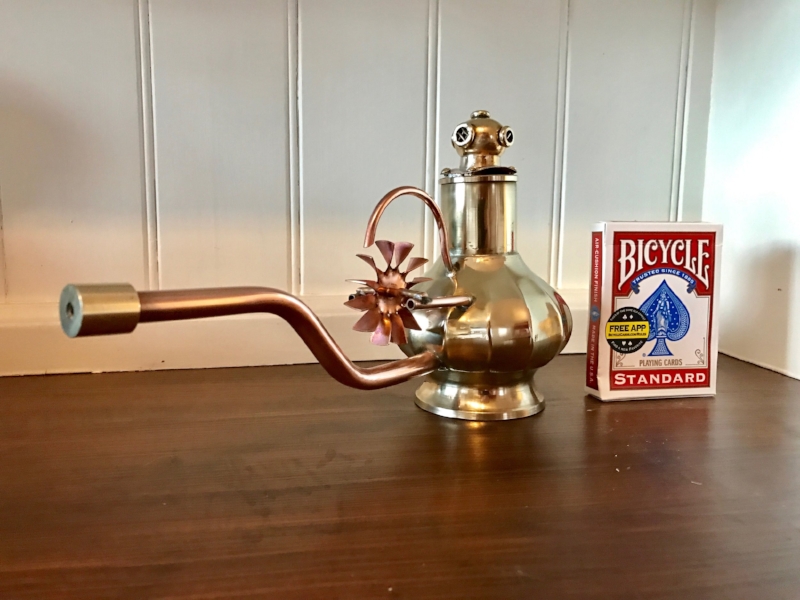
So a few years ago there was a product put out called The Divers Lung Tester. It's a steampunk looking thing that's used for a prank.

IMG_0824.jpg

The idea was that you would introduce the prop as an old "Divers Lung Tester" and you would blow into it and the air would flow through it and move the little paddle-wheel thingy. And you would say that the longer you could blow and move the wheel the better your lung capacity was for diving purposes. Or something.

But, when the other person goes to try it, they end up blowing a bunch of powder into their face.

The Diver's Lung Tester is a version of a prank known as a "blow back pipe."

u4I8N8i.gif

Is this funny? Maybe. It's just not really my scene. When I want to cover someone's face with a milky whiteness, I have them wrap their lips around something else. That's more my style.

But here's the weird thing. The guy behind The Divers Lung Tester has come out with this.

61852-alt1.png

It's a whistle that blows powder in people's faces. 

The ad copy says:

"Completely self-contained, The Whistle Blower does everything the Divers Lung Tester® does, but with the added advantage of being able to fit into a pocket."

Uhm.... okay... Here's the thing... if your only goal is to get powder on someone's face, then yes, I guess this does everything the Divers Lung Tester does. But, by that standard, Mr. Fuji does the same thing as well.

giphy.gif

The thing about the Divers Lung Tester is you could have it on a shelf or a table in your home and someone's going to look at it and wonder what it is. And when you describe what it does and demonstrate it, most people will have at least some inclination to want to try it themselves. So there's very much a garden path here that you're leading people down. 

But where is the motivation with a whistle? There is none. "Here, come blow this whistle I've been carrying in my pocket!" Uhm, yeah, no thanks. I'm good.

I guess you could come up with some convoluted rationale in regards to why you need someone to blow into a whistle for no reason, but it hardly seems worth it. Coming up with some lame thing like, "Blow the whistle when you see your card," or some shit is literally no different than just whipping some talcum powder in their face. There's no sport in just telling someone to do something arbitrary that has an unpleasant outcome.

Jokes and pranks are like little cons. And like cons, you want to have the "mark" acting on their own free-will. I offer you a piece of gum and you take it and it snaps down on your finger. You see a dollar bill on the street, go to pick it up, and I pull it away on a string. Classic pranks. But if I command you to take a piece of gum or pick up a piece of paper on the sidewalk, you kind of lose the prank aspect. (Coercing someone to do something that has a negative consequence isn't really a prank.)

One of the quotes used in the advertising gets things exactly backwards. "This is a beauty, it brings the classic Lung Tester with all its fun into a perfectly natural prop, just love it." The strength of the Lung Tester is that it's not a natural prop. That's what provides the motivation to get them to blow into it: the novelty of it. If you wanted to make a close-up plastic version, they should have built it into one of these. 

Screen Shot 2018-07-12 at 11.20.52 PM.png

You could brag about how good you are at it and how it "actually takes quite a bit of skill to keep the ball floating" and pretty soon someone would be grabbing it out of your hands just to try it and shut you up by showing you it's not really that hard.

Honestly, what they should have done is made something that said "Pocket Breathalyzer" with some kind of spinning wheel that supposedly tells you your blood alcohol level. You could bring it out at a party or a bar which would be a perfect location for this kind of prank. When they blow into it you could turn your back for a moment and when you turn back around you're like, "Well, you're not too drunk, but your cocaine problem is out of hand."

Or make it a "Breath Freshness Analyzer," people would be falling all over each other to blow into it. 

But no one wants to just randomly blow on a whistle you had in your pocket.

Could I come up with a motivation for this? Well...I guess you could gift it to your friend as a rape whistle, then break into his house later that night and start raping him to get him to blow the whistle. And sure, there would be lots of laughs later on as you two cleaned the powder from his face and the blood from his underwear, but is it really worth becoming a registered sex offender for this prank?

More from the ad copy: "You will certainly be a talking point with The Whistle Blower in your everyday carry!"

Oh, you'll be a "talking point" alright. People will be saying, "Did you know this fucking nerd carries around a trick whistle in his pocket every day?"


Also, if you want this, Penguin is running a great sale on it...

Screen Shot 2018-07-13 at 2.44.42 AM.png

And finally, every time I say something mildly critical about anything, I get at least one email lecturing me about why I'm wrong. Not to pull back the curtain too much but I don't really care about this type of stuff. It's just fun to write about and joke about. I mean, I believe the general gist of what I'm saying, but I don't care if anyone else does. You want to buy the whistle that shoots powder on people? Knock yourself out. Have fun. 

In fact, here's a mildly funny use for it.

"Check this out," you say, pulling the whistle from your pocket. "Seventy-eight dollars. No kidding. I know it looks just like a cheap plastic whistle, but it's actually a dog whistle. The cool thing is the company that manufactures them can make them so the sound is at a frequency that's unique to your specific dog. So it just calls him and not other dogs in the area. And it works up to three miles. Try it out. Give it a blow." They do and they get covered in powder. "There's ol' Rusty," you say. Then, very solemnly, "He got hit by a car three years ago. We had him cremated."


One of the more embarrassing things I've seen in a few different Penguin Live lectures is when someone shares a mediocre trick and then says, "This trick just gets stunned silence from spectators." No. It just gets regular silence. 

This is a little self-preservation thing a lot of magicians do. They'll do a trick and it doesn't get much of a response and they'll think. "Ah! They were just so blown away they couldn't respond." 

Understanding reactions is critical to getting better with magic. Here is how to differentiate between stunned silence and regular silence.

Stunned silence is the start of a reaction. It's a period of processing what happened. At some point, stunned silence is replaced by some sort of outburst—a physical or audible reaction.

If you get only silence—even if it's accompanied by a smile and a dropped jaw—that's just normal silence. If it's not followed by another reaction, the smile and the dropped jaw are there for your benefit because it's awkward for them to not say or do anything. So they'll do the least they can and move on.

The key is to not interrupt the silence. If it's genuine stunned silence then the reaction will only build from there. Don't step on it. If it's regular silence, and they move on to something else, you'll know the trick is perhaps not as strong as you imagined.

Stunned Silence

You: "And here is the coin!"

Them: [Silence... Mouth open... Silence... Silence] "W-w-wait... no way... the coin was— wait. What the fuck? Are you kidding me?"

Regular Silence

You: "And here is the coin!"

Them: [Silence... jaw dropped... smile.] "Okay... so what time is the movie?"


Okay, I'm not too proud to admit I'm dumb. 

Someone please explain this James Thurber cartoon from a 1930s New Yorker for me. 

Is there a joke here? Is it funny? Or is it the type of thing that we're supposed to look at, chuckle, and say, "Oh, how wonderfully droll," as if we have some idea what it means?

thurber.jpg

A goldmine of decks came for me in the mail this week.

First, from Chris Chelko, I received every version of the Whispering Imps decks that have been created. 

IMG_4973.jpg

The original Whispering Imps deck is one of my favorite premium decks from the past five years, and many of these variations are quite rare. I can't wait to practice my mercury card fold with them.

I also received my first batch of Magic Neko decks from my friend, and frequent Jerx collaborator, Stasia Burrington.

Screen Shot 2018-07-12 at 10.06.49 PM.png

The artwork is amazing and the little "oracle guide" that comes with it is rife with presentational possibilities for magicians and readers. 

Right after I got them in the mail, I went to a cafe near me to grab a coffee and go through the deck. Literally within 18 seconds of sitting down, the girl sitting next to me turned and said, "Oooh, what are those?" And with that, a trick ensued. 

Any prop that gets the other person to initiate the interaction is wildly valuable to the social magician.

(In Recognition of) The Best Rubik's Cube Trick

This is the final post before my summer break. Regular posting will begin again on Friday the 13th. (Spooky.)

The Summer edition of the X-Communication newsletter will be sent to subscribers on the 17th.

I'll always remember how much fun we had in Mr. Mitchell's class. 

One more year! Class of '19. Next year we RULE THE SCHOOL!

Have a bitchin' summer.

--Andy


In the last post, I wrote about how inconceivable improbabilities can sometimes cause some spectators to disengage from the trick. In recent years, the most popular trick that falls into the "inconceivable improbability" category is the Rubik's Cube matching effect. There are a bunch of different ones on the market. The one I use is Perfect Square by JB Dumas and Michael Lam. Why that one? Well, because they gave me one for free when it first came out. (Otherwise I probably never would have done the effect as it's not the sort of thing that immediately appeals to me.)

For the most part, everyone's presentation for a Rubik's matching trick is the same. "Did you know there are 43 quintillion different combinations a cube can be mixed up in?" Then they go on to try and break that number down in a way that is equally inconceivable. "If every star in the sky was a human, and those humans had as many hands as there are grains of sand on the beach, and if each hand mixed up a Rubik's cube into a different combination once per second for as long as the universe has existed... you still would be 118 combinations short of 43 quintillion."

It's like, ok dude, we get it. There are a lot of combinations. Get to the trick.

I wanted a way to perform the trick that was less of a math lecture and more of a profound weirdness. I also didn't want to tip the ending too much by emphasizing how many different combinations there were. And I wanted a way to naturally "fall" into the trick. When you bring out two Rubik's cube and start giving a dissertation on combinatorics, you're doing a lot to strip away the "magic" of the whole thing. When the interaction feels completely pre-planned you weaken the strength of the magic moment. 

What follows is the presentation I've been using for over six months. It uses a Hook to make the encounter feel more spontaneous. I don't go into this effect if they don't notice and comment on the hook. (But, there are a number of different hooks in my home, so even if they don't pick up on this one, they're likely to find another one that will allow me to roll into a different effect in a very organic way.)

Imagine

My friend Jessica is visiting my place for the first time and I'm giving her a quick tour. She doesn't mention the book titled How To Converse With Spirit Friends on my end table. She doesn't mention the old Polaroid camera on my dresser. But as we settle back into my living room, one of my Hooks does catch when she points at something on a shelf opposite us.

"What's that?" she asks. "Did you win a trophy for doing the Rubik's cube?"

IMG_8310.JPG

I give an embarrassed laugh. "Ah... no not quite. I found that in some old stuff at my mom's house. I was in a Rubik's cube solving competition at the mall in the mid-80s when I was little. I didn't come close to winning it. But everyone ended up getting a trophy for some made-up reason so no one felt bad. I can't even remember what mine was for. Something bizarre. But it was just like...you know... a participation trophy ultimately. I thought it would be funny to put it up like I was really proud of it."

"Can you solve one?" she asks.

"Uhm, yeah, sure. I still play around with them. I'm not super fast. But I can solve it in a couple minutes. Want to see?" 

I open the drawer on the end-table next to my side of the couch and dig around for a moment and pull out a solved Rubik's cube.

"Here, mix this up," I say and toss her the cube. 

We talk a bit more and then I ask for the cube back and she holds it out to me. 

I go to take it from her and then freeze. "What the...."

I look at her cube a little more, then I turn and look at the one resting on the trophy on the shelf across the room. "You've got to be shitting me," I say. I walk across the room and return with the trophy and cube. I take the cube off the top and put the trophy on the coffee table. "Let me see," I say, and extend my hand for the cube she's holding. I take it with my left hand and put it side by side with the other cube. 

"You're not going to believe this," I say. "So, there are like... I don't know... billions and billions of combinations a cube can be mixed up in. But check this out... This side matches. And so does this one. And this one. And this one. And... they all match." I give her the cube from the top of the trophy. 

"Oh waaaaiiit," I say, and stare off into the distance a bit. "Shit! Now this thing makes sense!" I set my cube off to the side and pick up the trophy and spin it around to reveal the inscription.

IMG_4946.GIF

In Recognition of the World's Greatest Coincidence.

Okay, the method has already been stated but let me point out some other details about what's going on here and what I love about this trick.

A Perfect Hook - The best hooks are those that are unusual enough to encourage your spectator to comment on them, but also things that aren't so odd that they scream, "This is for a magic trick." If you leave out a Tenyo trick, that might cause someone to ask about it and get you into the trick, but it's also obvious that that's why you left it out. A trophy off on a shelf somewhere isn't an obvious set-up, but at the same time, it's something many people will notice and comment on. 

The Real vs The Feel - Bringing out two Rubik's cubes and talking about probabilities feels pre-planned and set-up and the boundaries of the effect are well established. The fact that you're talking about all the different combinations shows that you already know where things are going. This presentation, on the other hand, feels much more spontaneous and natural. The boundaries are blurred. At the end they will surely understand on some level that you choreographed this interaction. And that's fine because it still felt like an organic amazing experience. When did the trick start? When they themselves brought up the trophy on the shelf? As a spectator, if you feel like you instigated the action to come, it's going to feel very authentic, even when you know certain elements of it are theater. 

Presentation - Talking about being at a Rubik's cube solving contest at a mall in the mid-80s is 43 quintillion times more interesting than talking about the mathematics behind the cube. In real life, when performing this, I flesh out that image a little and give some more details about how KB Toys had put on this event and there were dozens of kids there and it was out near the fountain by the food court. Or whatever. Paint a picture. If you're too young to go with that exact patter, well, I feel sorry for you. Being a kid in the 80s/90s was sweet. You could say it's your dad's trophy, or come up with a contest in a time that would be more era appropriate for you. But seriously, you missed out. The mall used to be real dope.

o-1989-MALLS-facebook.jpg

The Move - The nice thing about the Perfect Square move is that it's very quick and smooth. Yes, you can see something unusual if you know what you're looking for and you're staring directly at it when it happens. But under real circumstances, it's imperceptible.

IMG_4948.GIF

And it's particularly deceptive in this case for two main reasons. The first is that you do the move when they're not looking at the cubes. The second, and more important reason is, at this point they don't even know they're seeing a trick.

So I grab the gimmicked cube off the trophy, take the mixed up cube from the spectator and place them side by side. It's at the point where I say, "So there are like... billions and billions of combinations the cube can be mixed in,"—and my friend is looking at my face, and not the cubes—that I do the move. It's invisible. 

The Clean-Up: You never really know how things are going to go in a casual performance situation. It's not like a professional magic show where you're expected to control the audience. In social magic, the minute you start "managing your audience," you're forfeiting the whole casual feeling of the interaction. And that "casual feeling" is the element that makes social magic so powerful.

When I came up with this idea I wondered if the other person would immediately reach for the cubes so they could see for themselves if they matched up. I didn't want to say, "No! You can't look at these!" So here is how I routined it so that doesn't happen

  1. When I'm showing the sides of the cubes as matching, I don't rush the first few sides. I want it to be completely clear what they're seeing. 
  2. After showing the sides matching, I hand them the cube that was on top of the trophy. They've already handled the initial cube, so they know that's normal. Now they get to handle this one and see it's normal too. 
  3. At that point they might be inclined to grab my cube so they can compare for themselves, but just at this moment I draw their attention to the trophy, and I set the cube I'm holding to my side on the couch. The trophy now becomes the focus of attention.
  4. After the reveal on the trophy I bring back the Rubik's cube from my side, minus the gimmick. (I stuff that back behind a pillow when I get a chance.) Now they have two normal Rubik's cubes to look at. 

I know what you're thinking: "Wait... they can examine the cubes, but the cubes don't match anymore." True, but my theory was that if you initially showed that a few sides matched very slowly and cleanly, then you could speed up for the final few sides. I don't mean you rush through them, but you go at a pace that says, "Yes, of course the sides match too." At this point I don't think there is an intense desire for the participant to look at the cubes for themselves. At least not to see if they match. The "matching" aspect has already been proven. And given that there are six sides and four orientations for each side, it's not immediately apparent they don't still match.  So if there's suspicion about the cubes, I think the suspicion is that maybe the one on the trophy wasn't normal (but that's the one they were given to look at right after). And now the other cube is out to be examined too. So everything seems very clean at this point.

I've shown this trick to 7 or 8 people and while they've all looked over the cubes at the end, only two have said, "Hey, these don't match." But I'm not bothered when they do. It's actually a good thing, because then I get to extend the trick with another magical moment. 

I take the cubes back from them and say, "What do you mean? We just saw they matched." So imagine I'm sitting to their right on the couch. I take the cubes from them. My left hand holds the cube they originally mixed. My right hand holds the pre-set cube that was in the gimmick. I compare the two cubes together then start rotating the cubes in my hands to find the matching sides. But then, out of nowhere, one of the cubes is perfectly solved. 

Of course, what happens is that while my left hand rotates its cube, my right hand is doing the one-handed solve. But it doesn't come off as a one-handed solve. The right hand is obscured by the left. So it looks like I was just turning the cubes in my hand, looking for matching sides and one cube just became solved. 

IMG_4947.GIF

"Wait...,"I say. "This wasn't like this before, was it?" And I hand both cubes to the other person. "This is some weird shit, right?"

Again, it's not a demonstration of your ability to solve a cube with one hand. It's just supposed to be this bizarre transformation that occurs out of nowhere. This is a strong magical moment. The reason I don't do it every time (and only do it when they notice the cubes no longer match) is because I believe that structurally it's better to end with the trophy. 


Happy 4th of July to my fellow Americans.