The Jerx Trick Music Playlist

Some of the trick titles I’ve used in my work were inspired or just blatantly stolen from some songs I like. Here’s the breakdown..

From The Jerx, Volume 1

Narrow Your Eyes

Originally a They Might Be Giants song off of Apollo 13, but my preferred version is by David Miller. It’s a less quirky, more rocking version of the original and amps up the harmonies in the chorus.

Will You Let Me Into Your Dream?

An almost sickly sweet love song by Of Montreal, sung to a sleeping person. It features one of my favorite things in music when they bring back the verse or chorus and drop the lyrics for some “bah-bah-bahs” or “la-la-las.” In fact they do it twice. If you don’t like the love song aspect, the same band has an Identical song with different lyrics called Art Snob Solutions.

From The Jerx Amateur Magic Monthly

Caster of Worthless Spells

From the song of the same name by Parquet Courts. This was the perfect name for a trick that involved both spelling and getting every prediction you make wrong.

A Firm Background in Remembering

A lyric from the song Bad Light by Built to Spill off of the album Keep It Like A Secret, one of the best rock albums ever. I also stole that album name for an unpublished routine of mine that may see the light of day in the future.

Cold Hands Warm Heart

A song by Brendan Benson, a brilliantly catchy singer song-writer.

I’m Going to Haunt This Place When I’m Gone

From the song I’m Gonna Haunt This Place by Look Park which is the new band of Chris Collingwood from Fountains of Wayne.

Memphis (Long Distance Information)

From the song Memphis Tennessee by Chuck Berry. Below is Johnny Rivers doing his version. I like this version primarily because of the way Dick Clark pronounces Whiskey-A-Go-Go in the interview afterwards, which he seems to believe may be of hispanic or asian origin.

From Magic For Young Lovers

Send Me a Pillow, The One That You Dream On

This is a lyric from a song called Elevator Action by Masters of the Hemisphere, a song so obscure that I can’t find a recording of it online anywhere.

That lyric was likely inspired by a similar line in the Smiths song “Some Girls are Bigger Than Others,” which in turn was inspired by this old country tune, “Send me the Pillow You Dream On.”

The Only Ghost Here is Me

A slight variation on the title of the song The Only Ghost There Is Me by the Bellfuries. The song has, to me, an early 60s feel to it. The backing track is mostly strings, which you rarely ever hear in a pop song. I also like this non-string version quite a bit.

I’ll Be My Mirror

A variation on the classic Velvet Underground song, I’ll Be Your Mirror. That song has just about the loveliest lyrics you’ll find in a song…

I find it hard to believe you don't know
The beauty you are
But if you don't let me be your eyes
A hand to your darkness, so you won't be afraid

The version song by Nico is very well known, so I’ll link the Clem Snide version which is also pretty great.

The Sweetness In Water

I originally heard the song Fresher Than the Sweetness in Water done by Gorky’s Zygotic Mynci, and it wasn’t until, oh about 45 seconds ago, that I learned that it was a cover. Here’s the original version as done in the late 60s by the British group, Honeybus. I don’t think I’ve ever even heard of this band, but they seem right up my alley.

Two Dying Worlds In Orbit

This comes from a lyric in the song, Some Jungle by the group Umm. Usually I like music that has a ton of energy and fire behind it, but in this song, the singing and even the guitar part sound lethargic and I still love it. The boy-girl vocal harmonies have a really interesting quality to them.

Thursday Thailbag

The alliteration in the title of this post made much more sense when I intended to post this on Monday.

Let’s dip into the mailbag and (attempt to) give some quick answers to some questions that have come in recently.

giphy.gif

Did you read The Magic Rainbow? [Juan Tamariz’s book, recently released in an English translation.] If so, any thoughts on it? — JA

I haven’t! And I probably won’t. Not because I don’t think it’s valuable. I’ve only heard good things about it, including from many people I really respect. But because, since starting this site, I’ve made an effort to avoid magic theory. I just don’t know how interesting it would be to read someone’s theory based on other people’s theories. This site is an experiment. I want to develop my own magic theory based solely on my own experience and testing. I have the time to do so.

So, yeah, I’m probably hobbling myself in a way by not absorbing the thinking of the magic establishment, but I don’t think people come to this site to hear, “Well, Darwin Ortiz says…,” or “Well, according to Tamariz….”

And I’m still not even sure if Tamariz is really that great when it comes to magic or if people are just entranced by his keen fashion sense and potent sexuality.

juan-tamariz-cards.jpg

[…] I encountered your "Bazillion Dollar Bill Switch", and it's one of my favorites so far. I look forward to trying it. One thing is bugging me.

Slight detour […] I keep a few cards in my wallet and I'm ready to do Card Warp at the drop of a hat. […] A problem with the trick is that, at the end, it's not uncommon for someone to recover from their less-than-paralyzed astonishment and say, "now put the card back together". {…]

Anyway, I'm wondering if "put it back together" is a comment you've had to navigate after "Bazilion".  — CC

No, I don’t get that sort of challenge with that trick, or any other trick for that matter. And here’s why…None of the presentation styles I employ (Romantic Adventure, Engagement Ceremony, Distracted Artist, Peek Backstage, Wonder Room, among others) suggest, “I am a person with general magic abilities. Feel free to challenge me.” If your presentation is—even nominally—that you’re not taking credit for whatever happens, then it completely blunts the spectator’s inclination to say, “Okay… well… now do this..” That doesn’t make sense if I’m not taking credit for the magic (even if they know I’m responsible for it in reality).

Now, with Bazillion, I am taking credit. I’m saying, “I’m going to transport this half of the bill somewhere else.” But still, my attitude isn’t, “I can do anything!” My attitude is, “I’ve been working on this one specific thing. Let’s see what happens….” So even then it’s not super logical to follow that up with a challenge to do something more.

That’s not to say it will never happen. But I don’t ever need to feel “exposed” if it does, because my style is not the all-powerful magician. My style is someone whose relationship to magic is that he’s learning, and trying, and sharing. If someone said, “Can you put my bill back together?” I’d say, “Hmmm… no. I don’t think so. Is there a way to do that? I’ll do some reading and see if I can figure out how.” Then three weeks later I’d come back and say that I think I had it figured out, and I’d do a torn and restored bill where something goes wrong. The bill is mis-made or something like that. Two more weeks later I’d come back and say, “I think I’ve got it now.” And either do a good torn and restored bill or add some other chapter to the story.

In that way, rather than simply doing a bill switch for a restored bill, I’ve extended the story for weeks and pulled them into an ongoing narrative. That’s a much better outcome for what I want to do than just immediately meeting some challenge.

On a side note I don’t recommend carrying playing cards in your wallet to do a trick. I realize real estate in your wallet is available because you’ll never need that space for a condom, but it’s still not a good look. Do it with business cards.


Do you have tips for writing a book? […]

I've been working on a book for a few years now and I really want to get to the end of it this year. How do you do it? I assume the fact that you have a lot of people giving you good money to have it done by the end of the year is good motivation […] but I think it's obvious that besides this motivation, you have good work ethic.  — YR

The deadline and obligation I feel to the people who’ve chosen to support the site is obviously a huge factor. You might say, “Well, I don’t have a deadline or obligations tied to this project.” Okay. But you can create your own deadline and then just choose, going forward, to be someone who sticks to the deadlines you set for yourself.

As far as the logistics of scheduling your writing, your plan needs to be malleable enough that it works with your life, but not so malleable that you can weasel your way out of writing all the time. If you just say, “I’ll write when I fee like it,” then you’re at the mercy of your inspiration. If you say, “I’ll write every day, no question,” then a situation will come up where you’re on vacation, or there’s some kind of emergency, or a holiday, or whatever where you don’t want to write and you’ll find yourself in the position of having broken your word to yourself. Even if you say, “I’ll write a little bit every day when I don’t have something important going on,” that’s still a little nebulous because then you have to debate with yourself if what you’re dealing with is “important” enough to keep you from doing your work.

So, if I you want to write a book, here is the deal I would suggest you make with yourself. First, think of the things you do regularly that are your biggest time-wasters: watching tv, playing video games, perusing online porn, etc. Now, the simple rule you make is that before you allow yourself to do any of those things on a given day, you’ll write at least one page of your book. So you don’t have to write every day if other important things are going on. You only have to write one page a day on those days you want to “unlock” the time-waster activities. When a year passes you’ll probably have 300 pages written.

But I don’t have any time waster activities!” Well, if all your time is occupied with something productive, then you don’t have time to write a book. Sorry.

But that’s just a trick. I can still just choose to watch tv instead of writing if I want.” Yeah, no shit. Outside of a person holding a gun to your head and making you write, everything is a mental trick. You just need to find the tricks that work for you. The ones that work for me are all about leveraging. Here, you’re leveraging your desire to do pleasurable activities to get you to do a little writing each day.


Mailbag Questions

If you have a burning question you’d like to receive a likely unsatisfying answer to, you can email me here and it may appear in a future mailbag.

The Unknown Edible

This is an example of the prediction of an “unknown personal” in mentalism.

I met my friend Alissa at a cafe last week. I was already seated when she arrived. She dropped her coat off at the table on her way to get her drink. I asked her to bring me one of the loyalty-stamp cards from near the register after she got her coffee.

She came back and gave me the card. I told her I had something I wanted to try. I asked her to open her mouth and I peeked inside a little. Then I took her chin in my hand, asked her to make her jaw loose, and I raised it up and down a little. “Hmm…,” I said.

I wrote something on the back of the loyalty card and folded it up and set it on the table.

“Okay, I have a question for you. If you could safely eat some item in the world that isn’t edible, what would you eat?”

“Huh?” she said.

“Like, for example, I think I’d like to eat a thick yoga mat. Not the whole thing. But I just feel like that’s a texture I would enjoy a few bites of.”

“Hmmm. A paperback book,” she said.

“Ha, exactly,” I said. “And why?”

“I like books,” she said. “I think it would taste good to take a bite and have the individual pages fall apart in your mouth. It would be like baklava.”

“I don’t know about that,” I said. “But I did get the sense you’d be a book eater.”

I slide the card over to her and tell her to unfold it. She does and on the inside it says, “I think you’d eat a book.”

The method here is any sort of prediction system you have at your disposal. I use some personalizations on some classic techniques that will be described more in the 2019 book for subscribers. You could use certain apps as well.

The method isn’t the important thing. I just wanted to present this as an example of an “unknown personal” in action.

There’s nothing particularly interesting about the structure here. It’s a fairly straightforward prediction. But I’ve found that to be the power of the unknown personal: it tends to get a better response out of traditional predictions without the need to restructure the effect. Predicting something about someone that they didn’t even know about themselves is, I think, generally stronger than predicting a “random” word, or something about them you could have found out in some other way.

Even if the prediction itself is no stronger, what you’re predicting makes for a more interesting couple of minutes.

And logistically a question like this can give you more time do what needs to be done to achieve the effect. Sometimes you need to stall a little bit before revealing your prediction which can be awkward when you’re asking someone to explain “Why did you name 63?” after you’ve asked them for a random two-digit number. But with a question like this, it only makes to pause and discuss their answer for a moment.

I’m always keeping my ears open for potentially interesting questions that require someone to ask themselves something they’ve never asked themselves before. If you (or some kind of oracle, or a deck of mysterious letter cards, or a weird guy you met on the bus who won’t stop texting you) can somehow predict that information, it makes for a strong and memorable moment of strangeness. And you don’t have the issue of there being any other way you could have uncovered the information, or them saying something like, “Oh, does everyone say they’d like to eat a lacrosse ball?”

Recalibrating

Every now and again I like to take a post to reset with everyone here what my philosophy/viewpoint/goals are in regards to magic. I do this for a couple reasons. The first is because there is likely a slow evolution of those things going on with me, and it’s good to check-in on where I stand. The second reason is because there is a constant stream of new people coming to this site, and while I suggest reading the whole thing from the beginning, that can be a daunting/time-consuming task for someone who is new here. So a quick summary every year or so is probably a good thing. And finally, whenever someone writes me taking issue with something I’ve said, they almost always have no fucking clue of what my position is in regards to the subject they have a problem with. I think this comes down to some combination of poor reading comprehension and only having looked at a couple posts out of context because the regular readers of the site have very little issue following along.

I

So, the first point to make is that this site is meant to be about one person’s journey. It’s not intended to be prescriptive. That being said, I’m probably performing more social/amateur magic than anyone in the world, so you may want to give some consideration to my thoughts on that subject even if you’re initially skeptical, just as you’d give some weight to Doc Eason’s thoughts on bar magic. But I’m not trying to convince you or give you advice. You do you.

(Although when it comes to the things we’ve put through focus-group testing, I have a high level of confidence in those things. And I think it would be odd to wholly reject those results—some of the only testing of methodological and presentational techniques in magic—just because your instincts tell you to disagree.)

II

The second important concept when reading this site is that I’m talking specifically about amateur magic, and amateur/social magic is a very different thing than a professional performance. At least it should be, in my opinion. The distinction should not be between paid and unpaid. The distinction should be between performance and interaction. Professional shows will feel more like a performance, social magic should feel more like an interaction. You won’t be able to strip all the performance elements out of social magic, but it benefits from doing so as much as you can. These elements include:

  • spotlighting the performer

  • scripted patter

  • planned jokes and bits

  • obvious props

These all make perfect sense for a professional performance. But they take away from the feeling of interaction, which is the goal in amateur/social magic. (Unless you want to do things that feel like “performances” but just in casual situations. If that’s your goal, then feel free to take on all the trappings of a performance.)

III

The final “important piece” to understand this site is perhaps the trickiest to explain. A lot of people will read my work and they’ll see the time and effort I’ve put into certain things, and they’ll imagine my goal is to get people to experience “real magic” in some sort of mystical, esoteric way. That’s not my intention at all. My goal is simply to give the people I perform for a better experience by giving them more interesting fictions.

For me, the failing of magic is that most of the time the story comes down to this: “I’m the magician and I’m an incredible guy.” It’s just not that interesting. And it’s certainly not interesting long term, which is something the amateur needs to concern him/herself with because they may be performing to these people for decades.

There’s a difference between the feeling of being fooled and the feeling of experiencing something magical. And, in my opinion, the way to get people to have the “magical” feeling is through stronger narratives. And by that I don’t mean coming up with some horseshit story to accompany your Gypsy Thread routine; that only takes away from the magic. But if you put the trick itself in a narrative where things are unfolding in the real world, then people can get caught up in it. And getting caught up in a magic trick, leaves people open to feeling that magical feeling, just like getting caught up in a horror film leaves someone open to feel terror.

The goal is not to make them “believe” anything is real (just like the goal of the horror film isn’t to pretend it’s a documentary). The goal is just better entertainment. And better entertainment through magic doesn’t come from being fooled harder (we already know how to fool people), it comes via a more engaging narrative (context).

If you buy into that premise, then here is where it gets fun. For the amateur/social magician, the narrative does not need to begin when the trick does, and it does not need to end when the trick ends. You can set up the narrative two weeks before the trick. You can have tricks that take place over the course of a year that all have the same umbrella narrative. You can have callbacks to a narrative you established long ago. You can weave different narratives in and out of your life and your interactions with people. More on that to come.


Ok, so there we go. Now everyone is caught up. No stragglers. Let’s explore more…

Ahoy Hoy!

I think the trick in my repertoire that has had the most staying power is the Hoy Book Test. I would say a week has rarely passed and certainly a month has never gone by were I have not performed this trick in some form for the past… I don’t know… 20 something years maybe? I learned it from a Tom Mullica videotape, oddly enough. So whenever that came out.

The version I do most frequently these days is called Narrow Your Eyes and it’s in JV1. It justifies the need for a book because it’s not presented as mind reading. (If you have the book, you can use a similar justification in a drawing duplication, or when you have some write down a word they’re thinking of.)

I’ve probably tried a dozen other ungimmicked book tests, but have always come back to Hoy. My conclusion from trying all those other versions is that there are probably no good book test where you have to hold the book while they are looking at the word. I’ve tried a bunch of them. Some seem clever, but when I break it down with people afterwards they almost always say, “Well… I guess you must have got a look at the word at some point. Maybe you put your finger in the book? Or you looked when I looked?” The nice thing about the Hoy Book Test is they peek the word with the book in their hands on the other side of the room. Yes, there are still things that need to be justified with Hoy (why you’re using books at all, why two books, why can’t they just open to a random page, etc.) but I feel I can talk my way around those things. I can’t come up with a good justification for why I—the person we’re trying to keep the word a secret from—needs to hold onto the book other than the fact that it gives me the opportunity to take a quick looksy-poo at the word.

So that’s why I’ve stick with Hoy. I like my book tests like I like my barbecue sauce. Bold.

For the amateur/social magician there are even more benefits to the Hoy book test than many other others because you can do what I think of as the Delayed Hoy.

Traditionally, with the Hoy book test you’re limited to naming the first word or two on the page because you have to pick up that information very quickly. With the Delayed Hoy you can have someone read the page until they get to some imagery they can easily picture in their mind and you can reveal that instead of just a word.

The Delayed Hoy is an amateur magic technique because you’re not doing the method in real time.

I used to do it in the early-mid 2000s on the subway all the time. Back then, so many people were reading books because cell phones were still pretty useless.

So I would see someone, often an attractive female because I’m a typically shallow male, and we’d get to talking and I would be able to read her mind and tell her what she was thinking of from a random page in a book. And I could do this without ever touching her book at all.

How? Well, the day before I saw her reading that book on the train, and I just went to the bookstore after work, looked at a copy of the book and picked out the first compelling visual concept on page 183. The next time I see that person, I’m all set. (If you’ve never lived in a city with mass transit system like NYC, you might not realize that if you have a regular commute you’ll often end up seeing the same people, in the same subway cars, at the same time each day.)

I do something similar today. The last major book chain in the U.S. is Barnes and Noble. Almost all of them have a Starbucks inside of them. I’ll meander though the Starbucks until I see someone interesting. Get a look at the books on their table. Go into the main store, find those books, see what’s on page 183 and memorize the first easily pictured concept on that page. Then I can go back, sit at a table nearby, strike up a conversation, and go into a version of the effect where they can choose any of the books in front of them and I can read their mind. Again, without ever touching the book.

Another thing I used to do is this… I read a lot of shitty horror and mystery paperbacks, because yes, I’m dumb. Go read Dostoyevsky you fucking smarty-pants. Anyway, once a week i would go to the bookstore near where I worked and I would go through the bestsellers and note the first interesting thing on page 183 of each book and make a note of it on the blank pages at the end of the book I was reading. Now, anytime I run into someone reading a best seller, I can look at my crib in the back of my book and go into the trick. I would also trim down the page next to my force page in my book. That way I wouldn’t have to do a miscall. I could flip to the page and legitimately show the page number.

Ultimately that was maybe not worth the investment of time. I’d probably only use my best seller crib a couple times a year just by fate (I mean, just by stumbling across someone with a copy of one of those books). I would sometimes use it more directly, if I was in a bookstore cafe with someone I’d tell them to “grab any book on the best seller shelf.” If they asked why just the best seller shelf, I’d say, “It’s easier if it’s something in the zeitgeist.” But it really didn’t matter either way. If they picked a book that wasn’t in my crib, I’d just do the standard Hoy. I probably wouldn’t recommend someone put the effort into maintaining a best seller crib unless you, like me, would find it soothing to have this little weekly ritual where you go and get a coffee and peruse through the few new books on the bestseller list that week and jot down what’s on page 183 of each. (For anyone not familiar with the Hoy book test, no, there’s nothing special about page 183. I’m just using it as an example here.)

My point is simply that, for the amateur magician, you should keep your eyes open for opportunities where you can find out what someone is reading and do the prep for the Hoy Book Test not in real time.

There is an added bonus to doing it this way. When I would ask people about the trick later on (a week or so later), they almost universally forget about the second book. They would mention taking their book and flipping to a random page and that was the extent of the process in their mind. Which, of course, makes it almost a miracle. With the traditional Hoy book test, an equal amount of weight is put on both books at the beginning, so it’s maybe a little harder to make that page selection part fade into the background. With the Delayed Hoy all the focus is on their one book which I never go near. My book is only in play for less than 10 seconds and is used in a fairly off-handed casual way, so I think it becomes easier to forget.

I’m certainly not suggesting the original Hoy test needs any improving. I still love being able to walk into a huge library with someone and telling them to get me two books from anywhere and let’s try something. But the Delayed Hoy is, I think, a good example of taking advantage of opportunities we have in amateur performing situations that we often overlook just because, historically, magic books haven’t really looked at effects from that perspective.

giphy (1).gif


Magic Blogging for Fun and Profit

The window to support Season 4 closed last week. If your payment was processed by paypal, then you’re in. There is no other confirmation coming from me.

I want to again thank everyone who supports this site. We’re at the beginning of the fourth year of this site being fully reader-supported. I realize this is a unique business model in the world of magic, but it seems to be working well. And I’m comfortable saying that because:

  1. The people who don’t like this site, don’t need to read it.

  2. The people who like it but can’t afford to support it still get regular content.

  3. The people who do like it and want to support it seem to be pretty happy with their choice to do so as almost everyone who signed up for Season 3 signed up again for Season 4. I have a higher retention rate than Costco or Netflix, which are considered the gold standard for that sort of thing.

So everyone’s happy! Yes, there are still some people who get their dick all twisted that anyone would deign to pay to support this site. But they don’t mean it. When they say, “I can’t believe people pay to support a magic blog.” What they’re really saying is, “Why won’t anyone pay attention to what I have to say about magic?”

The answer is this: Ya dull.

You couldn’t write a compelling sentence if your (undoubtedly estranged) daughter’s life depended on it. And your ideas aren’t interesting.

“That’s not true! I’m a good writer! Really, really good. So goodly I write you wouldn’t believe it! And I have good and interesting things to say too. Oh boy, I do.”

Alright then, I encourage you to follow my path. I laid out the blueprint for you. Write everyday for six months. Then, if people want you to keep going, give them the opportunity to support the site in order to do so. Continue writing 100s of posts a year. Write a regular newsletter. And write a book with new material every year. Simple.

“I don’t have time for all that!”

No shit, dummy, neither do I. I only have the time because of the people who support the site. Now you see how it works?

I don’t know if what I’m doing is replicable, but when I occasionally get an email from someone who wants to do something similar, I give them this simple two-step process.

  1. Come up with a focus/POV that other people don’t have. If your focus is “amateur magic” or your focus is “testing magic” then people are just going to compare you to this site.

  2. Come up with 150 posts you want to write. The subject can’t just be, like, “Magician’s Choice.” You need to have something unique you bring to the subject. I mean, it doesn’t have to be brilliant. It can be stupid. But it has to be uniquely stupid. You can’t just have three things you want to write about and you’ll wing it after that.

Finally, keep your expectations in check. Magic blogging is probably not going to be your “career.” A good bellwether to know if being paid to write is in your future is if it was in your past. I was being paid to write before this site, it’s my only other source of income now, and I’m sure it’s what I’ll go back go full-time when this site is over.

Again, you only need those steps if you want to follow a path similar to mine. If you just want to write a post occasionally for fun, then it matters much less if you have a unique viewpoint or if you’re a good writer or whatever.


Now that the support window has closed, I can give you my regular lecture about supporting the things that make you happy without it seeming self-serving.

If there is some commercial enterprise that you take pleasure from—especially if it’s a small commercial enterprise—then I think you’ll find you’ll get measurably more happiness from that thing if you actively (financially) support it.

If there is a podcaster, youtube creator, blogger, musician, artist, or whatever, that brings you joy, it’s good for you to back their projects. What you’re saying is, “My happiness is important, so I’m going to reward the people who make me happy.”

You might say, “Ah, but wouldn’t I be happier if I didn’t pay $5/month for this podcast and instead downloaded a bootleg copy? Then I get both. I get to hear the podcast and I get my 5 bucks.” No. I’ve found that’s not how it works. If someone gives you the opportunity to support something you love at a fair price, you’re always better off doing that than trying to skirt your way around it. I don’t think this is just my own personal psychology. I think it’s true for most people. If you don’t believe me, consider supporting one of the content creators whose work you currently follow. I can almost guarantee you that you will find yourself taking more pleasure from that person’s work going forward.


People will write me and say, “This has to be the best gig in the world. You just write and talk shit about people. You perform a bunch of magic. It sounds like you’re having a blast. I want to do this.”

Well, yes, it’s pretty sweet. I may not be a great judge of these things because I’ve enjoyed every job I ever had. But I will give you my honest assessment of this sort of work. I’ll be speaking specifically to my situation, but much of this will hold true for anyone self-employed in a creative field.

First the negatives…

  • Just because you like to do something for five hours a week, that doesn’t mean you’d love to do that thing for 50 hours a week. So if you look at someone and think, “Aw, that guy gets paid to have fun!” It’s probably not that simple

  • In most jobs, you have that period of time where you’re not really working at all; you’re screwing around. Then you have that period of time where you’re working but you’re just kind of sleepwalking through the work. Then you have the time where you’re actively engaged in your work. If you’re self-employed in a creative field, you only have that last category. You’re either actively focused on the work or you’re just not being productive. I sometimes wish I could slack off and still get work done.

  • Screenwriter, Lawrence Kasdan said, “Being a writer is like having homework every night for the rest of your life.” Having that looming feeling isn’t a ton of fun. When I had a normal job (before moving to 100% freelance work) I would leave the office at the end of the day and not a single neuron would fire the rest of the evening in regards to thinking about work. Now, because of the type of work I do here and in my other endeavors, I never feel like I’m “off the clock.”

Those are the negatives, and as I said, they’re probably true for most self-employed people.

The positives are perhaps more specific to me and this situation.

The initial positive would be this… while I’m not enamored with the act of writing itself, the subject I get to write about is about as much fun as one could hope for. I’m not writing instructions for putting together an end table.

And everything I do for this site outside of the writing part is super enjoyable. Trying to come up with tricks, testing them out, and attempting to create special moments for people so that I can report back to others who want to do something similar is a hell of a nice “job” to have.

Writing this site has also put me in touch with a lot of people I’ve long admired in magic, and people I’ve never heard of but who are on a similar wavelength to me. So that’s another huge positive.

And the flip side of always feeling like I’m “on the clock,” is the fact that I almost never truly am. I have some self-imposed deadlines to meet, but beyond that I have the freedom to make the choice of what I want to do each day. Do I want to write a couple posts? Do I want to do some brainstorming? Do I want to to go cafe hopping and find a dozen people to try something out on? Or do I not want to do anything magic-related at all? Maybe I want to go hiking or snowboarding or sit on my ass and watch tv all day.

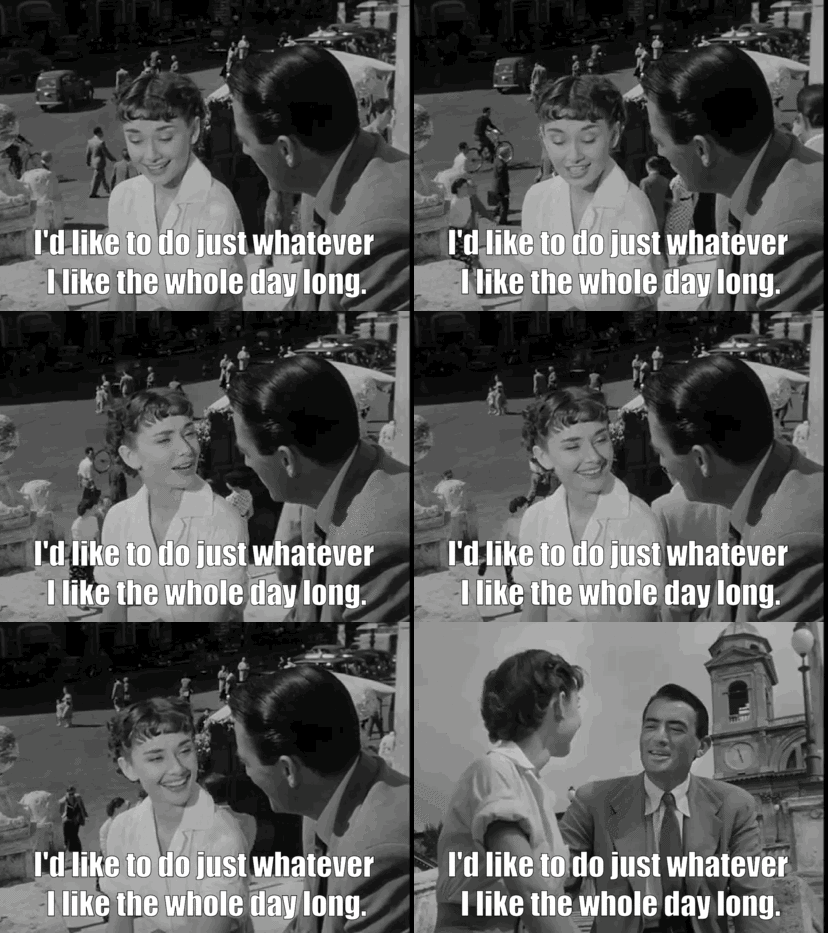
That freedom is the part of all this I appreciate the most. Sometimes I wake up in the morning and think “What should I do today?” And a quote from Audrey Hepburn in Roman Holiday comes to mind…

ezgif.com-add-text.gif

And I pretty much do. It’s a good life.

Dustings of Woofle #2

I’m in NYC for the next few days doing focus-group testing. Most of it is related to misdirection. We’re also testing if using a torn-corner to mark a card (or bill) is significantly better or worse than having it signed. It seems to me most people think the torn corner is the “weaker” option, and I always just assumed that as well, but I don’t know why it seems that way. And we’re finishing up some of the card-to-wallet stuff (palm vs. no palm) we started last year. All the results of this stuff will be relayed to supporters in some manner over the next year.


Good news, everyone. Your dad got a job writing for Pete Firman.


Sure, I’ve got a concept for you. It’s called Chris Ramsay Presents… Crowdsource My Show: I’m Out of Ideas, The Chris Ramsay Story, Season One “The Fuck Do I Do Now?”

Alternatively you should remake Bewitched, but as a reality show. And she’s trans.


Look at this beautiful post from Joshua Jay’s wife, Anna. What a thoughtful, lovely post that certainly doesn’t make me feel guilty about anything at all.

View this post on Instagram

Our love story isn’t perfect. It’s not always the fairytale that our photos make it appear. We had to fight for it over the last ten years. We broke up, and disagreed, and moved away…but eventually we found our way back together because nothing else, and no one else, made sense. It started with bad timing. I was a college student about to move to France, and he was a professional magician, leaving for a month-long tour through Japan. But we found ourselves huddled on his couch in Manhattan, in the midst of a party, unable to stop talking and sharing our dreams. I’d later learn he’d orchestrated the whole evening just to meet me. A gathering of his friends: sword swallowers, fire eaters, mind-readers and contortionists. My own personal circus, and that night I decided to join. We had a week and spent every minute of it together; exploring art museums, sipping cocktails from teacups in speakeasys, stealing kisses in the back of taxis, and staying up ‘til dawn talking about the places we wanted to go together. But we had to spend months a year apart while he toured performing magic, and my job moved me to London. The distance was detrimental, so we did something crazy. I quit my job. I moved out of my apartment. I gave up everything I’d worked for because I found a new dream. We decided to work & travel together, a giant leap of faith we took and never looked back. We left for a four-month tour of the world, every day a different city, a new hotel, another train ride. We lived in a state of jet lag, exhaustion, and complete exhilaration. Four months turned to eight, and then a year, and now ten years into our love story, the only way to tell it is to say that we fell in love sharing magic all over the world. Travel is what brings us closer: Driving across America for months in a Honda Civic, hiking through Tikal in the rain, tracking tigers in India, sharing a card trick with the Masai. But our greatest adventure is each other. We’ve become partners in everything, and when you live and work and love together, you can’t break a bond that strong ❤️ @qatarairways @passionpassport this flight would be a new chapter in our never-ending love story #pploveintheair

A post shared by Anna Kloots | inspiring travel (@traveloutsidethebox) on


IMG_5979.GIF

My first presentational idea for the Make It Rain effect posted on Monday was this…

“I come from a long line of strippers. My mother was a stripper, her mother, and her mother’s mother. The same goes for my father’s mother and grandmother. Our family crest is a boobie and a c-section scar. One of the skills that all great strippers have is the ability to identify the amount and denomination of bills that are being tossed on the stage. You don’t want to waste time rubbing your vulva in the face of a guy who is just giving up a single. But at the same time you don’t want to pause your act to carefully examine all the money coming in. It’s a valuable skill to be able to identify the most lucrative area of the crowd to focus your attention on. And, via evolution, natural selection, or whatever, I have this skill as well. In fact, I’m something of a savant at it. Anyone can learn to identify one bill coming at them. I can identify them en masse. Here’s what I want you to do. I’m going to strip over on this side of the stage, and I’d like you to tip me in that box over there. 1s, 5s, 10s, 20s, 50s, 100s. Whatever you’ve got. And at the end I want this person there to open the box and toss all the money at me my naked body.”

Etc.

In fact—and I’m being 100% serious now—if there’s a stripper out there who includes magic in their act, I think this would make a great, and profitable routine.