Mailbag #10

giphy.gif

All these questions come from the same email from supporter JC

I think one of the reasons your presentations hit so hard is because often the effect is simply being used to show proof of some other thing. So, in effect, the trick is a “Rep” of whatever premise you're using. Is that a good way to think about it?

You have the right idea but you’re mixing up the terminology. You’ve accurately characterized my position that tricks tend to be stronger (in my experience) when you present them as proof of something else. Well, let’s not say “proof” let’s say, “an example or demonstration of some phenomenon.” Now, performers are already doing this in a very general way. They are showing a trick and that trick is a demonstration of “my magic powers” or “my mental powers” or, more recently, “my powers of influence.”

Now, that’s all fine, and I certainly do plenty of effects that fall into those categories, but I don’t think we should limit ourselves to these three phenomena for a couple reasons:

  1. It’s not that interesting after a while. Demonstrating how you can read someone’s mind is great. Demonstrating general “magic powers” is also fine. If you’re working a restaurant and have a constant slew of new audiences, that will serve you well. But if you’re an amateur, performing for friends and family over months and years it can come across as the same thing over and over. “He read my mind and told me the card I was thinking. Then he read my mind and told me the city I was thinking. Then he read my mind and told me the name of the person I first kissed. Then he read my mind and told me my least favorite ethnicity. Then he read my mind and told me what I drew on the pad. Then he read my mind and told me what I believe to be my dog’s third favorite ice-cream flavor.” That’s the same phenomenon over and over. By nature it’s not going to be as interesting as if you couch the presentation as a demonstration of various phenomenon.

  2. The three phenomena mentioned above are all very magician-centric. “Look at me read minds.” “Look at me do magic.” “Look at me influence you.” In the long-run that’s going to come across as needy. Let’s assume the spectators already know you’re asking them to play along to some extent. They know you don’t really have magic powers. So if you’re going to ask them to play along with a bit of fiction, why is every bit of fiction about how special you are? Doesn’t that seem a bit desperate?

When you use your tricks to demonstrate other phenomena you can both tell a wider range of stories, and also not seem quite so pathetic.

As far as the word “rep” goes. That’s not quite the way I use it. A Rep is something you add outside the confines of the performances, to expand the boundaries of a presentation.

As an example of both parts of your question, think of the Wisdom of Crowds Word Reveal. This is taking a trick that would typically be a presentation of straight mind-reading, and then performing it in such a way that it’s a demonstration of something else: the power of the dark web, or massive data mining initiatives. Most people would still recognize this as some sort of trick, but the presentation is more compelling than saying, “I’m going to read your mind,” for the 50th time. 

Here’s how a “Rep” (Repercussion) might be used with that effect. Let’s say you performed it for a co-worker that you normally eat lunch with. For the next week or so you bring in a PB&J sandwich for lunch rather than go out to eat with everyone. When people ask you why you’re not going out you say, “Remember that data mining thing I showed you on Friday? It’s $120 each time you want to query it. I didn’t really budget for it so I need to save a little cash this week.” The “repercussion” of you performing that trick is that you need to tighten the purse strings for a few days. You’re continuing the presentation as if this seeming impossible thing (a database that can predict what random item you’d think of) is real.

What makes Reps so insidious when you want to fuck with people is that you have a magic trick that is inherently unreal, but then you have repercussions which are perfectly plausible as long as you accept the reality of the magic trick. So they’re another tool the amateur has to smudge fantasy into reality and vice versa.

2. You mentioned in a post that one of the ways you use equivoque to force a card is to let them make as many piles as they want, let them eliminate the piles fairly, palm in the force card, and then go into equivoque. Could you elaborate on this a bit? Not the palming or equivoque but the procedure before that?

Hmmm… well there’s not much of a “procedure” before that. The force card is in my lap or in my pocket. I have the spectator shuffle the deck as much as they want, and cut the cards into “a bunch of piles.” I tell them we’re going to narrow the cards down to one pile, then one card, and I have them start eliminating piles one by one. They do all this themselves. They can turn over the piles they eliminate and see that all the cards are different. So they get a real sense of seeing the potential outcomes dwindle.

Eventually we’ll be down to one pile which I push towards them while sweeping the other cards aside (and adding in the palmed card). Then I’ll equivoque to that card.

Actually, these days I’m more likely to use Phill Smith’s Quinta. With that the process is different. We’re down to one pile. If the pile has five cards, we’re set. If it has four cards, I tell them to add one “second chance card” from any of the discards. If it has three cards then I use a variation on Quinta with three cards in a triangle shape (which I’m pretty sure is also Phill’s but I can’t remember the name of it).

If there are more than five cards, it becomes even stronger. I spread the cards to see how man are in the pile. Let’s say it’s eight. I tell them to pick up the stack and deal them into a pile on the table. The top card is my force card because that was palmed on top of the stack. After they’ve dealt that first card I say, “and turn over any three as you go and set them out here to eliminate them.”

Either way, we’re left with five cards and I’ll go into Quinta from there.

You mentioned in an old post that there is a reason you use UNO cards a lot. You said you'd do a post explaining those reasons but I don't believe that post ever happened. Could you talk about those reason?
—JC

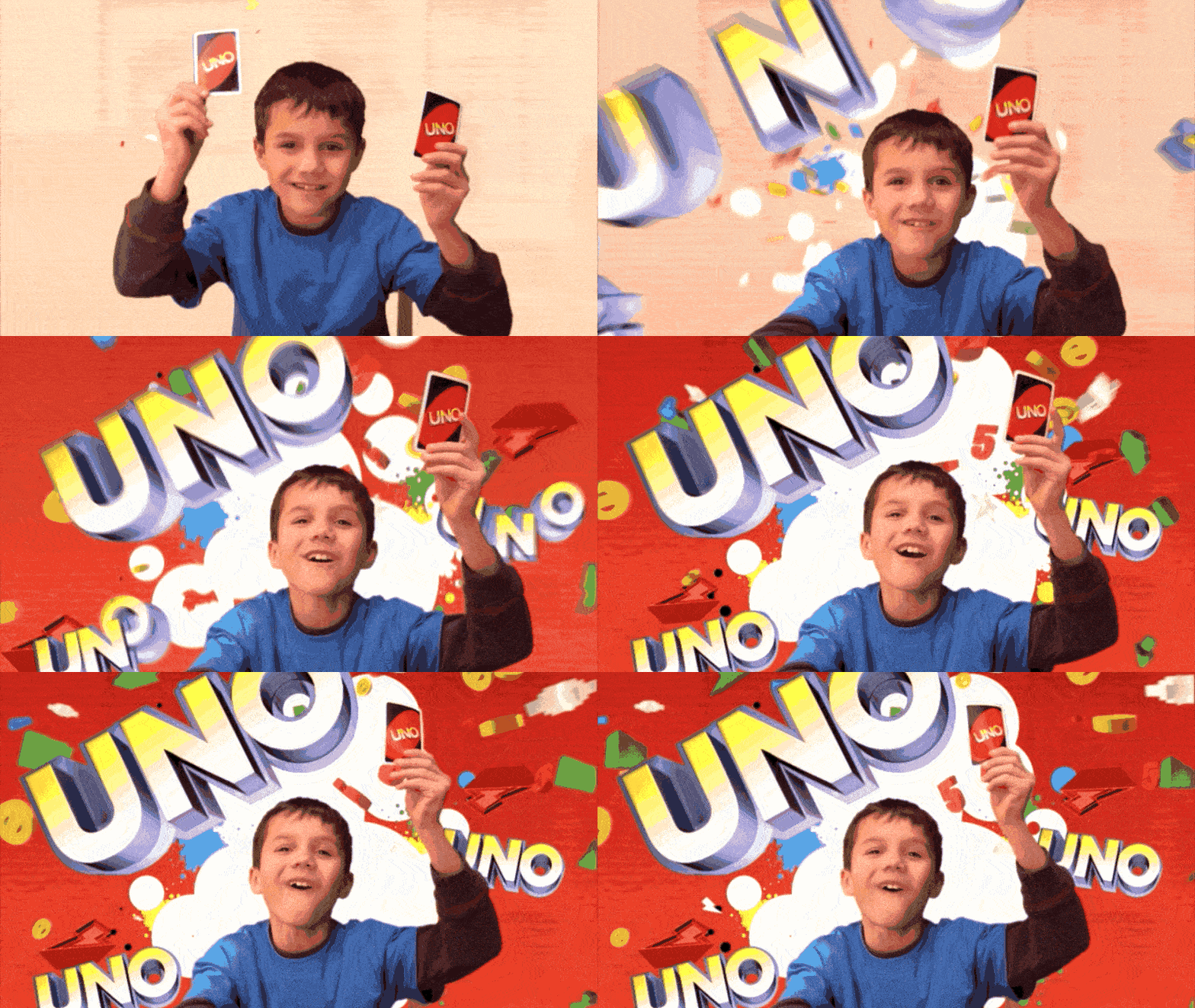
Yeah. You’re right. In this post I said, “I use Uno cards a lot. I'll write up the reasons why in a future post.” Given the fact it’s four years to the day from that original post, I guess it’s about time I get to that. Here are some of the reasons I like using Uno cards when possible.

  1. They’re smaller than playing cards, so somewhat easier to palm.

  2. You have 0s and 1s, so if you’re doing a trick where, say, someone shuffles the cards and mysteriously deals out their own phone number or something, you don’t have to do that thing where you’re like “a ten is a zero and aces are ones.” Some tricks just aren’t as pristine when you have to interpret the cards like that.

  3. There are natural duplicates in a pack of Uno cards which can prevent discrepancies that you might see in card tricks with a typical deck.

  4. There are actual “Wild” cards in an Uno deck which are naturally relevant for any trick where one or more cards transform into other cards.

  5. You don’t have the, “I’ve seen this one before” response you might get when you go into a trick with a normal deck of cards.

  6. I think people are less likely to question a deck of Uno cards. People have heard of trick decks of playing cards, but Uno cards feel somewhat above suspicion because it’s a brand name product, not just generic “playing cards.” Yes, but isn’t Bicycle a brand name product too? Not to people who don’t play cards regularly.

  7. I like performing for the ladies. Chicks dig Uno. If I have an Uno deck on my coffee table when a woman is around, there is a very good chance she’ll suggest playing it. Rarely will they pick up a normal deck and be like, “Let’s play cribbage!”
b1b4ab2e-4558-4b5e-ac39-f11a922bffbc_car_16x9.gif

How to Get People to Question Irrational Beliefs

This is a picture I took in a coffee shop the other day.

Screen Shot 2019-07-24 at 3.07.49 PM.png

It might not be 100% clear what’s going on here, but for the first time in my life I encountered people using a pendulum in the wild. I came in just as they were wrapping up whatever they were doing, so I didn’t quite get the gist of what was going on, but they were raving about how “amazing” it was.

For most of my life I would have been the person who would say, “Have you heard of the ideomotor response? You’re actually moving the pendulum yourself, with movement you don’t even sense that you’re doing. That crystal means nothing. It would work the same with a washer on dental floss.” Well, I probably wouldn’t actually say that to strangers at a cafe, but I’d want to.

While I’m still personally just as much of a skeptic/non-believer as I’ve been in the past, I’ve come up with a new technique for handling this sort of situation. I no longer try to make a rational argument against this sort of thing. You don’t rationalize with people who think a crystal on a chain has mystic powers. It’s not like it was a double-blind, placebo-controlled study that got them believing in the powers of crystals in the first place. Believing nonsense is just one of 1000 coping mechanisms we have for filling the holes in us that are inherent in the human condition. So it would be like trying to rationalize people out of doing meth. “Meth is actually really bad for you.” “Wait… whaaaaattt???!!!!”

So I don’t try and talk people out of that sort of thing these days. I’m still a grade-A expert at making people feel retarded for believing in something stupid. But I just don’t care about that stuff anymore. If you want to believe in crystals, or tarot, or ghosts, or the Law of Attraction, or whatever… knock yourself out. I’m not completely laissez faire about it. If someone is being taken advantage of, then I’ll intervene. And if someone is like, “You know, I’m thinking of stopping my chemotherapy treatments and instead rubbing this lucky penny for 45 minutes a day,” then I’ll say something. Beyond that, I don’t really challenge people on this sort of thing. (And I’ve even taken on some irrational beliefs of my own in regards to synchronicity and my own control over the universe. I find it has a positive impact on my outlook and behavior.)

Despite my change in approach, I think I’ve stumbled over a non-combative way to make people reassess beliefs that many of us would describe as nonsense. It’s a bit counterintuitive, and it certainly doesn’t always work, but I’ve found better success with this technique than I have with trying to debate these things with people.

Instead of arguing over the topic, I just amplify their belief and then demonstrate the phenomena in a very direct way. So, for example, if someone is talking about the power of the tarot, they usually mean that you can read into the cards in some sort of general way that maybe addresses your past or future if you squint enough. So I’ll be like, “Oh, absolutely, the tarot is incredibly powerful. I’ve learned techniques that allow it to make specific predictions of things that will happen in the immediate future.” And then I’ll do some sort of tarot-based card effect. Now, you might think that a strong trick would reinforce someone’s belief in the tarot. But what I find is that if it has any effect at all, it’s to undermine their belief in the phenomenon. If this clear, credible “evidence” seems like it must be fake, then the vague, sketchy evidence their belief was previously based on is going to come into question as well.

Not for everyone. A lot of the time they’ll still continue to separate the experiences. But for some people, doing something so blatant and “obviously a trick” will weaken their belief in the phenomenon in general.

I’m not trying to change people’s opinions. But that is the outcome for a subset of people when I do a trick with a presentation based in some irrational belief. And for everyone else, I’ve just done a trick dealing with a subject they’re interested in. So it’s a win-win. I don’t end up actually reinforcing anyone’s belief, because my style of magic is unbelievable.

With the women using the crystal in the coffee shop, I certainly wasn’t trying to change their opinion on crystals or pendulums. I did engage with them because it was such a perfect set-up for a trick that I was compelled to capitalize on it. I ended up talking with them about crystals and offered to show them something interesting I’ve learned about “crystal power.” “It’s not about the size of the crystal,” I say, “It’s the number of facets present. That’s why a packet of sugar crystals is so powerful. It’s just about the sheer number.” It’s funny to me when people who were just earnestly waggling around a pendulum are giving me sideways glances like I’m crazy. But they were game to play along. So they each dangled sugar packets over playing cards and they were able to each find the color cards I had assigned them. (An impromptu OOTW style trick.)

I then dumped some packets of sugar out on a saucer. And with the sugar and the cards completely out of my hands, they shuffled the deck in packets, holding them over the plate of sugar. Then they cut the deck to one card, the six of diamonds. Without touching anything, I showed them that if they looked at the sugar just right they could see a faint 6 ♦️ in the sugar. This completely fucked with them.

(How? The deck was marked, and I used some techniques I learned from Ben Earl to allow them to shuffle the cards before doing the cross-cut force on themselves. I had dumped the sugar out and subtly drawn the card in the sugar long before they finished shuffling and cutting. By the way, I didn’t have the marked deck on me. Months ago I put it in the bookcase at the coffee shop below. I’ve also set some stuff up in the Trivial Pursuit game and the Scruples game. And I have a crib for the first few words on page 127 of most of the books on that bookshelf. Always Be Prepared. It’s the Jerx Scouts motto.)

Screen Shot 2019-08-06 at 6.49.17 PM.png

As the women got ready to leave and one went off to the bathroom, the other said to me, “Do you really think there’s anything to the crystal stuff?”

I said, “Of course! You just witnessed it.”

She said, “Ahhh. Gotcha,” in a way that suggested: Okay, I get it. it’s all just fun bullshit.

My goal wasn’t to talk her out of this belief, but if it had been, I think I would have considered this a success.

Dustings of Woofle #11

Hey, everyone! I’m having a blast here at MAGIC Live! You know how cool and charismatic one magician is, right? Well, now imagine 1600 of them in one place! Talk about a party!

The dealer’s room is always a highlight. This year’s crop of pom pom sticks is really something to behold. But I think my favorite thing so far has been Dan Harlan’s newest version of Cardtoon. Instead of just a card reveal, you now flip through the deck and it tells the heartbreaking story of a young man’s struggle with his sexuality and coming out to his father (a decorated military veteran) and their subsequent 20 year estrangement. Not to spoil it, but they do reconnect when the father is diagnosed with cancer. And in the goosebump-inducing finale, the father—in his final days of life—joins the son to march in the gay pride parade. And together they raise a sign that says “3 ♧” (Or whatever card your spectator named.)

It seems every year this convention redefines the art of magic. I’m very excited because I’ve negotiated exclusive rights to broadcast the main stage on a webcam below. So even people who are unable to attend can still see the incredible artistry on display.

Let’s take a look…

giphy (1).gif

I came across an effect recently called Unsolved by Francis Girola. It’s a deck with information on cold cases printed on the cards.

Screen+Shot+2019-08-01+at+12.17.49+PM.jpg

If that sounds like an odd pairing to you, it does have a precedent. There have been decks of cards printed up in the past with information on murders and missing people on them. They’re given out, usually to prisoners, as a way to hopefully get people talking and maybe elicit some new information in regards to these cases that have gone cold.

In Unsolved, the cards are apparently marked in a way so that you can know details about the crime/victim on the face of the card.

With the amount of friends I have who are interested in true crime, this would be a no-brainer for me to pick up. And then I saw the face of the cards….

Unsolved-5.jpg

Check out the phone number. They went to the effort of making these cards mimic something that exists in reality, and then they put a “555” phone number on the cards.

Now, maybe this isn’t well known around the world… maybe they see American TV and someone gives out a 555 number and they assume that what a real phone number looks like. It’s not. The 555 is used in TV and movies because it’s not real. This number is particularly fake. It’s Jim Rockford’s phone number from the Rockford Files and has been used in a bunch of different tv shows.

Why they went this route, I have no clue. They could have just got a Google Voice number and printed that on the cards, and even had a recorded message when you called saying “leave your tip” blah, blah. Or they could have left off a phone number and had it say, “Please contact a prison official to report your tip,” since these were meant to be given out to prisoners.

Oh, Andy, no one will look at the phone number.

It’s the biggest thing in the boldest font on the card! A card you’re asking them to invest their attention in. A big 555 is pretty obvious, even if you’re not really focused on the phone number. It’s as obviously fake as if it said, “Please submit tips to: Santa Claus, 123 Main St., Anytown, USA.”

I’m going to guess that they didn’t print a ton of these, in which case it hopefully won’t be too much of a financial hit to set these on fire and print up a new batch with a proper phone number. I’ll be here with my grubby little fingers ready to click “buy” when that happens.


Cut for Time: F.U.2.

Here’s a section that was cut from my post on FU2 from last Friday.

It was inspired by a line in the Ellusionist ad copy which said the trick is the perfect heckler stopper. Now, I don’t know shit about “heckler stoppers.” I perform for people I like and who like me. Either no one ever seriously screws with me, or perhaps I just don’t ever interpret anything as that. So I can’t speak from experience. But I’m going to guess pulling out a specially-made card with a printed middle finger on it isn’t going to stop any hecklers. More than likely they’re just going to upgrade you from a regular wedgie to an atomic wedgie for your cornball trick.

Instead of suggesting to an asocial 14-year-old that they’re going to be stopping hecklers with this trick, I wanted to give them a more realistic expectation of how things will go down….

“Hey everyone, look at my special, funny joke card. Now I’m the life of the party! Hey, Kaitlyn, did you see? Did you see the funny card I had? Kaitlyn! Did you see it? It has a middle finger on it and it says ‘fuck you.’ And I totally made a fool of the school bully with my specially printed funny card from ellusionist.com. And now I’m the hero of the school! Kaitlyn, stop trying to kiss me! I’m sorry if my trick turned you on so much, but I have to go do some more magic. The whole party is really buzzing about me and my incredible tricks. Can’t you hear th—” buzzz, buzzz, buzzz. Huh? Bed? Sheets? Pillow? It was just a dream? But it felt so real! Aw, fudge… I jizzed my underpants. “Honey, time to get up. Do you want me to make you a soft-boiled egg?” “Mom! Get out of my room, you stupid B!” Ugh! I can’t believe it was just a dream. But soon it will be true. I’ll show them all. Mom, Kaitlyn, Trevor the bully. When I get that special card from Ellusionist, then they’ll show me the proper respect! Things are bound to turn around for me.

One week later the card arrives in the mail. One week after that he’s googling ways to build a bomb to blow up the school.


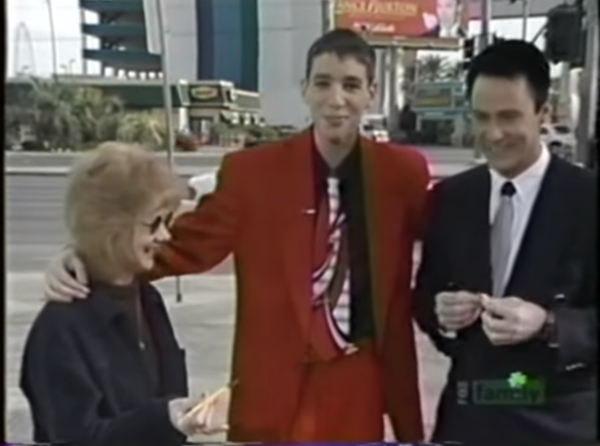
I think one of the more powerful moments of synchronicity in the existence of the known universe that very few people ever talk about is the fact that if you were on Lance Burton’s Young Magician’s Showcase in 2001, and you thought wearing a red jacket was a strong sartorial choice, then there is a 100% chance you went on to start a company called Vanishing Inc.

Screen Shot 2019-08-03 at 7.48.55 PM.png

Cafe Soaps: F.U.2

Cafe Soap are the little “soap operas” that unfold in threads on the Magic Cafe. Back in the early/mid 2000s, when the Cafe was thriving, the Soaps were plentiful and fascinating. You’d get a thread that would go on for 18 months and 30 pages with a guy promoting his self-levitation that he would assure you was totally real, and definitely coming out. “Ah, damn! There were problems with the DVD replicator. It’s going to be 6 more months.” That was always great news. It was like your favorite show got picked up for another season. There would be accusations of theft and fraud and obviously-fake accounts that were just made that day, “I’m a friend of Tom’s. This trick is real. I’ve seen it.” But the dude’s syntax was identical to Tom’s.

With the Cafe well on its way to becoming the equivalent of the once thriving, now empty, mall near you (the one full of 35 dark, deserted stores; a weird smelling shop that sells wall tapestries; a local pizza place operating out of the old Sbarro in the otherwise abandoned food court; and, for some reason, a Bath and Bodyworks), the quantity and quality of the Cafe Soaps has gone far down hill.

But here’s a decent one. It’s people arguing over a trick where you claim to have predicted a spectator’s chosen card. It turns out your “prediction” actually says “Fuck You” on it. You then go on to show that you actually did know the card they would choose. You may imagine people are arguing about it in this manner: “You came up with that shitty idea.” “No…you did.” But believe it or not, they actually want to take credit for it.

The dispute is between Lloyd Barnes, from Ellusionist, who has released the trick as FU2, and Harrison Green Bomb* who has been performing a very similar trick in his act for some time now, apparently.

[*Edit 8/4/19 - Yes, I know that’s not how you spell it, but H.G. wrote and asked me to remove the next paragraph about his penis so it wouldn’t show up in searches by corporate clients—so instead I just removed his last name altogether, so now they won’t find this post at all, and we all still get to fantasize about his sweet dong.]

(I once saw Harrison perform magic naked. I’m 100% serious. This was somewhere between 2008 and 2010, I think. It was a brief period of time where people thought it was brave to do whatever they were doing on stage naked. So you had naked improv and naked stand-up and naked magic. It was stupid, unless someone you thought was hot was involved in it, then it was great. I can’t remember much about the show. I remember the guy who hosted the show legitimately had a micro-penis. And I remember Harrison did the Baby Gag. Speaking of which, I don’t think Harrison was working with too much downstairs either. Making a “baby gag” would probably be the best he could hope to do with that thing. In a full grown adult’s mouth it would rattle around like a Jolly Rancher. (I’m kidding, Harrison. Your dick made no impression on me one way or the other…. Ah! And isn’t that the cruelest thing you can say about a dick? Indeed.))

I can see both sides of the issue. I can see why Harrison feels it’s a rip off of his trick, and I can see Ellusionist’s position that the tricks themselves are different in method and have a somewhat different payoff. Like a lot of things in magic, it’s ethically ambiguous. In this sort of situation, I tend to side with the original creator. And in this case that’s a particularly easy thing to do because I sure as shit am not going to walk around with some pre-printed cards with a middle finger on them.

The problem I see with the trick is this… only a bunch of corny-ass magicians would think the phrase “fuck you” is somehow shocking or edgy. It’s not. You can say it in a PG-13 movie. So it’s not really that crass, nor is it inherently funny in any way, it’s certainly not original, and it’s not even charmingly sophomoric like a sponge ding-dong. The trick gets a good response when Harrison performs it, but that’s because he’s a competent performer, not because “fuck you” itself is particularly clever.

As far as I’m concerned, the best use of this sort of idea is by Joshua Logan, John Bodine, and Brian Hart, in the November 2012 issue of MAGIC Magazine. In their trick, Freak Out, you print a horrible, explicitly graphic sexual image on a card (think “goatse” or “lemon party” or someone sucking a log of shit out of someone’s ass). When your spectator sees that, they will give it a look that you try and play off as them reacting to your correct prediction. That seems like it could be fun. But no one is going to react in a shocked way to the words “fuck you,” unless it’s 1880 and you’re performing at Little Loyd Fauntleroy’s birthday party.

But whatever. I’m going to put an end to this dispute by giving both parties some alternative phrasing to put on the card. So now it’s not a a “fuck you” trick anymore. Okay? Problem solved. Here… for anyone to use… are some other things you can print on the card as a way to say “fuck you” with a little more panache…

IMG_6271.JPG
IMG_6273.JPG
IMG_6274.JPG
IMG_6272.JPG

Mailbag #9

giphy.gif

One of the most common easy answers [Ed: See this post] you didn’t address is “He’s in on it” (stooges, plants, etc.).

After seeing shows at the Magic Castle, I listen to a lot of audience members as they’re filing out the door and or wandering around the Castle, and “Plants” is the most common answer, EVEN WHEN THAT WOULDN'T EXPLAIN WHAT HAPPENED. —John Lovick

Yeah, great point. This is something I never give much thought to because I’m never performing for more than a few people at a time.

This is another reason why one-on-one magic can be so powerful. It eliminates this possibility. No one can ever think, “He’s in on it!” They would have to think, “He’s in on it! Wait… I’m ‘he.’ And I’m definitely not in on it.”

I find, even when performing for a larger group, that you seldom get, “He’s in on it,” in social situations. In fact, even when I am being a stooge or a plant for someone else, I can’t remember a time when people suggested I was in on it, even when they knew me as someone who did magic.

I think the stereotypical neediness of magicians actually helps us here. It’s not hard to imagine that a professional magician might pay someone to help him look good—and that person will keep their mouth shut because they’re being paid. But in a casual situation, the idea that someone might be secretly assisting (for free) in a trick in a way that only makes someone else look good is a less obvious conclusion. (This is something I take advantage of in the trick Any Man Behind Any Curtain from The JAMM #5. Where you act as your own stooge, but no one ever questions it because it doesn’t seem like it’s a trick designed to make you look better.)

That’s why it can be so beneficial to find some wingmen to work with. You can really do some miracles together if you find a few people who are willing to set their ego aside and help each other out. I find that sort of thing is just unexpected in the area of amateur magic.


I might be misremembering, but I think I read something you wrote where you were looking for a good psychological card force. Did you ever find one? —AM

I don’t think that was me. But to answer your question, no, I have never found a good psychological card force. The reason for that is because they don’t exist. Now, to be clear, there are many good card forces that use some psychology to make them stronger. What I’m saying doesn’t exist is a psychological force where you theoretically use some powerful combination of words and gestures to get someone to name a specific card in the deck. That’s like a mentalism urban legend. It can’t be done in a way that is A) reliable, and B) not obvious to the person.

But doesn’t Derren Brown have some in his books?

Sure. But I think you might be misremembering exactly how those forces work. Re-read those descriptions and ask yourself if you’re secretly implanting a card in their mind or subtly imploring them to engage in a mini-game of charades with you.

I’m sure you can get people to play along and pick up on the signals you send them, or you can “psychologically force” a common card like the QH or AS. Those might be fine in some circumstances. But for my purposes, I would need something reliable that left the spectator with no clue as to what was going on, and I haven’t seen or read any type of psychological force that meets those criteria.


I thought about a presentation premise I call the sorcerers apprentice. Basically you tell (or insinuate) to the spectator what you are going to do and the you screw it up, but the end result is still magical, even though you play it as a failure.

I’m on a coin magic high so I’m thinking about the “classic” coin through hand, which I hate. I would set the idea and then perform a “psychic surgery” style mojo on my hand, chicken guts included, with out the coin actual coming out. Most likely freaking out and leaving. —DRM

Yeah, this kind of structure is good. It’s similar to some ideas I’ve posted here before. The one that immediately comes to mind is where you say you’re going to vanish a coin but you only end up shrinking it a little. So you “fail,” and you blow it off, but in a way that is still magical.

I would probably do the coin through hand once successfully at first. Because it’s such a quick trick and one that people often ask to see again (because they—rightfully—think they can probably figure it out if they see it again), I’d have it get stuck the second time. I’d spend the next twenty minutes trying to carry on like everything is normal, but rubbing my palm a lot. Sort of like when you’re talking to someone who has something in their eye and they’re trying not to let it distract them from the interaction, but it clearly is.

Eventually I’d leave and later that night I’d post a picture of myself on my instagram at the ER with my hand bandaged up. Caption: “Looks like I’ll be pleasuring myself left-handed for a while. Had to have surgery to remove a coin stuck in my hand.”

This is an example of a concept I call Reps (Repercussions) where you do something afterwards to extend a trick past the initial presentation. It may seem like a lot of work, but it would really just amount to a short detour to the hospital and taking a picture. It would be great if you could talk them into letting you take a picture in one of the rooms there, but they might not buy your “magic trick” excuse. They’ll probably think it’s part of some insurance fraud. So you might have to take the pic in the waiting room or even outside with the hospital in the background. It would still work. Reps are one of the more powerful ways of messing with someone’s mind with a magic trick.

The Bat Coin Conundrum

Most magicians are familiar with Paul Curry’s Unsolved Card Problem, also known as the Open Prediction.

There’s another story from magic history that is less well known, but along similar lines, and it’s one of my favorite pieces of magic lore. In the 40s and early 50s there was a magic periodical called The Bat, which was given away free with every order over a dollar from Magic Limited. It was, essentially, the Penguin Magic Monthly of its day.

In 1948, they published something called, The Bat Coin Conundrum. It was, essentially, a “challenge” to magicians (similar to the Open Prediction, but actually pre-dating it). The goal was to create a routine where three silver coins would change to three copper coins. That doesn’t sound that unique, I know. But the rules of the challenge were that only three coins could be used and they had to be examinable at the end. There were more rules than that, but those were the big ones.

So, how do you do a fully-examinable three coin transformation with no extra coins? Well, you don’t, of course. That would be real magic. And that’s probably why the publishers of The Bat were comfortable offering a $5000 prize ($50,000 in today’s money) for anyone who could present a solution.

So that’s printed up in the magazine and maybe it caused a little buzz, I don’t really know. Anyway, cut to three years later, and a guy named Carl Manley, who lives in the town of Brocton, NY, writes to The Bat publishers and is like, “Hey, I solved it. Show me the money, bitches.” Or whatever words to that effect someone would use in 1951.

The people at The Bat are like, “Well, we need to see you do it. Our judges need to make sure all the rules are followed, blah, blah, blah.” It’s 1951. There’s no internet, you can’t send a DVD. So they agree to meet up at a magic convention in Pittsburgh later that year where he’ll perform the trick and—if he has met the requirements—he’ll be presented with a check for $5,000. I’m assuming it would be a big novelty check.

So the magic convention rolls around and it’s the day he’s supposed to perform the effect and The Bat people are there (presumably with the big check, or perhaps they went the other way and had prepared a novelty teeny-tiny check—that would be cute), but Carl doesn’t show. People are pissed because this was intended to be a big moment at this convention. You can imagine if MAGIC Live was promoting the possibility that someone had solved a seemingly impossible magical problem, and the solution was going to be demonstrated live for the first time with the potential of someone walking away with $50,000, that would be a pretty exciting thing to witness.

But he doesn’t show and The Bat people and the convention organizers are assuming this was all a hoax the whole time. They’ve only corresponded with the guy through letters. He probably never had a solution. “Carl Manley” probably never even existed.

But that turned out not to be the case. 15 miles outside of the city, in a crappy motel room off the highway, Carl Manley’s body is found. It looks to be a robbery gone incredibly bad. His money and wedding ring were taken. And he was choked to death in a manner so violent that his neck was completely broken in the process. Nobody is ever charged for the murder.

In the early 60s, Carl’s now-grown daughter is going through his possessions that the police returned to them after the investigation. And she going through her dad’s magic notebook where he described tricks and routines he was working on. And she notices, for the first time, that two pages were ripped out of the notebook. By the dates on the pages surrounding the missing pages, it’s clear that the missing entries would have been written right around the time that he had, apparently, stumbled across the solution to the Bat Coin Conundrum.

So his daughter gets a new theory that this wasn’t some random robbery gone wrong, but that he was, in fact, killed by someone who either wanted this secret for themselves, or wanted to prevent the secret from being released. She believed it was the publishers of The Bat not wanting to pay up. But that seems a bit extreme, and nothing ever came from that theory.

This whole story pretty much faded into obscurity for 50+ years. Then, in 2015, there was a murder of a 22 year old named Gerry Parker in Gainesville, FL. Gerry was strangled to death so violently that his neck was completely broken. Gerry was also an amateur magician.

These were his last two tweets…

fYRPqx.png
x4ZorH.png

The cops, of course, looked into his social media and tried to make sense of these tweets, but they got nowhere. In fact, it wasn’t until almost a year later that anyone figured out what the tweets were driving at. There was a thread on The Magic Cafe about the murder and they mentioned the tweets and someone began to put it all together. You have a guy who was killed in exactly the same manner as the guy who supposedly solved the Bat Coin Conundrum and he’s a magician, and he tweets right before he dies with an image of a bat, money (coins), and he mentions 5 Gs, aka five thousand dollars.

But here’s the thing that makes it super messed up. Whoever killed Carl Manley in 1951 would be at least 85 now. An 85-year old is not going to be breaking a 20-something guy’s neck. So it had to be two murderers. But the weirder thing is this… Gerry had under 30 followers on Twitter. He wasn’t well known. Nobody knew he was working on this trick. And yet hours after apparently “figuring out” how to do this trick—and posting about it vaguely on Twitter—he’s murdered in the exact same way someone was 65 years prior? That’s crazy.

Anyway, I’ve been working on the Bat Coin Conundrum myself. And I think I actually had a bit of breakthrough. That’s why I asked you to come over tonight. I want you to record this. I want a witness who can verify that I really did this in case something happens to me.

Look, I have three silver coins…

The Unsolved Problem Universal Presentation

Yes, as I’m sure you quickly realized while reading that, it’s all just nonsense I made up.

The Open Prediction is something that has captivated magicians for a long time. And in recent years I’ve seen a few different people suggest presenting it by talking about the history of the effect and the “challenge” nature of Paul Curry’s “unsolved problem.”

I think that’s a fine idea, but here’s the thing… you’re not limited to using that presentation with an Open Prediction and talking about Paul Curry. You can make up magicians, make up challenges, make up rewards, make up situation, make up complete histories of a trick and capitalize on the potential intrigue that is generated by saying, “Here’s this challenge that no one was ever able to solve.” And giving people a peek into a fascinating (albeit fake) history of magic.

You don’t need to get as dramatic as I did in the story above, I was just doing that for your benefit.

The thing about the Open Prediction is, it doesn’t really need much of a hook. It’s a pretty simple, clear effect. So it’s maybe a better use of the “Unsolved Problem” presentation to save it for a trick that isn’t so clean-cut. Thus you’re justifying the procedure as part of the presentation (because that procedure can be laid out as part of the challenge).

For example, think of an ace assembly. Sometimes people will put such a trick in a gambling presentation to attempt to make it make some sense, but that doesn’t always work so great. So, frequently, the trick is just presented as, “I’m going to do this and you’re going to watch me do it.”

Apply the “Unsolved Problem” presentation to it and you can talk about this “classic” challenge in magic that people haven’t been able to solve for 75 years, where you put the aces into four different packets and make them all gather into one. You can build the story up if you want. Add sex and intrigue and death. Or it can just be some long-standing challenge that you think you’ve finally cracked and you want their help to see if it works.

You could separate the presentation out over time. Show them a standard ace assembly. Then mention there’s this long-running “impossible challenge” amongst magicians of doing the same trick but with aces that have different back colors. “I think it’s legitimately impossible,” you say. Then a couple weeks later you’re like, “Remember that thing I told you about? Well, I think I might have actually figured it out.” So now instead of a “meaningless” trick, you’re creating a story that unfolds over time.

As a “Hook” you could have a list of conditions for an effect written on a sheet of paper laying on a table in your house. When someone notices it, you could explain the “history” of the trick to them. Maybe you perform it then or maybe at some other date.

So you create a challenge for a trick you can already do, and then you create impossible conditions for it. The nice thing is, you don’t actually have to meet those conditions. You just say you do. For example, in the coin trick described in the first part of this post, you could just say you’re not using extra coins or gimmicks. You’re not actually performing this for a board of magician judges. So you should be able to get away claiming some conditions you’re not actually meeting.

I always like to put in a condition like, “No sleight-of-hand, and no gimmicks may be used.” If you’re—apparently—ruling those things out, it can be very fascinating to people to consider what you are using.

Now, it doesn’t matter if people believe the story. It’s not there to be believed. It’s there to entertain and add some context to a trick.

800wm.jpeg

Even though it’s not intended to be believed, it’s nice to wrap up the story in some way that puts a bow on it. If you claim you’ve solved some long-standing impossible challenge, then that should play out in some way. For example, in the story at the top of this post, I would text the person the next day and say, “Did you share that video with anyone?” When they say they haven’t, I’d ask them to erase it from their phone. “I’m feeling sketched out. I got a text from a blocked number with the image of a broken neck and the word ‘you’ written underneath it. I’ve literally not told anyone about this but you, so I don’t know who could have sent it to me. Let’s not talk about this again.”

Or, here’s a good “brush off” you can use to conclude any trick with this presentation. Maybe you’ve been telling someone you’ve been working on this trick for weeks. It’s an impossible challenge that you’ve somehow solved. That’s not inherently unbelievable, so they might think what you were saying is true. At some point in the future they might say, “Whatever happened with that trick you figured out?” Maybe you told them there was a prize for solving it, or that you’d get inducted into some secret magi society.

“Oh,” you say, “that didn’t pan out.” You bring up the list of conditions. “You see this one?” you say, and you point at one of the conditions (which is the opposite of one of the actual conditions in Paul Curry’s Open Prediction).

Condition #17: The method must not be something that could be used for criminal purposes.

“I think they thought the method I came up with was too dangerous to release. Because it definitely could have been used for criminal purposes. Definitely.”

Now you leave them with another little mystery wondering what that could possibly mean.

Dustings of Woofle #10

I was in my hometown the other day and ran into someone I hadn’t seen in about 25 years and she mentioned a trick I did in the lunch room in high school that I (apparently) called the Time Traveling Chicken Sandwich. I don’t remember the details about it, but I do remember I used the torn corn principle, except instead of a playing card I used a breaded chicken patty. I took a bite out of it and spit it out onto a napkin and gave it to someone to hold. In actuality I swapped the bite I had just taken for a bite from another chicken patty already in my mouth. I quickly devoured the rest of the chicken patty (including the extra piece I had just bitten off).

Then I did something, although I don’t remember what, and demonstrated that we travelled back in time and I revealed a restored chicken sandwich missing one bite—a perfect match for the one I spit on the napkin from the chicken I apparently ate earlier.

She remembered that shit 25 years later! That’s now officially the longest time gap between performance and spectator recollection in my magic history.

A testament, indeed, to the awe-inspiring power of such a beautiful routine and my magic genius.

giphy (1).gif

Speaking of… for those who have inquired about consulting, you can now find details on that in the menu at the top of the site.


Tom Frame sent me the PDF for his Hypercase. The Hypercase is inspired by the Hypercard, which is this classic “impossible object” which is made from a single playing card:

Screen Shot 2019-07-26 at 12.26.13 PM.png

Unfortunately, I’ve been familiar with the Hypercard for so long, that I can no longer see the “impossibility” of it. The topology of the object is too apparent to my eyes and I can’t get back my “spectator brain” about this thing as I can with most other things in magic.

Here is Tom’s Hypercase.

dkRRXzK.jpg

Similar to the Hypercard, I don’t have the ability to comprehend how a spectator’s mind would perceive this “impossible object.” What I mean is I don’t know how “impossible” it would seem. I think for it to be really strong you’d need to, apparently, construct it in the moment with the person you’re performing in a partially open/partially secretive manner, to give their imagination something to chew on.

Here’s how I’d do it one-on-one/jerx-style/extended presentation.

I would construct the case and have it in my pocket along with cellophane from a deck and an extra card. I'd buy a deck when I'm out with someone. When we get back to their place I'd ask if they had scissors. When they go to get the scissors I'd put the normal deck away somewhere. I’d pull out the Hypercase with the additional card held against it and the cellophane.

When they return I’d act as if I'm pulling the cellophane off the deck and toss the cellophane on the table. Maybe I'd even put a seal on the Hypercase so they could see me remove that too. Not too much attention is being paid at this point. I’d remove the cards, take the scissors and say, "I can't show you exactly what I'm doing just yet," and somewhat hide the procedure from them behind the case/my hands.

They’d hear me cutting the case, but really I'm just cutting the extra card. I’d set the scissors down. Fold the extra card behind the case and steal it away and ditch it at some point as I'm fussing around with things. Then I’d pick up the scissors again and trim a little bit off the actual tabs on the case. Just to reinforce that yes, I'm actually cutting up the case in this moment.

I’d set the scissors back down and mutter something like, “Well… here goes nothing." And I'd grunt/groan really loudly, "Gaaahhhh!!!!" as if I'm straining in some way—doing something requiring great effort on the back of the case (reaching into another dimension). Then I'd toss it on the table and be like, "There you go."

Tom doesn’t have a site, but you can get his PDF on this for $7. Find the details in this Genii forum post.


A couple people wrote me about these glasses, which Mike Close recently mentioned in his newsletter.

Screen Shot 2019-07-24 at 3.56.07 PM.png

They’re pretty interesting looking and fairly inexpensive.

You can get them with dice, poker chips, bullets, guitar picks, etc. I’d get the one with a poker chip. I wouldn’t use it directly in a trick, I’d just leave it out somewhere. When someone commented on it I’d say. “Oh, that was a trick gone wrong. Something I’m working on. Actually… let me give that another shot, hold on.” And I’d grab some coins and a glass and do some sort of coins through glass effect.

Now, when they’re mind starts going to sleight-of-hand and ways to sneak the coin into the glass, they have this strange object in their line of of sight that’s going to counteract that “easy answer.”

You could, of course, make the glass your finale for a coins through glass routine, and switch it in for a normal glass. “I’m going to pause the trick half way.” That sort of thing.

But I think I prefer a subtler use of it. Since everyone just assumes magicians are lying all the time, I think the less of a big deal you make about the glass, the more likely they are to believe that just maybe there is some way to pass items through glass and this glass represents a botched early attempt. Or at least their mind will be tempted with that notion.


Look, no one is a bigger fan of long, extended tricks than I am. I’ve mentioned before I think it’s pretty pathetic that people do Out of This World with half a deck because they can’t keep people engaged for the minute it takes to deal through a a full deck.

That being said, I think this version of OOTW by Michael Ammar is really swinging too far the opposite direction.

Screen Shot 2019-07-18 at 4.30.44 PM.png

I feel it starts to drag after the sixth deck. You do get something of a “second wind” around deck 10. But when he brings out deck 12 and is like. “Okay, for real this time. This will be the last one. I just want to be 100% sure it’s not a fluke. David…David! Wake the fuck up, and deal the 12th deck!” It feels borderline abusive.

Also, I question this line in the explanation, “It’s completely impromptu, as long as you run into someone with 12 decks of cards on them, or 12 people who each have one deck.” I mean… yeah, I guess.