The Reverse Psychology Force

This is the strongest card force there is.

Yeah, yeah, I know. Here's the thing, when you write a blog and half the time you're "in character" talking about what a genius you are and the other half of the time you think you're truly giving out genius ideas, it can be a bit confusing. Most of the time I'm not sure myself if I'm being serious or not. I read through old tricks and see a million ways for them to be improved. I read articles on theory and think I have better and more creative ideas on this blog multiple times a week. So when I write something on this blog about how this is the next evolution of magical thought, I'm doing it as a goof, but then part of me is like, "Actually, I kind of believe that."

At any rate, I was never going to write about this force. For me it is one of the most valuable things I've ever come up with. But when you give something away for free on a blog then I think everyone just thinks, "Aw, well here's another hunk of nothing, if it was anything good he'd sell it as a limited edition manuscript." Because we're all familiar with people selling half-baked shit for $600. And it's kind of easy to just assume anything without a price-tag like that is probably not all that worthwhile. Fine. The truth is, if this blog was a private, subscription-based thing that you had to pay for, then some of you would feel you got your money's worth based solely on this. 

I had originally written this up as part of a trick I'm posting next week. It's a trick you can do for someone's birthday, but it demands a really good force. I was going to hide this force in that write-up, but I'm already hiding a really strong addition to the torn corner ruse in that trick (which involves a spectator assist in the switch and vanish) and I didn't want the explanation to get overwhelmed.

So, I'm shining a spotlight on this force. As usual, my magic knowledge is not vast enough to know if it's original to me, but I feel like I would have read about it if it wasn't. It may seem like just a few small tweaks, and that's really all it is. But it's like if you had a boat with three small holes in the bottom and I plugged those holes with three small corks, then you'd see the value in those "small tweaks" to the bottom of your boat.

What are the strongest card forces you can do in magic? I think many people would argue they're the classic force and some version of a psychological force. But the problem with both of these forces is that the stronger your revelation is, the more heat is put on the force, and the "obvious" solution occurs to the spectator. "I guess he must have made me pick that card," or "I guess everyone says 7 of hearts."

I wanted to create a card force that I could use for even the most insane revelations and yet the card force would be beyond question. It had to be so strong that I could force the card on someone, walk outside, see the card up in the air in skywriting, and for them to still not question the fairness of the force. 

I came up with a handful of ideas and would test them with the following trick. I would have a duplicate of the force card in my pants pocket or my shirt pocket. I would stand my spectator directly in front of me and give her the deck to shuffle. When she was done I would take her right hand, curl her three fingers in so just her index and thumb were out, then I'd guide those fingers into my pocket and tell her to hold onto the item that was in there (the duplicate force card). Then I'd force a card on her and tell her to remove the item from my pocket. This might not seem like much of a trick to you, and with most forces, it's not. But if you have a force that is structured in a way that it couldn't possibly be a force, then this is an AMAZING trick. A classic force or a psychological force will crumble under the weight of this revelation, it's just too strong and direct. I knew once I had a force that could withstand this revelation, then it could withstand anything. 

And that's what led to the The Reverse Psychology force. It's a force that is essentially 100% effective, theoretically it could fail and I'm sure it will for some of you, but in the maybe 80 times I've done it in a performance situation, it has never not worked. And even if it did, like any other force, you could just perform a different trick -- there's no risk in a potential "failure." So the force is essentially 100%, and yet no layperson would ever feel it was a force, and, in fact, the few magicians who have seen this didn't understand how it could be a force. 

Haha, have I built it up enough yet? I think I'm just procrastinating from actually giving it away.

Okay, here we go. 

Let's build the force from its elements.

- The foundation of the force is an under the spread, cull style of force. You need to have that force in your arsenal. 

- This part isn't necessary, but to me it's part of what makes this force seemingly perfect. Palm out your force card and give the deck out to be shuffled. When it's returned to you, replace the palmed card and get it into position for your under the spread force with a little additional mix on your part. For me that means it's the fourth card down. Get it into position without looking at the deck. You might consider not palming out the card and just having them shuffle and then doing that thing where you look at the cards and spread them between your hands and say "Does this look well mixed," spotting the card and culling it out. I don't like that. It feels suspicious. Palm out the card, or don't bother with the spectator shuffle.

- Start your force, asking the spectator to touch any card at all. Tell them to keep their finger on the card. Ask them if they want to change their mind. Spread a little further and say that you can go further down if they want. Then indicate the cards in your right hand and say, "Or we can also go back and pick an earlier card, it's completely up to you. When we're done I don't want you to say, 'Duhhhh... I think you made me pick that card.'" You don't have to say that last part, but if you do, say it like a true fucking dimwit. You're planting a seed here that only a moron would think you could make them pick a specific card. Really give them time to consider this choice. It's the first of two apparently free choices in this force, and it's important they recognize it's up to them how the selection of this card proceeds.

- Once they've decided exactly which card they want (again, give them a beat longer than you normally would to decide this), you show them the card or remove it from the deck or however you handle your under the spread force.

- Now you say, "Do you like that card? Or do you want to start over and pick a different one?" And you spread the deck, showing the faces of the other cards.

- Wait... what?

- Yes, you give them the option to change to a different card. How does that work? Well this is where the force gets its name, because unlike a traditional psychological force where you're using verbal manipulation or some psychology and hoping they name the card you want, with this force you are going to physically force a psychologically attractive card on them. Now, instead of hoping they choose the 1 out of 52 that you want them to, you only need the card to be attractive enough to them that they don't want to select another card. And they'll never want to select another card. Why not? Three reasons:

1. You've forced a card that is appealing in some way. If I don't know the person I'll choose the Queen of Hearts for girls, and the Jack of Spades for guys. The overwhelming majority of people are not going to swap a card they might find interesting or identify with in some way for the possibility of ending up with a 6 of clubs or something.

If you know their favorite number -- just from knowing the person in life or by asking for it earlier in the evening in the context of a different trick -- you can also force any card of that value on the person. 

2. This is the second of two apparently free choices. If a spectator wants to dick around and swap cards, they usually get that out of their system in the first part of the force. This is why you make the decision to switch such a big deal in the first part. Giving them another chance to change their card at the end just feels a little like overkill.

3. Once they've seen their card you don't say, "Would you like to switch it for a different card?" (Although you probably could say that.) Instead you say, "Do you like that card?" At this point they'll think either "yes" or "whatever," they won't think "No," because you've chosen an attractive card and people just don't care enough to actively dislike a card. Then you say, "Or do you want to start over and pick a different one?" Start over! What does that mean? Like have her shuffle the cards again and go through the whole choosing procedure again? That's the boring part of the trick. No one wants to "start over." Everyone just wants to move forward.

Now put yourself in the spectator's position. You shuffled the cards (so there's no way the magician could have known which card was where). You touched any card you wanted. You were asked multiple times if you'd like to change your mind. You saw the card and you were again given the option to change your mind and pick a different one. If you now pull that card out of the magicians pocket or see it in the air in skywriting, where is there for your mind to go? 

The Reverse Psychology Force -- by combining a physical and a psychological force -- opens up the possibility for any revelation you want. Everything that you may have considered "too strong" is now on the table because you can't backtrack the trick to a force because there's too many free choices involved. In fact it really should be saved for truly strong revelations. It's probably not something that you should use regularly on the same people because at some point all the freedom involved in the selection will seem suspicious if they notice it's the same degree of freedom each time they pick a card. But you can definitely get away with using this once a year or so on someone, and there is no limit to the revelations you use with it. So go ahead and get that queen of hearts tattoo, or be a man and just carve it in your thigh with a knife.

Penn and Teller and Me

You'll have to indulge me today. This is less a blog post and more of a diary entry. I don't really use this blog as a journal, but the nice thing about writing it daily is that it does serve as a journal of my thoughts (if not my activities). For instance, I know one day I'll look back on the day I had the idea for Project 8X and be glad I made note of it in real time. I've always flirted with the idea of keeping a journal but then I fight against it. I feel like if I write down every interesting or fun thing that happens to me then I'm content with just sporadically having interesting or fun things happen because I'll have this book I can reference them in. But if I don't have a book then it's up to me to do interesting and fun things all the time in the present because I don't have a document of moments in the past to relive all the time. Does that make any sense? Yeah, not really.

But this pretty much is a diary entry, because I want to be able to look back and remember this night.

So I'm on the subway now, going back into Brooklyn. I just saw the final Broadway performance (ever?) of Penn and Teller.  

It took place in the heart of the theater district/Times Square area. (What's funny is people will come to NYC, spend a lot of time in that area and say to themselves, "Well, I guess this is what it's like living in New York City." Meanwhile, no one I know ever steps foot in that part of town. Times Square is the least  "New York" part of the city.)

I was sitting in the dead center of the orchestra section. My friend was sitting to my right and to my left was a stumpy little 11-year old with glasses on a sports-strap around his head. Right after he sat down he dropped his theater program and it fell under my seat and he proceeded to bury his head in my crotch as he reached to get it. I'm not exaggerating. I felt his cheek against my dick.  Half way through the show he had his legs spread, he was reaching up  the leg of his shorts, feeling around his ballsack and then pulling out his hand and smelling his fingers. I swear on my life this is true. After the third time he did it I turned to him and said, "What the fuck are you doing?" He kind of chilled out after that -- he was still kind of restless but the sniffing of his own genitalia went down 100%.

How was the show? It was amazing. The best magic show I've ever seen. I saw them in Vegas a few years ago and it was good, but there was an extra intensity and emotion last night. Maybe because it was their final night in NY, or maybe the show was just better than the other one I saw. I don't know. There's definitely a different energy from a Broadway show to a Vegas show. It also may have to do with the fact that when I saw it in Vegas I saw it alone, and when I saw it last night, I saw it with a friend who was really into it, and for whom the show was pretty much all new. So I got to see things I've watched for maybe 25 years through the eyes of someone who hasn't seen them before.

The setlist was:

  • Turn On Your Cellphones (Cell-fish)
  • Pulling A Rabbit Out of A Hat
  • TSA
  • Red Ball 
  • Psychic Comedian
  • He's a Little Teapot
  • One-Minute Egg
  • Polyester in Excelsis Deo
  • Looks Simple
  • East Indian Needle Mystery
  • Sawing A Woman Into Halves
  • Silverfish
  • Close-Up Magic With Little Cows
  • Nail Gun
  • The Vanishing Elephant
  • Shadows
  • 10 in 1

17 tricks and they were all highlights. I can't even really break it down, and there's no point really -- the show is over, you can't go to it. But you can go see them in Vegas, or if they come to your area at some point in time. And you really have to go. You might think, "Well, I've seen most of these bits on tv." And that may be true, but you are maybe getting 45% of the effect that you will get from seeing them in real life. In fact I think tv might be the medium they are least successful in, outside of maybe old Letterman or SNL appearances. The stage show is flawless. And the books they put out together in the late 80s, early 90s are also incredible and had a big influence on this site. 

Are there still people who don't like Penn and Teller because they're "exposers"? They don't still exist, do they? God, what a fucking embarrassment those people were. Actually... let me save that rant for another post. 

The thing magicians should take from Penn and Teller (and I'm including myself) is the variety in their act. Of the 17 pieces they performed, none of them felt similar, but they all felt like they belonged in the same show. I think the biggest mistake magicians and mentalists who want to be seen as "real" make is they've convinced themselves they need "define their abilities." "My character can read minds, but he can't bend metal," they'll say. Oh, knock it off. It would be one thing if they could then put together an entertaining 45 minute show of just mind-reading, but they never do. And what's funny is that they harp on this consistency-of-character notion like it's very important. Which it would be if they were trying to tell some cohesive theatrical story. But they're not, they're just doing a bunch of disconnected tricks. The reason they don't want to mix it up is because they still want people to see them as having real powers. They have it in their mind they're going to convince the world they're the next Uri Geller. Bad news, folks. When Uri Geller was most popular he was a joke to 50% of the population. And now he's lived long enough to be a joke to 98% of the population. That's your best case scenario. 

Another thing about the P&T show was how well everything has aged. Tricks that are almost 40-years old feel fresh and vital. I love Copperfield, but when I think back to his 80s specials, his patter might as well be, "So Spudz McKenzie spilled my Jolt cola and then Loni Anderson told me I have a new disease called AIDS." Like that's how dated some of his presentations are. But Penn and Teller's stage show is timeless.

I realize I'm rambling now. I just wanted to get some thoughts out after the show. As I said, it was the best magic show I've ever seen and it was one of the best nights of the year for me (because an 11-year old smashed his face against my cock.)

My Buddy

I hope this post puts to rest the idea that Steve Brooks has any issue with me or this site. Steve loves this site. He reads it everyday. Do I bust his balls? Yeah, I bust his balls. That's exactly what you do with your buddies! Steve is a pal. 

Okay, Andy, well we have your word for that, but how do we know how Steve really feels?

Goddammit, ItalicsVoice! Why won't you ever take my word on anything?

You know I don't need to prove anything to you. This isn't going to be a very fun blog for me to write if I need to constantly be proving things.

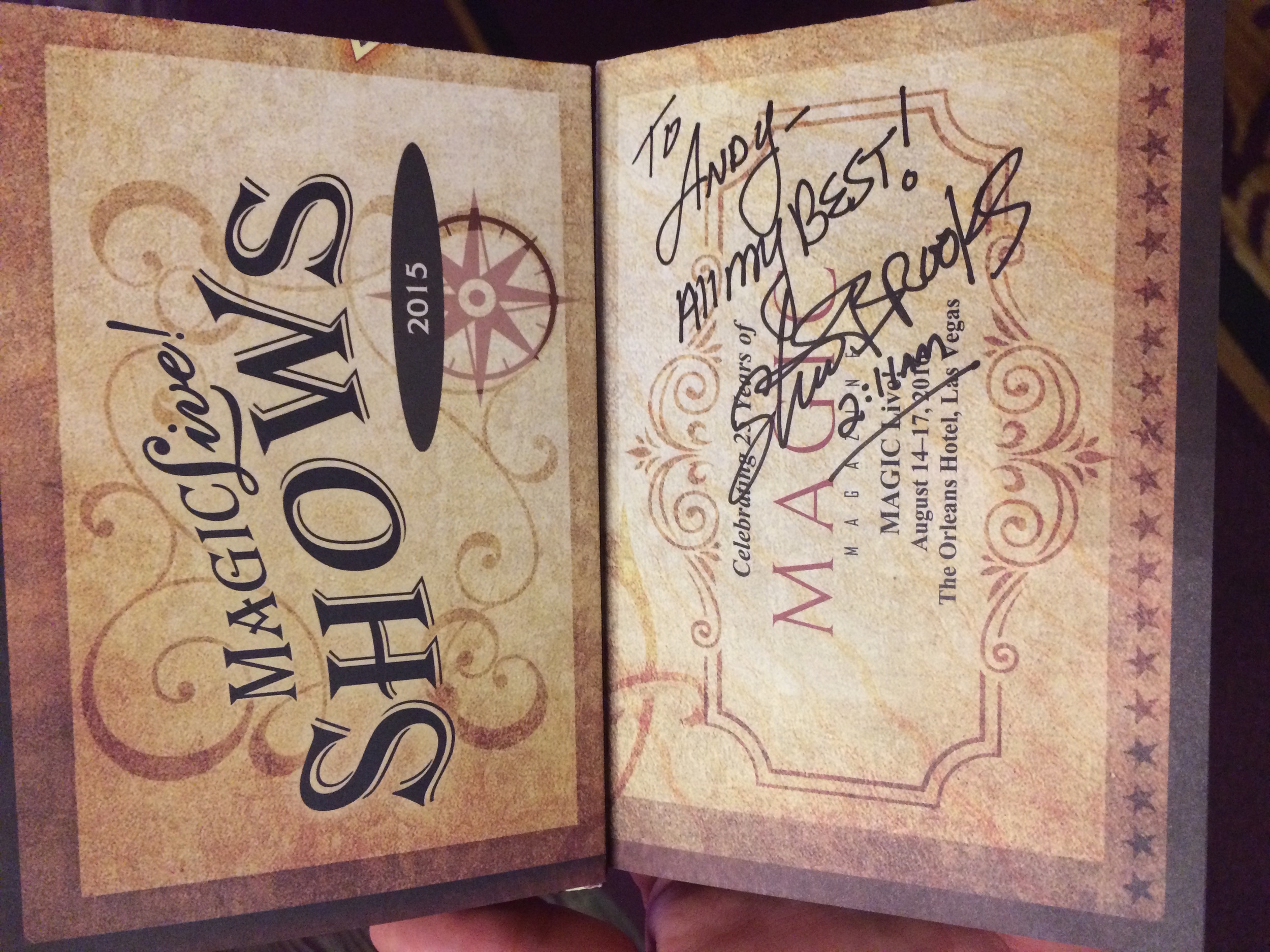
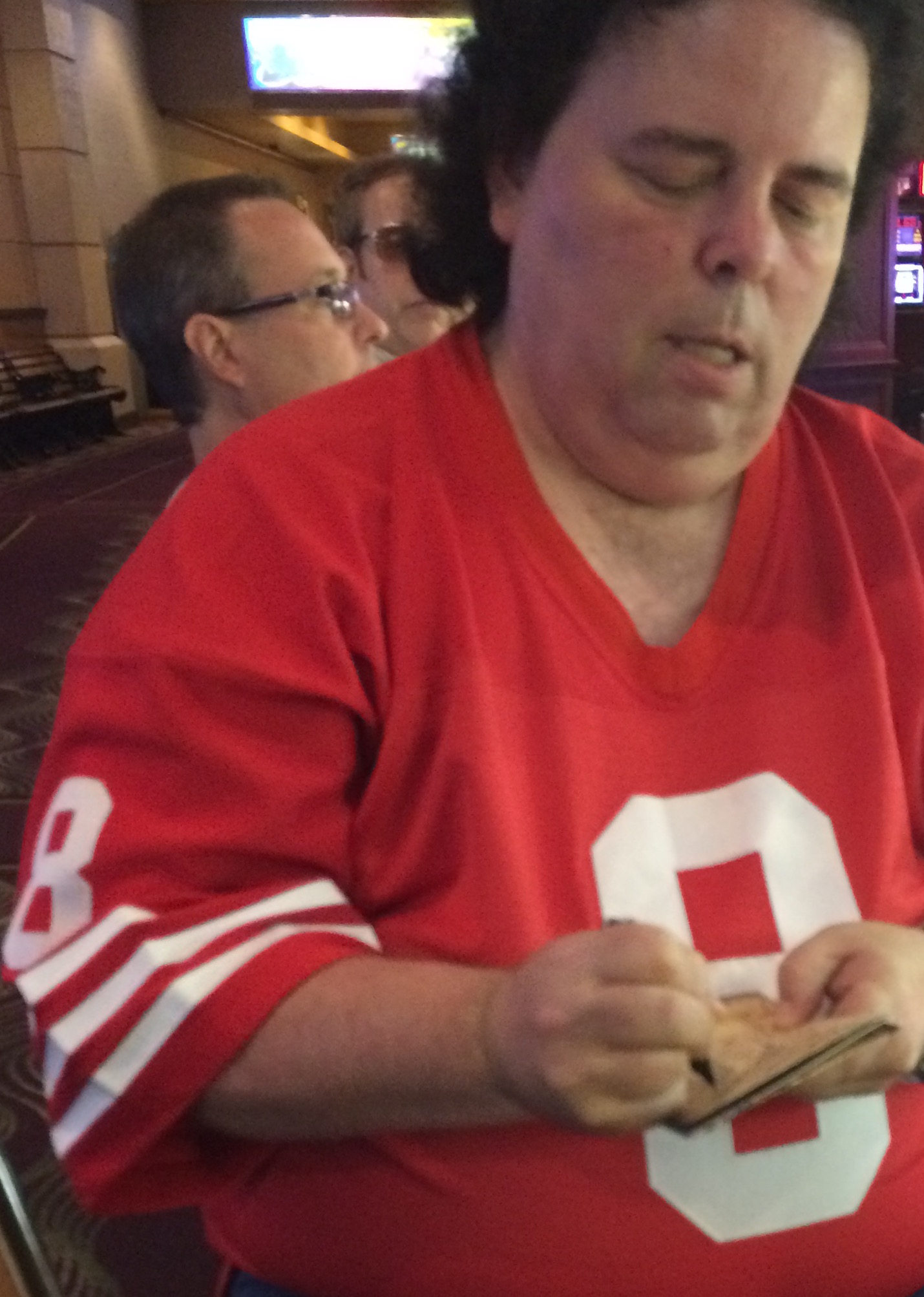
But okay, okay. Here's your proof. Here's a picture of my buddy, Steve, signing my program last week at MAGIC Live.

And what did he write in it?

Did you get that, dummies? All his best. All of it. With an exclamation point. Does that sound like somebody who has a problem with me or what I'm doing? No. It sounds like just the opposite. It sounds like someone who's being very encouraging towards me and this site. Which is exactly what I would expect from my friend, Steve. So take whatever doubt you may have about our friendship and cram it up your buttholes, bitches. 

Sundry Drive No. 7

Dear Murphy's Magic,

In your At The Table lectures, instead of saying, "Let's take a skype call," you should say, "Let's bring everything to a screeching halt." Because that tends to be what happens. I don't need to see more ugly magicians try to manage the 2-second delay. If we need video questions (we don't) then have them cram that shit into a Vine.


Well I can only see one possible explanation. The trick is just too powerful! Do we just expect humanity to watch that and then be able to...what, exactly?... just go to work the next morning as if nothing has changed? Don't be naive. That footage is going to end up in a vault somewhere with the alien autopsy video, the Steve Brooks sex-tape, and other things the world just isn't ready for yet.


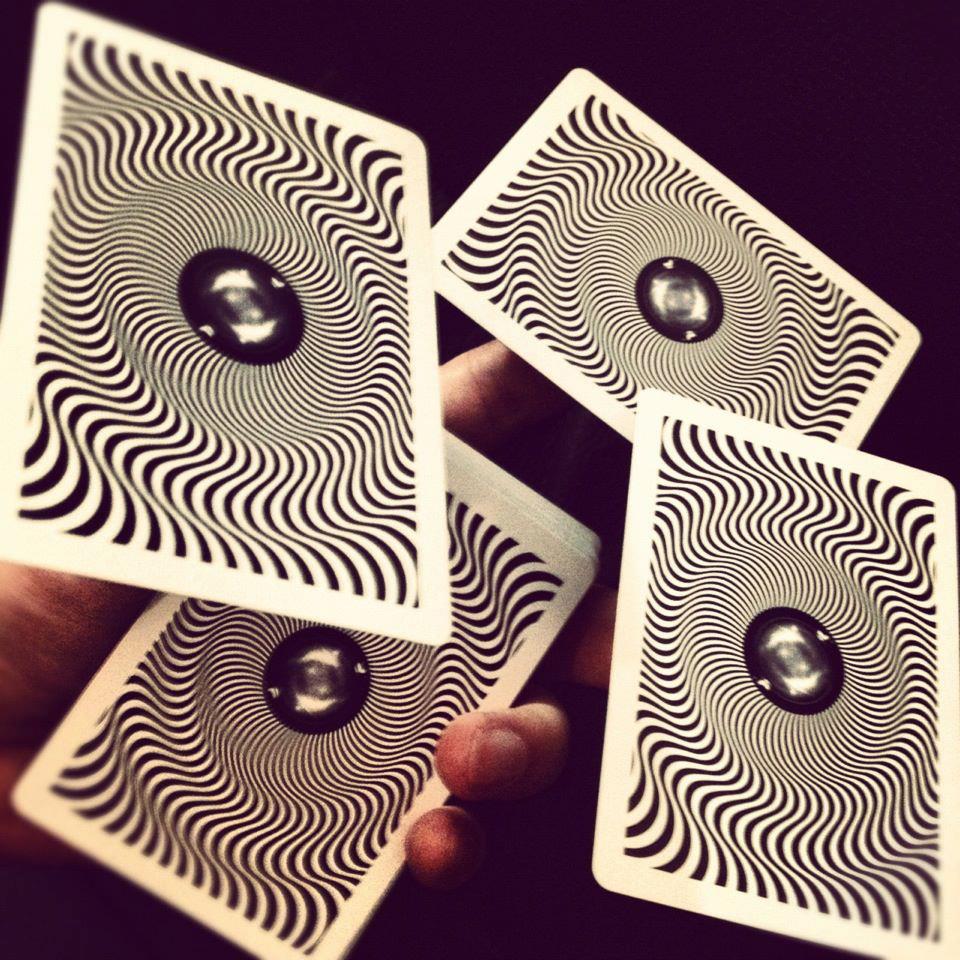
The Ogma cards by Skulkor are pretty trippy to begin with. I've been combining them with Greg Wilson's Revolution to hopefully either get someone to vomit or assassinate a senator or something.


Jack Shalom wrote an all too kind post on his blog about this site yesterday. I want to thank him for that. I also want thank Intensely Magic and Bizzaro for their posts about the site as well. And to those of you who post about it on twitter, message boards, reddit, and facebook. I don't know who is writing about me on facebook, but someone sends crazy amounts of traffic this way. Also, Bizzaro deserves special commendation for keeping that damn blog of his going since 2003. That's like me keeping this site going until 2027. That's when Children of Men takes place. I can't see me writing this site during Children of Men time.


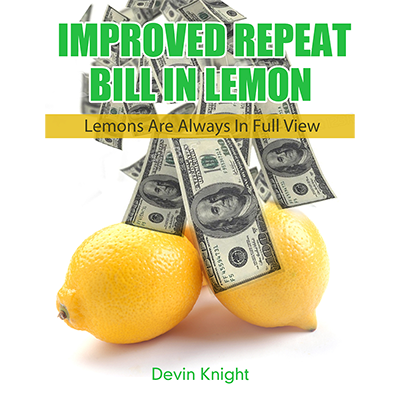
The only way to improve the Repeat Bill in Lemon is to do the trick two less times.

Guys, we're living in a post-Bill to Vagina world, surely you can come up with something better than putting a bill in a lemon.

Seriously, I know you all love bill in lemon, but trust me, we will one day look back upon this meaningless effect the way we look back on the historical treatment of African-Americans, or the practice of chaining the mentally handicapped to a radiator in the basement for their entire lives. We'll be looking in the mirrors, lips-trembling, saying, "I can't believe I used to do that. I can't believe I was that monster."

That tricks sucks.


Field Report: The Talent Swap

While thinking of Project 8X (my secret Halloween project I wrote about earlier this week), I was reminded of another trick I performed once. The two tricks have a lot in common. They are both holiday-related tricks. They both require a lot of preparation. And they both involve a jaw-dropping moment of magic with a method that may ultimately be obvious. That last thing probably seems like a big negative and usually it would be. But in the case of these two tricks, the method is almost as awe-inspiring as the trick itself, so I don't mind the audience figuring it out.

Let me set the stage.

It was December of 2013. I was at a Christmas party that one of my friend's hosts every year. I have a lot of friends who are struggling comedians, actors, musicians etc., here in NYC. So it's a lot of extroverts who are always looking for a chance to perform. In keeping with that, my friend who hosts the party always incorporates a talent show into the proceedings. So, of the maybe 60 guests at the party, 30 of them will be involved in the talent show in some way. Since I am not an extrovert -- or if I am, I'm a lazy one who doesn't love performing -- I usually just do something quick and Christmas-y. The year before I had done a trick based on David Acer's routine, Holiday Miracle. In my version, a "freely chosen" colored lightbulb is plucked from a string of Christmas lights on the tree. I hold it in my cupped hands and it lights up when the climactic scene from A Very Brady Christmas is played. (You know the one. Where Mike is inspired to free himself from the collapsed building he's trapped in when he hears Carol singing O Come, All Ye Faithful.)

So I'm standing on the "stage" section, which is in the corner of my friend's cleared-out living room. The audience is gathered 270 degrees around me. I ask for two volunteers who have already performed in the talent show who don't know each other (outside of maybe chatting at one of these christmas parties). I was joined by Craig, a banjo player, and Kerry, a dancer (ballet and hip-hop). I ask Craig if he can dance and he says, "No." I ask his wife if he can dance, and she says, "He most certainly can not dance." I ask Kerry if she plays any musical instruments and she says, "No." I ask her sister/roommate if Kerry plays any musical instruments, she mentions a two-year stint with a clarinet 15 years ago when they were in school, but other than that, no. I ask anyone else in the room if they know anything about Craig's dancing ability or Kerry's musical ability. All the people who know one or the other of them admit that neither has any talent in the other person's field. 

"Perfect," I say, "So we have two talented people, but their talents don't overlap." I had them sit back-to-back with their heads almost touching. I gave Kerry the banjo and said, "If you feel inspired, feel free to play something." Then I stood behind them, dramatically, with my right hand 6 inches over their heads. After a few moments I looked at Kerry and said, "Nothing?" And she just kind of shrugged. Then I moved my right hand down so it was touching both of their heads. After another few moments still nothing happened. "What the hell...," I said, mostly to myself. I pushed my right shirt-sleeve up and revealed my iphone was strapped to my wrist. I removed it from my wrist and started intently scrolling around on it. "Sorry," I said, distractedly, "This app was 40 bucks. I expected a little more from it. Let's start over." I messed around a little more on the phone, then placed it so they were essentially holding it between their heads. "That should work. Let's just give this a moment." After about 10 second, Kerry started plucking a couple of strings on the banjo. As the seconds passed she started playing a little faster and a little faster until a melody began to arise. Craig starts tapping his toe to the melody. I remove my phone from between their heads and say, "Okay, it looks like it worked." Over the course of a few more seconds, Kerry goes from playing one note at a time to a blazing fast, full-on performance of Cripple Creek, and as she plays Craig jumps up and performs a spot-on hip-hop dance to the song. I stand back with my arms spread out as if I'm satisfied with my experiment. The audience -- specifically the 70% or so who know at least one of the participants on stage -- are going crazy. Craig's wife and Kerry's sister are standing with their mouths wide open. 

Eventually Craig's feet get tied up and he falls down and Kerry's fingers just become a mass of confusion on the banjo and the song falls apart. "It only lasts a little while," I say. "Thank you."

How did I do it? Well, the previous year at the party I was out on the fire escape with a couple of people after the talent show. They had enjoyed my magic trick and were asking about learning magic. Did I give lessons or what books would I recommend, things like that. An idea came to me and I said, "You know what would be cool? If next year at this party I did a trick where I made your talents swap." They were both very intrigued by this idea and wondered what it would entail. "Well," I said, "you'd have to learn banjo and you'd have to learn to dance." I think they were hoping for something more clever, but they were both immediately on board. So on that fire escape we made our plan. We would go back into the party and not be seen speaking to each other the rest of the night. We didn't want anyone there to have any memory of us ever being seen together (not that they would, but it's just fun to be covert.)

The next day I emailed them both and asked if they were still into the idea. Surprisingly, they both said yes. I'm used to people getting all excited about something in the late hours of the night, but once the strong, sober light of the morning rolls around, they're like, "Ah, fuck that idea." So I put the plan in motion. Every other week, throughout 2013, we would meet up at a rehearsal studio for an hour on our lunch breaks. And in that time Craig would teach Kerry the banjo, and she would teach Craig how to dance. Well, kind of. After the first lesson, where they both introduced each other to the basics of their skills and virtually no progress was made, I knew we had to change things up. I mean we had dedicated an hour to learn two skills, so half an hour a piece, every two weeks for a year. So about 13 hours of teaching time per skill. How much can you really learn in 13 hours of teaching time? So I changed the idea. Instead of teaching each other how to actually do their talents, they would just teach them how to look like they had mastery of those skills over the course of a 50 second performance. So I had Kerry choreograph an intense 50 second routine, and every time we got together she would teach Craig 2 seconds of it. So the learning curve was minimal each week, but it built up to a super-impressive routine. He looked like a great dancer. But he wasn't. He was just great at this one 50 second routine. 

Similarly, Kerry would learn things in even smaller snippets (because Cripple Creek repeats the same parts over and over, essentially). I told Craig to write out all the notes and divide them by 20 and each time we met up he would teach her 1/20th of the song -- like a second or two of music. She didn't know the names for notes or the plucking technique, she never learned to read music. She was just mimicking the movements. She was learning the banjo like she would a dancing routine.

We met up every two weeks over the course of the year. One of us would grab lunch on the way and we'd eat in the rehearsal studio. They would teach each other their 2-second fragments, run through what they had learned up until that point, and then we'd go our separate ways. I wasn't even needed, I just liked hanging out with them, and watching these talents build week after week -- like a time-lapse video of a skyscraper being built. 

As the months passed it got more and more exciting. This dumb thing was really going to happen. It may seem like a huge investment of time and energy, but really it wasn't. It was just 26 hours. And most of that was just eating lunch and hanging out with people who had become relatively good friends. Trust me, you've wasted more time on things that were even less consequential than this. The time is going to pass anyway. 

The big night came, and the performance happened and people were flipping out. The idea that there is an iphone app that allows people to swap talents is ridiculous. But the alternative, that they had somehow become experts in these fields (and the performance did make them seem like experts) without anyone ever knowing seemed almost as ridiculous. Everyone at the party enjoyed the trick. Those who knew them personally were really amazed by it. But those closest to them were struck dumb by it. Can you imagine if your spouse or the sibling that you live with all of a sudden had this crazy talent? And you knew for a fact they weren't practicing hours a day, as it seems they would have needed to. That would be so confusing. 

Craig and Kerry played dumb for about an hour or so after the performance. They acted as amazed as everyone else. But after a while they were anxious to let people in on the secret, especially their loved ones and I was completely cool with that. So while everyone sat around we told them about these clandestine meet-ups we had all year where we would all arrive separately and leave separately, like we were spies or something. Craig told how he would practice the routine every time his wife took a bath by going down to the basement, which was the only place he could do all the jumping around it required without it shaking the house. Kerry told how she never once held a banjo in her hand outside of our bi-weekly meetups. She would go home and practice the fingering on a non-working fake banjo whose body was made of a cat-food tin. Everyone loved hearing about the process.

To this day whenever Craig is at a party where some hip-hop is playing, he'll bust out this routine and people will be really impressed. But then he'll kind of wave them off as if to say, "That's all for now." But really, that's all for ever because he doesn't know how to dance other than that particular routine.

The Takeaway: As I mentioned previously, field reports are not intended to be tricks you'll end up doing, just interesting magic-related stories. But there are some takeaways to be had. In this case I would point to the notion of the false-explanation being "exposed" rather than just explained to the audience. In this performance I acted like there was some phone app making this happen and that I was trying to hide the fact that the phone was involved but the trick wasn't working until I just said, "Ah, fuck it, just put the phone directly between your heads." You can do this with all your pseudo explanations and I think it makes things a lot more interesting. For example, a lot of people have changed from "I'm reading your mind" to something like "I'm able to read your slight eye movement in order to  sense what you're thinking." If, instead of saying this to people you act as if you get caught doing it, it adds another layer to everything. So maybe you say, "I'm going to read your mind, " but then it becomes clear your trying to subtly look into their eyes out of of the corners of yours. After a bit you switch positions so you can look more precisely at their eyes. And after that fails you act like, "Shit, sorry, I need to move you into better light for this to work." Your attitude is as if you're conceding to them, i.e., "Okay, you got me. I'm not really reading your mind." You don't say that, you just act like you're deflated a little. I wouldn't do this all the time, but it can be fun to let the audience bust you on something only to convince themselves of something else that is equally untrue. 

Dear Jerxy: Suspending Their Disbelief


Dear Jerxy: A lot of your effects/presentations seem to involve the spectator being very willing to go along for the ride. I find people want to bust me when I perform. How do you get an audience to play along/suspend their disbelief/not question everything you do?

Tom in Austin

Dear Tom: "Tom in Austin" is not a good advice column letter-writer name. We need some alliteration or something. I'm going to call you Wondering in Wichita. And no, I don't care that you're not in Wichita.

Dear Wondering: That's better. 

I have a few thoughts on this. 

The one thing that will get you 90% of the way to having people suspend their disbelief and being a participant rather than a combatant is to have an entertaining presentation. People don't want to pull the rug out from under an entertaining presentation. They don't gain anything from that. But if your presentation amounts to: "Look at this incredible thing that I can do that you can't," then it's more fun for the audience to bust your ass rather than to play along. And of course it is. What would you rather do? Listen to someone bore you while he tells you how great he is, or point out what a buffoon he is and mock him for his attempt to get one over on you?

There are those who believe the magician's job is to fool people. But that's not what it is. Fooling people is essentially a neutral act that is part of the process. The magician's job is to entertain people through the medium of deception. ("Entertain," in the broadest sense. It could mean to move them to tears, intrigue them, scare them, enrage them.) To think otherwise is to believe that the photographer's job is to press the shutter button. No, the photographer's job is to capture images that move people in some way.

When people get busted a lot they often think, "I need better tricks." But what I'm saying is that better presentation will negate the impulse to call you on your shit for most people. There's very little in it for them to put the brakes on a fun, entertaining time in order to fight you on something. As the greatest magical mind of our generation once said, "The world wants to be charmed."

There will definitely still be a small percentage who will always see a magic performance as a battle of wits. And to a certain extent I want that trait in the people I perform for. When your audience is somewhat critical then your effects will have a bigger impact. But if it's only a battle for them, they will question every last little thing you do, and you will never get any momentum behind your performance. Here are the things I would suggest for dealing with those types of people in the following categories.

1. If you think you can reason with them. If I think the person is reasonable I sometimes suggest an analogy that gives them an idea of how they might want to try and perceive these effects. There's the classic Paul Harris line of telling them that astonishment is a gift and it brings them back to their child-like state of wonder, but I never got any traction with that line. Instead I use a much more prosaic, and I think relatable, analogy and that is comparing a magic trick to a movie with a twist ending. If you're a fan of thrillers or suspense films then you're probably familiar with the concept of turning off your brain a little and letting the move just play out without questioning everything. I will sometimes suggest this is a good way to look at a magic trick as well. Not for my benefit, but for them. "The end of a magic trick is kind of like the twist at the end of a suspense film." I'll say. "If you're up in your head the whole time, questioning everything, you can learn to anticipate even the most clever twists. But you're kind of denying yourself the enjoyment of experiencing the movie, or in this case, the trick, to the fullest." 

2. If you don't think you can reason with them. Walk away. That's what I do. If someone is paying you to perform, and you can't just walk away without doing anything, then lay your most bulletproof effect on the person and then walk away. (By bulletproof effect, I mean something that doesn't have many sleights for you to get caught doing, and has a method that is not something a layperson would even know to consider. Like the Gilbreath principle or some other impenetrable shit like that.)

3. If you don't think you can reason with them and you want to make them feel like a moron. I've never done this when I was performing, but I did do it when a friend was performing for a small group of people, including myself, and one guy was calling him out on everything he tried to do. I turned to the antagonist's girlfriend and I was like, "Is he [pointing to her boyfriend] kind of... dumb?" He turned at me and said, "Oh, I'm dumb because I can figure out all his tricks? Yeah, I guess I'm real dumb."

To which I spun this yarn...

"Oh, I'm sorry. I didn't mean anything by it. It was just... did you see that article on reddit sometime last week? I was just going over it earlier today so it was in my mind and it just seemed to go along with that stuff you were saying. Oh... you didn't see it? Well, I guess at Harvard or one of those schools they actually just did a study on magic. And they tested IQ against people's abilities to figure out magic tricks. And I guess they thought it would be a pretty straight line but they were shocked to find that it was actually the people in the "well below average" category who did the best at figuring out tricks. And at first they thought maybe these people had made up for their lack of intelligence with some other type of intellectual gift. But as it turns out it's just that people with at least average intelligence feel like there is nothing to be gained by trying to figure out magic tricks, so they just watch them for pleasure, not as something that needs to be debunked. For a smart person, being hyper critical of a magic trick is like going to The Avengers movie and sitting there saying, 'This is so fake.' It's something only a moron would do. And I guess what was borne out in their research is that people who feel a desperate need to figure out magic tricks are similarly... you know... dumb. Just to be clear, I'm not saying you fall into the lowest category. It's not the lowest category at all. You wouldn't be labelled retarded. I think technically your category is considered 'feeble-minded.'"


Some Rambling Thoughts About Presentation and I Put That Know-It-All Tamariz in His Place

Over on the Conjure Nation forum there is a thread that started way back in 2005 when I shut-down the Magic Circle Jerk blog. The thread was revived when I started this site. In general I don't tend to read what people have to say about my site, unless they're saying it directly to me via email. Other than that I really don't think it's my business. Plus I like to let people live with their misconceptions. When I first launched this site I saw a message somewhere that was commenting on one of my first posts saying how bad it was and that it didn't live up to the stuff I was writing on MCJ. Which may have made me doubt myself -- have I lost my mojo? -- except for the fact that the post he was commenting on was conceived and mostly written 10 years ago for my old site, I just hadn't gotten around to posting it yet. My other favorite criticism of this site that I read in a few places early on was that while some of my ideas were good they didn't like the site because I'm a lazy writer who uses dirty words to shock people. I hate to break it to you ding-dong, but I never think, "I'm really going to shock these guys when I say 'fuck' and 'dicklicker.'" There is nothing shocking about those words to me. That's how I talk, and that's how many of the people in my social circle talk. And because we're not 5 years old, we don't place value judgments on "bad words." I think in a blog situation you want people to write like they talk, because it feels more personal that way. That's the only thing that dictates how I write on the site. And for those who want to label that as "lazy writing," you've got a big problem, because I'm 10 times more interesting a writer than you. And that's when I'm being fucking LAZY. But I don't need your readership, so stop fanning yourself on the fainting couch and hit the bricks, you fucking dicklicker. Oh wait, I mean, "you abhorrent ignoramus!" Look at me! I'm such a hard-working writer now for avoiding curse words. Thanks for the lesson in self-expression.

Annnyyyywhooooooooo.... where was I? Oh yeah, about a week ago, over on the Conjure Nation forum, in the memorial thread for my old site, which turned into the baby shower for my new site, there were a few posts about the relative importance of method, effect, and presentation. One person (and I'm not naming names only because it's a private forum and it really doesn't matter) suggested he subscribed to the Juan Tamariz school of thought that method is the most important, followed by effect, then presentation. And he mentioned Tamariz's analogy that compared method to the skeleton, effect to the flesh, and presentation to the makeup or clothing.

Juan Tamariz is a genius (which we sometimes forget because we think he's just another pretty face) but the more I thought about this, the more I disagreed with it. First off, it's not really an analogy at all. It's just an assignment of value based on his personal belief of what's most important. And second, the fact that we treat presentation as simply "makeup" is magic's failing, not something that should be championed. It's true that most presentations in magic seem superficial and slapped-on at the end -- yes, like makeup -- but that's not the way it has to be. In fact, it shouldn't be that way (in my opinion).

You might wonder how I rank method, effect, and presentation in importance, but the truth is, I don't think it's a useful or meaningful question. It's almost like saying-

Okay, when playing the trumpet, what's more important: 1. The song the audience hears, or 2. The process of blowing air through the horn?

You can't really rank those two things in order of importance. 

When we look at method, effect, and presentation, it seems like method is the foundation of a trick, but it doesn't have to be. You could build a trick from the presentation. I do it all the time. And I guarantee you'd rather watch someone with great presentations for uninspired methods, rather than someone with clever methods for dull presentations. Well, maybe you wouldn't, as a lover tricks and their methods, but a normal audience would. 

Of course, this is all pretty much semantics, as the people on Conjure Nation seemed to agree. You can't really separate these things, and if you ignore any one of them you're going to end up with a bad final product. But I do think there is something of value in assessing two of these three elements when working on effects. 

First, let's get rid of method. Method is essentially binary. Since my preferred performing scenario is one-on-one, the method either fools the person, or it doesn't. I don't care if the method is clever or unique. Magic, by definition, has a method that fools people. If it doesn't, then it's not magic. It's just some kind of boring exhibition. 

So we're left with effect and presentation. And I think the issue is that we treat these as two different things. But I find the strongest tricks are the ones where the effect and presentation are the same.

Let's look at a trick where effect and presentation are somewhat disparate things.

Effect: A card keeps rising to the top of the deck.

Presentation: One of the cards in the deck is ambitious, so it rises above all the other cards.

or

Effect: The aces vanish from packets of four cards and reappear in another packet.

Presentation: The Ace of Spades is the "leader" ace, and the other aces are drawn to it. 

These presentations could all be considered "makeup" They're just slapped on at the end. They're mostly nonsense and boring, but they're not too egregious because they are at least in the same ballpark as the effect.

When there is a big gap between effect and presentation, then you have stuff that comes off as hokey or condescending. The biggest offender is probably gospel magic.

Effect: A sponge ball changes color.

Presentation: Jesus Christ is our all-powerful lord and savior

Maybe it's just meant to be effective on kids, but I have a feeling even stupid kids are like, "Hey c'mon, I'm not that stupid."

On the other hand there are tricks where effect and presentation are the same.

Effect: Cards are absorbed into the performers hand in an "Invisible Palm."

Presentation: Cards are absorbed into the performers hand in an "Invisible Palm."

I find people tend to be the more engaged in these types of presentations. 

An effect that can be differentiated from its presentation will come off as a performance. Which is fine if that's what you're going for. But when your presentation becomes the effect to the spectator then you are performing the most affecting type of magic. I'm not sure if I'm making this clear... Okay, so presentation is the story that accompanies the trick. If you make that "story" something that is happening in the present tense then you not only immerse your spectator in the effect, but you also make the presentation and effect the same thing.

Let me think of an example...

Okay, let's say you have a trick where you can make a ball disappear and reappear. That would seem to be the effect: a ball disappears and reappears. But that's not necessarily the effect. Let's imagine two performers who can both perform this trick perfectly.

Performer One has a presentation about how when he was a kid he used to lose his favorite ball all the time, but if he wished hard enough he could make it come back. He makes the ball vanish and reappear a few times as he tells this story. This is kind of a standard presentation that's tacked onto a trick. What Tamariz would consider "makeup."

If you asked the spectator after the performance what the effect was, she would say, "He made a ball disappear and reappear." 

Performer Two has a presentation where he sits the spectator down and draws a square in the air with his finger. Then he goes through a brief "hypnotic induction" and says that after he snaps his fingers, for the rest of the performance whenever he says the word "square" her mind will latch onto that concept and the notion of "squareness" so tightly that it will cancel out the visual image of the round ball in her brain for a few moments. He snaps his fingers and says the word "square" and the ball seems to disappear. This wears off after a few moments and the ball reappears. Then he does it again and it disappears again.

By making the "story" of the presentation the story of that moment in time he has made the effect and presentation the same. 

If you asked the spectator after the performance what the effect was she is likely to say, "He hypnotized me to not be able to see the ball." In fact, she's likely to say that even if she knows it's not true. 

And the trick will almost certainly be more powerful to her because she is central to the presentation and the effect, rather than just a witness to it. This is the locus of audience-centric magic. Bring them an experience that happens to them, in real time, and would not be the same without them there. "Magic is the only art form that doesn't exist without an audience," magicians are fond of saying. And then they perform for people the same way they would for a tree stump.