
Literomancy
/Here’s a word reveal I’ve been having fun with the past couple of months. It’s based on something I originally wrote up for a previous issue of Keepers. That was tied to a specific trick. This is for anytime you need to reveal a word and want to do so in a way other than “mind reading.”
I introduce a deck of alphabet cards. (It can be any sort of alphabet deck you might have: from a magic trick, a word game, dollar store flash cards, or whatever.)
I talk about a forgotten branch of fortune telling from the Victorian era called literomancy, which used letters on cards or wooden tiles to tell people’s fortunes or connect with the dead. “It was sort of a tarot/ouija hybrid. People would sit around a table spelling out messages one letter at a time, waiting to see if anything meaningful emerged. It didn’t really stick.”
I explain I came across an old exercise people used with these cards to “establish a connection” between the sitter and the deck. I tried it a few times, and it worked weirdly well.
My friend writes down a word and sets it aside.
I give them the deck to mix any way they like, then ask them to cut it into as many piles as there are letters in their word. I have them arrange the piles in a row. And finally, I tell them for each pile they can turn over the top card or the entire pile.
At this point, of course, I’ve already peeked their word earlier in the process.
I tell them we’re looking for “overlaps” between the letters that come up and the word they’re thinking of.
I take their hand by the wrist and hover it over each pile. I go letter by letter and point out any similarities between the revealed letter and the letter at that position in the word they’re thinking of. I treat it as if they’re giving off some energy over each card.
Because I know their word, I can “sense” if they’re having a strong reaction to the letter.
Occasionally I’ll get a perfect letter match—where the letter they dealt is the same as the letter at that position in their word. (Once every 12 million performances or so, they’ll cut to their exact word. When this happens, just end the trick there.)
More frequently, though, I’ll be noting smaller similarities.
“Okay, there’s an intense energy on this letter. Was the second letter in your word also a vowel?”
“Oh… something’s happening here. I doubt your word ended with a Q, but is the real letter a similar shape? An O or a C, maybe?”
After this, I take the random letters they dealt out and say them as if they form a word.
I have them gather up the cards and hold them between their hands, focusing on their word. I put my hands around theirs. “Think of using your word in a sentence. Or a context it might be used in.”
After focusing on it, I now say the nonsense word in place of their actual word in a common phrase, building it piece by piece, somewhat confusedly.
For example…
Let’s say the person is thinking of the word HOME. And they cut to these letters.
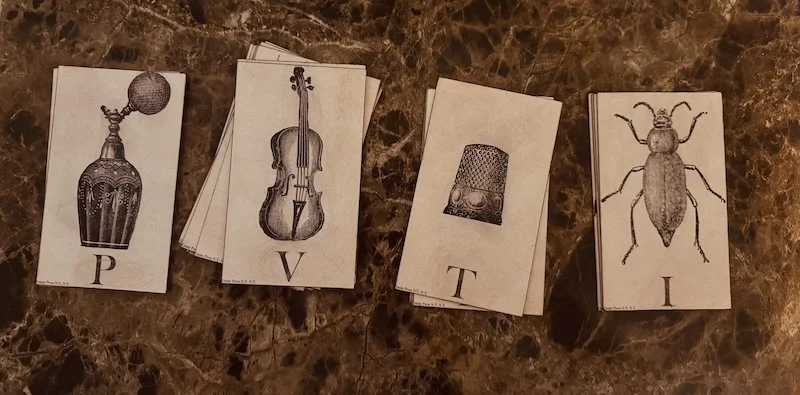
During the first phase, as I’m holding their hands over the cards one by one:
Card 1 (P) – “Hmm… I’m not getting much here. You might also be thinking of a consonant.”
Card 2 (V) – “I don’t know. It’s either not similar at all or the connection isn’t there.”
Card 3 (T) – “There’s something here that’s similar to the letter in your word. I don’t think it’s a T, but maybe it’s structurally the same? Mostly straight lines or something?”
Card 4 (I) – “Okay, I’m getting more similarities here. This is either a letter that sounds similar—like another vowel—and it may also have a similar structure. Straight lines. Maybe an A or an E.”
As they hold the cards between their hands, I’m now repeating the “word” they cut to: PVTI. (Just say the letters as a word as best you can.) “Pivty, pivty, pivty…” I’m saying it in a searching way, as if I’m trying to find some connection that’s out there somewhere.
“Pivty. Pivty… At pivty? Hmm… At pivty… yourself? Yourself at pivty?” Pause. Thinking. Then, questioningly: “Make yourself at pivty? Maybe? I don’t get it. What is ‘Make yourself at pivty’?”
I say it in a “does that mean anything to you?” way. Then they explain, or it dawns on me that they must be thinking of “home.”
What’s interesting is that this is a word reveal where you never actually reveal the word. You’re describing a context that word might appear in and leaving it up to them to explain how what you said makes sense. So it has a different feel from a traditional word reveal.
This also sets up a future trick I do for them, again using the letter cards as a kind of divination tool (since the deck is now “calibrated” toward them). There, they mix the deck and the cards end up revealing an important word or name to them directly. (This is Letter Perfect by David Regal.)