
Until May...
/Sorry for the delay in posting this. I was at the White House Correspondents' Dinner, and stuff got crazy.
This is the final post of April.
The next issue of Keepers will be sent Sunday, May 3rd.
Regular posting will resume on Monday, May 4th. Which is some Star Wars shit, if I’m not mistaken.
"Pete," The Unnamed Magician, is still sticking to his story about his trick. Skip this section if you don’t care.
Just to update you… He's now telling people he's going to retire from magic because he made so much money selling his trick to a "very well known and rich magician."
He also is telling people that this famous magician is "very disappointed" in the method but they "had to pay up" because the trick met all the conditions.
But Andy, if he's making it up, why wouldn't he say the magician was thrilled with the trick?
Because he knows suggesting that would be a bridge too far. He can't say the method was good because that narrows down the possibilities drastically. Instead he's suggesting he has some byzantine method that he was able to conceive of that somehow meets all the conditions, looks exactly like the video, works 95% of the time… but somehow it's not good. (As a creative exercise, try to imagine what possible issue someone might have with a trick that works 95% of the time and looks exactly as it does in the video.)
Now, I told you a while ago you'd never see the trick and that he'd pretend to sell it to this fake magician. And I also knew this was going to be his next ploy: "It was a real trick all along, it met all the conditions. But the reason you'll never see any famous magician actually perform this is because the method isn't great."
He set this up in his emails to me when he said, and I quote:
"I can tell you that the method is quite disappointing. People wouldn't like it or perform it."
So now you have two possibilities to believe.
A. The Jerx Theory
He came up with an average trick. Realized he could frame it as a great trick if he just showed one part of it. Got caught up in the marketing of the trick and used some questionable language to describe the conditions. Then was forced to lie about it once he got called out on it.
B. The Unnamed Magician's Story
In February, he was so desperate for cash that he was selling his entire backlog of downloadable effects for $40.
In March, he just so happened to create the cleanest looking version of the most classic challenge in card magic.
Strangely, this effect looked nothing like any other trick he'd ever released.
Coincidentally, he chose a brand new method of selling his tricks which involved an incredibly high price (for a card trick), months of pre-sales, and no actual details of when and where the trick would be released.
Conveniently, he told absolutely no one the method. Not even the well-respected magicians he had shared tricks with in the past.
Oddly enough, when I offered to sell the first 200 copies for him… he wanted nothing to do with that idea.
Remarkably, a mysterious, wealthy magician broke with all known understanding of price negotiation and offered him an amount that was multiples of the highest public offer. Weird! And this, for a trick that had never been performed on record anywhere for anyone. Not only that, but it was a trick that had conditions no layperson would ever appreciate, but at the same time, it couldn't be performed for magicians because they could easily make it not work.
For some unknown reason, he preferred to deal with the Secret Millionaire Magician, rather than make the same (or more) from me, retain the rights to sell the trick, preserve his reputation, and make me look like an idiot for questioning him.
As luck would have it, some dastardly person who had verified conversations with the Unnamed Magician lied to me—fed me a fake method and claimed it was the real one. A fake method that, coincidentally, would have produced an identical result to the videos released.
By chance, just when I had learned the (supposed) method and realized it was pure horseshit… that was when he was finally ready to let me buy the very real method for the very real trick! I just missed out by only waiting a month. What rotten luck!
Thankfully, one of the many millionaire magicians was still interested.
Amazingly, the escrow process (which typically takes 3-5 weeks) took only days this time and he now has all his money.
Unfortunately, the method WHILE LIVING UP TO THE CONDITIONS 100%, isn't good (somehow), so you'll never see the trick performed. Aw, rats!
And wouldn't you know it, now he's decided to retire from magic. That's certainly the action of someone who just created one of the most deceptive tricks of all time that sold for one of the highest amounts of money for a single card trick in history. And not the reaction of…oh, say, someone whose pseudonym is now burned—someone slinking off the magic scene because he knows this release will follow him forever.
So those are the options.
In my version of events, his actions are flawed, but feel very human to me. You don't sell hundreds of dollars of downloads for $40 unless you're desperate. He needed money and got swept up in a way he thought would get him some. I felt for him when I thought that was the case. I asked him to let me help him get out of this predicament. I imagined collaborating with him—working on a project where I took a few of his very procedure-heavy tricks and came up with some different premises or presentations to make them more interesting to non-magicians. Put that together in an ebook, or very limited edition hard-copy, sell it to my supporters, and let him keep the proceeds.
But now I guess I was wrong. I was lied to by my source. The Unnamed Magician really did have this "Ultimate Open Prediction" effect. The method was "quite disappointing" and "people wouldn't like it or perform it." This was a trick he was willing to sell to people for $100. He didn't sell it as some trick that was just an exercise in meeting conditions—he sold it as "the strongest trick he ever created." In the end, he sold this unappealing method to someone for somewhere between 50,000 and 100,000 dollars.
That's the story he wants you to believe. He thinks that story makes him look better than mine. Okay fine. I changed my mind. I believe him now. But I also have to change my assessment of him from an earlier post where I said I didn't think he was a scam artist.
Claiming a trick is the "ultimate" version of the Open Prediction, saying it's the strongest thing you've ever created, and then asking anywhere from $100 or $100,000 for it—all the while knowing the method wasn't something anyone would use—makes you a scam artist.
I've gotten on Murphy's Magic in the past for using AI to write their ad copy. I think they used AI for their ad for Shinkansen by Max Maven as well. And by that I mean they used An Idiot.
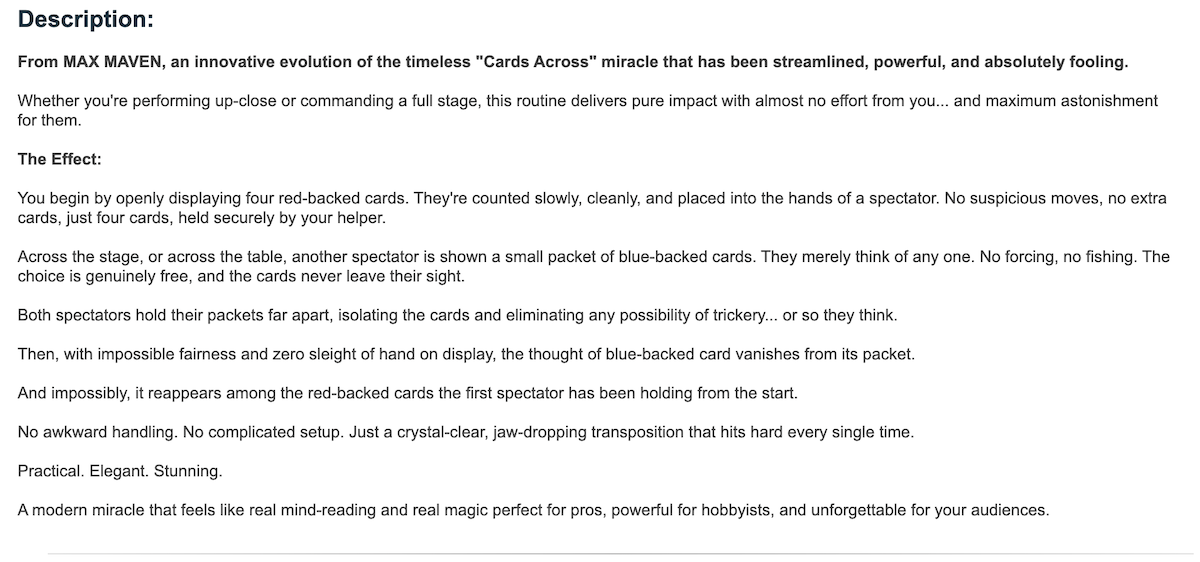
First off, what is this abortion: "From MAX MAVEN, an innovative evolution of the timeless 'Cards Across' miracle that has been streamlined, powerful, and absolutely fooling."
Quick grammar lesson: Items in a list must all have the same grammatical form. This is called parallel structure.
Rarely does parallel structure get so monumentally jacked up that it becomes perpendicular.
"has been streamlined" → This is a verb phrase in the passive voice
"powerful" → This is a simple adjective
"absolutely fooling" → This is a participial phrase
It would be like if I held up a banana and said, "This banana has been peeled, sweet, and absolutely delicious."
Okay, no one here cares about that. I know.
You may care about this issue though. The ad copy clearly states "They merely think of any one. No forcing." Which is odd given that the trick relies 100% on a force. How does this slip into the ad copy? What could they possibly have been thinking? I have no clue. My goal isn't to become the magic police, but when it's this egregious, I feel it needs to be noted.
Maybe it's a punctuation problem. Perhaps it was supposed to say:
"They merely think of any one? No. Forcing!"
Were you involved in this? —MC

I got a few emails about this trick and whether I had anything to do with it. At first I had no idea what they were talking about, but then a reader reminded me of this post from 7 years ago.
So, the answer is no, I had nothing to do with it other than having a similar idea in the past.
By the way, this logic is kind of insane
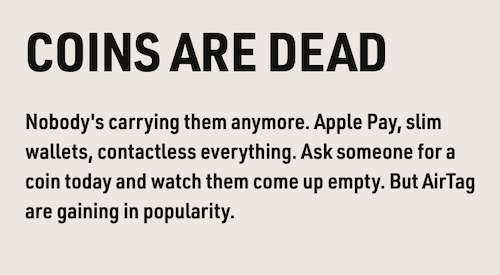
Uhm… okay. I get it, coins aren't as common as they once were. But there are still about 3,000 times more coins in the U.S. than AirTags.
The death of coins isn't the argument for this trick.
The argument for the trick is that a coin vanish doesn't allow you to explore where the coin goes after it disappears—which is an interesting premise. You can leave it at that. You don't have to pretend people are going to be scratching their heads when you pull out a quarter. "What's that thing??"
Peace. See you next month, my little may flowers. 😘