
Mailbag #170
/
In the post on The Breakthrough System, I wrote: “In the trailer above, Johannes makes a comparison to this effect and walking on water. That’s how into this trick he is.”
Johannes took issue with this and wrote:
One misinformation you had was mentioning that I compared TBS with walking on water. If you listen to the trailer again, you'll understand that this was not the case. The comparison was between the experience whether a spectator is watching a magician perform a trick or experience doing the impossible themselves without knowing how, I simply brought an example with "walking on water" trick to deliver the point home, as clearly it would be more powerful experience for the spectator if THEY could do it themselves not just watch.
There’s no “misinformation,” but I can see how it could be misinterpreted if you didn’t watch the trailer.
I said he made a comparison between TBS and walking on water—and that’s exactly what he does. He literally says, “Let me give you a comparison,” and then launches into walking on water as the example. He uses it as an analogy. An analogy, by definition, is a comparison.
To be clear, he never says, “This trick is as powerful as walking on water.” I wasn’t suggesting he did. But reference points aren’t neutral. They imply a degree of comparability.
For example, if you asked, “Andy, what makes your next book so good?” and I said:
“Well… let me give you a comparison. You know the Bible, yes? It has lots of seemingly impossible things in it. That’s part of what makes it so compelling. Well, my book has descriptions of seemingly impossible things too.”
I’m not claiming my book is as impactful as the Bible. But choosing that as the comparison tells you something about how I’m framing it.
Same principle here.
Or to flip it the other way, if I wrote in my review, “Johannes’ trick is convenient because it fits in your hand. Sort of like how dog shit fits in your hand,” he’d be justified in taking that as a dig, even though I never explicitly said the trick was dog shit. The comparison does the work.
But to reiterate, Johannes wasn’t claiming the effects are equally strong. If he had been, I would’ve called him delusional instead of just teasing him for being very “into” his trick (Which there is no denying once you watch the tutorial.)
I was interested in your thoughts on one alternative presentation for solid penetrations: making the trick about memory distortion/manipulation.
For example, show a hypnotic spiral video on youtube, then tell the participant to pay close attention to what I'm about to show you and try to remember as my details as possible. Show the penetration (match through the matchbox or whatever, then take the match out). Snap fingers (implying that the participant is being taken out of hypnosis). Ask the participant to describe what he/she just saw in as much detail as possible. Once the participant finishes describing, say that couldn't possibly be what you saw, and then show the block. —DS
Yes, I like it. That’s a good approach to get them to pay detailed attention without spoiling the surprise ending.
I would add a beat where after they describe what they saw, I'd say, "So you're sure you saw it going through the middle of the box? It wasn't just sliding behind the box, like this?" And I'd clearly slide the match behind the box in an unconvincing illusion of penetrating the box.
They would insist that no, it was going through the middle. This is good because it gets them to cement that image in their mind.
You’d want to make sure your attitude matches the story you’re telling. You would want to be almost smiling to yourself at this point as if thinking, "Damn, that actually worked, I can't believe it."
Thanks for sharing. This got me thinking of a similar approach that I'll share with you later this week.
What do you think about using smart glasses in mentalism performances? Do you think they would raise suspicion? —BC
Well… I mean… of course. Wearing smart glasses raises suspicion in literally any context. (The suspicion is usually, “Oh, what is this pervert trying to take pictures of?”)
I did a trick last summer at the beach where the person I was performing for thought of an ESP symbol, I drew something in the sand under a beach towel, and when she revealed her symbol, it matched what I had drawn. It was a whole thing about the “crystals” of the sand and vibrational energy and blah, blah, blah.
When performing, I was wearing these glasses…
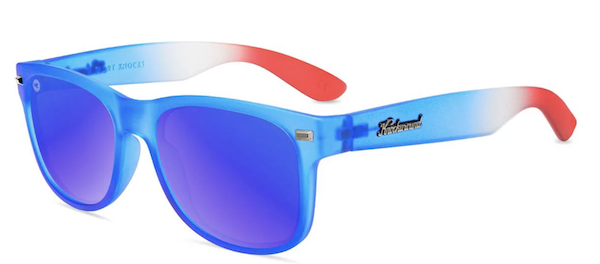
After the effect had sunk in for a moment, the girl said, "How did you do that? Wait… are those smart glasses?"
As if:
A) Them being smart glasses would explain anything.
B) There's a big market for smart glasses inspired by the design of Rocket Pops.

If you're performing for people who know you, and you're suddenly wearing glasses or wearing different glasses than usual, that's going to be a dead giveaway, of course.
But that's more of an issue for the amateur performer. Professionals have different concerns. If one person in the group recognizes you're wearing smart glasses, everyone will know it once you leave the group.
Even if they don't know how that helps you, they will assume it's part of the method.
So you'd definitely want custom frames that don't match anything on the smart glass market. But even then, the more ubiquitous these glasses become, eventually people may just assume any glasses you wear are potentially suspicious.
After that day at the beach, I make sure to take off even normal sunglasses when performing.