
When Onyx Eyes Are Lying
/This is a use for Marc Kerstein's newest app, Onyx. I haven't had a chance to work with the app yet, so this is just a theoretical use at the moment. Although I intend to play around with it later this summer once the next book is complete.
Onyx allows you to manipulate photos taken on the spectator's phone.
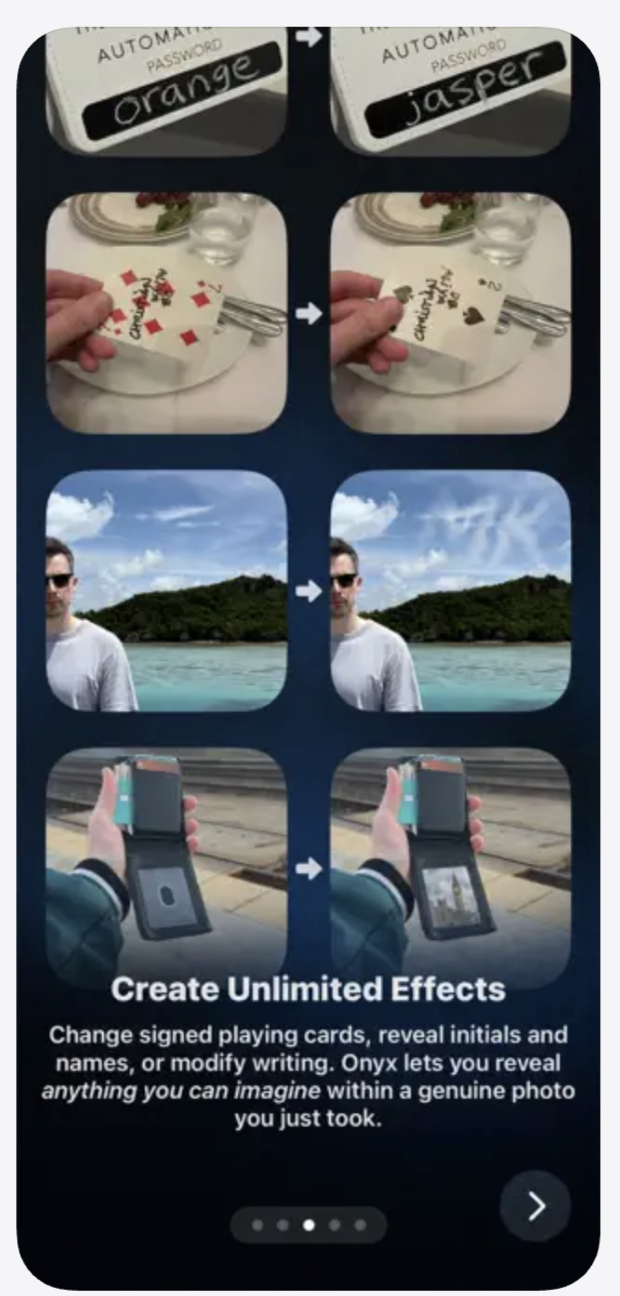
For better or worse, we have zoomed past the point where a photo on your own phone will be good for much, magic-wise. AI manipulation is too obvious an answer. You really need something on the spectator's phone, or something printed. (Onyx also has a print feature that I can see being great for The Look of Love.)
My idea is a perhaps too subtle use for the app, as a magical Rep for any “lie detecting” plot.
You start by asking your friend to tell you some true statements, then some lies, then go back and forth. “People think they’re good at lying, but most people have one thing they can’t hide. I want to see if you have one.”
After a bit, you say, "I think I've got it."
Now you ask them to hide a coin in one of their hands or tell you details about a card they selected. (Any trick you have that you can frame as "lie detecting.") They can lie or tell the truth and you're able to tell them which they're doing.
You repeat this a couple of times.
"Want to know how?" you ask.
You borrow their phone and take their picture twice—once after they tell you a true statement, once after a lie. Then you show them the pictures.


"See? Your pupils dilate like crazy when you lie. No one's ever told you this?"
I like the idea of suggesting to someone they have a somewhat obvious tell when they lie—and actually "proving" it.
(Originally I thought it would be interesting if you could have their pupils compress slightly. But the AI couldn't do that subtly. They looked like an animal's eyes. Which is actually kind of an interestingly crazy premise: "When you lie, your pupils squeeze in. Almost like a cat's.")

The nice part of this routine is how the first part supports the second part. Even if they question the photo, they will get pulled back to the first part of the effect and think, "Well he was able to tell when I was lying. So maybe I do have a tell."
If they should call you out on it later—e.g., "I asked my sister to see if my pupils got bigger when I lied. She says they don't."
Then you just say, "Oh, that's because it was a subconscious tell. Once you know about it, they go away. But you likely have a different tell now. Here, put this coin in either hand."
Pretend you find their new tell, but this time don't tell them what it is. "I'm going to keep that info to myself. But I'd be really careful about lying around me."