
Mailbag #173
/I prefer to remain anonymous because what I’m about to ask may sound like crocodile tears.
I’m a full-time professional mentalist, and I’ve become fairly well known in my area through immersive ticketed shows that combine magic and mentalism. The audience becomes part of the experience instead of just watching tricks happen to them. I’m genuinely proud of the work I’ve built.
But because of that reputation, I run into a strange problem whenever I perform in more casual environments. For example, a new speakeasy hired me to do walk-around a few weeks before my ticketed show there. People brought friends, and the friends were immediately extra skeptical.
They say things like, “I don’t believe you.”
And I have to explain, “I’m not asking you to believe a single word I say.”
At that point, I usually just want to do a simple card trick because they clearly are not the right people for mentalism. But of course that only makes them double down harder. They start demanding that I tell them who they’re thinking of or reveal something personal about them.
I know this is technically a professional issue, but it’s started bleeding into my personal life too.
I’ve literally had people approach me at coffee shops while I’m off the clock, introduce themselves as fans, and then their friend immediately says, “Do something right now.”
Sometimes I’m simply not up for it. Also, unlike a lot of magicians, I’m not a total slut for attention who instantly asks “how high?” every time someone says “jump, performing monkey.”
One person even told me, “Well, I won’t buy a ticket unless I know you can really do it.”
Again, I know this is an absurdly niche problem, but I’m trying to understand how to integrate it into my work as an artist.
A lot of what you write about regarding carefree attitude and lowering stakes works beautifully in magic. But people seem to treat mentalism differently. They either desperately want to believe or aggressively need to disprove you.
At a recent gig, one woman said, “Oh, I’ve heard about you. Are you like a medium?”
I said, “No.”
Then I did a few mentalism effects, and she said, “Oh, so it’s more like magic.”
Then the very next group said, “But this ISN’T like magic, right?”
Am I just trapped in an endless loop of spectators who are too far on either side of the belief/disbelief spectrum?
I’m still trying to figure out how to guide people into that happy middle ground. So far, the only place it reliably happens is in my ticketed shows where people consciously opt into the experience. Even if they’re skeptical or got dragged there by someone else, they’re at least committed to sitting through the full arc of the show.
By the end, I can basically tell them, “It’s a show. I’m not trying to convince you of anything.”
And weirdly, that tends to work, but it’s happening more so I’d prefer to keep it down
Anyway, I was just curious what your thoughts are on all of this.—XX
My first piece of advice to all professional magicians is this: quit. Magic is so much more fun when it's just something you do for fun.
Nobody loves that advice. So my next piece of advice is this: create some delineation between what you do onstage and offstage. Even if you're just sort of making it up.
Instead of seeing what you do offstage as a "taste" of what they're going to see onstage, frame it as a "parallel interest" of yours. Then the feeling is, if they like you and like what they saw, then they should definitely check out your primary interest—your formal show.
It's like if you owned a cupcake shop. You spend all day baking cupcakes for a living. You don't have to bake cupcakes for everyone when you're not working. If you're doing some "promotional" baking or making something casually for some friends, you can make banana bread. "Oh, you like this? Thank you. This is just something I like dabbling in. If you want to see me at my best, come visit my cupcake shop." That way you get to do something you enjoy (baking, generally) but not everything is a reflection on your “real work” (making cupcakes).
The good news is, you're not trying to convince anyone you're a “real” mentalist so you don't have to be consistent with doing the same things in your show as you do outside of that. Onstage, you're a mentalist. But offstage, you don't have to be.
If I were you, my attitude would be that a professional performing environment is where I do "my thing" because that’s what they were designed for. Offstage, in casual situations, or strolling situations—I'm doing something different.
My story would be that learning the techniques of mentalism leads you down all sorts of crazy roads and introduces you to many unique individuals with unusual interests and skills, and these are some of the other cool things I learned in my travels.
"I can't really show you what I do in my show in this environment. But I can show you some other fun things I picked up along the way."
You're disassociating the two, but they're still tied together with a backstory. So they're connected, but not in any real way that lets them make judgments or pronouncements about one based on the other.
"You didn't like the banana bread? That's okay. You should check out my cupcake store, that's my real passion."
"You liked the banana bread? That's kind of you to say. You should check out my cupcake store, that's my real passion."
To put it simply: You're probably not ever going to get people in the same headspace when performing casually for a couple of minutes as you will when having them sit through a full show. So don't try. The show works because of everything that builds toward it: the arc, the investment, the accumulated strangeness. None of that carries over to a two-minute encounter at a bar. A casual performance isn't a mini-show. It's a different thing entirely. Just disconnect the two things for your own sanity.
That gives you two characters to play. The Mentalist—that's who shows up on stage. And The Guy Who Picked Up Fascinating Things On His Way To Becoming The Mentalist—that's who shows up everywhere else.
This allows you total freedom with what you perform offstage. You can do sponge balls or silhouette cutting or some second deal routine you learned from a degenerate gambler in 2009. Anything at all. If you still want to do mentalism, then make up a distinction. "These are some rough ideas I'm playing with. It's a different style, more experimental, I'm still getting a feel for it. If you want to see what I actually do, come to the show next week. But this should be fun in the meantime."
This also elevates the show. It’s something special that people have to come and see to experience it. It’s not something you can dole out a “sample” of wherever you are.
People brought friends, and the friends were immediately extra skeptical. They say things like, "I don't believe you."
[With a sort of confused smile.] "Oh, of course. You're not supposed to."
One person even told me, "Well, I won't buy a ticket unless I know you can really do it."
"Oh, okay."
"Oh, I've heard about you. Are you like a medium?" "Oh, so it's more like magic." "But this ISN'T like magic, right?"
I'll answer this tomorrow as it’s a slightly bigger issue (people’s need to resolve what you are) I have a more universal technique anyone can use when someone tries to categorize you or what you’re doing.
How goes your attempt at becoming less reliant on phone magic?—TR
Good and bad. Good in that I'm performing less phone magic for people generally. Bad in that much of the most exciting magic coming out these days is phone-based.
It also conflicts with another approach I've been working on—the Zero Carry idea—since most phone tricks require nothing but the phone, which I always have anyway. So those two things are pulling against each other.
The net result is performing less with the phone, but not phasing it out entirely.
One thing I've realized since consciously trying to avoid using the phone so much is that a phone lessens reactions by about 20%. So a trick that is a 9/10 impossibility with a phone gets a similar reaction to a trick that is a 7/10 impossibility that doesn't use technology. For that reason, when I do a phone trick these days I try to make it something significant so it can absorb that reaction hit.
I saw this on Facebook today and was wondering what the “third wave” equivoque approach to this would be?—FT
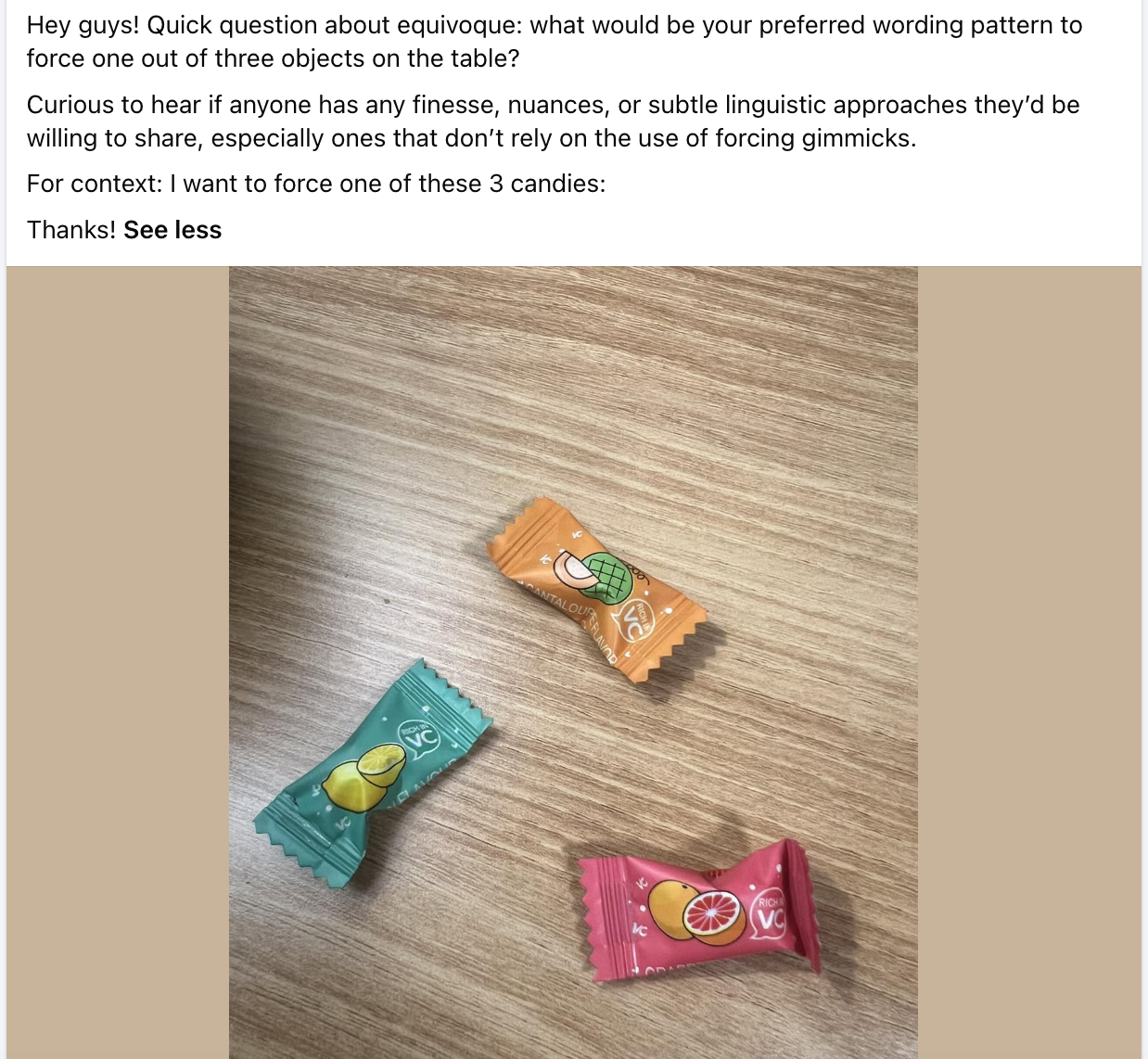
First, please don't make me go to Facebook anymore. All the responses on that post are either bad or the most elementary-level thinking on Equivoque. "Tell them to point to two." Is this what happens on magic Facebook pages? People giving the most obvious answers to questions? That’s all I ever see. Oh, and there's some guy in a mask that fits his head the way a PLU sticker fits an apple, doing things that are ostensibly tricks. Those are the two categories of video I see there.
To answer your question, no, there is no "Third Wave Equivoque" for this because we don't have enough information. The Third Wave style is about using real language that sounds definitive. Not "point to"—which is meaningless language that has to be given meaning after the fact (which is very clear to non-magicians as well).
Third Wave Equivoque isn't generic, it's written with a purpose in mind. What is going to happen to the chosen candy? We need to know what the trick is to know the language to use. We don't know that here. He doesn't give us any context. (Well, he does, but he just says: For context I want to force one of these 3 candies. Uhm, yeah, we got that part, goofball.)
The closest I can give you without knowing the trick is the phrase "take away."
"Take away two of the candies."
Depending on what they do, we can now put the focus on the "take" part of the phrase: "So you chose the red and the green."
Or we can put the focus on the "away" part of the phrase. "So that leaves us with the orange."
If needed, I would then likely use Michael Murray's Tombola Force for the final "choice." Although the language used there would again depend on what the actual trick is.