Dustings #133

An addendum to yesterday’s post…

When reading through it before hitting publish, I deliberately changed this line:

Touch the deck as little as possible.

to this:

Touch the deck as little as necessary.

You may have a trick where you just need to make one small adjustment to the deck mid-trick, but otherwise it’s completely hands-off. In that case, you wouldn’t want to take the deck, do your move, and immediately hand it back—that puts too much heat on that one moment when you’re holding the deck. Instead, you’d want to handle the deck only as much as needed for the trick to be fooling. In this example, that would mean touching it a couple of other times during the routine so the one time you do your move doesn’t stick out.

It’s not an absolute rule to touch the deck as little as possible, but rather as seldom as necessary for the deception to work.

I see magicians who want the deck in their hands almost like a security blanket so they can riffle the edges or spring the cards. Or they have a compulsion to square and straighten every pile a spectator deals. These are the sorts of things I’m suggesting you avoid.


When you’re recording your friends to get them to be fake amazed by your magic trick, make sure you let them know what part they’re supposed to be amazed by.

The girl on the right is astonished that he can poke a pen through a dollar bill. That’s not the magic part, you goofy bitch! She actually seems less impressed by the trick itself.


If you had a bet with Craig Petty about who could make the nerdiest YouTube video, pay up.

Stop Touching the Fucking Cards

You would think this would be the first thing magicians understand about card magic, which is why it’s so bizarre to me when magicians violate this seemingly obvious rule:

Touch the deck as little as necessary.

I constantly see magicians:

  • taking the deck back unnecessarily

  • squaring up packets

  • dealing through the cards themselves to “speed up the process”

  • shuffling “for” the spectators

  • spreading the cards in a nice ribbon spread for a selection

In casual performing situations, these things don’t add anything to the procedure and instead detract greatly from the impact of an effect.

Every time you touch the deck you are—from the audience’s perspective—potentially doing something underhanded. And that’s most of what people know about card tricks: the magician touches the deck and does something stealthy.

Now, you might say, “But I’m clearly not doing anything. I’m just squaring the pile of cards.”

  1. Regular people don’t know that. They suspect that sleight of hand is probably meant to look like nothing. So the fact that they don’t see you do something doesn’t mean they don’t think you might have done something.

  2. Spectators don’t have a video camera in their head that records everything perfectly. They don’t necessarily remember how “cleanly” you handled the deck when you handled it. All they remember is that you did touch the deck at times.

Here’s a specific example…

Last week, I mentioned John Bannon’s 51 Fat Chances as a good “Failsafe Trick.”

In looking for a performance of it on YouTube, I stumbled across this person’s version.

51 Fat Chances is a trick that can be done more or less entirely in the spectator’s hands.

Yet he keeps taking the deck, spreading through the cards, giving them back to the spectator, taking them back… to the point where there is essentially no trick anymore—certainly not if you look at the spectator’s reaction.

When you perform casually, you want to do whatever you can to touch the deck as seldom as possible—even if that means the trick ends up being sloppier or slower than it would be otherwise.

It’s easy to forget that a layperson’s understanding of the “trickery” in card magic is mostly that the magician is going to do something sneaky when they touch the deck. They have less of an understanding about procedural sneakiness or obscure mathematical methodologies, so they’re less on the lookout for such things.

That’s not to say a self-working trick is always going to be better than a sleight-of-hand trick. I’m just saying you don’t want to give them an answer as to how something might be done by playing into their knowledge of methods and allowing them to brush something off as sleight of hand.

“I’m not going to touch the deck at all” is one of the strongest conditions you can place on a trick. Don’t undermine it unnecessarily.

Pop & Lack

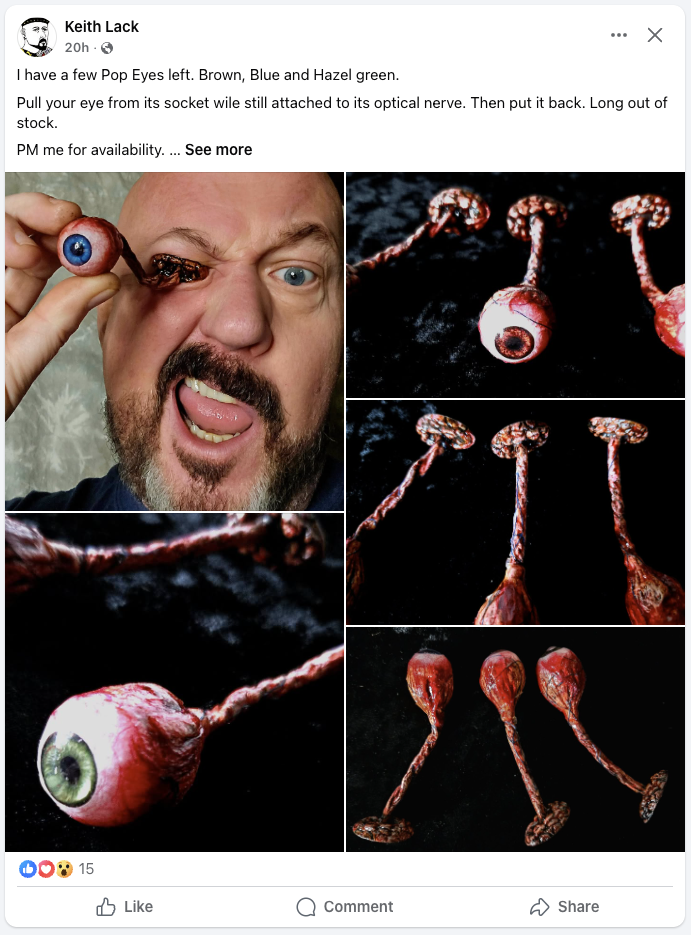
It’s rare for me to dip into the archives, but I heard that our old pal, Keith Lack, is selling some of his Pop Eye units over on Facebook.

Always one to help Keith out when I can, I thought I would repost my enthusiastic promotion of this product from 21 years ago on my old site.

The notion that struck me back then was from the advertising copy which emphasized the possibilities with this.

Pulling your eye from its socket actually struck me as a fairly specific effect—which tends to limit the “possibilities” for a trick.

But the advertising was so seductive. “Nothing comes in contact with your actual eyeball.  No adhesives used of any kind.” So I don’t have to hot glue the gimmick to my cornea? 🤔 Ok, now I’m intrigued.

With that knowledge, I focused my mind and realized Keith was correct. This is a gimmick with unlimited possibilities.


From June 7th, 2004

Magicians are a savvy bunch, and as such, they're always on the lookout for the next big utility gimmick. Oh sure, you can stun the pants of the ladies with one-trick-wonders like Color Monte or Milk to Light bulb, but the true bang for your buck comes from the gimmicks you can use for multiple effects like the thumbtip, the Raven, Xpert, and of course, Slush powder. 

Well, get ready, because now you too can harness the awesome power of the most versatile utility gimmick since the thumbtip .

As the ad copy says, "The possibilities are limited only by your strange imagination."

Oh yes, the possibilities. Think of all the wonderful, varied tricks you could accomplish with this gimmick. Here are just a few ideas: 

1. Pull your eyeball away from your head.
2. Pull your head away from your eyeball.
3. Pull both your head and your eyeball equidistant from an imaginary midpoint.

...among other possibilities too numerous to get into and too obvious to warrant mentioning. 

And think of all the patter possibilities! Why, anytime you need to say the word eye, or even the word I, you can unleash a magical moment of astonishment. For example: 

"Keep your finger on that card and don't move it. I have my eye on you." [Yank out your eyeball.]

or

When performing for the elderly. "I don't know about you, Old Man Periwinkle, but I can barely tell these cards apart from this distance. Let's take a closer look." [Yank out your eyeball.’

or

"Boy, I really wish I saved my $80." [Yank out your eyeball.]

I prefer to use this in my birthday clown shows as misdirection for the knuckle-busting move in my Forgetful Freddie routine. (By the way, I use my Forgetful Freddie routine to teach kids about the joys of forgetting. In particular, forgetting the way I caressed the birthday-boy's sweet, tender buttocks while his mom was in the other room scooping ice-cream.)

When performing for an adult crowd, I like to get into this effect by telling a touching story about the first time I saw snow. You see, when I was growing up, my family would spend the winters with my grandparents in Florida. These were wonderful times, but I never got to experience snow because we would always leave New York before the first snowfall and return after it had all melted. But then, when I was seven, my father needed to stay in New York a bit longer than usual on business. And one cold November night as I looked out my window, I saw these beautiful white crystals falling from the sky. It was the most amazing thing I ever saw. I ran outside in my bare feet and twirled around in the falling snow. I was so awed by the spectacle of nature's majesty that my eyeball popped out of my fucking skull!

(Now, I realize that by so generously divulging my presentations to you, I could be in danger of someone stealing my routines, but that's a risk I'm willing to take if it gets people's creative juices flowing.)

And for those of you that like to do magic tricks to pick up women, I can't think of anything more romantic than getting two of these things and yanking them out of your head as you stare at some girl's tits. She'll really be flattered.

I applaud Keith Lack for doing something different and putting out some unique products. I'm particularly looking forward to August when he is going to release "Bust A Nut" which is an effect where you pull your nutsack out through your zipper and tug and squeeze it until one of your balls apparently rips through your sack and dangles from the epididymis. It's a worker.

A Paper Gameboard Tweak

Based on the emails i got, people seemed to enjoy Quinta idea I posted last month, The Paper Gameboard.

I really like your concept for creating the paper gameboard for the Quinta force. You're right, it definitely smooths out some of the rough points of the force. I know there are people who use Quinta all the time, but something about just using the counting procedure to make a selection between 5 objects always seemed a little contrived to me. But this idea gives it motivation and makes the procedure more engaging.

That was the start of an email from reader Ryan M. He then went on to offer a tweak to the procedure that eliminates the need for the Paul Harris Pointer Anomaly Principle… or whatever it’s called.

What Ryan discovered (maybe discovered is the wrong word, maybe this is obvious to people, but I hadn’t thought of it) is that an arrow is naturally equivocal.

An arrow can be seen as pointing to the starting point OR pointing in the direction the game piece should move. Both make perfect sense.

There are a couple of ways you could do this.

Verbally

This was my first thought, based on what Ryan suggested in his email.

I would introduce the arrow and the balled up piece of paper.

“The arrow will be used as a spinner, to determine which direction we start moving from. The ball is going to be a 50-sided die. But you’ll use your imagination to determine what actual number it rolls.”

That first sentence seems to make sense at this point, although if you really examine it, you’ll see it’s not exactly clear. But nobody will ever notice that because you’re immediately telling them this wadded up paper ball is 50-sided die. That’s more interesting than the previous sentence.

After “rolling the die,” you can have them spin the arrow freely (I would still probably have them do this face-down) and they can turn it over however they want.

You now say one of the following two things:

  1. Okay, so we’ll move in that direction. And the number of moves was what again?

    or

  2. Okay, so we’ll start from that side. And the number of moves was what again?

Both sentences make sense with what you said originally about the purpose of the arrow.

Non-Verbally

Here’s another option that came to my mind.

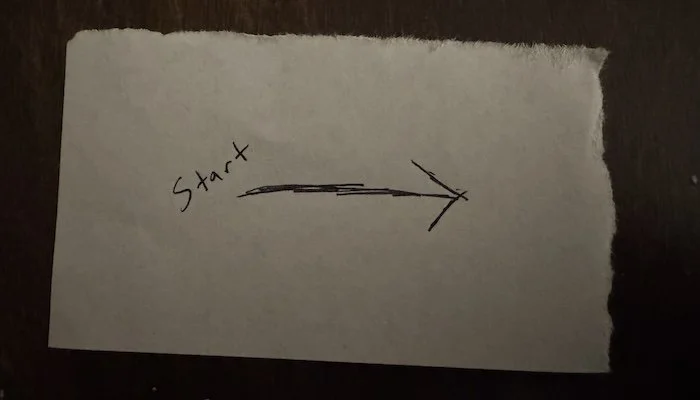
Write this on the paper:

This image can be interpreted two ways.

  1. We start on the left and move to the right.

    or

  2. We start on the right.

In this case, I wouldn’t show them the arrow or mention its purpose. I’d draw it on the paper and have it placed face-down on the table. Have them roll the “die” and name the number. Then have them rotate the arrow (that they still don’t know is an arrow) face down on the table and turn over the piece of paper so it faces either direction. As they turn the paper, I’d tell them that “this is like a spinner on a gameboard,” then when they turn it over I’d cement in what it means.

“So it looks like we’re going to start on this side, and move this direction.”

or

“So we’re going to start on this end.”

I haven’t done it yet, but it feels pretty much unimpeachably fair to me.

Thanks to Ryan for writing in and letting me share the idea with you guys.

Mailbag #151: Hoy Tweaks

Re: A Hoy Book Test Tweak

If you got them to just think of a random number before you even introduce the books, then ask them, after riffling to their "stop" page whether you should go back or forward that number of pages would that improve the effect or is it overcomplicating? My thoughts are that they might just remember that you allowed them to think of a completely random number (you might have to limit it to, say,  between 1 and 20 depending on how many pages the book has). 

My aim is always to keep it simple. Not give too many instructions. But the possibility that the participant's memory of the effect (which is often more impressive than what actually happened) could be that there was total randomness of choice is tempting.  —AD

My first instinct is that this is a bit too overcomplicated. But everything is worth trying to see how it goes over.

The tweak I suggested was intended to be quick and casual, this one feels like you might end up getting bogged down as you’re counting ahead or back 15 pages or something.

What you might want to consider is saying something like, “We’ll use this book to select a random page, but I’ll also give you a free choice so we know there’s no way anyone could know what page we’d end up using. Give me a number between negative ten and positive ten, your choice.”

They say, negative seven.

You flip through the book and let them say stop. “Okay, we’re at 175. And what was the number you chose again?”

Negative seven.

“Okay, we’ll use your choice and subtract seven. So we’re at 175… 168, yes? That’s as fair as I can be. A random page where you said stop, and then a free choice of how many pages we’d go back or forward from there.”

They may, in time, misremember that “free choice of number” as a free choice of a page number.

Of course, you’re just modifying the force number by the opposite of their free choice.

What I mean is, if the force page is 100, and thei’r number is negative seven, then the number you give them will be your force page plus seven.

If their number is positive ten, you’ll tell them you stopped at the force page minus ten (90).

You get the idea.

There’s no rush to do this simple math because you have all the time you need between when they tell you their number and when you flip through the pages.


I like your addition. It seems you could easily make it even more effective by memorizing the first word on three subsequent pages in their book.

Then you could have them say stop, miscall the page, have them turn to that page in their book and THEN give them the option to stay on that exact page, go one page forward, or one page back. It should be easy enough to see which choice they make and therefore cue you to which word they end up on. 

To me, it seems that would make the choice even more visceral since they would be able to see how the choice affects the end result. —MH

It’s not a bad idea, but the cost of this is that you must be left alone with the book for a few moments to memorize the words and for me, that’s too much of a trade-off.

In the past, I would sometimes have my friend grab any book from the library or book store, bring it back, and then tell them to grab a second book. Then while they got the second book, I would learn the force word from the first. But I’ve been doing some iteration testing of different elements of the Hoy Book Test for the past few months (possibly for discussion in the next book). And my feeling now is that it’s stronger to get the word in real time and for me to never be alone with the force book.

The feeling I want them to remember is they grabbed any two books and we immediately went into the performance.

Dustings #132

It’s my favorite time of year, Haunted Key Season!

That special time of year when a cylindrical object rolls over on your own hand, and you try to convince an adult with a brain in their head that only a ghost could do such a thing.


GLOMM Lodge #5, The Ghost Shrimps, has now been established in Savannah, Georgia.

They join these other four GLOMM lodges:

GLOMM Lodge #1: The Does
West Lafayette, Indiana

GLOMM Lodge #2: The Mastodons
Melbourne, Australia

GLOMM Lodge #3: The Coyotes
Eugene, Oregon

GLOMM Lodge #4: The Otters
Sacramento, California

The GLOMM, which is the largest magic organization on earth (because everyone with an interest in magic whose not a sex offender is automatically a member), is also now the fastest growing magic organization because the official chapters have gone from zero to five in the past year or so. Technically, that’s like infinite growth percentage-wise.


Here’s an email I received from Tomáš H. regarding the Damsel List Force shortcut as discussed in this post.

Thanks for sharing the Damsel List Force shortcut. I like it over the DFB because of it simplicity and use of native features of iOS.

However, I had few issues with the shortcut you shared. So i re-worked it and made improved version. Here is the link: https://www.icloud.com/shortcuts/c57623c992d341a795c46d2a2e897db3

There are two main improvements:

- The default list of items does not have to be numbered. The numbers are added during the list creation automatically. That makes editing and adding more items much easier. And there does not have to be empty line at the beginning.

- It works even with first and last number selected

But here is another, imho very interesting followup of the shortcut: https://www.icloud.com/shortcuts/0a7852b1fad04728bf0073cfc761839a

Instead of typing the number on the phone, the value is dictated. It tries to parse a number from the dictated text. The phone needs to be in a silent mode otherwise there is a "dictation" sound.

I did not have a chance to try it on real performance yet. But the way how I imagine it would work is that you start the shortcut just before the spectator is going to say the number. Or, alternatively, after the spectator tells the number you start the extension and repeat the number, like you are confirming the number they said.

I think it would require some testing and the shortcut can be further improved - e.g. re-trying the dictation if no number is parsed from the text. Feel free to experiment with the shortcut, if you find the idea interesting.


Big news for the Vanishing Inc. Boys!

First, Andi Gladwin shared this on facebook….

And now I’m hearing that an upcoming cover story on Joshua Jay smashes the record for the number of times Genii has used the word “cunt.”

A Hoy Book Test Tweak

I have five people in my life who I regularly test magic tricks on. Meaning, I’ll show them a trick with very little presentation, and then pick their brain about how it might be done in order to road-test the method.

These are people I would never perform for otherwise. They’re just so focused on method and not being fooled that there’s no point trying to show them anything more interesting or immersive. Are you surprised to hear they’re all men?

While I think their attitude towards magic is a little corny, I find it’s useful to have people like this in your life. This way I can test out tricks or ideas without having to burn them on someone whose reaction matters.

Here’s a tweak to the Hoy Book Test procedure that I tested on them recently.

After they say “stop” while I’m flipping through the pages of the second book, I say:

“Okay, one more choice. I can stay on this exact page, flip one page forward, or go one page back. What do you want?”

The reason I wanted to add this was because I thought it would add an extra element of choice to the page selection, which I felt was missing. Yes, they sort of “choose” where to say stop—but I don’t think that really feels like a “selection” on their part. Here they have a distinct choice. Of course, we know their choice doesn’t matter, but it feels like it should matter.

But I wasn’t sure it was a great idea. By slowing down here, am I just spotlighting a moment that’s better glossed over? Giving them a chance to think, “Hang on—I never actually saw that page number. He could’ve just been lying.”

So over the past few months I’ve been testing it out—including through my gauntlet of the five trick dissectors I mentioned earlier—and I’ve come to the conclusion that it does add to the impossibility and doesn’t draw attention to the force as I worried it might. As I broke down the effect with these guys and they tried to work out the method, two of the five actually mentioned that moment as a reason it couldn’t be one of the methods they were considering. As in, “If you somehow knew the page you’d stop on… wait, but you let me choose to go forward or backward from there.”

I just don’t think it occurs to people that you would make a big deal about what page exactly you were going to have them use… if your intention the whole time was to lie about the page number.

So from my personal testing, I think this is a tweak worth adding. Yes, in the trick’s reality, you knowing the word they’re thinking of from page 113 shouldn’t be any more impressive than you knowing the word they’re thinking of from page 111. It’s all technically the same trick. The benefit is just adding a distinct choice into the process, which I think helps trip them up if they try and unravel it in their mind.