
Salvage Yard: Pixx
/So I grabbed Pixx off Penguin a couple weeks back. The method's solid — no surprise, it's Max Maven — but the trick itself feels arbitrary in a very “magic-y” way. The pictures are just random objects. And the predictions aren’t exact matches for the original possibilities. Which means someone in your audience could imagine that one prediction applies to multiple selections which just makes it feel less clean overall.
And then in this video they suggest you just use the method and come up with your own cards and images — cool, so I'll do the creative work you were supposed to do. Great division of labor.
I've got nothing for framing. Genuinely stumped.
So now it's your problem. Any ideas for a way to perform this that’s maybe more interesting? —HT
Actually… yes.
I had similar thoughts when this was performed for me. Strong method, but uninspired overall framing. But it's only $20, so I didn't really see an issue with it.
Here's an idea for a premise that is more interesting, more cohesive, less arbitrarily limiting (the part where there are colored frames around the original images lumping two together), and more memorable than the current version.
You'll have to go to a little effort to make it up, though, but with AI and online card printing companies it won't be that difficult.
Or, if Penguin wants to produce Pixx: Jerx Edition, they have my permission. Here's my signature signing the rights over to them.
Here's how it works…
You bring up the concept of "psychic detectives"—people who seem to have insights into crimes and their perpetrators they couldn't possibly know.
"These people come out of the woodwork all the time, but 99% of them are lunatics or bullshit artists, but 1% seem to be the real deal. And that's somewhat frustrating because—are the cops supposed to follow up on 99 bad leads for the one good one? Or do they just ignore these people and end up missing out on a key bit of information?"
"What they end up doing is giving these people a little test based on a crime that's already been solved. Even a fictionalized case will work, as long as a verified answer for the case has been created as well."
I want to try that with you today, because I get the sense you'd be good at it.
You bring out two envelopes. One labelled "Suspects," the other "Perpetrators."
From the Suspects envelope you remove eight police sketches and put them in groups of two. Each group has some very basic similarities between the individuals, but also some obvious differences.
Group 1 - Two white male "punk" types. One with a mohawk and clean shaven. The other bald with a long beard.
Group 2 - Two black males. One thin with a long face. One fat with a round face.
Group 3 - Two older women. One with dark straight hair, one with blond curly hair.
Group 4 - Two children. One boy, one girl.
"The scenario is a bank robbery gone wrong. 18 people killed. The authorities know it was a crew of four and they have sketches of people who were in the area. But anyone who could positively identify exactly who was involved was killed and all the security cameras were taken out."
"I'm going to ask you some questions about who was involved. I don't want you to use your brain or try to ‘logic’ out the correct answer. Instead, just go with your intuition."
"We're going to start furthest out and work our way towards the vault."
"On the street, in front of the bank, there were two individuals in cars. One was the getaway driver; the other was just an innocent person sitting in their car. Use your gut. Which of these groups had the getaway driver in it?"
They point to the two white males.
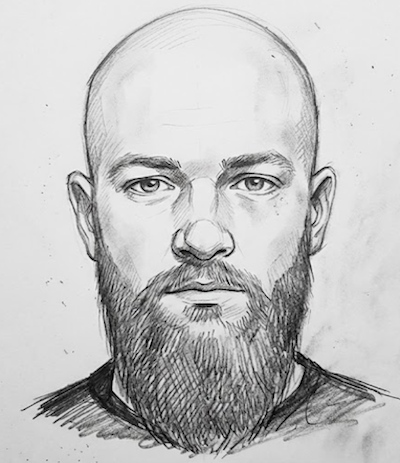
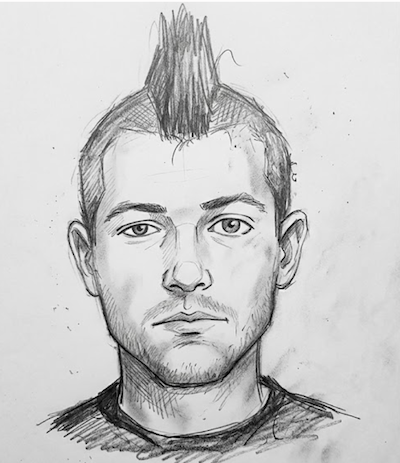
"Okay, and which of these was the actual getaway driver?"
They indicate the bald one.
You slide that picture off to one side, and put the other one in the start of a discard pile.
"Now there was an individual at the front door of the bank, guarding it and acting as a lookout. And there was another individual out there who was just an innocent bystander. Which group contains the door guard?"
They pick the two black males as containing the door guard. And then identify the thin one as the actual perpetrator.
They then decide it was the two children that were in the lobby and the one doing crowd-control was the little girl (the little boy was innocent).
And finally, inside the vault were the two older women. Although they both claimed they were innocent, your friend identifies the curly-haired one as the mastermind. The other one was just her final hostage.
As you place the unchosen individual's police sketches away, you recap. "You identified which person you thought was guilty and exactly where they were located during the crime. The odds of getting every one right are like in the 100s or 1000s to one." Maybe not exactly, but close enough.
You slide the contents of the perpetrators envelope out. On top of the pile is a cover card (my addition, just to delay and clarify the climax). It says something like:
Perpetrators
Getaway Driver
Door Guard
Lobby
Vault
"So first we have the getaway driver. You said the white males were in the cars outside. And between those, you thought the guilty one was the bearded man."
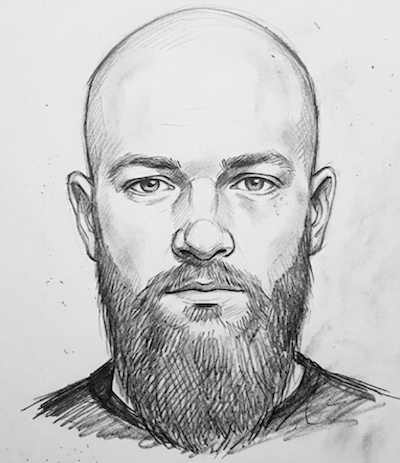
"And the actual getaway driver was…" You remove the cover card.
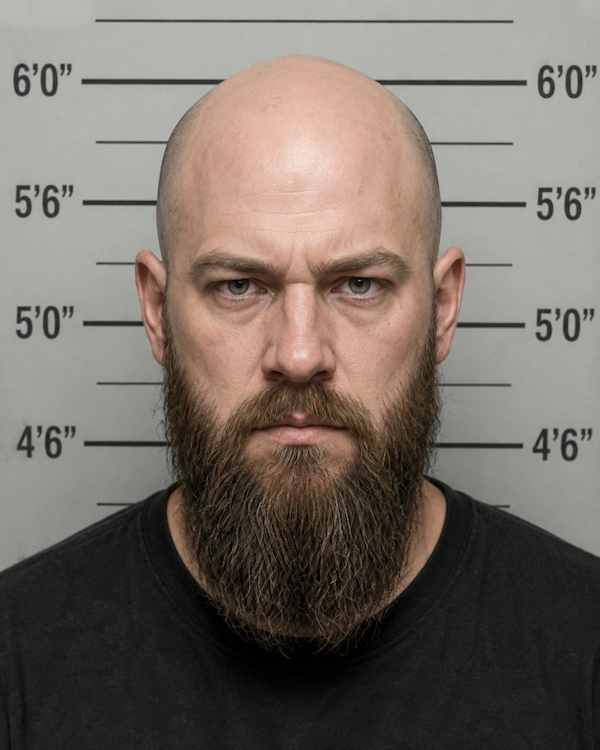
You then go through the rest of the cards, showing they found the full guilty "crew" and identified what their roles were.
The "patter" I'm giving here is pretty basic—just to get the idea out there. In reality I'd try to come up with something a little more interesting. And, of course, you’d want to emphasize your amazement that they got everything correct.
Maybe give them a picture of JonBenet-Ramsey at the end and be like, “Use your powers. Don’t hold back on us now. What happened to her?”
Mainly what I want to do is come up with a less arbitrary grouping of the two images (these are two suspects spotted in the same general area), a way of making the order meaningful (they're choosing what the people's roles were), and more generally interesting subject matter (psychic detective).
Note
I found it somewhat difficult to get AI to create something that looked like a real police sketch. It produced something too perfect looking each time. The closest I got was with this prompt in Google Gemini.
-
Create a black-and-white police composite sketch, like a witness-based forensic drawing rather than a polished portrait. The image should look imperfect, rough, and slightly amateurish, as if drawn by a competent but not highly artistic police sketch artist.
Use graphite pencil on plain white paper. The subject should be shown front-facing in a simple head-and-shoulders composition, with a neutral expression and no dramatic lighting. The facial proportions should be slightly off in believable ways: mild asymmetry, uneven eyes, simplified nose and mouth, awkward jawline, imperfect ear placement, and features that feel approximate rather than lifelike.
Use visible pencil lines, basic crosshatching, smudgy shading, and uneven line weight. Avoid beautiful realism, cinematic portraiture, fashion illustration, or highly detailed anatomy. The sketch should feel utilitarian, flat, and witness-driven — clear enough to identify a suspect, but not refined or artistically “good.”
Subject: [Ex. A white male, in his 20s, "punk" look with a mohawk.]
Do not make it a polished realistic portrait, charcoal art, concept art, glamour drawing, hyper-detailed illustration, or attractive finished sketch. Avoid perfect symmetry, perfect anatomy, dramatic lighting, and painterly rendering.
I then asked ChatGPT for a photo-realistic mugshot based on the image.
If I was going to pursue this further, I’d then use makeplayingcards.com or something similar to create the cards.