The Asymmetry of Fooling
/This is a concept I thought was well known, but it's come up a few times this past year, so maybe it's not as understood as I thought.
It's in regards to what we consider an effect that fools people.
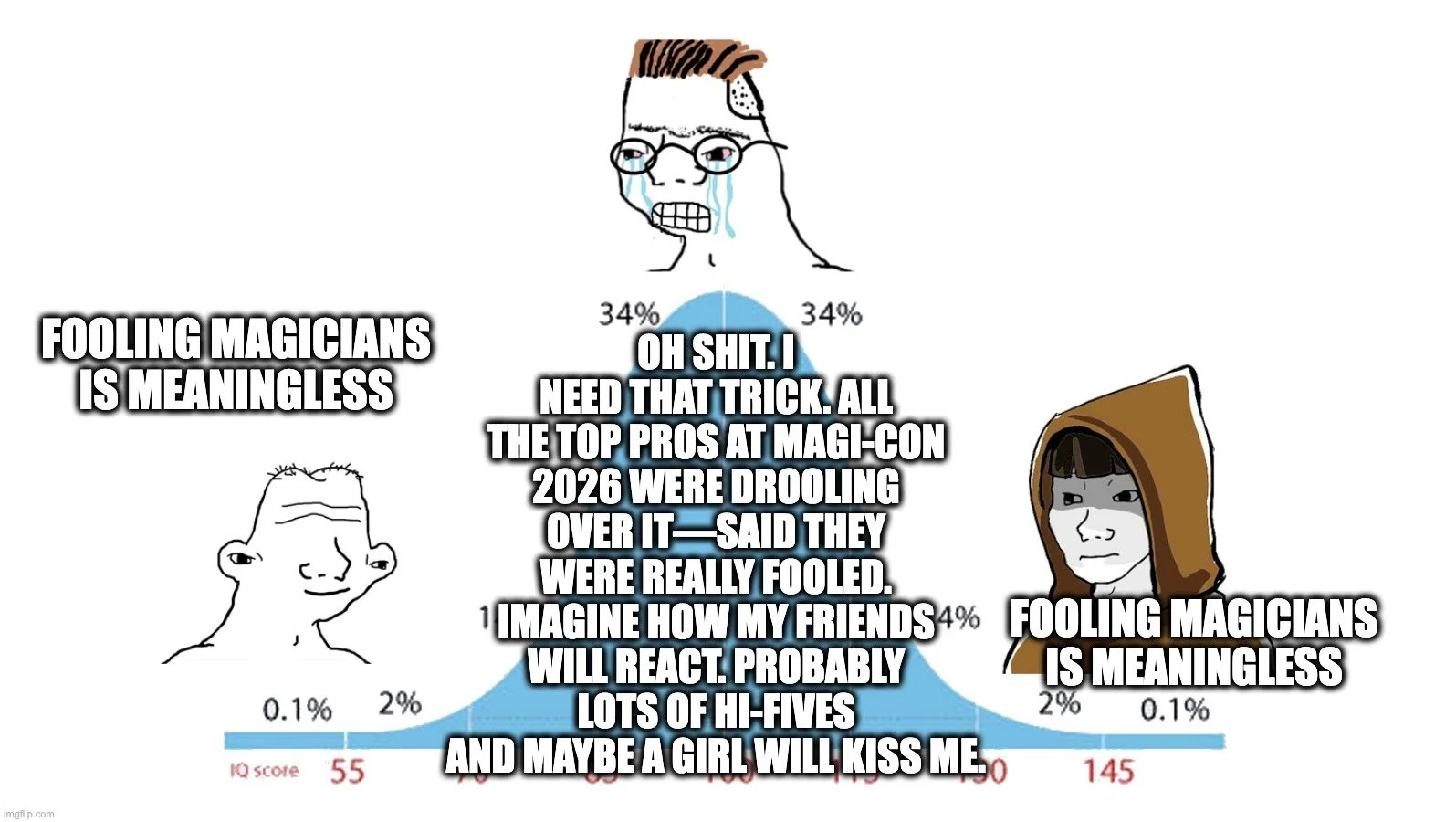
"That would never fool anyone," says Bob.
"What are you talking about?" says Steve. "I showed it to many well-known magicians and mentalists at a magic convention and everyone was fooled by it."
Is Steve lying? Maybe.
But let's assume he's not. Let's assume he showed it around at a magic convention and all the magicians said they were fooled.
Probably some are lying. That's how these things work.
But again, let's assume no one is lying. Not Steve and not the people at the magic convention he performed for.
If magicians were fooled by this trick, then simple logic tells us laypeople will feel fooled too.
But logic fails us here.
Here's the thing you have to understand…
If a magician understands 95% of what you did but can't quite figure out that last 5%, he will often say, "I was fooled."
If a non-magician catches on to just 5% of what you did, they will often say, "I wasn't fooled." They know enough to know it wasn’t really impossible.
So “it fooled a room full of magicians” may tell you almost nothing about whether the trick will fool an audience. Fooling magicians and fooling laypeople are not different degrees of the same achievement. They are different tests.
Keep that in mind the next time someone is like, “But it fooled everyone at WizardFest!” That may not be the best metric to know if it’s going to awe the people in your life.
The magician focuses on what he can't figure out.
The non-magician focuses on what they can.
Note: Denis Behr has sent along this quote from Strong Magic by Darwin Ortiz which makes the identical point in one sentence:
"An interesting difference between performing for magicians and performing for laypeople is that, if a magician succeeds in figuring out ninety percent of a trick but can't figure out the other ten percent, he will feel that the trick fooled him; if a layperson succeeds in figuring out ten percent of a trick but can't figure out the other ninety percent of the trick, he will feel that it didn't fool him."
There you go. There’s no reason to be suckered by the marketing of how many magicians were fooled by something when “fooled” for them frequently means, “I didn’t catch one small aspect of the method.”
If a smart guy like Darwin Ortiz, and a dumb guy like me can reach the same conclusion, you can be pretty sure the idea has merit.