
Mailbag #177
/
This is gross, right?
Like, is it just me, or is this kinda crazy? Like a true breach in privacy for spectators!
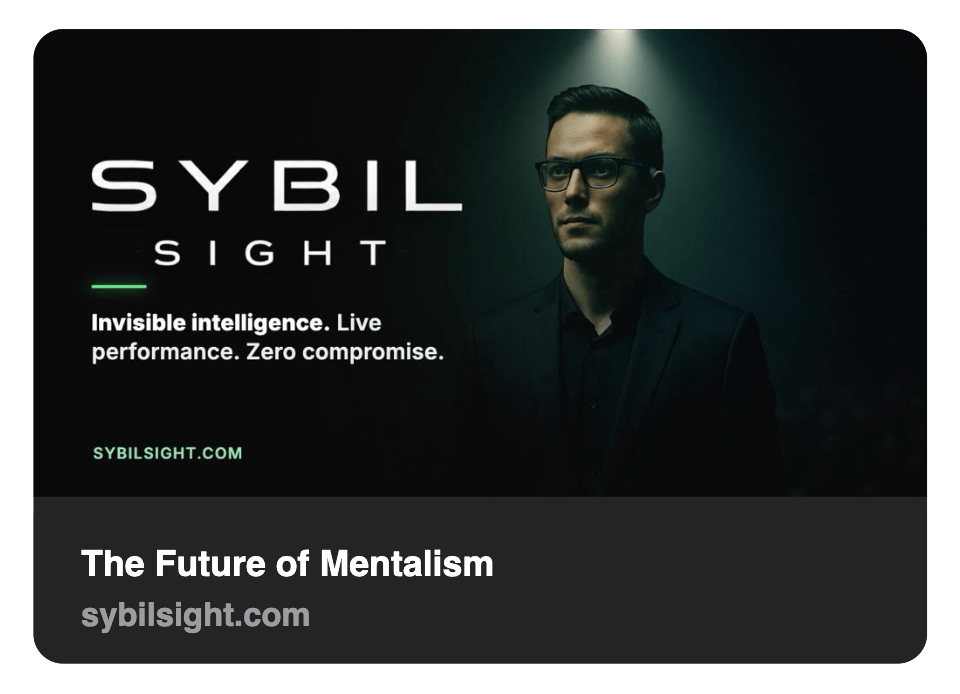
Like, I feel it’s creepy to be looking at your audience purely as data points for revealing information, rather than, um… as HUMAN FUCKING BEINGS?
I don’t want Terminator vision while trying to truly connect with my audience.
How is this NOT gonna look like staring off into space/reading text while performing?
Have we lost the plot? Max Maven once said that there’s all these new electronic gizmos that GET information, but no one asking “Ok, you have the information, now what do you DO with it?”
Curious your thoughts on this….? Am I being too harsh? Do I just ‘not get it’?—XX
Yeah, I think you’re probably being too harsh. Although I'm not the best person to judge this. I don't perform professional mentalism where these things might be used.
My common-sense, amateur perspective is that this is not really the solution people think it is.
You know how you'll see a mentalism show and the performer will have people look in his ears to make sure there's no secret transmission devices?
They do that because it's BEYOND OBVIOUS that electronic devices could be used to help accomplish their feats. It's something so obvious to laypeople that we go out of the way to cancel that thought in their minds.
Well, now what are they going to think when you're wearing your questionable dorky glasses on stage?
The guy selling this has an answer on his site…
Sybil Sight runs today on the Even Realities G2: magnesium and titanium, 36 grams, clear untinted lenses in your prescription or none, no camera, no LEDs. […] People who recognize smart glasses see a familiar consumer product and dismiss it.
This strikes me as kind of naive.
An engaged audience has their suspicion up about everything. They're going to dismiss your smart glasses because they're familiar with them?

"Oh, I know those glasses. They have a private micro-LED display only he can see and Bluetooth-connected AI. Nothing to worry about. He must have to read some small text."
Familiarity is only disarming when the familiar function is innocent. Here, the familiar function is privately feeding the wearer information.
It doesn't feel that far removed from saying:
This card trick uses a common Bicycle Svengali deck. People who recognize gimmicked decks see a familiar consumer product and dismiss it.
It also doesn’t help that, in certain lighting, people may see some weird shit shimmering across the lens of your glasses.

If anything, people who recognize them or suspect them as being smart glasses will probably think they're capable of more than they're actually doing—assuming there are cameras in them, facial recognition, etc.
I'm not morally opposed to this technology (or any technology) in magic. I just feel the deception here is awfully fragile. If one person in your audience has seen these glasses before, then everyone in their group will know you were wearing them, and then everyone in surrounding groups.
Then the danger isn’t merely that the audience correctly identifies how one piece of information was obtained. It’s that the glasses become a universal explanation for the entire performance.
It's probably notable that some of the first things I heard non-magicians talk about doing with AI smart glasses is walking around acting like they know the answer to every trivia question or acting like they could do complex math in their head. So I don't think using these for deceptive purposes is that far off anyone's radar.
While I'm sure people of a certain age will still be fooled by this, younger and/or tech savvy people won’t be as much. In fact, I think we're probably already at the point where the most forward-thinking magicians will be taking their glasses off before walking onstage—specifically to signal this type of trickery isn’t involved.
How the hell is anyone supposed to learn magic now? The paywalls are insane and everything is really decentralized. Where would you start if you had to start over or would you just pursue creative writing over magic? —CR
Hmm… I'm not sure I agree with your premise. Anyone who tried to learn magic pre-internet knows the feeling of checking out the same one or two books on magic from the local library for years.
The paywalls don't really keep new magicians from accessing anything they actually need to learn magic. A beginner in magic now has access to all the information they need for free. 1000x the information people had access to 30 years ago.
If anything, there's too much information. (Maybe that's what you meant by decentralized?) I think there's a benefit from having just one Genii magazine to keep you entertained for the month. Maybe you buy a couple of books each year and pore over them dozens of times each. Having to learn to make something work for you is more educational than just dismissing everything that doesn't immediately grab you.
Yes, I know how I sound.

Where would I start if I had to start over? The same place I started the first time.
I’d get Scarne on Card Tricks. I’d get the Karl Fulves books from Dover. I’d learn everything in them—and, more importantly, I’d actually perform them.
There are gems throughout those books, but you may have to do some work to make the material feel relevant and compelling to a modern audience. That work has an enormous payoff if your goal is to truly captivate people with magic.This will get you much further than spending those same hours working on sleights.