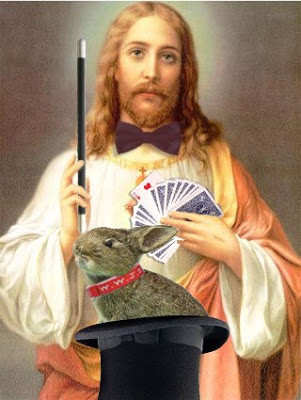
WWJD?

One of the most pervasive and most annoying lies in magic is that if you're a good magician, spectators won't want to look at your props. Or that if they do, you can somehow remove that inclination with proper "audience management." I'm not sure where this idea originated. It probably came from one of those crusty old magic theory books which are great as historical documents, but, sadly, less and less relevant about performing for actual people in the modern world. 

People selling magic tricks have long proposed this idea as well. "No, the restored card can't be examined, but your audience won't want to examine it." This is their way of getting around selling half of a trick. If a restored object, for example, can't be handled by the spectator then the trick you have isn't, "I can tear a card and restore it." The trick you have is, "I can tear a card and make it look restored." Audiences know the difference. 

Now, because you had a lot of magic marketers repeating this claim, it got picked up by the rejects on the Magic Cafe and other message boards as well and it just rattled around that retard echo-chamber until it became not just an opinion, but almost an accepted rule of magic: If people want to examine your props, you're not a good magician. 

I will concede that an audience shouldn't want to examine the objects that are tangential to the effect. They shouldn't want to examine your pen in a drawing duplication. And they shouldn't want to examine the card case if it's not used in an overt manner during an effect. If they do, that may suggest a flaw in your performance. (But it's also possible they just might be hyper-analytical and there is no amount of skill you could possess or presentation you could put together that they wouldn't dismiss and immediately just want to scrutinize everything that's in play. Some people are like that.)

But if you change one object to another, or tear and restore something, or harmlessly penetrate something, or change the color of something -- and if you do these things in a close-up situation -- then I would argue that the trick is not complete until the audience has examined the object of the effect at the end. 

"But they should believe the magic is coming from you, not the props, so why would they want to examine them?"

For the sake of argument, let's pretend a modern audience is really going to be convinced that you have some sort of supernatural powers. Does that mean they don't want to look at an object that you affected with your magic? Why would that be? I would think it would be just the opposite.

We need to stop seeing spectator examination as some sort of challenge. We only see it as a challenge because we're not prepared for it in many cases so it is a challenge to us. But for the spectator, wanting to look at the object is often just a natural reaction to being shown something amazing with that object. It's not about "figuring it out" or debunking you, it's about taking interest in what you just showed them.

If you're having a hard time understanding this, imagine you are Jesus. You're Jesus and you're showing a miracle to one of your believers. "I changed this water into wine," you say. 

What would be the reasonable response you would expect here?

  • The disciple says, "Amazing," turns around and walks away.
  • The disciple says, "Amazing. Can I have a sip?" And Jesus says, "Uhm, no, maybe later. First let me show you how I multiply these loaves and fishes."
  • The disciple says, "Amazing!" And Jesus holds out the glass for him to drink from.

The first option is the bizarre way magicians want their spectators to react. They want them to be impressed but simultaneously take zero interest in what they've shown them after the trick is done from the magician's point of view.

The second option is how magicians suggest you handle a "difficult" spectator. Move on to something else. 

The third option is the normal and natural response of both the miracle worker and the audience. 

Notice that we've removed the notion of believability and skepticism. This is someone performing real miracles for a believer. 

So when you consider a new trick, put yourself in the role of Jesus showing it to one of his disciples. The deck changes color. Does Jesus immediately put it in his robe? No. Does Jesus move on to another effect? No. He would hand them deck so they can look at this miraculous object. He is not giving them the deck to convince them. He's giving them the deck because that would be part of the natural action when demonstrating something like this.

Neuropathy

Here's a guy who does NeuroMagic. It combines magic and illusion with neuroscience and psychology. Here he is doing a coin trick.

[Update: So, he's removed the video. You snooze, you lose, people. That's why you need to visit this site every hour on the hour. (No, please don't.) You're not missing much if you didn't see it. It was just someone performing a coin trick somewhat poorly.]

Wow! That was some stunning magic. Was it me or did those coins just seem to melt in and out of existence in a flash of fire?! I really need to do some research to understand the neuroscience of how this fooled my brain. brb

...

Exciting news! I worked with some doctors and scientists and they did some neuroimaging and they were able to figure out how this trick fooled me. Apparently I have a brain-eating parasite.


Now look, I'm not interested in pointing out bad magic just for the hell of it. I have plenty of other things to write about. I'm not trying to make fun of this guy. I'm trying to help him. And not in that bullshit way that people are cruel to other people and then imply they're doing it for that person's own good. "I called you a fat cunt because I want you to get healthy!" 

Check out some other videos by this guy. They're really not good. 

So what? Some guy with some shitty videos on youtube? 

Ok, yes, big deal. But apparently no one has told this guy he's not good and now he's planning on a U.S. tour

Magic, as a whole, does a shitty job of telling people when they're bad. I'm not quite sure what the reason is. I think, in part, it's because it's filled with such delicate egos that no one wants to risk sending someone over the edge with an honest critique. And I also think if you are a decent magician you look at a bad magician and think, "Let this idiot fumble around some more. It makes me look better."

And so we clap them on the back and say, "good job" and they continue to believe they're on the right track and then they're on stage at FISM getting booed and they must be like, "What in the fuck?" (My favorite part of every FISM recap is when we hear about how awful a bunch of the acts were and the performers that get booed off the stage. In a healthy art form, the shitty performers don't get to the biggest stage only to find out they're not good. But magic is filled with such pussies that only when surrounded by 1000 other cretins do magicians feel comfortable voicing a negative opinion.)

And it's really incumbent on magicians to give each other honest feedback. The audience won't. In fact, the more nervous and unsettled you seem to be, the less likely the audience is to point out you're awful. "Hey, that was great, thanks," is often the worst thing an audience will say to you. 

So, Matthew, the "neuromagician" behind these videos, take this in the spirit in which it's intended: Your magic needs a lot of work. In fact, much of it is actively bad. Your sleights are super rough and your presentation is just this side of comatose. Look at that coin trick. Your hands never appear empty in the slightest. The coins are clearly visible when they shouldn't be. And when your "invisible" coins turn visible, it's clear you're just reaching for the coin in your palm. There's no magic to it other than what is accomplished by the gimmicks. And that's with a static webcam and no audience to deal with. Your other videos have different, but also significant, performance issues. You need to be aware of these things. I'm not trying to bash you. I just want you to not turn a blind eye to these things for your sake.

You know the best thing to ever happen to my sex-life? It was when I was 18 and in college and I was dating a girl who refused to let me think I was satisfying her when I wasn't. She wasn't rude about it, she would just make sure I was where I needed to be and would take the lead on dictating pace and pressure and the sorts of things guys don't think about because why would they when they can get off by sticking their dick between the mattress and the boxspring? So many women are hesitant to give that type of direction because so many men are too fragile to accept it. So instead they lay back and say, "Hey, that was great, thanks." And the guy walks away thinking he's a tremendous lover. But this girl was having none of that. And I didn't flip out about it. I wasn't like, "How dare you suggest I'm anything other than perfect." I accepted her critique and instruction and happily learned from it. It was only a positive thing. The result was that when I was a young man I was able to interact with women sexually as a much more experienced man would. And now that I am much more experienced, it's like I'm some government-created cyborg designed to distribute orgasms and sent back from the future to quell the 2018 uprising of dissatisfied females. "Come with me if you want to... come...with me." Has this analogy gone off the rails yet? My point is only that for the sake of ourselves as performers and the art as a whole, we need to be better at giving and accepting criticism. It only serves to make you better and stronger.  

Shush

Now look, I don't know if this video suggests a lack of originality or if these people all thought they were just doing their version of a classic pose. I actually don't care about that either way.

What is funny/interesting/telling to me about this is that the subtext of one of the most common poses in modern magic is that the magician got caught -- the one thing a magician can't do -- and he's silently pleading with the person not to say anything about it.  "I'm terrible at this... please don't tell!" And this is the image they've chosen to represent their work. They thought it was a good idea. This is definitely a magic-only phenomenon. You don't see ads for housekeepers where it's a woman on her hands and knees smearing shit into a shag carpet, looking back and shushing you. Or a doctor with a woman on his table bleeding out after a botched abortion, coyly peeking over his shoulder, "Shhhh..." 

Gardyloo #5

I'm traveling at the moment and working on a trick I've been planning for the past few months. It involves a series of color changing object -- including my clothing -- all done in a black and white hotel. Someday I may write up the story, although it may be one of those "you had to be there" type things.


D.D. wrote in to warn anyone that searches Workers 2 Michael Close, on ebay -- in the "more items related to" section -- they will get a lot of results for Gung Ho, and also a book which is decidedly not part of Michael Close's Workers series.

That is to say this one:

This erotic, gay, contemporary novel is NOT part of Michael Close's erotic, gay, contemporary set of magic books which features such modern gay classics as:

  • A Visit from Rocco
  • The Big Surprise
  • Butte Ox? Two Butte Ox!
  • Two For Simon
  • The Incredible Growing Toothpick

Don't get fooled. 


This may make me sound like an idiot, but what is the purpose of a false faro shuffle? I mean, a faro shuffle is an unusual looking shuffle (at least here in the US) that even the people who are great at it have to perform in an overly fussy way. The only reason we do it is because it's a perfect shuffle. So what would be the point of faking it? If you want to do a false shuffle you'd do a false regular-looking shuffle, right? I mean you want your false shuffle to look normal, so why would you fake a non-normal looking shuffle?

[Update: A number of people have written in to tell me the purpose of a false faro shuffle. It's so if you mess up the weave on your actual faro shuffle then you can "complete" it falsely -- instead of unweaving them and trying again. Which makes sense in a magic-y thinking kind of way. But here's the thing, you've already given up all pretense of a casual shuffle in the first place when you're doing a faro. You're probably better off shining a light on the fastidious-ness of the process like Paul Gertner does when he performs Unshuffled. Or stop being such a bitch about it and learn the tabled faro shuffle which actually resembles a real shuffle. Or do what I do and say, "Fuck that noise," and just do a deck switch when your spectator gets up to pay the pizza delivery guy.]


R.D. wrote in to make me aware of the following tweet. You have to feel for this guy. He's going to be soooooo embarrassed when he realizes what happened. You see, he only wanted to let everyone know about this great ventriloquist he saw at the Blackpool convention. But he wanted to give the tweet that "personal touch" by including a picture and making sure he took up 80% of the image. And apparently this idea hit him just as he was changing -- or maybe he had been masturbating to the DVD? -- I don't know. At any rate, he looks around his place for the best location to take a pic, does a few push-ups to get a pump, and casually shoots the picture. What he doesn't realize is he accidentally took the photo shirtless in front of his trophy case.

Oops!

Don't worry, Carl. This type of thing happens all the time. 

Did I tell you guys about my favorite ventriloquism DVD? It's How to Be a Ventriloquist by Paul Winchell. Here's me holding the DVD if you're curious about what the cover looks like.

Time You Enjoy Wasting Is Not Wasted Time

Here are some ideas I wasted my time working on this week. 

Shadow Coins Done Vertically on a Refrigerator with Magnets - It works, but the refrigerator needs to be completely smooth. It can't have any texture to it or the sliding makes too much noise. Because it's so easy to make marble magnets with any image you want, I figured it would be pretty simple to come up with some interesting presentation angles. And it's certainly more natural to arrange magnets on a refrigerator than coins on a floor. But I got bored after playing around with it for a little while and I think it has the disadvantage that it's less impressive that objects come together when those objects are magnets, because, well, that's what magnets do.

Altered Expectation Paint By Numbers - So, when you have a paint-by-numbers board and you look at it, you pretty much know what the final image will be.

But if you made it up of somewhat small segments you could then do a bolder outline around a picture that isn't really in the final image. So then when someone paints it (which obliterates the lines) they end up with an image they weren't expecting. Not only that, but if two numbers referred to the same color paint, things that are demarcated in the unpainted image would be part of a whole in the final image.  Does this make sense? Imagine a large grid and each number has a color it's supposed to be painted. And in the grid I've kind of used bold lines to outline an apple. So you would assume when you color it in you'll have a pixelated picture of an apple. But the color designations for each square are such that when they're filled in they actually produce a picture of a banana, but you don't know that until you color in the squares (covering up the bold lines which implied an apple.) Well, you could do a similar thing with the random shapes in a paint -by-number. 

So you could have a paint by numbers board that looks like the last supper, in its unpainted state, but when you paint it in it could be a gay orgy.

And that's actually the best idea I had for that concept, so I'm done with it for now. 

Rolled-up Sleeving - I know very little about coin magic -- at least in comparison with things I've studied extensively like card magic or mentalism. There is a coin vanish I do that I assume is standard, but I don't know what it's called. You have the coin in your right hand and pretend to take it in your left, but you actually use your thumb to slide it around your index finger and on the back of your hand where it slides into your sleeve. It looks like this from the front.

This week I was seeing how far I could roll up my sleeves and still do the vanish. I can go most of the way to my elbow now. 

My plan was to use it for the last coin in Joshua Jay's 3-coin routine, but it may be wasted effort because I don't really know how to get out of the position once the coin is there. I suppose I could brush my hands together and pull my sleeves back up, but I'd kind of like to avoid the sleeves altogether if I could. We'll see.

The "We Throw Parties, You Throw Cards" Change - I wanted a single-card color change that looked like the card changed with just the wave of a hand. And so I was playing around with the idea of having a double in your left hand, stealing the back card off in the process of showing your hands empty, and then just throwing the stolen-off-card from your right hand on top of the card in your left as your right hand passed over it. You literally just throw the card. I got it looking okay on a consistent basis but I don't have much of a use for it as I don't really do much that falls into the category of obvious sleight-of-hand like this. But it was fun to mess around with. Now I'm trying to do the Erdnase color change with my feet. 

Book Report - 2/16

  • Revised and updated the headline prediction (aka Preemptive Headline Prediction or Eerily Edition or I Wrote the News Today, Oh Boy), including a variation which flips the given presentation around in a way that strikes me as funny.
  • Worked on the handling for Talisman aka The Shadow of the Shallow End. Part of the challenge of writing the book is to come up with handlings that are strong and will work in any given situation. This is in contrast to a lot of the methods I use in casual performances which are like, "Drop it behind the couch when no one is looking."
  • Reached out to the publishing company to talk about some different options in regards to materials used for the book itself and for some formatting assistance. It's funny the way that -- when they're unformatted -- the contents can look like a high school book report. But then when you get the proper size and fonts and margins and all that, it looks like On the Origin of the Species or some legit book. A legit book with a dollar bill to vagina trick in it (now with illustrations).