
Turns
/The transition from not performing to performing in social magic is, I think, the most important moment of the whole interaction. That sounds like hyperbole, but it's genuinely been my experience.
A trick that's a 7 but feels casually introduced always gets a better response than a trick that's a 9 that we lurch awkwardly into performing.
In social magic:
We're talking. We're talking. We're talking. [Something happens.] And now we're doing a trick.
That [Something happens] is so important, but it's hardly ever talked about in magic.
This is the Turn—the point where we're not doing a magic trick into the point where we are.
[I've written in the past about blurring the lines of that moment. But this approach is different. With a Turn we're being a bit more blatant about it.]
I think the worst thing you can do in that moment is say, "Do you want to see a magic trick?"
Also, the most common thing people say in that moment is, "Do you want to see a magic trick?"
That's how bad we are at this stuff. We're doing the worst, most obvious approach as the first element we use when introducing a trick.
It's similar to snapping to make magic happen, which I pointed out years ago was the laziest, least-effort thing you could do to affect magic—and it's also one of the only things people would ever do.
"Do you want to see a magic trick?" is a line that only sounds right when preceded by, "Golly gee, mister." And when it comes out of someone who looks like this:
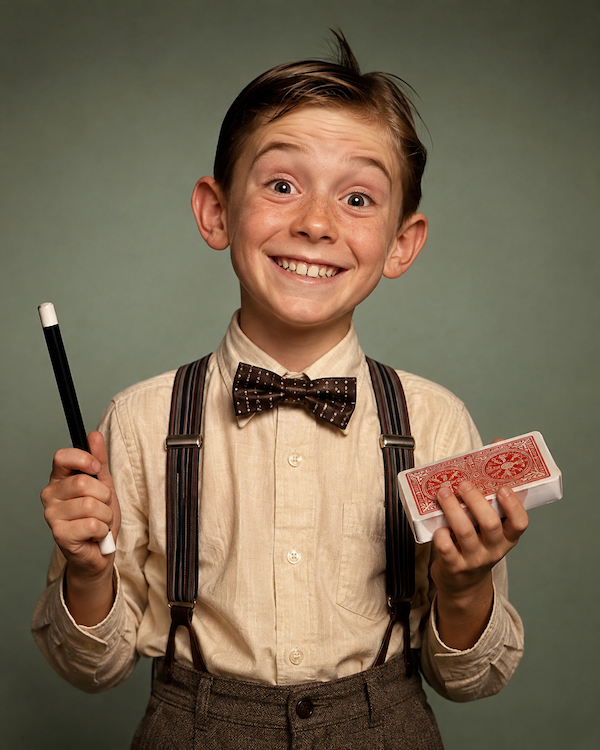
That’s the first problem, it sounds juvenile.
Secondly, “Do you want to see a magic trick?” immediately sets the performer/audience dynamic in place. And that's not what people want to feel like when they're spending time with someone. "Oh, I'm the audience and he's going to entertain me." That's uncomfortable and not fun.
And asking permission creates a third problem: it frames what you’re about to do as a potential imposition. Something you need their consent for before you burden them with it.
The key to making the Turn is not to ask for permission to perform.
Think of the difference between these:
"May I show you the photos from my vacation?" vs. "Oh man, you have to see these photos from my vacation."
"Can I recite a joke to you?" vs. "I heard this great joke. This door-to-door salesman…"
"Would you like to hear about an interesting article I read?" vs. "You've gotta hear about this thing I just read!"
The first options subtly suggest you might be imposing on them, so you better get the “ok” first before going on with it.
The second options frames the content as a gift of enthusiasm rather than a request for their time. "I have something interesting/crazy/fascinating/hilarious to share with you. And I have the confidence in it just to go ahead with it."
What do you think is going to capture people more? The one where they have to say, "Yes, you may entertain me." Or the one where they think, "Oh, what's this exciting thing all about?"
These are “Excitement Turns” and they’re what I use most often (if I’m not using “Can I get your help with something?” Or some other form of a “Help Turn.”)
You want what you say to set the stage for how they should feel about what’s to come. You’re excited, so they should be excited. You’re not asking permission to show them a trick. You’re sharing something cool.
“Oh, I almost forgot—I’ve been dying to show someone this.”
“Hang on, you’re actually the perfect person for something I’ve been wanting to try.”
“What you said just reminded me of something wild. You’ve got to check this out.”
“Oh man, I got something in the mail yesterday that you’re going to love.”
“I learned something crazy the other day. You’ve got to see this.”
“You know, you have such a unique energy, and it’s got me thinking. There’s this thing I discovered recently, and I’m wondering if it would work on you.”
“So, I found this thing the other day, and I genuinely don’t know what to make of it.”
“You just reminded me of something I think you’d get a kick out of.”
Of course, I’m keeping these examples as generic as possible. With an actual trick in mind, you’d usually make the wording more specific to the effect.
The idea behind Excitement Turns is to transition into the performance by expressing excitement about what you have to show them, the person you’re with, or both.
If you’re performing from a magician-centric perspective, this can feel difficult because it seems like you’re just cheerleading yourself.
But from an audience-centric standpoint, an Excitement Turn is the most natural thing in the world. “I’m excited about this.” “I’m can’t wait to get your perspective on this.” That’s exactly how you talk in real life when you have something incredible to share.
The Turns discussed above are general approaches. But there are more specific, narrowly defined Turns as well.
Tomorrow I’ll share my favorite of these—an approach that gets people wishing you would perform before you ever offer to.