This is a variation on Larry Becker's Sneak Thief routine which I was introduced to via Andy Nyman's Magician's Graphology effect.
I'm going to dance around some of the details of the method, but that's because I don't see this site as a place for beginners to learn methods. I'm writing for magicians with a pretty healthy understanding of magic techniques and what I write below will either be clear to you, or it will set you off in the right direction to track down further work on it.
The Sneak Thief effect is this: You hand out four business cards (in this handling) and ask four people to draw something on a card while your back is turned. The cards are mixed up face-down. You take them back and turn them over one-by-one and you're able to identify who drew each picture. With the last picture (since it's obvious who drew it) you instead reproduce that picture without ever having looked at it (apparently).
The peek in Sneak Thief is one of my favorites. It's bold but you'll never get caught doing it.
However, I've found there to be a fairly significant issue with the Sneak Thief routine. While you won't get caught during the moment you peek the final drawing, there is nothing to add to the spectator's conviction that you didn't just peek the drawing at some other point while you were handling the cards. Magicians and mentalists get caught up in the success of the peek. "They didn't call me out on looking at the drawing when I was doing it right in front of them!" But just because people don't catch you doing the peek in the moment, that doesn't mean they don't assume that's how you did it.
Peruggia is the Sneak Thief routine perfected for close-up. The conviction level that you never saw the final drawing at any point is incredibly high because that drawing never leaves the spectator's hands.
Here's the method. You hand out four business cards that are marked in some way, nail-nicks, pencil-dots, whatever. You just need to know whose is whose when they're returned to you.
You turn away or leave the room and ask everyone to draw a simple picture on the back of their cards. You then ask one person to gather up all the pictures and mix them drawing side down so no one knows which is which.
You turn around or return to the table and tell the spectator to give the cards one last mix and deal three of them into your palm up right hand (or whatever your dominant hand is). Ask them to place the last card on their right hand (you demonstrate with your cards that they should place it the long way, along the palm). You want to be opposite of the person who ends up holding onto the last card.
You now turn over the top card of your stack and you display the drawing to everyone to look at. During this time you will get your peek of the bottom drawing, as per the original Sneak Thief routine. Because of the markings you will know who this first drawing belongs to. Do your psychic reading of the person who drew it, or get your psychological impression or whatever the case may be. Then finish by identifying the person who drew it.
At some point during this process you need to move the bottom card to the center of the pack. This is not a secret sleight, just something that happens as you're holding the cards. Don't even look or pay attention to it. If someone notices it, you're just absent-mindedly mixing the cards.
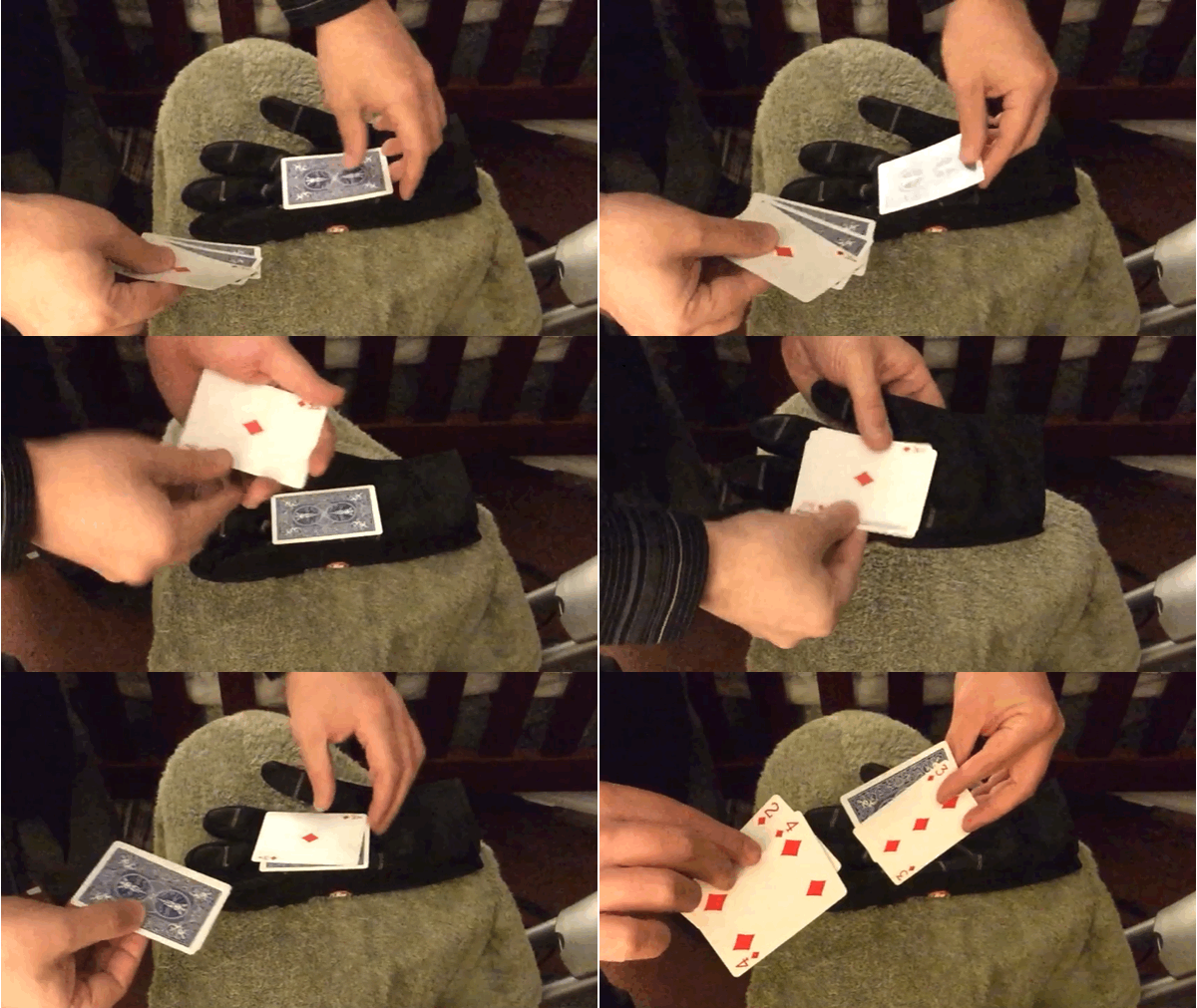
You now hold the stack of drawings at your right fingertips. The first drawing you looked at is facing up, the other two are face down beneath it. You are now going to do a variation on John Bannon's Assisted Switch with the card the spectator still holds. This is a more advanced version, but you're free to do it as Bannon describes it in Smoke and Mirrors if you're more comfortable that way. (You just have to justify how they hold the cards in that one.)
Essentially what you're going to do is the second step of an Elmsley count, but into their hand.
Here it is broken down step by step.
1. You bring both your hands towards the spectator.
2. You say, "I'm going to have you take this card too."
3. Your left hand takes her right hand and pulls it gently and slightly towards you. Your fingers are below her hand and your thumb is on top, pressing down on the left side of the face-down business card and raising the right side a little bit.
4. You apparently thumb off the picture you just looked at into her hand, but actually you execute the Assisted Switch. Your left thumb levers up the right side of the card which will give you the maneuverability you need.
Here's what that all looks like. (I'm demonstrating with playing cards for clarity, but it's actually easier with business cards, as long as your business cards will slide against each other.)