MFYL Preview

In November of last year I sent an email to 56 of my friends.

In it, I said there was a magic site I read regularly that was holding a contest looking for stories that recounted memorable magic performances. Ideally emotionally resonant ones. And I asked if they got the chance if they could let me know what trick I showed them that was the most memorable.

It was a bit of an odd email because I was pretending like I read some dumb magic site, when really I write some dumb magic site.

The purpose of the email was designed to elicit information for the forthcoming book.

50 of my friends responded and the list of effects that left the longest lasting impressions on them were pretty varied. Some of the effects weren't ones I created. And some have already been described in my first book or in The JAMM. But there were a number of routines that I haven't published anywhere yet and those routines will appear in Magic For Young Lovers, with excerpts from my friends' responses intro'ing the effect. MFYL is in the early stages, but I'm happy with how it's coming together.

One of the responses to my email request started:

"I don't know if it was 'emotionally' resonant but the one I'll never forget is the one where you sent me the licorice and picture of your dick in the mail."

To be clear, it was an artistic rendering of my dick. 

And yes, that trick, Dickorice, will be in MFYL.

Dear Jerxy: Propless Mentalism

DearJerxy.jpg

Dear Jerxy: I was wondering if you had come around at all on propless mentalism. I know in the past you've said you didn't like it, but it's a passion of mine and it has evolved a lot in recent years. Are there any propless routines you've used and liked? And do you have any thoughts on presenting propless routines? As much as I like them they don't always get the reaction I would expect.

Signed,
Need One Propless Recommendations Or Performance Suggestion

Dear NO PROPS: First, thanks for putting effort into the name initialism! That made me happy.

Second, I don't think it's true to say that I don't like propless mentalism. It's just that "propless" isn't a consideration for me (much in the way that "sleight-free" isn't something I care about with card magic). It doesn't matter to me because I don't think laypeople think in terms of "props" when it comes to mentalism. I think they think in terms of process.

In other branches of magic, I have no issue with process. I think it can be fine, I think it can even enhance the experience sometimes. I have an entire performance style called The Engagement Ceremony which is designed for the performance of process-heavy tricks. But that style is predicated on shifting the power of the effect off yourself. We would expect an "old Afghani synchronicity ceremony" to have a process to it. But if you're presenting this as "I'm going to read your mind," then you own whatever process comes after. 

So, on the occasions I do perform mentalism, I look for process-less mentalism, not prop-less mentalism. That's not to say the act of mind-reading can't involve a process, but if it does, I want it to be a process I've created for theatrical purposes, not a process dictated by the method itself. 

In general, I agree, the fewer props the better, but not to the point where it creates a significantly greater process. Using a pad of paper and a pencil (and a nail-writer) to guess a number someone is thinking of is more natural and "invisible" to the spectator than making them go through a mathematical process without the pad and pencil. 

To be fair, I also think propless mentalism is evolving and while I don't follow that branch of the art too closely, I have some friends who do and it's clear that the people creating the material are producing stronger effects now than were available in the past.

If you're a propless fanatic keep me updated on anything I really need to check out in this arena. 

Ultimately, I think the best course of action is to obtain a well-rounded knowledge of the best of everything (for the sake of your audience). Not simply avoiding or embracing anything propless. But instead knowing the best propless stuff, and having that in your arsenal with your marked ESP cards, invisible deck, and nail-writer. Only the weird dogmatic nonsense either way is going to hold people back.

NO PROPS also wrote:

"And do you have any thoughts on presenting propless routines? As much as I like them they don't always get the reaction I would expect."

I don't have any general presentation thoughts in regards to propless mentalism, but I think I do know why it often gets a reaction that seems muted compared to the purported effect.  (And this can be seen even in the videos made by the pioneers in propless mentalism.)

I will tell you a story, and this is something I hinted at years ago in another post, but I didn't go into details because I was worried the person I was writing about would find this site somehow. I'm less worried about that now, but I'm still going to tip-toe around some of the details.

About five years ago I met a fellow magician, I'll call him Oscar, and we had very different taste in tricks. He was very much into propless mentalism and assured me he had "never been busted." And he made a convincing argument to me about what is more impressive: some sleight of hand trick with cards or coins OR telling someone a PIN number or a word they were just thinking of. Obviously it seems the latter would be the way to go.

And yet one time I met his sister and her fiancé while we were waiting for him to show up for dinner and I performed an early version of "A Firm Background in Remembering" from The JAMM #2. This is a simple coin trick but they both had strong audible reactions to it. And I said something like, "Oh, I'm glad you liked that. Sometimes people get burnt out on seeing magic when they have a family member who performs."

And Oscar's sister said, "Oh... his tricks are... different." She went on for a bit but the part I remember is her describing the tricks as involving a lot of "asking questions and looking for clues." And she was kind of being dismissive of his tricks in a way.

Later I would see him perform for the two of them and their response was positive but kind of subdued. Like a disinterested uncle reacting to his nephew demonstrating a shitty somersault. "Oh, that's great." I could see why Oscar felt his tricks were working, because they weren't blatantly calling him out. But at the same time, if they really felt that, for instance, he had just told them a pin code that only existed in their mind, shouldn't their reactions have been significantly stronger? 

It's not that they were humoring him with their reactions, they were being nice to him because they cared about the guy and didn't want to make him feel bad.

In most circumstances in life, that would be a good thing. But if you're trying to hone your material, and you're a social magician who performs for family and friends, and they don't want to be "mean" to you... well, then it can be somewhat detrimental because honest feedback is required to create really strong material. 

When people get into magic, often their big fear is that they're going to get busted. But honestly you should want the kind of dynamic with your audience where they're not afraid to point out a discrepancy or catch you on something shady you're doing. The much more insidious problem is when people don't bother telling you what's working or not working. They just kind of baby you along. 

This may sound like a small issue, but I don't think it is. I think it's pervasive. I think the majority of people you perform for are nice and won't give you a critical response, especially if they feel your ego is tied up in the performance.

And I think this is significantly more true for propless mentalism because it demands such an earnestness in presentation (most often). Your presentation is generally tied so closely to the process and it only works if you're sincere and they're honest with their responses and they play along. And that's why when you watch some of these videos of propless performances they can seem serious, almost to the point of being somber in some weird way. And when you're taking it so seriously it can make it hard to get an honest reaction from people, because only a jerk will take a shit on something you seem so invested in. And that's why you end up with these odd reactions sometimes where they give a positive, but underwhelming response. I'm not saying they're not fooled. I just don't think they're fooled as intensely as you'd like them to be.

I think I have a way around this issue though. And on Wednesday we'll talk about developing a resource to help you identify and/or create much stronger material in the area of propless mentalism or any other branch of the art. 

Gardyloo #54

Here's something called Ghost System by Lloyd Barnes and Ellusionist.

I like the visual element of the trick. It's a clever idea. But the trick definitely has an issue and it's a pretty glaring one. 

How about if we take a look the FAQ in the email announcing this trick.

FAQ's
Q. Is there a slit in the box?
A: Absolutely not.

Okay.

And now let's take a look at the top comment Ellusionist has made on that youtube video. 

Screen Shot 2018-04-19 at 1.38.48 AM.png

What they're saying is, "We know it kind of looks like there's a slit in the box. There's not."

Ok, but surely we can follow the logic of this one step further, yes? What happens when you show this trick to someone and they say, "Did it go in a slit in the box?" Because, here's the thing, "slit in the box" is not some obscure concept Stewart James came up with. A layperson is completely aware of the concept of "slits." Therefore, the disavowal of a slit isn't something that needs to be in the advertising, it needs to somehow be in the trick itself. Laypeople don't care if they have the right explanation. They're satisfied just to have an explanation that could be right.

So now we go back to the spectator who says, "Is there a slit in the box?" What's the game plan?They can't examine the case. Maybe you say, "Actually, let me direct you to this FAQ from Ellusionist and you'll see there is not, in fact, a slit in the box." What are the other options?

Someone on the Cafe said, "You can't hand the case out. [But] there is no need if you structure your routine." I have to be honest, I never understand what the fuck magicians are talking about when they say stuff like this. "Structure your routine"? How does this work? It sounds like voodoo. Like there's some special "structure" you can use to make people forget the box is suspect.

From what I can tell, most magician's definition of "structure," "routining," and "audience management," is: "If you're worried they're going to bust you on the method of your trick, do another trick right after to stop them from talking." This comes from the same school of thought as, "Turn up the radio and you won't hear the rickety noise your car engine is making." 

If there's some way to present this effect without people jumping to the conclusion of "there's a slit in that box," then Ellusionist should have filmed that for a demo. Then they wouldn't have to fall all over themselves to remind us it's not just a slit.

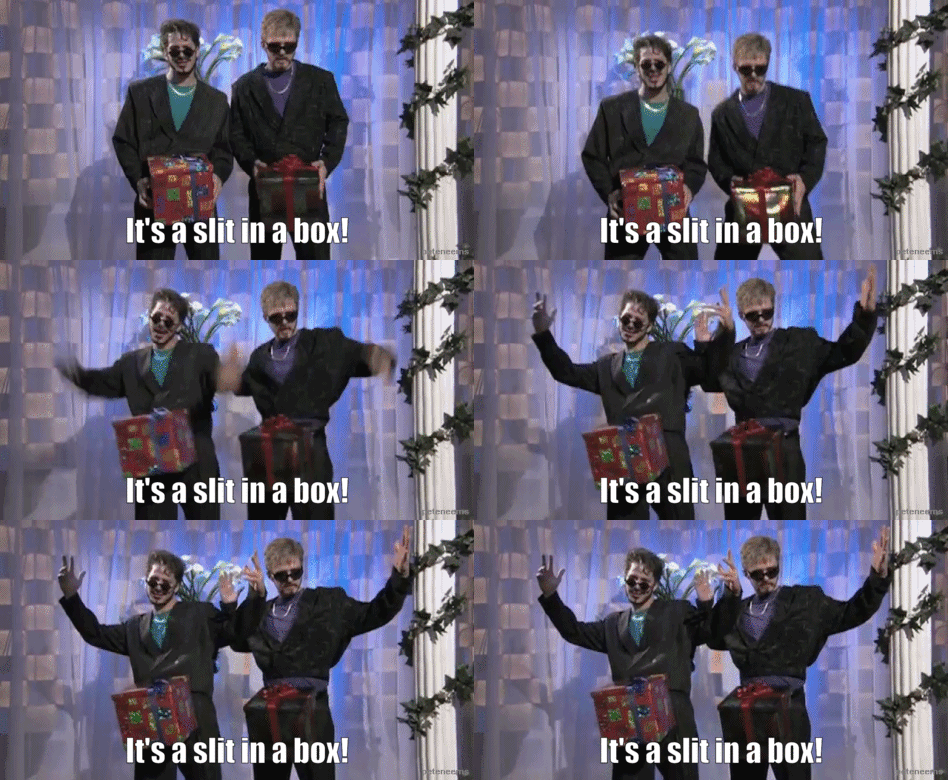
ezgif.com-add-text.gif

From the Spring edition of X-Communication:

Help an old magic blogger out. A couple months ago I witnessed one of my favorite moments in entertainment history. It was an episode of the Andy Griffith show and Andy had just been sprayed with perfume by Ellie May. He returns to the jail and Barney starts sniffing around a cooing over this new scent, Midnight Madness.

At one point he says, “Midnight Madness, Zazoo Zaz!” . 

I love this. Please start saying it. I have no idea where it comes from, and googling it has been no help. Barney uses it to mean, like, “Ooh-la-la.” But I think it makes a good all-purpose positive exclamation. “Our team won! Zazoo Zaz!” “Zazoo Zaz, this car is fast!” “Ooh, ooh… I’m coming… Zazoo Zaz!”

A few of you have informed me that it's probably a reference to the song Zaz Zuh Zaz by Cab Calloway and I was just mislead by the closed captions. That's probably the case. Although I prefer Zazoo Zaz! 

The next step is for you to start incorporating it into your everyday vernacular and online posts.  It's a natural phrase to throw around at magic conventions and on magic message boards. "Zazoo Zaz! It really looked like that coin penetrated that box. And you say there's no slit?"


"Quick! Snap a picture of me in idea-cooking mode."

Screen Shot 2018-04-18 at 5.46.04 PM.png

Yigal is notoriously litigious, or, at the very least, he's known to protect his intellectual property rigorously. I have no problem with that. I think it's a good thing (except when I don't). 

But that fact has given me a wonderfully diabolical plan. I could use some help. I need to find out what he's reading here. Then find out what page he's on. Then see if I can intuit what type of idea he was cooking. Then I go and trademark or patent or copyright the idea myself. Then, later, when he tries to come out with... I don't know... an invisible thread reel built into a belt buckle or something... guess who beat him to the punch? Your boy, Andy. And then I'll be rich with that magic money like:

giphy (1).gif

Goddammit, someone find out what he's reading in that photo! Zoom in. Enhance. Enhance!

[Dear Yigal, please don't sue me for using your facebook photo. I am but a poor magic blogger, tending my posts. It's all in good fun. I actually think it's a very nice photo. You look good enough to take to the picture show. (zazoo zaz)]


I got another one of these offers. You have no clue how tempted I am to see what they would come up with for this site.

Screen Shot 2018-04-20 at 12.29.19 AM.png

In fact, I look forward to the day when this entire site is populated by "well-written pieces of content" written by others that I was paid to post.


I have a new favorite magician.


This isn't magic, but it's one of my favorite things I've stumbled across on youtube in a long time. It's from Candid Camera in 1965. It's nothing complicated. All they did was introduce some students to a new hot teacher and then record their reactions. The girls at the beginning are adorable, but it really picks up when we see the boys' reactions to "Miss Darling." It's so great. They totally flip out. I guess this is what it was like before the internet, when any random hot lady would just send you out of your mind because it might be 8 more months before you saw another one (undoubtedly when you were peeking through a hole in a picket fence or some other 1960s shit). And to be fair, the teacher is a genuine smoke-show. If anyone can track this woman down for me, please do so. Seriously, Miss Darling, I don't say these words often, but, Zazoo Zaz!

Presenting Coincidences

I really love this one. This is a model for a lot of what I believe—and what I espouse—in regards to how magic should be incorporated into the day-to-day existence of a social magician. It is an amalgamation of a lot of the concepts I've talked about here: imps, hooks, smear technique, shifting the power away from yourself, etc. And it's a way to extend a trick so the magic is not just one instant, but instead a thread that is woven through your interactions with someone over time. 

There are a number of tricks in the literature that are presented as an example of an incredible coincidence. And there are hundreds more than that when you realize that most any prediction effect can be rejiggered to come off as a coincidence. I love the concept of coincidence as a theme, but the truth is that none of these effects really come off as a coincidence. How could they when we're sitting here and counting and dealing cards on a close-up mat and so on. Oh, sure, these cards matched those other cards over there, but that doesn't feel like a coincidence. Not when you were telling me how to count and cut the cards, that just feels like a trick. We wouldn't have even started this process if you didn't know where it was going—and if you know where it's going... then it ain't a coincidence.

So how do you present coincidence effects in a way that the coincidence aspect doesn't just feel like a cheap pretense for a trick? I've thought about this a lot and have come up with a number of ideas I really like, but this is one of my favorites.

The best way to present a coincidence effect is to wait for a coincidence to occur.

I'll explain.

I've moved around quite a bit for the past few years. And anytime I know I'll be staying somewhere more than a few months, I install a plank shelf by ILOVEHANDLES near the front door. It's a small "floating" shelf with a magnet inset in the bottom so you can just touch your keychain to it and your keys will stick underneath. On top of mine I keep a deck of cards.

IMG_4673.jpg

So let's imagine you come visit me. You walk in the front door and I say, "Can you do me a favor? Mix up that deck of cards." You do. "Now name any card," I say. You say the two of diamonds. "Now turn over the top card," I say. You do... and it's the nine of spades.

"Ah...," I say. "So do you want to order food now or do you want to wait until the game starts?"

If you're like most people you will say, "Was that supposed to be a trick or...what was that?"

"Oh, no. It's nothing. I used to have this science teacher in high school and every day he'd walk in the classroom and throw a piece of chalk against the chalkboard. And he said the reason he did it is because all physical objects are made of atoms and atoms are mostly empty space or whatever. So, his theory was that one day, all that empty space in the chalk and the chalkboard would line up perfectly and then the chalk would just GLORP! right into the chalkboard."

"I don't know if that's really possible or not. I think probably not. It was probably just his way of waking us up at the start of class. But I've been doing a similar thing for a while now. I'm kind of fascinated by coincidences. And there's a theory that suggests that coincidences aren't just these random occurrences, but they're the result of an alignment of energy. The energy between people and the room they're in and the objects in the room. That sort of thing. So the thing with the cards is sort of my version of throwing chalk against the chalkboard. Just trying to see if things are potentially lined up in perfectly. And if that ever does happen, then I'll know the situation is right to try and induce even bigger coincidences."

And that's it. That's the set up. (And, of course, it's not quite a monologue in real life.)

Now every time you come over I ask you to shuffle the deck, name a card, and turn over the top card.

After a few times, it's just something you do without prompting. You come in. Take off your shoes. Grab the deck. Name a card. Shuffle, cut, turn-over a card. 

And then, months down the road, you come in, name the 7 of spades, shuffle the deck, cut, and turn over... the 7 of spades! I stumble over the coffee table, to check and see if you really named it correctly. You did! We celebrate like something actually exciting has happened. 

I'm looking around. We need to try something else. "How much change do you have in your pocket?" You have 12 cents. So do I!

"Wait. Hold on. Let's try something really impossible." And now we grab the cards and we're shuffling and dealing and things are matching or whatever. But now it doesn't feel like "coincidence" was just a tacked on pretense to a magic trick. Now it feels like we're in some sort of weird state—a coincidence-saturated environment—and it's crazy how things are falling into place.

And when it's over your mind is kind of racing trying to process it all. Did that really happen? It happened, yes, but did it really happen? It had to be some kind of trick. Maybe you're a little spacey and you truly believe you just experienced something crazy. Or maybe you're hyper-rational, so you know it was a trick. But it doesn't matter because someone planting a seed and then waiting 8 months for it to sprout in order to give you this fun, fascinating encounter, unlike anything you've ever experienced, that's really great too. It's something you'll never forget. 

I've been doing this for years, and I do it to everyone. So multiple times a year—and there's no way to know when it will happen—I get to enjoy this crazy experience of coincidence with someone.

Here are 5 non-obvious benefits to this:

1. No one ever seems to forget the story—and it's a true story—of my teacher throwing the chalk at the chalkboard. So that concept of testing something that's unlikely to happen on the off chance it does (and then taking that and running with it) stays with them. And I don't have to justify why they're doing it again each time.

2. As a performer/social magician, this keeps you very engaged. It's fun to not know when you'll get the chance to perform this in full. (You have to always have a couple follow-up effects chambered for when this hits.) And it's genuinely exciting when it does happen. I think the participants pick up on that excitement. 

3. It's true that 51 out of 52 times you won't be able to perform this. But the fact that they're coming in your place and immediately grabbing a deck of cards is going to present you with many unobtrusive ways to transition into some other trick if you want to.

4. This presentation creates a sense of continuity over a very long period of time that you can only get in non-professional performing situations. Last month this finally "hit" on a friend of mine who had been visiting me for years, all over the northeast. And later in the evening she was reminiscing about all the different places where she'd come to see me and gone through the process of naming and turning over a card. It was a real travelogue of apartments and hotel rooms and rented cabins and this trick/presentation kind of tied all of that together in a very cool way.

5. It happens... and it seems to happen more often than you'd imagine... that I meet someone new, or they're visiting me for the first time. They come to my place, I ask them to name a card, shuffle the deck and turn one over... and they nail it the very first time. I do not do anything more when this happens. I don't play it off as a coincidence. No. When this happens I fully accept the role of the world's greatest (and cockiest) magician. This is the rare occasion where I do take complete ownership of the miracle. They stand there with their mouth agape and I just kind of sniff and smirk a little, run my fingers through my hair then polish my nails with my shirt. "You like that? Just a little something I'm working on. If you're good maybe I'll show you another trick sometime."

There you go. I hope some of you will find value in this. I would resist the urge to do something to the deck (put in duplicates or add a breather crimp to commonly named cards) let the universe dictate when you perform this. 

If you want to know my favorite coincidence effects, I think I'll write an article on that for the Summer X-Communication. And if you want to know my other favorite way of presenting coincidences, it's going to be in Magic For Young Lovers. It requires a little prop that will be included with the book. It's got a similar feel to this, but it's the version I use when I know I want to do a coincidence type routine on a specific time/day.

X-Communication Spring Issue

Will be in Season 3 supporter's email boxes this evening. You'll get it after I do my taxes, assuming I don't throw myself out the window in the process. (If your copy doesn't show up by midnight (my time-NY), get in touch. There is undoubtedly someone whose email I got wrong, or wasn't added to the correct subscriber list or something, so this mailing will flush that out.)

This issue includes a trick called "There In Spirit," which I performed most recently this weekend. 

Many magicians want gasps, some prefer applause or stunned silence. The response I got from the woman I performed this effect for on Saturday was, "That literally made me pee a little in my pants."

The Fail-Safe

This is an idea I came up with for a friend of mine for a very particular situation. He was performing a trick with mis-pipped cards. We'll say it was Michael Skinner's 3 Card Monte. It wasn't, but we'll say it was so you can follow along. (The actual trick isn't one you know because it's his own effect.) His concern was this, he had found that in workshopping this trick that if he was to put the cards away right after the effect, people would become suspicious about the cards. On the other hand, if he just tossed the cards on the table at the end, people almost never reached for them. But... on the third hand, on the rare occasion someone does go for the cards, there's really no way of talking yourself out of that situation. You're completely busted.

So what do you do? Typically, the course of action magicians seem to take is that you should put the gimmicked items away and then move onto another trick. They've convinced themselves that this is going to fool people. It doesn't. People know what's up. Outside of a formal show there's no real reason to rush along to another effect and hide everything you just used other than that they're suspect. I think it's a bit of a puss move. I'm not sure it's worth salvaging one performance in 20 if the other 19 are diminished in some way (which I believe they are when you squirrel away the props right after an effect).

No one likes getting busted on a trick, I get that. Even if you don't have your ego wrapped up too much in the performance, it's still a waste of an effect and of people's time. 

So my friend had a performance for an important individual for whom he wanted to make a strong impression. He had this trick he wanted to perform and he didn't want to come off as the scared magician, immediately putting the deck away after a trick. But he knew if he set it down confidently there was maybe a 5-10% chance the other person would pick it up and bust him on it. You could say, just don't do that trick. But he really wanted to do that trick.

Here was my idea...

Imagine this from the spectator's perspective. You have this person over your house who you know performs magic. At some point you ask to see a trick. He shows you this really mind-blowing card trick where cards are transforming and transporting all over the place. When he's done he just sets the deck on the table and goes back into conversation. Your curiosity gets the best of you and you pick up the deck and start looking at it. "Hey," you say, "all these cards have two different values on each card." And this great trick you saw just crumbles.

At this point, the magician just sits there, stone-faced and says in a cartoonishly sad, monotone voice. "Oh... gee. I'm so embarrassed. You busted me. Who could have guessed you would figure out my trick at," he looks at the clock, "7:19 pm." Silently, he reaches into his wallet and pulls out a business card and slides it to you on the table. He indicates you should turn it over. You do, and on the back it says, "Oh... gee. I'm so embarrassed. You busted me. Who could have guessed you would figure out my trick at 7:19 pm."

Now the whole scenario shifts. You were set up! But how could he know when you'd ask to see a trick. How could he know you'd reach for the deck of cards? How could he have seen how everything would play out? 

Well, he didn't. He just owns a nail-writer and a wallet that allows for nail-writing. But you don't know that. You're an entertainment lawyer, for chrissake. 

So that's the idea behind The Fail-Safe: Having a way to predict the exact time you got busted on a trick. 

It's not something you'll need every time you perform, but it may be something you can use for confidence and peace of mind during an important performance opportunity. As it turned out, my friend didn't need to employ the fail-safe. But I've used it a couple times and it's really very strong. I don't think it feels like you "salvaged" a trick that was busted. I think it feels like you anticipated how everything would play out and the first part was just an entertaining "sucker" effect, in some way. 

I'm not suggesting you use this in situations where you know the person is going to get handsy and grab something they're not supposed to. This is more for those times when you think there's a small chance someone might take a look at something that blows the trick, and you just want to have an insurance policy in place. 

You can use any secret writing technique you want. I use the set-up from the trick Millinta in the JAMM #10. This allows me to nail-write on the inside of a folded piece of card in an apparently sealed envelope. I have one in an end-table near my couch and another in my messenger bag. 

The funny thing is, because I've been wanting to test this out, I've been very cavalier about just tossing gimmicked items onto the table when I'm done. Most of the time, that seems to be all it takes to make people assume there's nothing to be found. What's even been more enjoyable to me is watching people pick up gimmicked items, examine them and then replace them having found nothing. I've had people pick up gimmicked coins and gaffed notebooks and not find anything. I had someone pick up and spread through an invisible deck and not realize it.

And for the people who ended up looking at the items or even just feeling like they could, I would assume the trick had a greater level of impossibility than if I had just turned and put the items in a drawer somewhere. In that way, the Fail-Safe may not only be a useful ploy for salvaging a trick that gets busted, but just having it in your back pocket may affect the openness with which you perform in a way that makes your tricks stronger across the board.

Gardyloo #53

A few months ago I mentioned a round of focus group testing that was going to look at discrepancies in card tricks to see how frequently they were noted by an engaged, critical audience. We conducted that research about a month ago in NYC. The reason I haven't written up any of the results on this site is because the testing didn't really bear fruit in the way that I had hoped it would. 

This is mainly my fault because it wasn't a very well designed test. There were too many different variables we were hoping to look at. And because we're limited by the number of subjects we can work with (limited by time and money) we just need to stick with simpler questions in the future, because all the variables got in the way. 

I originally was inspired to test discrepancies because I had found a trick that I thought was really beautifully constructed, but it had a big discrepancy (in the trick you show the four queens singly, but really you showed the same two queens twice). And I was wondering how often that would be noticed. There are a lot of card tricks that contain a big discrepancy. And maybe someone only mentions that discrepancy once every 25 times you perform. But that doesn't mean that someone doesn't actually notice it much more often.

So I wanted to test that, but got carried away with variations. How often do people notice the duplicate card in an Elmsley Count? Does it make a difference if the EC is done with aces, face cards, or spot cards? What if you use a change in tempo or position of the card to block them from getting a clear view of the card the first time around—does that help hide the discrepancy or does it just create more suspicion? These sorts of things. 

But ultimately the data was too diluted to come up with any meaningful results. Which may seem like a waste of $2500. Which is what a couple days of testing costs (and that's with the people who are helping conduct the testing volunteering their time). But I feel like we learned a lot from this experience in regards to how to construct future tests to make sure our result definitely have some value. And I also feel like the people who contribute to this site would rather me be putting the money into something that may potentially provide value/content for the site rather than just spending it on high-price prostitutes. (Not that I don't spend it on high-priced prostitutes. I just mean that's not all I spend it on. I try to split it up in a "one for you...one for me," type of way.)

And all was not lost because during this round of testing we came up with something to study the next time around that I think is going to be very interesting. You should hear about that in a month or so.


I've said in the past that lapping a coin while sliding it off the table is my favorite coin vanish, and given the reasons for that here.

I also think it's probably the best way to switch a coin as well.

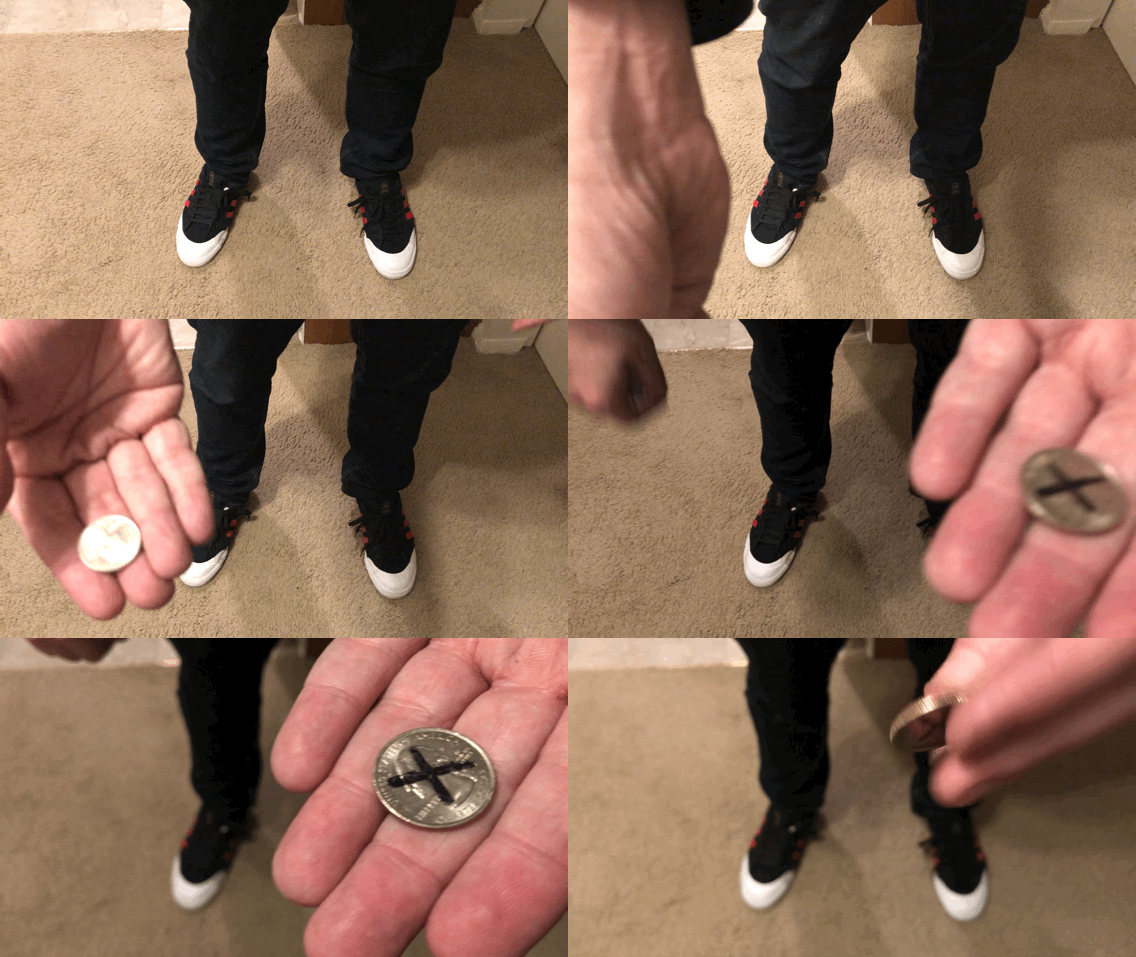
But when I'm not sitting, the coin change I use is the Capricorn Change by Jay Sankey from his Revolutionary Coin Magic DVDs. If you don't know that move, I think it's worth tracking down and working on. It's a good fundamental move to have in your arsenal. It's not a visual change, although I guess it can be. I use it more when I want to switch in a particular coin at the start of a trick. The spectator places their coin in your empty right hand, you place it in your genuinely empty left hand (it's not a shuttle pass) to set it aside or give it to someone on your left, and in that process it's switched. It looks pretty innocent (in the gif below it's isolated and being transferred for no reason, so it looks less innocent, but in real life, before a trick has even really started, it's fairly invisible).

IMG_4616.GIF

"Surprise can be an agent of social change." So says a new research paper out of the University of Illinois. (Thanks to reader, G.G., for sending me the link.)

Consider the professional comedian or magician and - presto! - you have someone who is a "professional surprise engineer," Loewenstein said.

"A magician is setting up a situation where you think you're seeing most of or all of what's happening, but in fact you're not really seeing the critical bits," he said. "What's amazing is that you know when you go to see a magician perform that you're going to see something that you didn't expect - and they do it anyway.

"Crafting surprises is something everyone can learn to do, and they will be more influential if they do."

Is this true? Maybe. I haven't read the actual paper the article references. Although it is hard to imagine a group less influential than magicians. Oh sure, once a century a magician demonstrates some actual influence on culture. But that doesn't strike me as such a great batting average. 


The way magicians imagine magic can be used to attract women...

How it actually comes off when people use magic expressly to try and attract women.

da5cfe.gif

I'm off next week. Posting resumes on the 16th. Also, subscribers to the site will be receiving the first issue of the new quarterly review magazine around that time as well.

In that issue I spend a few pages describing a routine I've been using in conjunction with a new magic app. The routine is a combination of an old premise with this new app and some handling that I believe is new (although it's not particularly revolutionary). The combination of these elements has created one of the strongest tricks you will ever perform. I'm not kidding and I'm not hyping it. When it comes to strength of effect and practicality I would put it in the top .1% of effects in magic history. You can learn it in 5 minutes. It's dead easy. It takes 5 seconds of prep time. You can carry it with you all day and it takes up essentially no more space than what you already carry with you. You can go into the effect instantly at any moment. It feels completely impromptu. There are numerous presentational angles to get into the trick. It would work great in a show, it's even better in a social magic setting. And the effect is fucking devastating

Those of you who have paid the $260 in support of this site are getting a full year's worth of posts, a limited edition hardcover book, a limited edition deck of cards, and another 100 pages of content in the quarterly magazine. I suspect if you perform this trick you will feel you already got your money's worth. 

Again, not kidding, no hype.

Later.