
He Shoots, He Scores
/Here’s a trick you can do with the NBA and college basketball seasons starting up.
Imagine
“Can I get your help with something?”
I hand my friend Nate a blank deck of cards and ask him to deal through it. He starts.
“Okay, slower,” I say.
After a few cards, I ask him to go slower, and then even slower, to the point where he’s dealing just one card every seven or eight seconds.
“Okay, cool. Thanks,” I say.
I have him look through the deck to see that it’s blank on both sides, then I take it from him.
I remove four cards from my pocket. Two say SCORE on them, and two have basketballs on both sides.
“So there’s this underground gambling club I go to a couple times a month downtown. It’s not a casino, because it’s not really legal. But it’s more organized than just, like, a home game or something. There are a bunch of different tables and games going on.
“There’s poker and other typical games, but then you have all sorts of atypical things. People betting on odd versions of tic-tac-toe and Candyland and made-up games.
“Weirdly, the one thing they don’t have is sports betting. Apparently, that’s the one thing that would definitely get them shut down. You can get away with a little underground gambling, but once you start cutting into the sports-betting industry’s money, you’ve got some very powerful people who suddenly give a shit about what you’re doing.
“But it’s a bunch of guys who like to watch sports, so they came up with this sort of workaround. It’s a betting game that you play while you’re watching the game.
“The bettor places the two SCORE cards anywhere he wants in the deck. Then the dealer deals through the deck at whatever speed he wants as the game goes on. Whenever the first basket is scored, the first basketball card is dropped in. The deck is reassembled, and they do it again for the second basket of the game.
“You get paid depending on how close the basketball cards are to the SCORE cards you placed in the deck. The odds of both basketball cards landing right next to the SCORE cards are over 1,300 to one. So the payout can be pretty substantial.
“If you put down $100 and hit both, you walk out with $100,000.
“Obviously, it’s completely random. You don’t know when the teams are going to score, and you don’t know how the dealer is going to deal.
“But… what if you had someone on the inside? Someone who could make sure the teams scored at a particular time? Now you’ve eliminated one of the random elements. And what if you could learn to anticipate the dealer’s rhythm, because people tend to fall into patterns even when they’re trying not to?
“That’s what I want to test out tonight. I know when these guys are going to score, so that’s one variable down. The hard part will be trying to anticipate how you’re going to deal.”
I take the blank deck and the SCORE cards and put them somewhere in the deck without Nate seeing.
When the game starts, I have him deal through the deck.
“You don’t have to deal evenly. You can mix up the pace. But give it a couple seconds at least between cards.”
Nate begins casually dealing through the deck.
Sixteen seconds into the game, Tyrese Maxey hits a 3-pointer for Philadelphia.
“Okay, good, good,” I say.
I have Nate place the first basketball card in the deck, reassemble it, and start dealing again.
After a missed 3, a block, and two steals, Maxey hits another 3-pointer.
I grimace a little.
“Okay, they did their part. I’m not sure about your dealing, though. I wasn’t paying close enough attention.”
I have him place the other basketball card where he stopped and reassemble the deck.
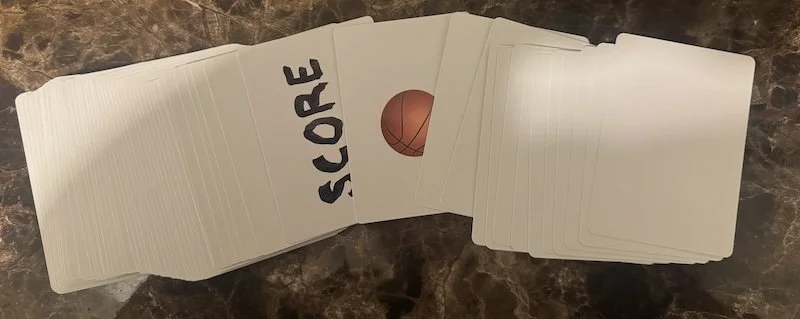
The deck is spread on the table. I gently poke aside the first basketball card. Beneath it is a SCORE card.
“Holy shit. Okay. That’s one.”
We spread through and I stare at the second basketball card for a moment.
“I can’t look. You do it.”
I have Nate move the second basketball card aside. Beneath it is the other SCORE card.
I pump my fist.
“Nice. Now I just need to get Tyrese, Jalen, and the boys on board to do it again, but for real this time.”
Method
It’s just Gemini Twins.
My one concern was that telling them exactly how the game worked beforehand would make them more cognizant of the orientation of the cards. But the basketball cards have basketballs on both sides (just stickers I got on Amazon). And the rest of the deck is blank on both sides, besides the SCORE cards.
So when I take the deck back, flip it over, and spread it, the orientation—and what should be where—becomes a bit confused. All they know is that the basketball cards are right near the target cards, and that’s all that matters.
[On a logistical note, I’m going to make this up again with either larger basketball images, or fully orange cards. The version shown in the images required a bit of digging in order to find the basketball cards. Which was fine for creating some mild tension. But I’d prefer they stand out more. On the other hand, I like the SCORE cards needing to be spread a bit to be identified.]
The nice thing about using a basketball game for this is that you can point out all the missed shots, blocks, turnovers, and fouls that delayed the baskets. Any one of those plays could have gone differently, changing the timing of the scores and where the basketball cards landed in the deck. It’s a great way to drive home just how unpredictable the whole sequence was, and how easily the cards could have ended up somewhere else entirely.
This is one of a number of variations I have of Gemini Twins where the person doesn’t just choose to stop dealing at random. This is an easy way to make the trick about more than “I knew where you’d stop dealing.”
The idea that I’ve somehow convinced two teams of millionaires to script out the opening of their game just so I could win this card game is completely absurd. But there’s just enough internal logic holding it together that people can indulge in the fantasy that it might actually be true.