Mailbag #185
/I’ve been messing about with double deception (beautiful trick) but im really struggling to work out a good presentational angle. I’ve got the ‘I’m building up to being able to do this this a wooden table but so far I can only manage to do it through a piece of cloth’ or ‘I’ve been reading up on how to create a tiny black hole, which means I should be able to move these two coins a very short distance’ (due to the amount of power involved I can only move the one). I remember you mentioning that you’ve played with the effect, and wondered if you had any thoughts you might be happy to share?—TB
Double Deception is a great trick. The gimmick is so invisible that I’ve accidentally spent the coins twice already. So I’m out $200. Well, $199. I did get a dollar’s worth of stuff out of it.
The weak point of the trick, to me, is that it uses two coins for no apparent reason. If I’m going to pull one coin through your shirt, why do I need another coin sitting there doing nothing? Besides disguising the method, of course.
The way I address that is like this. First, I put an X on the primary gimmick like this.
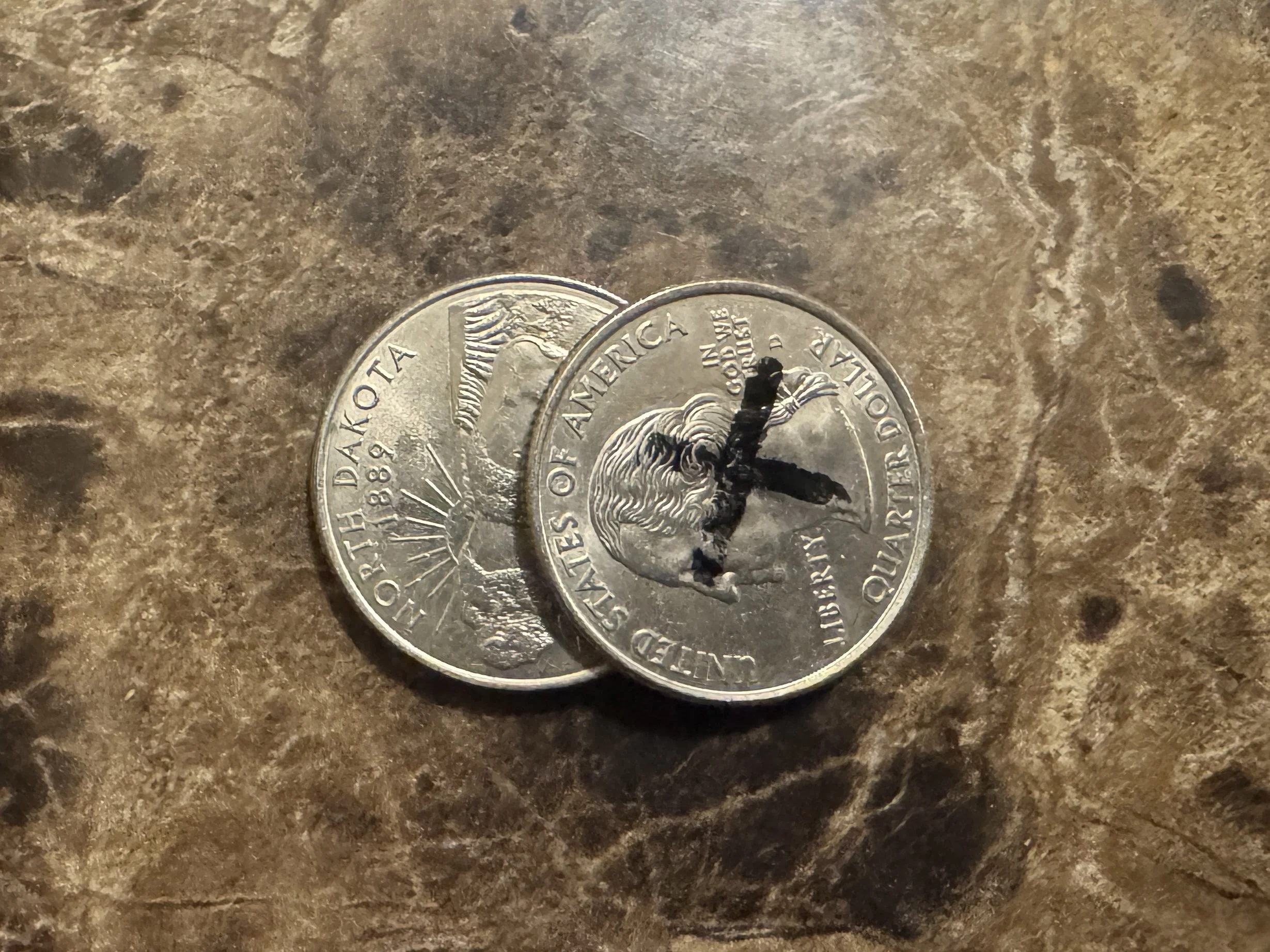
You could also just put a smudge or some other mark on it if you want the trick to feel a little less planned out. (Marking one of the coins in some way also makes getting into the trick much more straightforward as you immediatley know which coin is which.)
The premise I use is that I’m practicing my ability to target the magic.
“Like… there are certain techniques that allow you to vanish a card. That's not easy, but it's something you can learn with practice. The really hard thing is controlling the magic so precisely that you can vanish one particular card out of an entire deck, while leaving all the others untouched. Does that make sense?”
To be clear, the way I present this isn’t “I’ve been carrying around these coins so I can show you a trick.”
Instead, at some point I “notice” the coins in my pocket, spot the X, and am reminded of what I was using them for.
“Oh, let me try something with you. I’ve been testing myself on this one particular aspect of magic…”
I explain that there’s a little exercise I’ve been practicing to develop this ability, and I show them the coins. They can examine each one individually.
I then say that I’m going to try to focus the magic on one of the coins while avoiding the other.
Once the coins are set up, I ask, “Which do you prefer? The one with the X or the one without?”
If they say With the X: “Okay, I’ll try to leave you with that one.” And I pull the other coin through.
If they say Without the X: “Okay, I’ll try it with that one, then.” And I pull that coin through.
(I don’t make a big deal about this “free choice.” It’s just a passing question before moving on to the effect.)
This makes the second coin—and the fact that it doesn’t pass through—seemingly part of the challenge, rather than some weird, unnecessary element of the trick.
Subject: How Long Should They Be Fooled?
Just read recent posting - "A Long Question with an Unsatisfying Answer"
Years ago I started to ponder this. (Heck, over a quarter century now.) This was the result of working in a couple magic shops and having people come back to tell me what they figured out. More often than not they were right. I also started to experience this with friends, family and acquaintances.
I came up with a completely arbitrary rule at the time. One year. I wanted them to be able to remember the experience and still not know how it was done a year laer.
Now I have an additional requirement I got from Michael Close. I want them to tell the story to others without being able to say how it happened.
Ive followed up here and there and have noticed when the story is told many questions get asked about conditions around the effect. So this drives me all that much further to present effects that cant be reverse engineered. Not all my magic buddies agree with me.
[…]
To rephrase what Simon Aronson said, I dont want them to not know how it is done, I want them to know it cant be done but yet they saw it happen with their own eyes.
So a person surprised momentarily is hardly worth the effort for me.—RN
There are four things that can happen after someone sees a magic trick:
The spectator figures out how it was done.
The spectator thinks they’ve figured out how it was done, but they’re wrong.
The spectator figures out how it was done, but eventually forgets the explanation.
The spectator never figures it out.
For our purposes, numbers 1 and 2 are essentially the same. It doesn’t matter whether the spectator has correctly reconstructed the method or has come up with a completely wrong explanation. If they believe they know how it was done, the mystery is gone either way.
Number 3 is pretty much the same, too. Once you’ve figured out a trick, the mystery and wonder of that experience are gone. Even if you eventually forget the specifics of the method, you still remember that there was an explanation. I have no idea how my TV works, but I don't sit there every night marveling at the miracle of moving pictures appearing in a box. I don't need to understand the explanation to know there is one.
As far as I’m concerned, #4 is the only goal worth pursuing. I want to perform tricks that people remember but never figure out. That’s the goal, at least.
I think a lot of magicians would consider that a childish ambition. “Come on. People are going to figure out tricks. Just focus on being entertaining.”
But that strikes me as a defeatist mindset. Yes, of course people are going to figure out some tricks. But there's a difference between acknowledging that you won't always succeed and deciding that it doesn't really matter if you do. And I think that willingness to lower our ambitions is part of what has reduced magic to such a trivial pursuit in so many people's eyes.
A mystery that someone remembers for the rest of their life, without ever figuring out how it happened—that’s the romantic ideal I’m chasing when I perform.
Re: Wrap It Up 2.0
Please tell me you've actually used this with someone.
I was pretty jazzed to mess around with this with someone I'm messing around with but then was put off by your follow up note that "trying to attach a lubed-up condom and an empty condom wrapper to a piece of elastic to make a pull is both disgusting and entirely fruitless."
And then thinking about it further, was also like...this seems like a much more logistically complex thing to pull off than at first glance. Like...assuming this is something you want to do after intercourse, you'd likely be naked so...not sure where the pull pulls off to. Unless you get fully dressed and set up first, and then pull this off? Hmm I guess that could work and not be too odd. But then there's the added wrinkle of the lubed up condom potentially being full of additional liquid. —JT
No, I never really did that shit. But here’s your solution to the pull problem. Instead of anchoring it to your clothes, you anchor the elastic to the inside of a plastic thumbtip. You can keep the whole set-up inside there. Then, when you’re ready to perform, shove the thumbtip up your naked ass and pull everything around and in front of you.