
Worst Things First: A One-Ahead Variation
/I have what I think is a pretty solid advancement of the one-ahead method.
As always, when I come up with something that feels like a genuine improvement on a classic technique, I naturally assume somebody else must have thought of it already. How could they not have?
But if they have, I haven’t heard about it. So here goes…
What’s the issue people most often point out with the one-ahead method?
The last thing you predict is usually a force—and therefore usually the weakest.
Name a number between one and a trillion.
Name any word in the English language.
Say stop while I riffle these cards.
That’s not exactly building to a climax.
If you mapped that onto a play with a three-act structure, Act Three would just be everybody deciding to turn in early.
This one-ahead construction lets you put the force first (sort of), so the revelations get progressively stronger. And it includes a small convincer that helps disguise the underlying method.
You start with three identical billets, business cards, or slips of paper.
Here’s an example of how it might play out. Obviously, the premise and the things you’re predicting will affect the exact language you use. But this should give you the general idea.
Let’s say you tell someone you’re going to build a scene together, starting with a single detail and gradually pulling back to reveal the bigger picture.
Start with the person you know the least.
“I think you might be the most difficult because we just met. So I’m going to give you the one I’m most comfortable with. Pick a card from the deck.”
Here you force a card. Or use a marked deck. Or whatever.
As they concentrate on their card, you pick up a business card to write something down. You struggle a little. Shake your head. Finally, you write something.
“Okay, don’t tell me what it is. Just tell me if I’m on the right track so far. Is it a 7?”
You show them what you wrote.
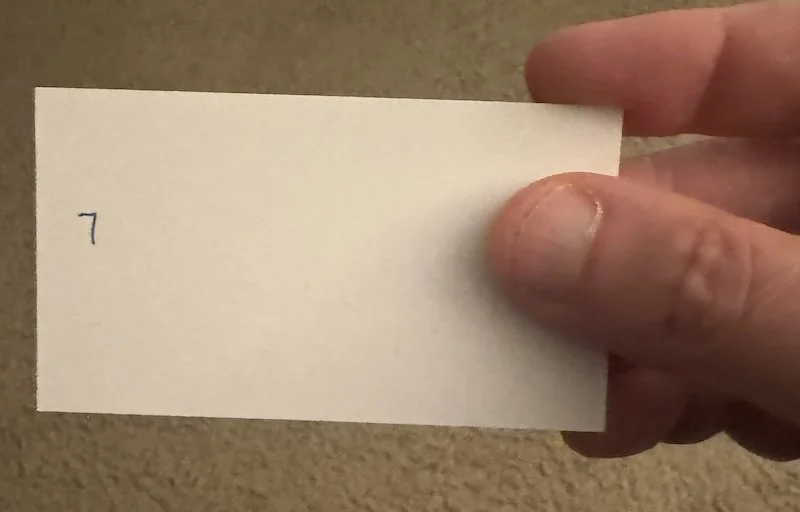
They tell you it’s not.
You shake your head. “I’ll get back to you.”
Leave the business card face-up on the table and pick up the next one.
On the second card, write another 7, exactly as you did on the first. Cross it out, as though you're correcting your earlier mistake. Then write the forced or known card below.
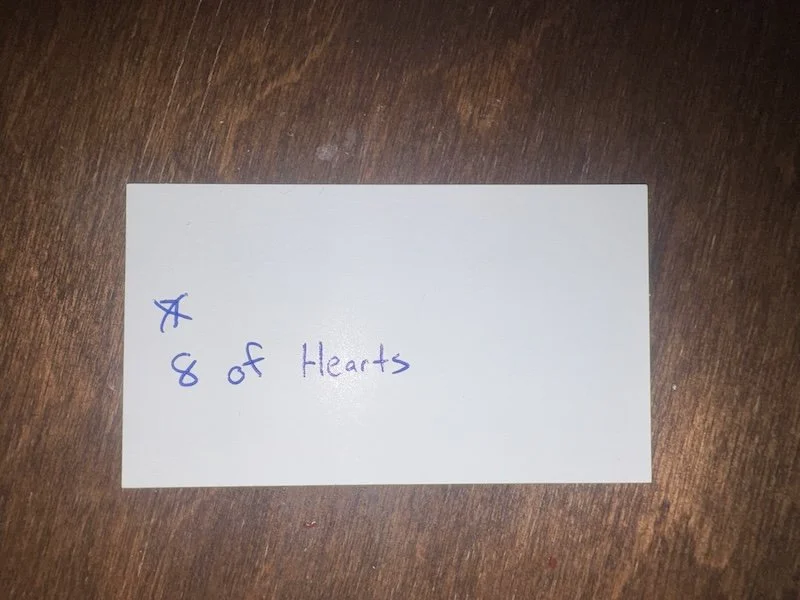
Then place the billet writing-side down on the table.
To person #2, you say, “Imagine that deck sitting on a blackjack table in a casino. Pan up from the cards to the dealer standing behind the table. Now zoom in on his name tag. What does it say?”
“Carlton,” they say.
“Okay, okay. Now we’re making progress.”
Pick up the remaining business card and turn to person #3.
“I want you to think of any word. This word is going to have a meaning in the scene we’re creating, but you don’t need to know what that is yet. It’ll only complicate things.”
As they think of a word, write down what person #2 said, or something close to it. (In this case, maybe you’d write “Carl” instead of “Carlton.”)
Place the card facedown on the table.
“You have a word in mind? Okay, when I point to you, say your word.”
“So, we pull back from the table, across the casino floor, through the hotel lobby, and out onto the street. We can see all the casinos along the Strip. There’s the Bellagio, the MGM Grand, and the…?”
You point to the third person.
“Infanticide.”
“That’s right. The Infanticide. The newest, classiest casino on the Strip. Good job.”
Turning back to the first person, you say, “Okay, let’s try again.”
You pick up the first billet and apparently cross out the 7 with your pen or pencil. In reality, you're only scratching across it with your fingernail. You then secretly turn the 7 into a T and complete the words The Infanticide. (Because I told the person the casino is called The something, I know I’ll be able to just add a bar to the top of the 7 turning it into a T.)
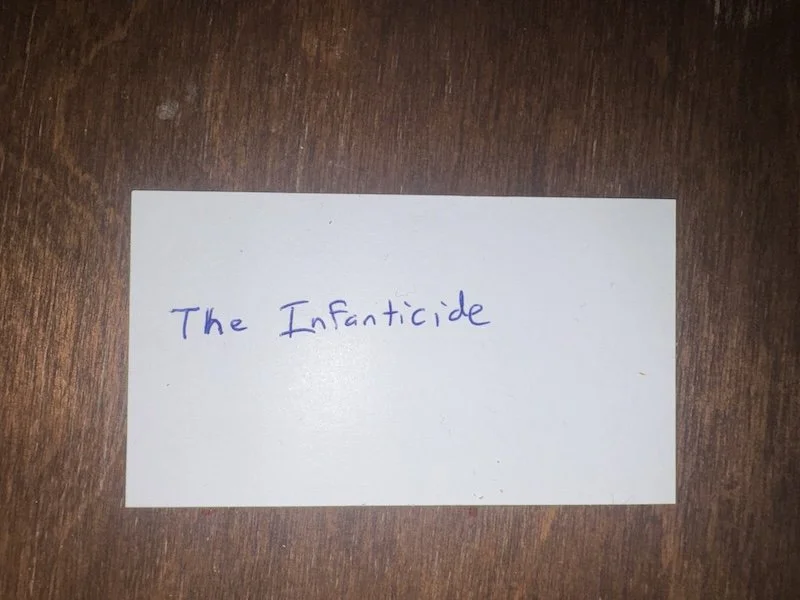
You now pick up the cards and redistribute them in front of the correct people, using whatever secret technique you prefer to get each card where it needs to be.
You can do this while saying to the first person, “I’m still not sure about this one. Can I see which card you picked?”
You then reveal what you wrote down for them, followed by the second and third people.
This makes perfect sense. You're revealing the items in the same order you originally asked for them. The card selection came first, so you reveal it first. And because the revelations now get progressively stronger, what would normally be the weakest moment becomes the opening act.
The key to all of this is that 7 you write down at the beginning. (Although it doesn’t have to be a 7. Just something you can write on the first billet that gets modified to be part of the final billet’s prediction.)
In a typical one-ahead routine, the audience never really knows what you're writing. That's what makes the method possible, but it's also the weakness someone might latch onto when trying to reconstruct the trick.
Here, you're apparently showing them exactly what you wrote on that first billet. They saw the 7. They know it was wrong. And they watched you leave it on the table.
That creates a false certainty about the contents of that billet because the 7 anchors it to the first person who is thinking of a card. If they accept that certainty, they have no reason to suspect that the first billet could eventually contain the final prediction.
And without that possibility, the entire one-ahead sequence becomes considerably harder to reconstruct.